Plato, Republic 7.514a-521b: the Allegory of the Cave
Introduction
Book 7 of the Republic opens with the image of the Cave. Men are chained from childhood in an underground cave, facing the wall, and see only the shadows of objects carried past a fire behind them; they take the shadows for reality (514a-515c). One prisoner is released, turned round and dragged up the steep ascent into the sunlight; he sees first shadows and reflections, then the things themselves, the heavens by night, and at last the sun itself, and understands that it governs everything in the visible world (515c-516c). If he went back down, his eyes full of darkness, the prisoners would laugh at him and would kill the man who tried to free them (516e-517a). Socrates then explains the image: the cave is the visible world, the ascent is the soul's ascent to the intelligible, and the last thing seen is the idea of the Good, 'the cause for all things of all that is right and beautiful' (517b-c, Shorey). Education is not putting sight into blind eyes but turning the whole soul round from becoming to being (518b-d). The philosophers who have seen the Good must be compelled to go back down into the cave and rule (519c-521b).
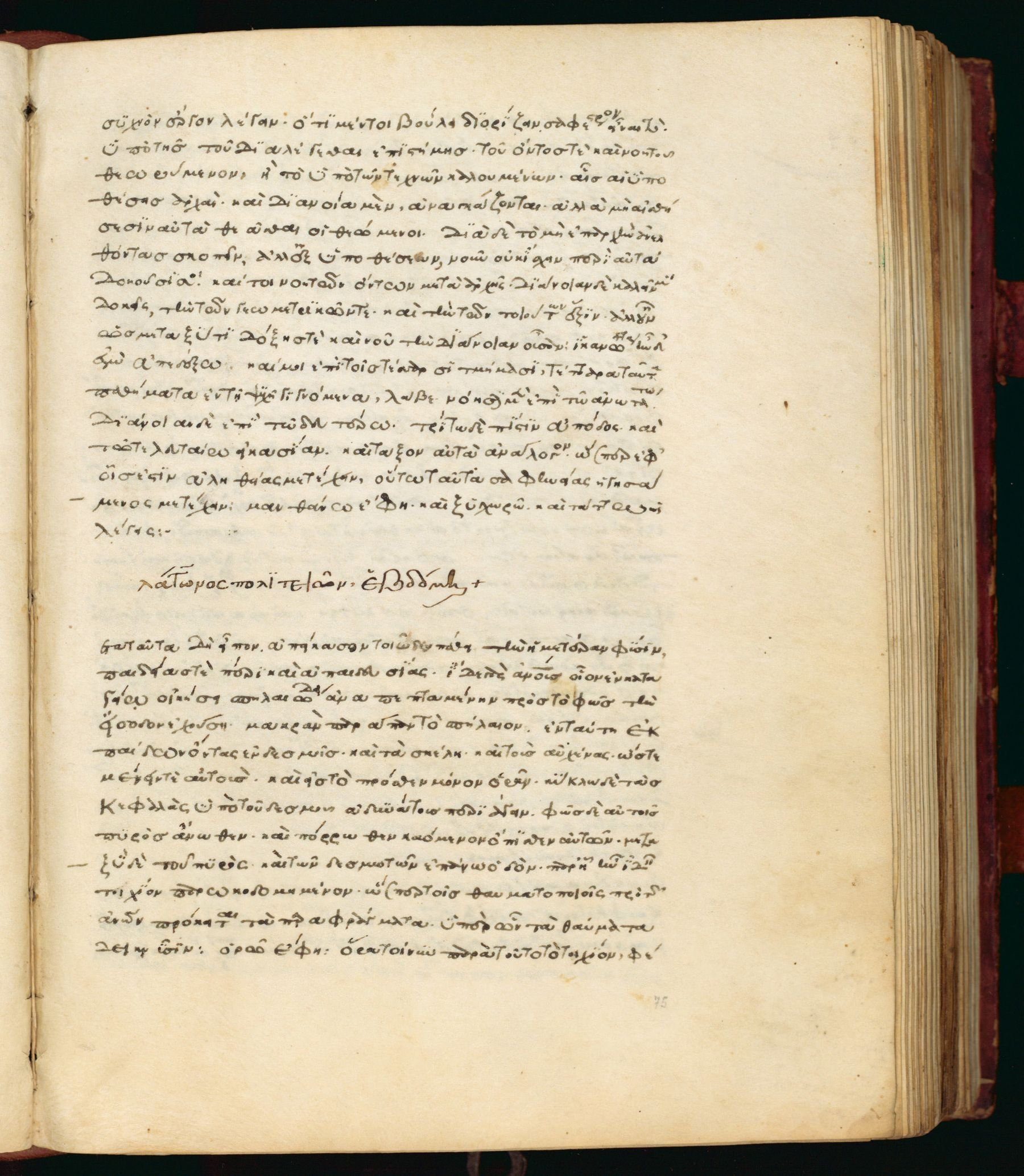
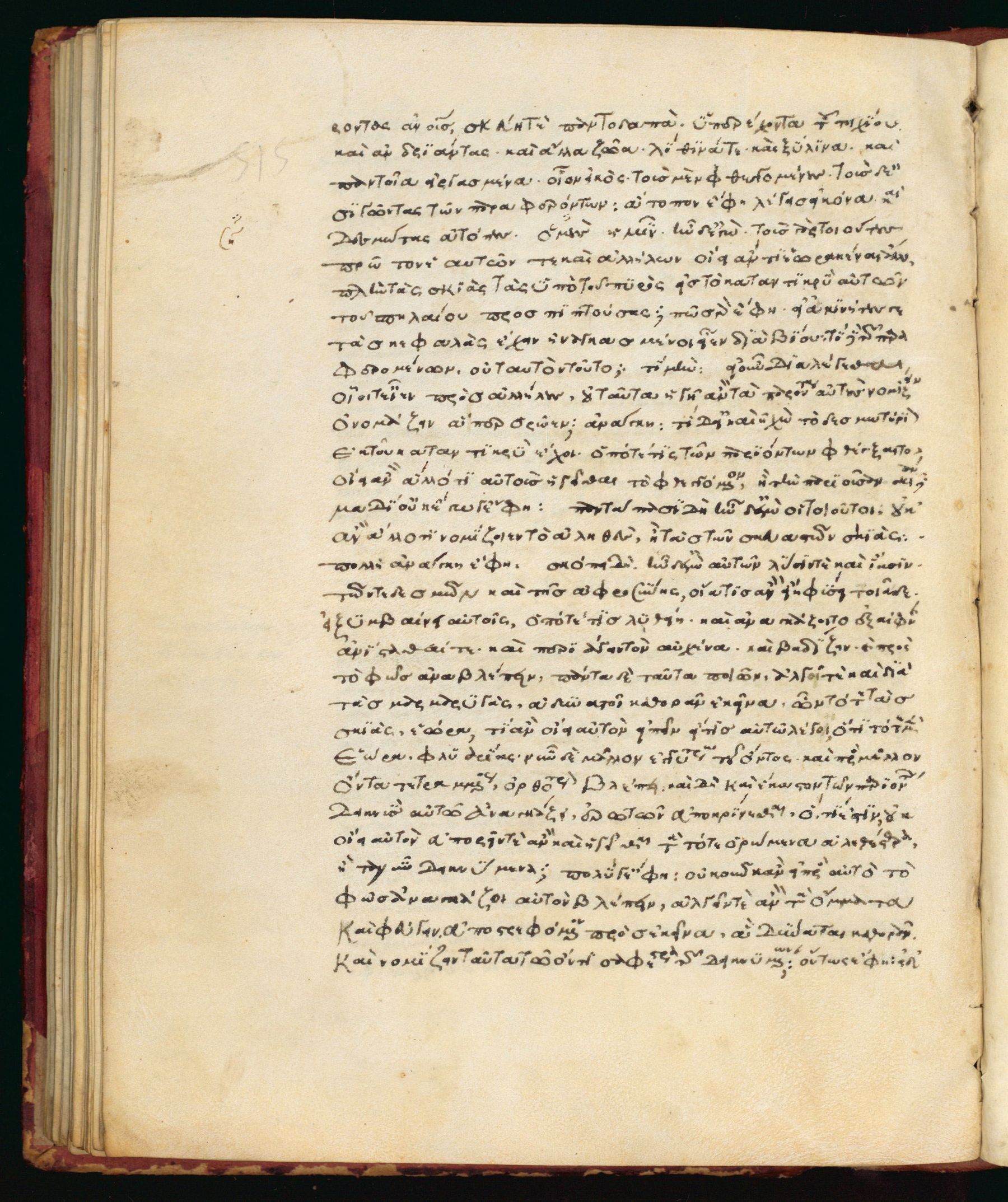
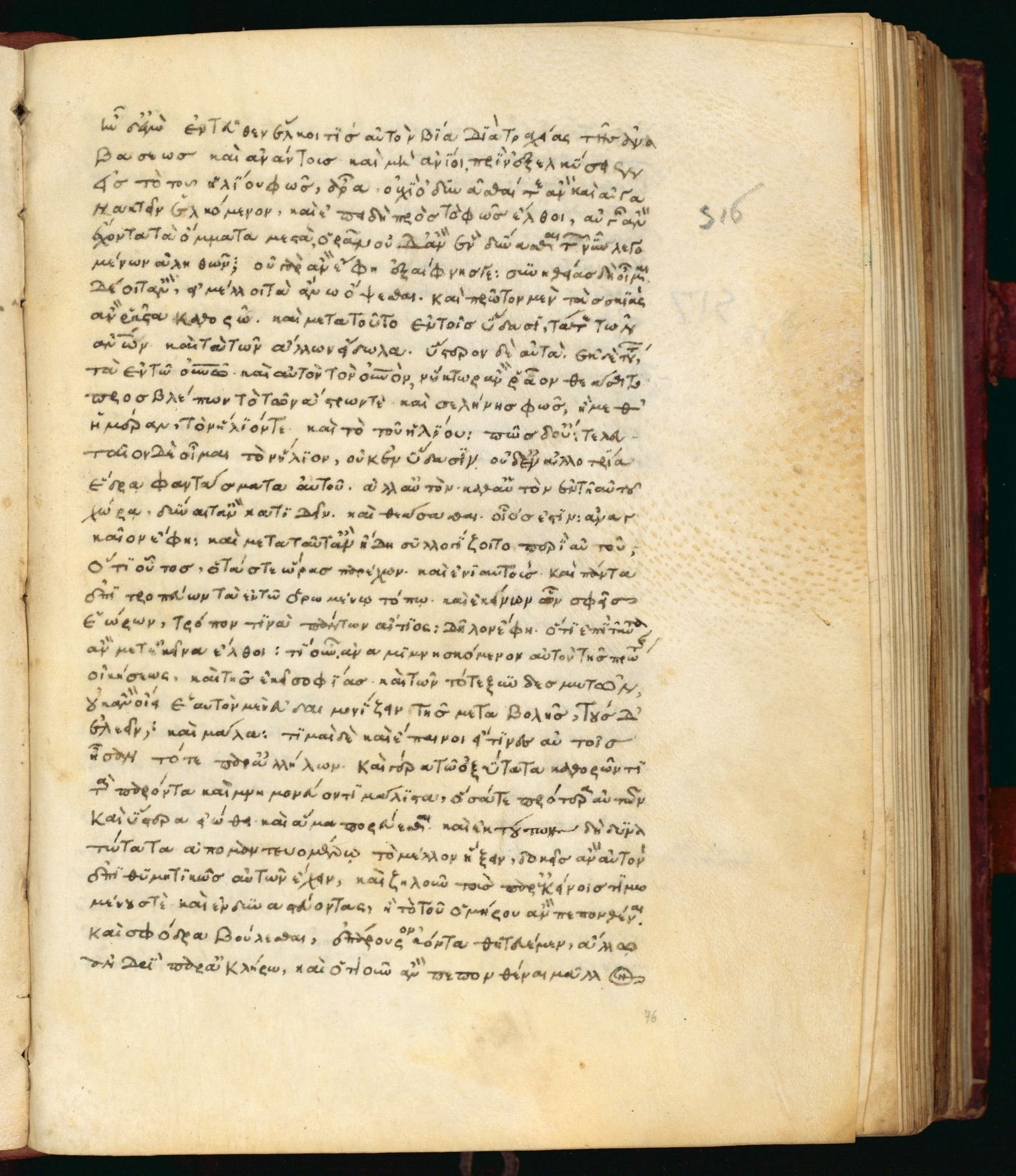
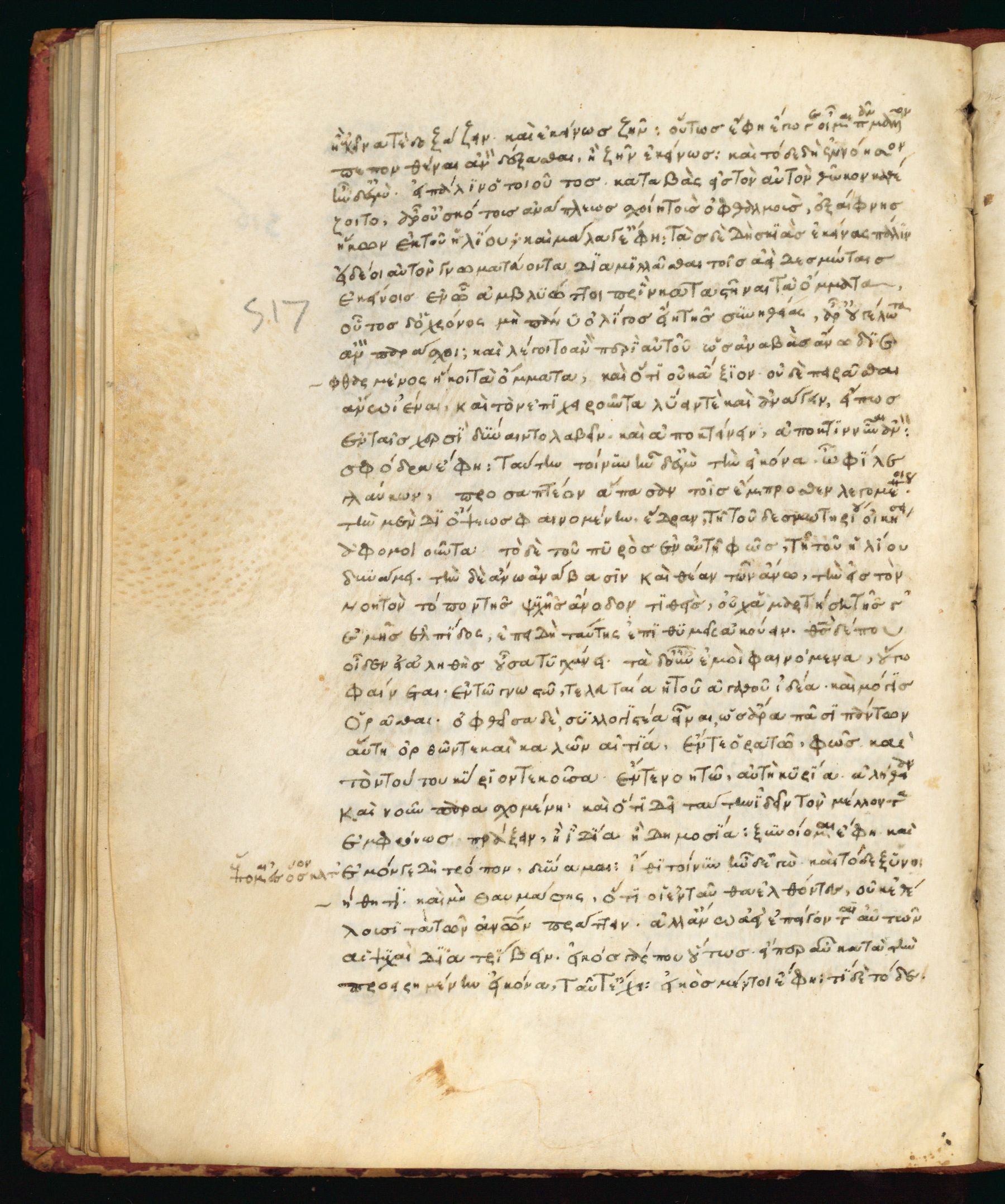
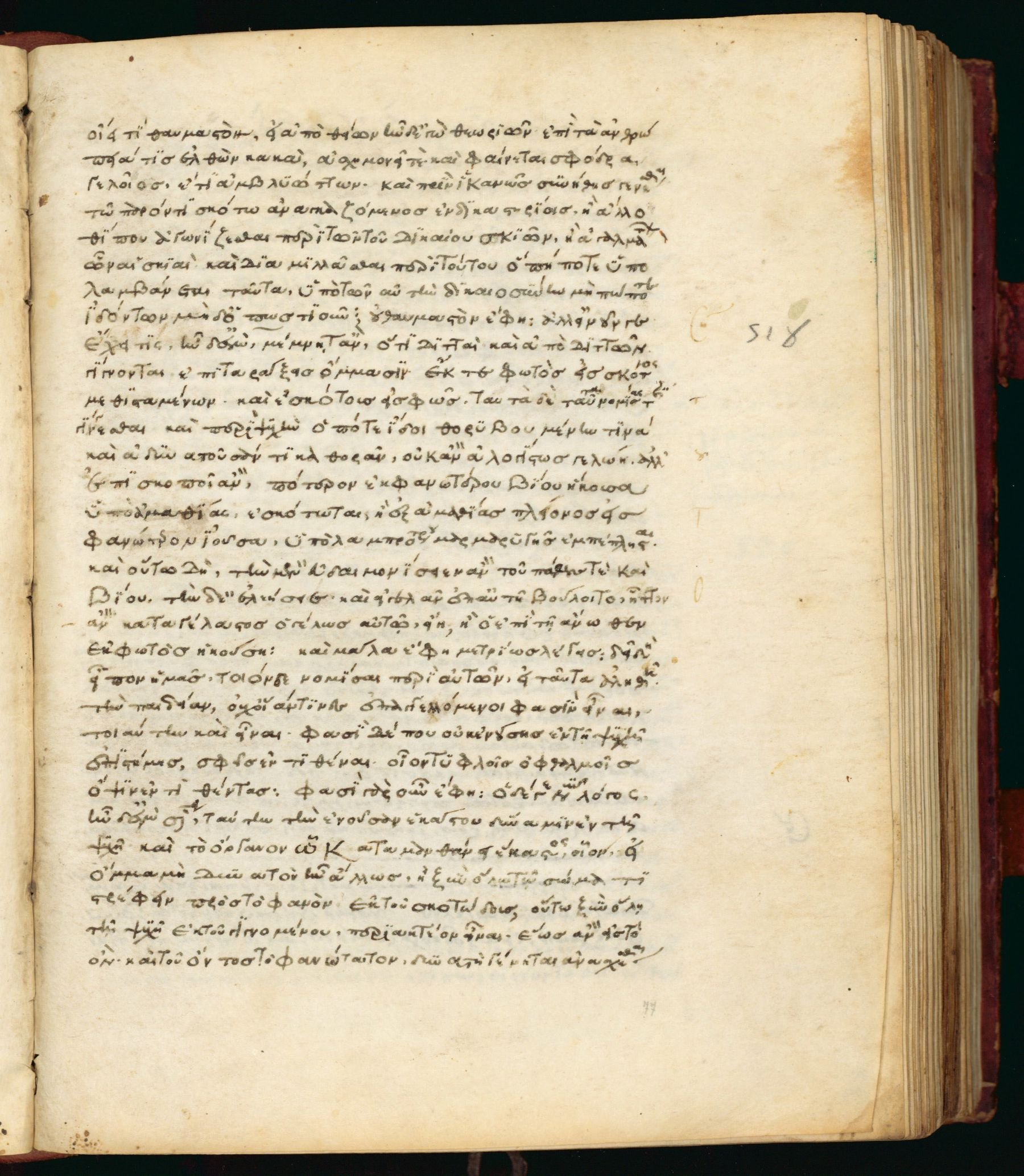
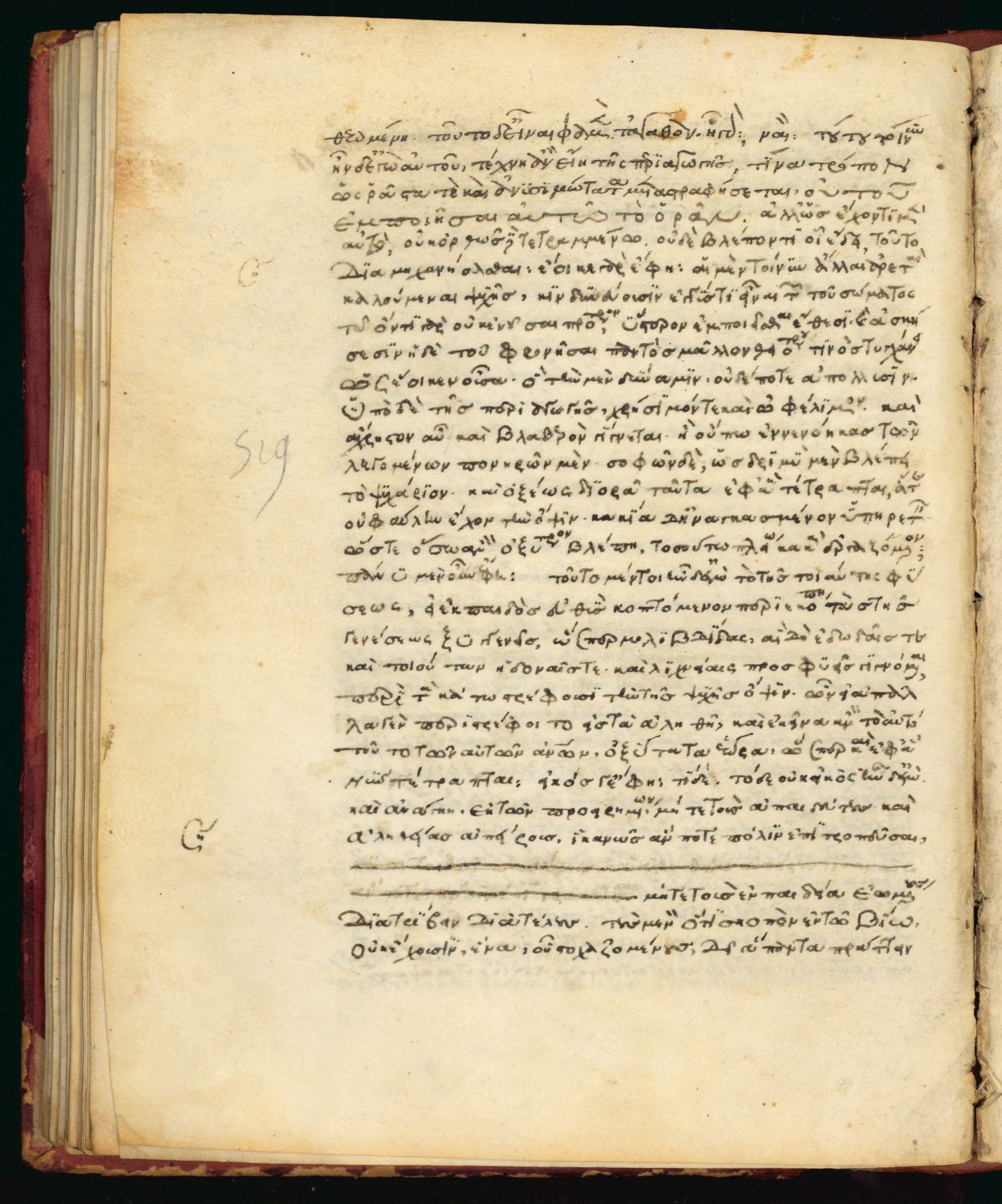
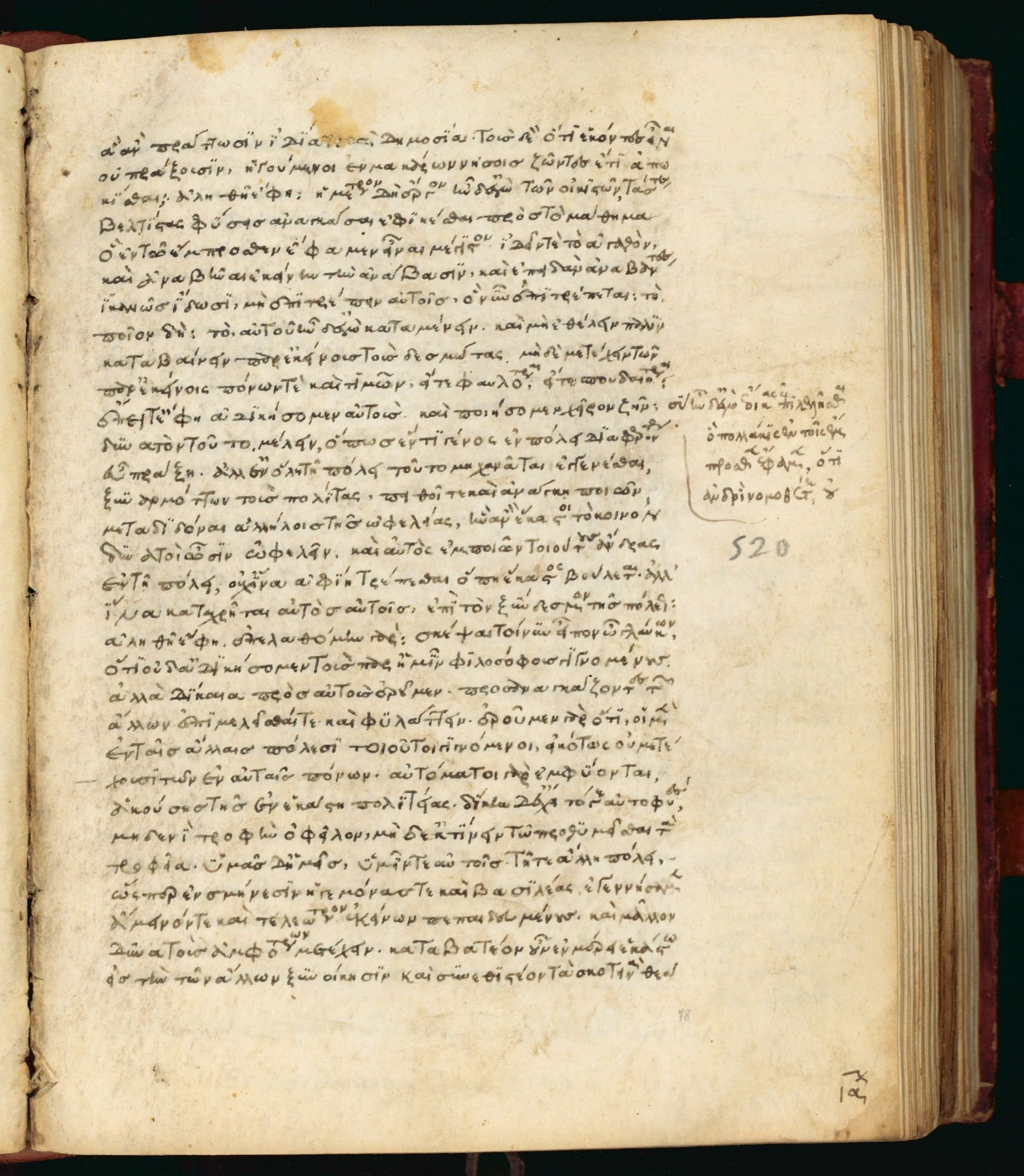
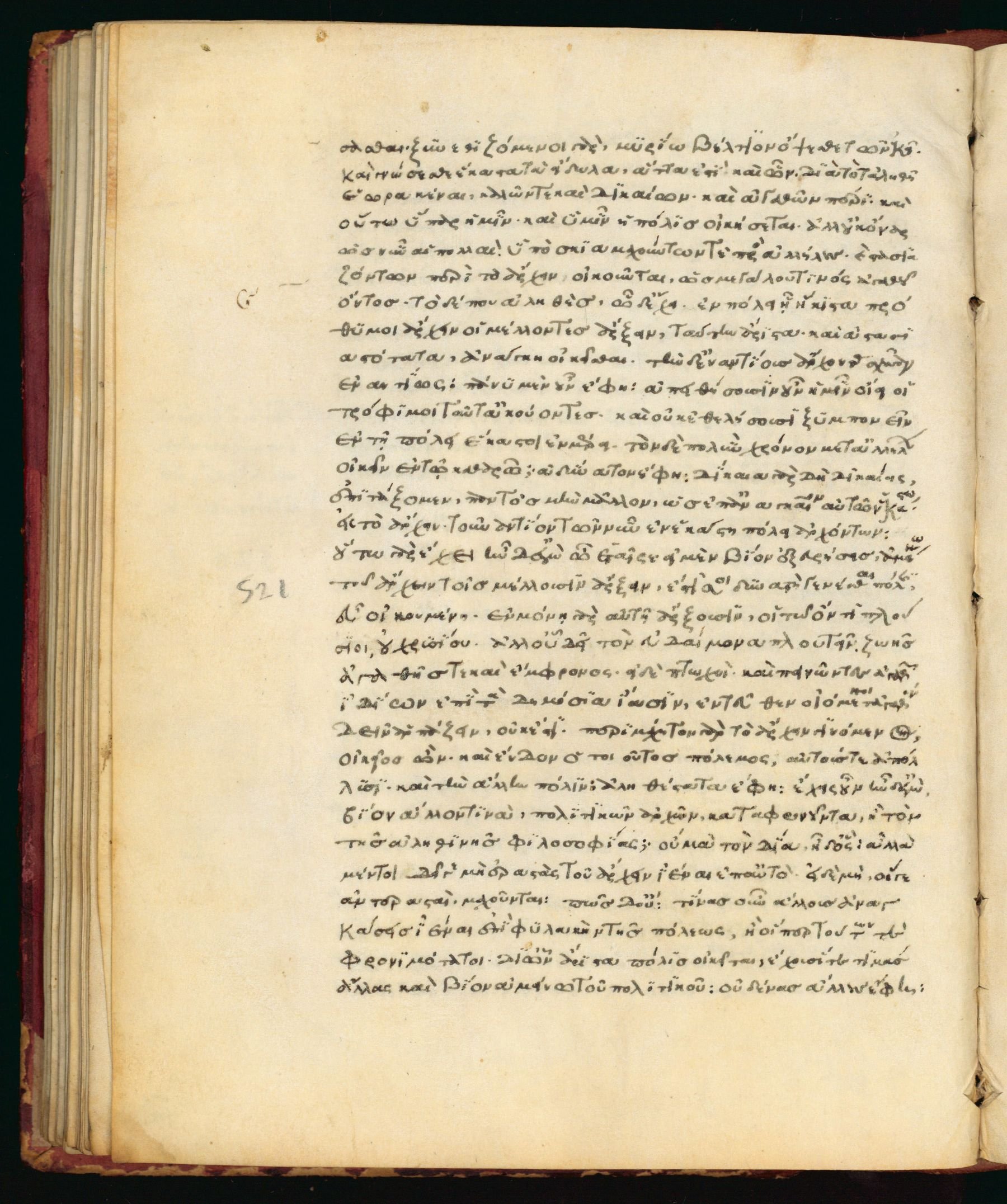
The pages shown are from Florence, Biblioteca Medicea Laurenziana, Plut. 80.19, a parchment manuscript of the Republic and the Timaeus of the 12th century (library dating). The passage fills fols. 75r-78v; book 7 begins in the middle of fol. 75r below its title. Each section below is a Stephanus subsection, linked to the page or pages that carry its words; the pages were identified by reading the first and last lines of each page on the image. The Greek is Burnet's critical text (1902), not a transcription of this manuscript. The English is Paul Shorey's Loeb translation (1935). Stephanus page 514 has only subsections a and b, because book 7 begins there; subsections in which no new sentence begins are joined to the one before (516c-d, 520a-b). Where Shorey joins two Greek sentences into one, the English section starts inside his sentence (515d, 518d, 520d).
How was this verified? (Provenance)
Where on the image
On Laur. Plut. 80.19 fol. 75r. Laur. Plut. 80.19 fol. 75r begins 'συχνὸν ἔργον λέγειν· ὅτι μέντοι βούλει διορίζειν σαφέστερον εἶναι' on its first line and ends 'ὁρῶ, ἔφη. ὅρα τοίνυν παρὰ τοῦτο τὸ τειχίον φέ-' on its last line. Book 6 ends in the middle of the page with 'μανθάνω, ἔφη, καὶ ξυγχωρῶ καὶ τάττω ὡς λέγεις'; below it stands the title '(Π)λάτωνος πολιτείας ἑβδόμη' and book 7 (514a) begins '(Μ)ετὰ ταῦτα δή, εἶπον, ἀπείκασον τοιούτῳ πάθει τὴν ἡμετέραν φύσιν', the initials left blank for a rubricator. Viewer: https://cdm21059.contentdm.oclc.org/digital/collection/plutei/id/950405 Checked on the images. The Greek shown is Burnet's edition, not a transcription of this manuscript.
μετὰ ταῦτα δή, εἶπον, ἀπείκασον τοιούτῳ πάθει τὴν ἡμετέραν φύσιν παιδείας τε πέρι καὶ ἀπαιδευσίας. ἰδὲ γὰρ ἀνθρώπους οἷον ἐν καταγείῳ οἰκήσει σπηλαιώδει, ἀναπεπταμένην πρὸς τὸ φῶς τὴν εἴσοδον ἐχούσῃ μακρὰν παρὰ πᾶν τὸ σπήλαιον, ἐν ταύτῃ ἐκ παίδων ὄντας ἐν δεσμοῖς καὶ τὰ σκέλη καὶ τοὺς αὐχένας, ὥστε μένειν τε αὐτοὺς εἴς τε τὸ πρόσθεν μόνον ὁρᾶν, κύκλῳ δὲ τὰς κεφαλὰς ὑπὸ τοῦ δεσμοῦ ἀδυνάτους περιάγειν, φῶς δὲ αὐτοῖς πυρὸς ἄνωθεν καὶ πόρρωθεν καόμενον ὄπισθεν αὐτῶν, μεταξὺ δὲ τοῦ πυρὸς καὶ τῶν δεσμωτῶν ἐπάνω ὁδόν, παρʼ ἣν ἰδὲ τειχίον παρῳκοδομημένον, ὥσπερ τοῖς θαυματοποιοῖς πρὸ τῶν ἀνθρώπων πρόκειται τὰ παραφράγματα, ὑπὲρ ὧν τὰ θαύματα δεικνύασιν.
“Next,” said I, “compare our nature in respect of education and its lack to such an experience as this. Picture men dwelling in a sort of subterranean cavern with a long entrance open to the light on its entire width. Conceive them as having their legs and necks fettered from childhood, so that they remain in the same spot, able to look forward only, and prevented by the fetters from turning their heads. Picture further the light from a fire burning higher up and at a distance behind them, and between the fire and the prisoners and above them a road along which a low wall has been built, as the exhibitors of puppet-shows have partitions before the men themselves, above which they show the puppets.”
Where on the image
Starts on fol. 75r and continues on fol. 75v (page break inside this section). Laur. Plut. 80.19 fol. 75r begins 'συχνὸν ἔργον λέγειν· ὅτι μέντοι βούλει διορίζειν σαφέστερον εἶναι' on its first line and ends 'ὁρῶ, ἔφη. ὅρα τοίνυν παρὰ τοῦτο τὸ τειχίον φέ-' on its last line. Book 6 ends in the middle of the page with 'μανθάνω, ἔφη, καὶ ξυγχωρῶ καὶ τάττω ὡς λέγεις'; below it stands the title '(Π)λάτωνος πολιτείας ἑβδόμη' and book 7 (514a) begins '(Μ)ετὰ ταῦτα δή, εἶπον, ἀπείκασον τοιούτῳ πάθει τὴν ἡμετέραν φύσιν', the initials left blank for a rubricator. Viewer: https://cdm21059.contentdm.oclc.org/digital/collection/plutei/id/950405 Laur. Plut. 80.19 fol. 75v begins '(φέ)ροντας ἀνθρώπους σκεύη τε παντοδαπὰ ὑπερέχοντα τοῦ τειχίου' on its first line and ends 'καὶ νομίζειν ταῦτα τῷ ὄντι σαφέστερα τῶν δεικνυμένων; οὕτως, ἔφη· εἰ δ'' on its last line. The later marginal number 515 stands near the top of the page. Viewer: https://cdm21059.contentdm.oclc.org/digital/collection/plutei/id/950406 Checked on the images. The Greek shown is Burnet's edition, not a transcription of this manuscript.
ὁρῶ, ἔφη. ὅρα τοίνυν παρὰ τοῦτο τὸ τειχίον φέροντας ἀνθρώπους σκεύη τε παντοδαπὰ ὑπερέχοντα τοῦ τειχίου καὶ ἀνδριάντας καὶ ἄλλα ζῷα λίθινά τε καὶ ξύλινα καὶ παντοῖα εἰργασμένα, οἷον εἰκὸς τοὺς μὲν φθεγγομένους, τοὺς δὲ σιγῶντας τῶν παραφερόντων.
“All that I see,” he said. “See also, then, men carrying past the wall implements of all kinds that rise above the wall, and human images and shapes of animals as well, wrought in stone and wood and every material, some of these bearers presumably speaking and others silent.”
Where on the image
On Laur. Plut. 80.19 fol. 75v. Laur. Plut. 80.19 fol. 75v begins '(φέ)ροντας ἀνθρώπους σκεύη τε παντοδαπὰ ὑπερέχοντα τοῦ τειχίου' on its first line and ends 'καὶ νομίζειν ταῦτα τῷ ὄντι σαφέστερα τῶν δεικνυμένων; οὕτως, ἔφη· εἰ δ'' on its last line. The later marginal number 515 stands near the top of the page. Viewer: https://cdm21059.contentdm.oclc.org/digital/collection/plutei/id/950406 Checked on the images. The Greek shown is Burnet's edition, not a transcription of this manuscript.
ἄτοπον, ἔφη, λέγεις εἰκόνα καὶ δεσμώτας ἀτόπους. ὁμοίους ἡμῖν, ἦν δʼ ἐγώ· τοὺς γὰρ τοιούτους πρῶτον μὲν ἑαυτῶν τε καὶ ἀλλήλων οἴει ἄν τι ἑωρακέναι ἄλλο πλὴν τὰς σκιὰς τὰς ὑπὸ τοῦ πυρὸς εἰς τὸ καταντικρὺ αὐτῶν τοῦ σπηλαίου προσπιπτούσας; πῶς γάρ, ἔφη, εἰ ἀκινήτους γε τὰς κεφαλὰς ἔχειν ἠναγκασμένοι εἶεν διὰ βίου;
“A strange image you speak of,” he said, “and strange prisoners.” “Like to us,” I said; “for, to begin with, tell me do you think that these men would have seen anything of themselves or of one another except the shadows cast from the fire on the wall of the cave that fronted them?” “How could they,” he said, “if they were compelled to hold their heads unmoved through life?”
Where on the image
On Laur. Plut. 80.19 fol. 75v. Laur. Plut. 80.19 fol. 75v begins '(φέ)ροντας ἀνθρώπους σκεύη τε παντοδαπὰ ὑπερέχοντα τοῦ τειχίου' on its first line and ends 'καὶ νομίζειν ταῦτα τῷ ὄντι σαφέστερα τῶν δεικνυμένων; οὕτως, ἔφη· εἰ δ'' on its last line. The later marginal number 515 stands near the top of the page. Viewer: https://cdm21059.contentdm.oclc.org/digital/collection/plutei/id/950406 Checked on the images. The Greek shown is Burnet's edition, not a transcription of this manuscript.
τί δὲ τῶν παραφερομένων; οὐ ταὐτὸν τοῦτο; τί μήν; εἰ οὖν διαλέγεσθαι οἷοί τʼ εἶεν πρὸς ἀλλήλους, οὐ ταῦτα ἡγῇ ἂν τὰ ὄντα αὐτοὺς νομίζειν ἅπερ ὁρῷεν; ἀνάγκη. τί δʼ εἰ καὶ ἠχὼ τὸ δεσμωτήριον ἐκ τοῦ καταντικρὺ ἔχοι; ὁπότε τις τῶν παριόντων φθέγξαιτο, οἴει ἂν ἄλλο τι αὐτοὺς ἡγεῖσθαι τὸ φθεγγόμενον ἢ τὴν παριοῦσαν σκιάν; μὰ Δίʼ οὐκ ἔγωγʼ, ἔφη.
“And again, would not the same be true of the objects carried past them?” “Surely.” “If then they were able to talk to one another, do you not think that they would suppose that in naming the things that they saw they were naming the passing objects?” “Necessarily.” “And if their prison had an echo from the wall opposite them, when one of the passersby uttered a sound, do you think that they would suppose anything else than the passing shadow to be the speaker?” “By Zeus, I do not,” said he.
Where on the image
On Laur. Plut. 80.19 fol. 75v. Laur. Plut. 80.19 fol. 75v begins '(φέ)ροντας ἀνθρώπους σκεύη τε παντοδαπὰ ὑπερέχοντα τοῦ τειχίου' on its first line and ends 'καὶ νομίζειν ταῦτα τῷ ὄντι σαφέστερα τῶν δεικνυμένων; οὕτως, ἔφη· εἰ δ'' on its last line. The later marginal number 515 stands near the top of the page. Viewer: https://cdm21059.contentdm.oclc.org/digital/collection/plutei/id/950406 Checked on the images. The Greek shown is Burnet's edition, not a transcription of this manuscript.
παντάπασι δή, ἦν δʼ ἐγώ, οἱ τοιοῦτοι οὐκ ἂν ἄλλο τι νομίζοιεν τὸ ἀληθὲς ἢ τὰς τῶν σκευαστῶν σκιάς. πολλὴ ἀνάγκη, ἔφη. σκόπει δή, ἦν δʼ ἐγώ, αὐτῶν λύσιν τε καὶ ἴασιν τῶν τε δεσμῶν καὶ τῆς ἀφροσύνης, οἵα τις ἂν εἴη, εἰ φύσει τοιάδε συμβαίνοι αὐτοῖς· ὁπότε τις λυθείη καὶ ἀναγκάζοιτο ἐξαίφνης ἀνίστασθαί τε καὶ περιάγειν τὸν αὐχένα καὶ βαδίζειν καὶ πρὸς τὸ φῶς ἀναβλέπειν, πάντα δὲ ταῦτα ποιῶν ἀλγοῖ τε καὶ διὰ τὰς μαρμαρυγὰς ἀδυνατοῖ καθορᾶν ἐκεῖνα ὧν τότε τὰς σκιὰς ἑώρα, τί ἂν οἴει αὐτὸν εἰπεῖν, εἴ τις αὐτῷ λέγοι ὅτι τότε μὲν ἑώρα φλυαρίας, νῦν δὲ μᾶλλόν τι ἐγγυτέρω τοῦ ὄντος καὶ πρὸς μᾶλλον ὄντα τετραμμένος ὀρθότερον βλέποι, καὶ δὴ καὶ ἕκαστον τῶν παριόντων δεικνὺς αὐτῷ ἀναγκάζοι ἐρωτῶν ἀποκρίνεσθαι ὅτι ἔστιν;
“Then in every way such prisoners would deem reality to be nothing else than the shadows of the artificial objects.” “Quite inevitably,” he said. “Consider, then, what would be the manner of the release and healing from these bonds and this folly if in the course of nature something of this sort should happen to them: When one was freed from his fetters and compelled to stand up suddenly and turn his head around and walk and to lift up his eyes to the light, and in doing all this felt pain and, because of the dazzle and glitter of the light, was unable to discern the objects whose shadows he formerly saw, what do you suppose would be his answer if someone told him that what he had seen before was all a cheat and an illusion, but that now, being nearer to reality and turned toward more real things, he saw more truly? And if also one should point out to him each of the passing objects and constrain him by questions to say what it is,
Where on the image
On Laur. Plut. 80.19 fol. 75v. Laur. Plut. 80.19 fol. 75v begins '(φέ)ροντας ἀνθρώπους σκεύη τε παντοδαπὰ ὑπερέχοντα τοῦ τειχίου' on its first line and ends 'καὶ νομίζειν ταῦτα τῷ ὄντι σαφέστερα τῶν δεικνυμένων; οὕτως, ἔφη· εἰ δ'' on its last line. The later marginal number 515 stands near the top of the page. Viewer: https://cdm21059.contentdm.oclc.org/digital/collection/plutei/id/950406 Checked on the images. The Greek shown is Burnet's edition, not a transcription of this manuscript.
οὐκ οἴει αὐτὸν ἀπορεῖν τε ἂν καὶ ἡγεῖσθαι τὰ τότε ὁρώμενα ἀληθέστερα ἢ τὰ νῦν δεικνύμενα; πολύ γʼ, ἔφη.
do you not think that he would be at a loss and that he would regard what he formerly saw as more real than the things now pointed out to him?” “Far more real,” he said.
Where on the image
Starts on fol. 75v and continues on fol. 76r (page break inside this section). Laur. Plut. 80.19 fol. 75v begins '(φέ)ροντας ἀνθρώπους σκεύη τε παντοδαπὰ ὑπερέχοντα τοῦ τειχίου' on its first line and ends 'καὶ νομίζειν ταῦτα τῷ ὄντι σαφέστερα τῶν δεικνυμένων; οὕτως, ἔφη· εἰ δ'' on its last line. The later marginal number 515 stands near the top of the page. Viewer: https://cdm21059.contentdm.oclc.org/digital/collection/plutei/id/950406 Laur. Plut. 80.19 fol. 76r begins 'ἦν δ' ἐγώ, ἐντεῦθεν ἕλκοι τις αὐτὸν βίᾳ διὰ τραχείας τῆς ἀνα(βάσεως)' on its first line and ends 'ἀνδρὶ παρ' ἀκλήρῳ, καὶ ὁτιοῦν ἂν πεπονθέναι μᾶλλον ἢ' on its last line. The marginal number 516 stands near the top of the page. Viewer: https://cdm21059.contentdm.oclc.org/digital/collection/plutei/id/950407 Checked on the images. The Greek shown is Burnet's edition, not a transcription of this manuscript.
οὐκοῦν κἂν εἰ πρὸς αὐτὸ τὸ φῶς ἀναγκάζοι αὐτὸν βλέπειν, ἀλγεῖν τε ἂν τὰ ὄμματα καὶ φεύγειν ἀποστρεφόμενον πρὸς ἐκεῖνα ἃ δύναται καθορᾶν, καὶ νομίζειν ταῦτα τῷ ὄντι σαφέστερα τῶν δεικνυμένων; οὕτως, ἔφη. εἰ δέ, ἦν δʼ ἐγώ, ἐντεῦθεν ἕλκοι τις αὐτὸν βίᾳ διὰ τραχείας τῆς ἀναβάσεως καὶ ἀνάντους, καὶ μὴ ἀνείη πρὶν ἐξελκύσειεν εἰς τὸ τοῦ ἡλίου φῶς, ἆρα οὐχὶ ὀδυνᾶσθαί τε ἂν καὶ ἀγανακτεῖν ἑλκόμενον, καὶ ἐπειδὴ πρὸς τὸ φῶς ἔλθοι, αὐγῆς ἂν ἔχοντα τὰ ὄμματα μεστὰ ὁρᾶν οὐδʼ ἂν ἓν δύνασθαι τῶν νῦν λεγομένων ἀληθῶν;
“And if he were compelled to look at the light itself, would not that pain his eyes, and would he not turn away and flee to those things which he is able to discern and regard them as in very deed more clear and exact than the objects pointed out?” “It is so,” he said. “And if,” said I, “someone should drag him thence by force up the ascent which is rough and steep, and not let him go before he had drawn him out into the light of the sun, do you not think that he would find it painful to be so haled along, and would chafe at it, and when he came out into the light, that his eyes would be filled with its beams so that he would not be able to see even one of the things that we call real?”
Where on the image
On Laur. Plut. 80.19 fol. 76r. Laur. Plut. 80.19 fol. 76r begins 'ἦν δ' ἐγώ, ἐντεῦθεν ἕλκοι τις αὐτὸν βίᾳ διὰ τραχείας τῆς ἀνα(βάσεως)' on its first line and ends 'ἀνδρὶ παρ' ἀκλήρῳ, καὶ ὁτιοῦν ἂν πεπονθέναι μᾶλλον ἢ' on its last line. The marginal number 516 stands near the top of the page. Viewer: https://cdm21059.contentdm.oclc.org/digital/collection/plutei/id/950407 Checked on the images. The Greek shown is Burnet's edition, not a transcription of this manuscript.
οὐ γὰρ ἄν, ἔφη, ἐξαίφνης γε. συνηθείας δὴ οἶμαι δέοιτʼ ἄν, εἰ μέλλοι τὰ ἄνω ὄψεσθαι. καὶ πρῶτον μὲν τὰς σκιὰς ἂν ῥᾷστα καθορῷ, καὶ μετὰ τοῦτο ἐν τοῖς ὕδασι τά τε τῶν ἀνθρώπων καὶ τὰ τῶν ἄλλων εἴδωλα, ὕστερον δὲ αὐτά· ἐκ δὲ τούτων τὰ ἐν τῷ οὐρανῷ καὶ αὐτὸν τὸν οὐρανὸν νύκτωρ ἂν ῥᾷον θεάσαιτο, προσβλέπων τὸ τῶν ἄστρων τε καὶ σελήνης φῶς, ἢ μεθʼ ἡμέραν τὸν ἥλιόν τε καὶ τὸ τοῦ ἡλίου.
“Why, no, not immediately,” he said. “Then there would be need of habituation, I take it, to enable him to see the things higher up. And at first he would most easily discern the shadows and, after that, the likenesses or reflections in water of men and other things, and later, the things themselves, and from these he would go on to contemplate the appearances in the heavens and heaven itself, more easily by night, looking at the light of the stars and the moon, than by day the sun and the sun’s light.”
Where on the image
On Laur. Plut. 80.19 fol. 76r. Laur. Plut. 80.19 fol. 76r begins 'ἦν δ' ἐγώ, ἐντεῦθεν ἕλκοι τις αὐτὸν βίᾳ διὰ τραχείας τῆς ἀνα(βάσεως)' on its first line and ends 'ἀνδρὶ παρ' ἀκλήρῳ, καὶ ὁτιοῦν ἂν πεπονθέναι μᾶλλον ἢ' on its last line. The marginal number 516 stands near the top of the page. Viewer: https://cdm21059.contentdm.oclc.org/digital/collection/plutei/id/950407 Checked on the images. The Greek shown is Burnet's edition, not a transcription of this manuscript.
πῶς δʼ οὔ; τελευταῖον δὴ οἶμαι τὸν ἥλιον, οὐκ ἐν ὕδασιν οὐδʼ ἐν ἀλλοτρίᾳ ἕδρᾳ φαντάσματα αὐτοῦ, ἀλλʼ αὐτὸν καθʼ αὑτὸν ἐν τῇ αὑτοῦ χώρᾳ δύναιτʼ ἂν κατιδεῖν καὶ θεάσασθαι οἷός ἐστιν. ἀναγκαῖον, ἔφη. καὶ μετὰ ταῦτʼ ἂν ἤδη συλλογίζοιτο περὶ αὐτοῦ ὅτι οὗτος ὁ τάς τε ὥρας παρέχων καὶ ἐνιαυτοὺς καὶ πάντα ἐπιτροπεύων τὰ ἐν τῷ ὁρωμένῳ τόπῳ, καὶ ἐκείνων ὧν σφεῖς ἑώρων τρόπον τινὰ πάντων αἴτιος.
“Of course.” “And so, finally, I suppose, he would be able to look upon the sun itself and see its true nature, not by reflections in water or phantasms of it in an alien setting, but in and by itself in its own place.” “Necessarily,” he said. “And at this point he would infer and conclude that this it is that provides the seasons and the courses of the year and presides over all things in the visible region, and is in some sort the cause of all these things that they had seen.”
Where on the image
Starts on fol. 76r and continues on fol. 76v (page break inside this section). Laur. Plut. 80.19 fol. 76r begins 'ἦν δ' ἐγώ, ἐντεῦθεν ἕλκοι τις αὐτὸν βίᾳ διὰ τραχείας τῆς ἀνα(βάσεως)' on its first line and ends 'ἀνδρὶ παρ' ἀκλήρῳ, καὶ ὁτιοῦν ἂν πεπονθέναι μᾶλλον ἢ' on its last line. The marginal number 516 stands near the top of the page. Viewer: https://cdm21059.contentdm.oclc.org/digital/collection/plutei/id/950407 Laur. Plut. 80.19 fol. 76v begins 'ἐκεῖνά τε δοξάζειν καὶ ἐκείνως ζῆν. οὕτως, ἔφη, ἔγωγε οἶμαι πᾶν μᾶλλον' on its first line and ends 'προειρημένην εἰκόνα τοῦτ' ἔχει. εἰκὸς μέντοι, ἔφη. τί δέ; τόδε' on its last line. The marginal number 517 stands beside the upper third of the page. Viewer: https://cdm21059.contentdm.oclc.org/digital/collection/plutei/id/950408 Checked on the images. The Greek shown is Burnet's edition, not a transcription of this manuscript.
δῆλον, ἔφη, ὅτι ἐπὶ ταῦτα ἂν μετʼ ἐκεῖνα ἔλθοι. τί οὖν; ἀναμιμνῃσκόμενον αὐτὸν τῆς πρώτης οἰκήσεως καὶ τῆς ἐκεῖ σοφίας καὶ τῶν τότε συνδεσμωτῶν οὐκ ἂν οἴει αὑτὸν μὲν εὐδαιμονίζειν τῆς μεταβολῆς, τοὺς δὲ ἐλεεῖν; καὶ μάλα. τιμαὶ δὲ καὶ ἔπαινοι εἴ τινες αὐτοῖς ἦσαν τότε παρʼ ἀλλήλων καὶ γέρα τῷ ὀξύτατα καθορῶντι τὰ παριόντα, καὶ μνημονεύοντι μάλιστα ὅσα τε πρότερα αὐτῶν καὶ ὕστερα εἰώθει καὶ ἅμα πορεύεσθαι, καὶ ἐκ τούτων δὴ δυνατώτατα ἀπομαντευομένῳ τὸ μέλλον ἥξειν, δοκεῖς ἂν αὐτὸν ἐπιθυμητικῶς αὐτῶν ἔχειν καὶ ζηλοῦν τοὺς παρʼ ἐκείνοις τιμωμένους τε καὶ ἐνδυναστεύοντας, ἢ τὸ τοῦ Ὁμήρου ἂν πεπονθέναι καὶ σφόδρα βούλεσθαι ἐπάρουρον ἐόντα θητευέμεν ἄλλῳ ἀνδρὶ παρʼ ἀκλήρῳ καὶ ὁτιοῦν ἂν πεπονθέναι μᾶλλον ἢ ʼκεῖνά τε δοξάζειν καὶ ἐκείνως ζῆν;
“Obviously,” he said, “that would be the next step.” “Well then, if he recalled to mind his first habitation and what passed for wisdom there, and his fellow-bondsmen, do you not think that he would count himself happy in the change and pity them?” “He would indeed.” “And if there had been honours and commendations among them which they bestowed on one another and prizes for the man who is quickest to make out the shadows as they pass and best able to remember their customary precedences, sequences and co-existences, and so most successful in guessing at what was to come, do you think he would be very keen about such rewards, and that he would envy and emulate those who were honoured by these prisoners and lorded it among them, or that he would feel with Homer and greatly prefer while living on earth to be serf of another, a landless man, and endure anything rather than opine with them and live that life?”
Where on the image
On Laur. Plut. 80.19 fol. 76v. Laur. Plut. 80.19 fol. 76v begins 'ἐκεῖνά τε δοξάζειν καὶ ἐκείνως ζῆν. οὕτως, ἔφη, ἔγωγε οἶμαι πᾶν μᾶλλον' on its first line and ends 'προειρημένην εἰκόνα τοῦτ' ἔχει. εἰκὸς μέντοι, ἔφη. τί δέ; τόδε' on its last line. The marginal number 517 stands beside the upper third of the page. Viewer: https://cdm21059.contentdm.oclc.org/digital/collection/plutei/id/950408 Checked on the images. The Greek shown is Burnet's edition, not a transcription of this manuscript.
οὕτως, ἔφη, ἔγωγε οἶμαι, πᾶν μᾶλλον πεπονθέναι ἂν δέξασθαι ἢ ζῆν ἐκείνως. καὶ τόδε δὴ ἐννόησον, ἦν δʼ ἐγώ. εἰ πάλιν ὁ τοιοῦτος καταβὰς εἰς τὸν αὐτὸν θᾶκον καθίζοιτο, ἆρʼ οὐ σκότους ἂν ἀνάπλεως σχοίη τοὺς ὀφθαλμούς, ἐξαίφνης ἥκων ἐκ τοῦ ἡλίου; καὶ μάλα γʼ, ἔφη. τὰς δὲ δὴ σκιὰς ἐκείνας πάλιν εἰ δέοι αὐτὸν γνωματεύοντα διαμιλλᾶσθαι τοῖς ἀεὶ δεσμώταις ἐκείνοις, ἐν ᾧ ἀμβλυώττει, πρὶν καταστῆναι τὰ ὄμματα, οὗτος δʼ ὁ χρόνος μὴ πάνυ ὀλίγος εἴη τῆς συνηθείας, ἆρʼ οὐ γέλωτʼ ἂν παράσχοι, καὶ λέγοιτο ἂν περὶ αὐτοῦ ὡς ἀναβὰς ἄνω διεφθαρμένος ἥκει τὰ ὄμματα, καὶ ὅτι οὐκ ἄξιον οὐδὲ πειρᾶσθαι ἄνω ἰέναι;
“Yes,” he said, “I think that he would choose to endure anything rather than such a life.” “And consider this also,” said I, “if such a one should go down again and take his old place would he not get his eyes full of darkness, thus suddenly coming out of the sunlight?” “He would indeed.” “Now if he should be required to contend with these perpetual prisoners in evaluating these shadows while his vision was still dim and before his eyes were accustomed to the dark—and this time required for habituation would not be very short—would he not provoke laughter, and would it not be said of him that he had returned from his journey aloft with his eyes ruined and that it was not worth while even to attempt the ascent?
Where on the image
On Laur. Plut. 80.19 fol. 76v. Laur. Plut. 80.19 fol. 76v begins 'ἐκεῖνά τε δοξάζειν καὶ ἐκείνως ζῆν. οὕτως, ἔφη, ἔγωγε οἶμαι πᾶν μᾶλλον' on its first line and ends 'προειρημένην εἰκόνα τοῦτ' ἔχει. εἰκὸς μέντοι, ἔφη. τί δέ; τόδε' on its last line. The marginal number 517 stands beside the upper third of the page. Viewer: https://cdm21059.contentdm.oclc.org/digital/collection/plutei/id/950408 Checked on the images. The Greek shown is Burnet's edition, not a transcription of this manuscript.
καὶ τὸν ἐπιχειροῦντα λύειν τε καὶ ἀνάγειν, εἴ πως ἐν ταῖς χερσὶ δύναιντο λαβεῖν καὶ ἀποκτείνειν, ἀποκτεινύναι ἄν; σφόδρα γʼ, ἔφη. ταύτην τοίνυν, ἦν δʼ ἐγώ, τὴν εἰκόνα, ὦ φίλε Γλαύκων, προσαπτέον ἅπασαν τοῖς ἔμπροσθεν λεγομένοις, τὴν μὲν διʼ ὄψεως φαινομένην ἕδραν τῇ τοῦ δεσμωτηρίου οἰκήσει ἀφομοιοῦντα, τὸ δὲ τοῦ πυρὸς ἐν αὐτῇ φῶς τῇ τοῦ ἡλίου δυνάμει· τὴν δὲ ἄνω ἀνάβασιν καὶ θέαν τῶν ἄνω τὴν εἰς τὸν νοητὸν τόπον τῆς ψυχῆς ἄνοδον τιθεὶς οὐχ ἁμαρτήσῃ τῆς γʼ ἐμῆς ἐλπίδος, ἐπειδὴ ταύτης ἐπιθυμεῖς ἀκούειν.
And if it were possible to lay hands on and to kill the man who tried to release them and lead them up, would they not kill him?” “They certainly would,” he said. “This image then, dear Glaucon, we must apply as a whole to all that has been said, likening the region revealed through sight to the habitation of the prison, and the light of the fire in it to the power of the sun. And if you assume that the ascent and the contemplation of the things above is the soul’s ascension to the intelligible region, you will not miss my surmise, since that is what you desire to hear.
Where on the image
On Laur. Plut. 80.19 fol. 76v. Laur. Plut. 80.19 fol. 76v begins 'ἐκεῖνά τε δοξάζειν καὶ ἐκείνως ζῆν. οὕτως, ἔφη, ἔγωγε οἶμαι πᾶν μᾶλλον' on its first line and ends 'προειρημένην εἰκόνα τοῦτ' ἔχει. εἰκὸς μέντοι, ἔφη. τί δέ; τόδε' on its last line. The marginal number 517 stands beside the upper third of the page. Viewer: https://cdm21059.contentdm.oclc.org/digital/collection/plutei/id/950408 Checked on the images. The Greek shown is Burnet's edition, not a transcription of this manuscript.
θεὸς δέ που οἶδεν εἰ ἀληθὴς οὖσα τυγχάνει. τὰ δʼ οὖν ἐμοὶ φαινόμενα οὕτω φαίνεται, ἐν τῷ γνωστῷ τελευταία ἡ τοῦ ἀγαθοῦ ἰδέα καὶ μόγις ὁρᾶσθαι, ὀφθεῖσα δὲ συλλογιστέα εἶναι ὡς ἄρα πᾶσι πάντων αὕτη ὀρθῶν τε καὶ καλῶν αἰτία, ἔν τε ὁρατῷ φῶς καὶ τὸν τούτου κύριον τεκοῦσα, ἔν τε νοητῷ αὐτὴ κυρία ἀλήθειαν καὶ νοῦν παρασχομένη, καὶ ὅτι δεῖ ταύτην ἰδεῖν τὸν μέλλοντα ἐμφρόνως πράξειν ἢ ἰδίᾳ ἢ δημοσίᾳ.
But God knows whether it is true. But, at any rate, my dream as it appears to me is that in the region of the known the last thing to be seen and hardly seen is the idea of good, and that when seen it must needs point us to the conclusion that this is indeed the cause for all things of all that is right and beautiful, giving birth in the visible world to light, and the author of light and itself in the intelligible world being the authentic source of truth and reason, and that anyone who is to act wisely in private or public must have caught sight of this.”
Where on the image
On Laur. Plut. 80.19 fol. 76v. Laur. Plut. 80.19 fol. 76v begins 'ἐκεῖνά τε δοξάζειν καὶ ἐκείνως ζῆν. οὕτως, ἔφη, ἔγωγε οἶμαι πᾶν μᾶλλον' on its first line and ends 'προειρημένην εἰκόνα τοῦτ' ἔχει. εἰκὸς μέντοι, ἔφη. τί δέ; τόδε' on its last line. The marginal number 517 stands beside the upper third of the page. Viewer: https://cdm21059.contentdm.oclc.org/digital/collection/plutei/id/950408 Checked on the images. The Greek shown is Burnet's edition, not a transcription of this manuscript.
συνοίομαι, ἔφη, καὶ ἐγώ, ὅν γε δὴ τρόπον δύναμαι. ἴθι τοίνυν, ἦν δʼ ἐγώ, καὶ τόδε συνοιήθητι καὶ μὴ θαυμάσῃς ὅτι οἱ ἐνταῦθα ἐλθόντες οὐκ ἐθέλουσιν τὰ τῶν ἀνθρώπων πράττειν, ἀλλʼ ἄνω ἀεὶ ἐπείγονται αὐτῶν αἱ ψυχαὶ διατρίβειν· εἰκὸς γάρ που οὕτως, εἴπερ αὖ κατὰ τὴν προειρημένην εἰκόνα τοῦτʼ ἔχει.
“I concur,” he said, “so far as I am able.” “Come then,” I said, “and join me in this further thought, and do not be surprised that those who have attained to this height are not willing to occupy themselves with the affairs of men, but their souls ever feel the upward urge and the yearning for that sojourn above. For this, I take it, is likely if in this point too the likeness of our image holds.”
Where on the image
Starts on fol. 76v and continues on fol. 77r (page break inside this section). Laur. Plut. 80.19 fol. 76v begins 'ἐκεῖνά τε δοξάζειν καὶ ἐκείνως ζῆν. οὕτως, ἔφη, ἔγωγε οἶμαι πᾶν μᾶλλον' on its first line and ends 'προειρημένην εἰκόνα τοῦτ' ἔχει. εἰκὸς μέντοι, ἔφη. τί δέ; τόδε' on its last line. The marginal number 517 stands beside the upper third of the page. Viewer: https://cdm21059.contentdm.oclc.org/digital/collection/plutei/id/950408 Laur. Plut. 80.19 fol. 77r begins 'οἴει τι θαυμαστόν, εἰ ἀπὸ θείων, ἦν δ' ἐγώ, θεωριῶν ἐπὶ τὰ ἀνθρώ(πεια)' on its first line and ends 'ὂν καὶ τοῦ ὄντος τὸ φανότατον, δυνατὴ γένηται ἀνασχέ-' on its last line. The marginal number 518 stands beside the middle of the page. Viewer: https://cdm21059.contentdm.oclc.org/digital/collection/plutei/id/950409 Checked on the images. The Greek shown is Burnet's edition, not a transcription of this manuscript.
εἰκὸς μέντοι, ἔφη. τί δέ; τόδε οἴει τι θαυμαστόν, εἰ ἀπὸ θείων, ἦν δʼ ἐγώ, θεωριῶν ἐπὶ τὰ ἀνθρώπειά τις ἐλθὼν κακὰ ἀσχημονεῖ τε καὶ φαίνεται σφόδρα γελοῖος ἔτι ἀμβλυώττων καὶ πρὶν ἱκανῶς συνήθης γενέσθαι τῷ παρόντι σκότῳ ἀναγκαζόμενος ἐν δικαστηρίοις ἢ ἄλλοθί που ἀγωνίζεσθαι περὶ τῶν τοῦ δικαίου σκιῶν ἢ ἀγαλμάτων ὧν αἱ σκιαί, καὶ διαμιλλᾶσθαι περὶ τούτου, ὅπῃ ποτὲ ὑπολαμβάνεται ταῦτα ὑπὸ τῶν αὐτὴν δικαιοσύνην μὴ πώποτε ἰδόντων;
“Yes, it is likely.” “And again, do you think it at all strange,” said I, “if a man returning from divine contemplations to the petty miseries of men cuts a sorry figure and appears most ridiculous, if, while still blinking through the gloom, and before he has become sufficiently accustomed to the environing darkness, he is compelled in court-rooms or elsewhere to contend about the shadows of justice or the images that cast the shadows and to wrangle in debate about the notions of these things in the minds of those who have never seen justice itself?”
Where on the image
On Laur. Plut. 80.19 fol. 77r. Laur. Plut. 80.19 fol. 77r begins 'οἴει τι θαυμαστόν, εἰ ἀπὸ θείων, ἦν δ' ἐγώ, θεωριῶν ἐπὶ τὰ ἀνθρώ(πεια)' on its first line and ends 'ὂν καὶ τοῦ ὄντος τὸ φανότατον, δυνατὴ γένηται ἀνασχέ-' on its last line. The marginal number 518 stands beside the middle of the page. Viewer: https://cdm21059.contentdm.oclc.org/digital/collection/plutei/id/950409 Checked on the images. The Greek shown is Burnet's edition, not a transcription of this manuscript.
οὐδʼ ὁπωστιοῦν θαυμαστόν, ἔφη.
“It would be by no means strange,” he said.
Where on the image
On Laur. Plut. 80.19 fol. 77r. Laur. Plut. 80.19 fol. 77r begins 'οἴει τι θαυμαστόν, εἰ ἀπὸ θείων, ἦν δ' ἐγώ, θεωριῶν ἐπὶ τὰ ἀνθρώ(πεια)' on its first line and ends 'ὂν καὶ τοῦ ὄντος τὸ φανότατον, δυνατὴ γένηται ἀνασχέ-' on its last line. The marginal number 518 stands beside the middle of the page. Viewer: https://cdm21059.contentdm.oclc.org/digital/collection/plutei/id/950409 Checked on the images. The Greek shown is Burnet's edition, not a transcription of this manuscript.
ἀλλʼ εἰ νοῦν γε ἔχοι τις, ἦν δʼ ἐγώ, μεμνῇτʼ ἂν ὅτι διτταὶ καὶ ἀπὸ διττῶν γίγνονται ἐπιταράξεις ὄμμασιν, ἔκ τε φωτὸς εἰς σκότος μεθισταμένων καὶ ἐκ σκότους εἰς φῶς. ταὐτὰ δὲ ταῦτα νομίσας γίγνεσθαι καὶ περὶ ψυχήν, ὁπότε ἴδοι θορυβουμένην τινὰ καὶ ἀδυνατοῦσάν τι καθορᾶν, οὐκ ἂν ἀλογίστως γελῷ, ἀλλʼ ἐπισκοποῖ ἂν πότερον ἐκ φανοτέρου βίου ἥκουσα ὑπὸ ἀηθείας ἐσκότωται, ἢ ἐξ ἀμαθίας πλείονος εἰς φανότερον ἰοῦσα ὑπὸ λαμπροτέρου μαρμαρυγῆς ἐμπέπλησται, καὶ οὕτω δὴ τὴν μὲν εὐδαιμονίσειεν ἂν τοῦ πάθους τε καὶ βίου, τὴν δὲ ἐλεήσειεν, καὶ εἰ γελᾶν ἐπʼ αὐτῇ βούλοιτο, ἧττον ἂν καταγέλαστος ὁ γέλως αὐτῷ εἴη ἢ ὁ ἐπὶ τῇ ἄνωθεν ἐκ φωτὸς ἡκούσῃ.
“But a sensible man,” I said, “would remember that there are two distinct disturbances of the eyes arising from two causes, according as the shift is from light to darkness or from darkness to light, and, believing that the same thing happens to the soul too, whenever he saw a soul perturbed and unable to discern something, he would not laugh unthinkingly, but would observe whether coming from a brighter life its vision was obscured by the unfamiliar darkness, or whether the passage from the deeper dark of ignorance into a more luminous world and the greater brightness had dazzled its vision. And so he would deem the one happy in its experience and way of life and pity the other, and if it pleased him to laugh at it, his laughter would be less laughable than that at the expense of the soul that had come down from the light above.”
Where on the image
On Laur. Plut. 80.19 fol. 77r. Laur. Plut. 80.19 fol. 77r begins 'οἴει τι θαυμαστόν, εἰ ἀπὸ θείων, ἦν δ' ἐγώ, θεωριῶν ἐπὶ τὰ ἀνθρώ(πεια)' on its first line and ends 'ὂν καὶ τοῦ ὄντος τὸ φανότατον, δυνατὴ γένηται ἀνασχέ-' on its last line. The marginal number 518 stands beside the middle of the page. Viewer: https://cdm21059.contentdm.oclc.org/digital/collection/plutei/id/950409 Checked on the images. The Greek shown is Burnet's edition, not a transcription of this manuscript.
καὶ μάλα, ἔφη, μετρίως λέγεις. δεῖ δή, εἶπον, ἡμᾶς τοιόνδε νομίσαι περὶ αὐτῶν, εἰ ταῦτʼ ἀληθῆ· τὴν παιδείαν οὐχ οἵαν τινὲς ἐπαγγελλόμενοί φασιν εἶναι τοιαύτην καὶ εἶναι. φασὶ δέ που οὐκ ἐνούσης ἐν τῇ ψυχῇ ἐπιστήμης σφεῖς ἐντιθέναι, οἷον τυφλοῖς ὀφθαλμοῖς ὄψιν ἐντιθέντες.
“That is a very fair statement,” he said. “Then, if this is true, our view of these matters must be this, that education is not in reality what some people proclaim it to be in their professions. What they aver is that they can put true knowledge into a soul that does not possess it, as if they were inserting vision into blind eyes.”
Where on the image
Starts on fol. 77r and continues on fol. 77v (page break inside this section). Laur. Plut. 80.19 fol. 77r begins 'οἴει τι θαυμαστόν, εἰ ἀπὸ θείων, ἦν δ' ἐγώ, θεωριῶν ἐπὶ τὰ ἀνθρώ(πεια)' on its first line and ends 'ὂν καὶ τοῦ ὄντος τὸ φανότατον, δυνατὴ γένηται ἀνασχέ-' on its last line. The marginal number 518 stands beside the middle of the page. Viewer: https://cdm21059.contentdm.oclc.org/digital/collection/plutei/id/950409 Laur. Plut. 80.19 fol. 77v begins '(ἀνασχέ)σθαι θεωμένη. τοῦτο δ' εἶναί φαμεν τἀγαθόν. ἦ γάρ; ναί. τούτου τοίνυν' on its first line and ends 'οὐκ ἔχουσιν ἕνα, οὗ στοχαζομένους δεῖ ἅπαντα πράττειν' on its last line. In 519b-c, after '... ἱκανῶς ἄν ποτε πόλιν ἐπιτροπεῦσαι', the scribe left a line and a half blank, filled with a drawn stroke, with a mark in the left margin; the text goes on 'μήτε τοὺς ἐν παιδείᾳ ἐωμένους διατρίβειν διὰ τέλους' without missing words. The marginal number 519 stands beside the upper part of the page. Viewer: https://cdm21059.contentdm.oclc.org/digital/collection/plutei/id/950410 Checked on the images. The Greek shown is Burnet's edition, not a transcription of this manuscript.
φασὶ γὰρ οὖν, ἔφη. ὁ δέ γε νῦν λόγος, ἦν δʼ ἐγώ, σημαίνει ταύτην τὴν ἐνοῦσαν ἑκάστου δύναμιν ἐν τῇ ψυχῇ καὶ τὸ ὄργανον ᾧ καταμανθάνει ἕκαστος, οἷον εἰ ὄμμα μὴ δυνατὸν ἦν ἄλλως ἢ σὺν ὅλῳ τῷ σώματι στρέφειν πρὸς τὸ φανὸν ἐκ τοῦ σκοτώδους, οὕτω σὺν ὅλῃ τῇ ψυχῇ ἐκ τοῦ γιγνομένου περιακτέον εἶναι, ἕως ἂν εἰς τὸ ὂν καὶ τοῦ ὄντος τὸ φανότατον δυνατὴ γένηται ἀνασχέσθαι θεωμένη· τοῦτο δʼ εἶναί φαμεν τἀγαθόν.
“They do indeed,” he said. “But our present argument indicates,” said I, “that the true analogy for this indwelling power in the soul and the instrument whereby each of us apprehends is that of an eye that could not be converted to the light from the darkness except by turning the whole body. Even so this organ of knowledge must be turned around from the world of becoming together with the entire soul, like the scene-shifting periact in the theatre, until the soul is able to endure the contemplation of essence and the brightest region of being. And this, we say, is the good,
Where on the image
On Laur. Plut. 80.19 fol. 77v. Laur. Plut. 80.19 fol. 77v begins '(ἀνασχέ)σθαι θεωμένη. τοῦτο δ' εἶναί φαμεν τἀγαθόν. ἦ γάρ; ναί. τούτου τοίνυν' on its first line and ends 'οὐκ ἔχουσιν ἕνα, οὗ στοχαζομένους δεῖ ἅπαντα πράττειν' on its last line. In 519b-c, after '... ἱκανῶς ἄν ποτε πόλιν ἐπιτροπεῦσαι', the scribe left a line and a half blank, filled with a drawn stroke, with a mark in the left margin; the text goes on 'μήτε τοὺς ἐν παιδείᾳ ἐωμένους διατρίβειν διὰ τέλους' without missing words. The marginal number 519 stands beside the upper part of the page. Viewer: https://cdm21059.contentdm.oclc.org/digital/collection/plutei/id/950410 Checked on the images. The Greek shown is Burnet's edition, not a transcription of this manuscript.
ἦ γάρ; ναί. τούτου τοίνυν, ἦν δʼ ἐγώ, αὐτοῦ τέχνη ἂν εἴη, τῆς περιαγωγῆς, τίνα τρόπον ὡς ῥᾷστά τε καὶ ἀνυσιμώτατα μεταστραφήσεται, οὐ τοῦ ἐμποιῆσαι αὐτῷ τὸ ὁρᾶν, ἀλλʼ ὡς ἔχοντι μὲν αὐτό, οὐκ ὀρθῶς δὲ τετραμμένῳ οὐδὲ βλέποντι οἷ ἔδει, τοῦτο διαμηχανήσασθαι. ἔοικεν γάρ, ἔφη. αἱ μὲν τοίνυν ἄλλαι ἀρεταὶ καλούμεναι ψυχῆς κινδυνεύουσιν ἐγγύς τι εἶναι τῶν τοῦ σώματος—τῷ ὄντι γὰρ οὐκ ἐνοῦσαι πρότερον ὕστερον ἐμποιεῖσθαι ἔθεσι καὶ ἀσκήσεσιν—ἡ δὲ τοῦ φρονῆσαι παντὸς μᾶλλον θειοτέρου τινὸς τυγχάνει, ὡς ἔοικεν, οὖσα, ὃ τὴν μὲν δύναμιν οὐδέποτε ἀπόλλυσιν, ὑπὸ δὲ τῆς περιαγωγῆς χρήσιμόν τε καὶ ὠφέλιμον καὶ ἄχρηστον αὖ καὶ βλαβερὸν γίγνεται.
do we not?” “Yes.” “Of this very thing, then,” I said, “there might be an art, an art of the speediest and most effective shifting or conversion of the soul, not an art of producing vision in it, but on the assumption that it possesses vision but does not rightly direct it and does not look where it should, an art of bringing this about.” “Yes, that seems likely,” he said. “Then the other so-called virtues of the soul do seem akin to those of the body. For it is true that where they do not pre-exist, they are afterwards created by habit and practice. But the excellence of thought, it seems, is certainly of a more divine quality, a thing that never loses its potency, but, according to the direction of its conversion, becomes useful and beneficent, or, again, useless and harmful.
Where on the image
On Laur. Plut. 80.19 fol. 77v. Laur. Plut. 80.19 fol. 77v begins '(ἀνασχέ)σθαι θεωμένη. τοῦτο δ' εἶναί φαμεν τἀγαθόν. ἦ γάρ; ναί. τούτου τοίνυν' on its first line and ends 'οὐκ ἔχουσιν ἕνα, οὗ στοχαζομένους δεῖ ἅπαντα πράττειν' on its last line. In 519b-c, after '... ἱκανῶς ἄν ποτε πόλιν ἐπιτροπεῦσαι', the scribe left a line and a half blank, filled with a drawn stroke, with a mark in the left margin; the text goes on 'μήτε τοὺς ἐν παιδείᾳ ἐωμένους διατρίβειν διὰ τέλους' without missing words. The marginal number 519 stands beside the upper part of the page. Viewer: https://cdm21059.contentdm.oclc.org/digital/collection/plutei/id/950410 Checked on the images. The Greek shown is Burnet's edition, not a transcription of this manuscript.
ἢ οὔπω ἐννενόηκας, τῶν λεγομένων πονηρῶν μέν, σοφῶν δέ, ὡς δριμὺ μὲν βλέπει τὸ ψυχάριον καὶ ὀξέως διορᾷ ταῦτα ἐφʼ ἃ τέτραπται, ὡς οὐ φαύλην ἔχον τὴν ὄψιν, κακίᾳ δʼ ἠναγκασμένον ὑπηρετεῖν, ὥστε ὅσῳ ἂν ὀξύτερον βλέπῃ, τοσούτῳ πλείω κακὰ ἐργαζόμενον; πάνυ μὲν οὖν, ἔφη. τοῦτο μέντοι, ἦν δʼ ἐγώ, τὸ τῆς τοιαύτης φύσεως εἰ ἐκ παιδὸς εὐθὺς κοπτόμενον περιεκόπη τὰς τῆς γενέσεως συγγενεῖς ὥσπερ μολυβδίδας, αἳ δὴ ἐδωδαῖς τε καὶ τοιούτων ἡδοναῖς τε καὶ λιχνείαις προσφυεῖς γιγνόμεναι περὶ κάτω στρέφουσι τὴν τῆς ψυχῆς ὄψιν· ὧν εἰ ἀπαλλαγὲν περιεστρέφετο εἰς τὰ ἀληθῆ, καὶ ἐκεῖνα ἂν τὸ αὐτὸ τοῦτο τῶν αὐτῶν ἀνθρώπων ὀξύτατα ἑώρα, ὥσπερ καὶ ἐφʼ ἃ νῦν τέτραπται.
Have you never observed in those who are popularly spoken of as bad, but smart men, how keen is the vision of the little soul, how quick it is to discern the things that interest it, a proof that it is not a poor vision which it has, but one forcibly enlisted in the service of evil, so that the sharper its sight the more mischief it accomplishes?” “I certainly have,” he said. “Observe then,” said I, “that this part of such a soul, if it had been hammered from childhood, and had thus been struck free of the leaden weights, so to speak, of our birth and becoming, which attaching themselves to it by food and similar pleasures and gluttonies turn downwards the vision of the soul—If, I say, freed from these, it had suffered a conversion towards the things that are real and true, that same faculty of the same men would have been most keen in its vision of the higher things, just as it is for the things toward which it is now turned.”
Where on the image
Starts on fol. 77v and continues on fol. 78r (page break inside this section). Laur. Plut. 80.19 fol. 77v begins '(ἀνασχέ)σθαι θεωμένη. τοῦτο δ' εἶναί φαμεν τἀγαθόν. ἦ γάρ; ναί. τούτου τοίνυν' on its first line and ends 'οὐκ ἔχουσιν ἕνα, οὗ στοχαζομένους δεῖ ἅπαντα πράττειν' on its last line. In 519b-c, after '... ἱκανῶς ἄν ποτε πόλιν ἐπιτροπεῦσαι', the scribe left a line and a half blank, filled with a drawn stroke, with a mark in the left margin; the text goes on 'μήτε τοὺς ἐν παιδείᾳ ἐωμένους διατρίβειν διὰ τέλους' without missing words. The marginal number 519 stands beside the upper part of the page. Viewer: https://cdm21059.contentdm.oclc.org/digital/collection/plutei/id/950410 Laur. Plut. 80.19 fol. 78r begins 'ἃ ἂν πράττωσιν ἰδίᾳ τε καὶ δημοσίᾳ, τοὺς δὲ ὅτι ἑκόντες εἶναι οὐ πρά(ξουσιν)' on its first line and ends 'εἰς τὴν τῶν ἄλλων ξυνοίκησιν καὶ συνεθιστέον τὰ σκοτεινὰ θεά-' on its last line. The marginal number 520 stands beside the lower half of the page. Viewer: https://cdm21059.contentdm.oclc.org/digital/collection/plutei/id/950411 Checked on the images. The Greek shown is Burnet's edition, not a transcription of this manuscript.
εἰκός γε, ἔφη. τί δέ; τόδε οὐκ εἰκός, ἦν δʼ ἐγώ, καὶ ἀνάγκη ἐκ τῶν προειρημένων, μήτε τοὺς ἀπαιδεύτους καὶ ἀληθείας ἀπείρους ἱκανῶς ἄν ποτε πόλιν ἐπιτροπεῦσαι, μήτε τοὺς ἐν παιδείᾳ ἐωμένους διατρίβειν διὰ τέλους, τοὺς μὲν ὅτι σκοπὸν ἐν τῷ βίῳ οὐκ ἔχουσιν ἕνα, οὗ στοχαζομένους δεῖ ἅπαντα πράττειν ἃ ἂν πράττωσιν ἰδίᾳ τε καὶ δημοσίᾳ, τοὺς δὲ ὅτι ἑκόντες εἶναι οὐ πράξουσιν, ἡγούμενοι ἐν μακάρων νήσοις ζῶντες ἔτι ἀπῳκίσθαι;
“It is likely,” he said. “Well, then,” said I, “is not this also likely and a necessary consequence of what has been said, that neither could men who are uneducated and inexperienced in truth ever adequately preside over a state, nor could those who had been permitted to linger on to the end in the pursuit of culture—the one because they have no single aim and purpose in life to which all their actions, public and private, must be directed, and the others, because they will not voluntarily engage in action, believing that while still living they have been transported to the Islands of the Blest.”
Where on the image
On Laur. Plut. 80.19 fol. 78r. Laur. Plut. 80.19 fol. 78r begins 'ἃ ἂν πράττωσιν ἰδίᾳ τε καὶ δημοσίᾳ, τοὺς δὲ ὅτι ἑκόντες εἶναι οὐ πρά(ξουσιν)' on its first line and ends 'εἰς τὴν τῶν ἄλλων ξυνοίκησιν καὶ συνεθιστέον τὰ σκοτεινὰ θεά-' on its last line. The marginal number 520 stands beside the lower half of the page. Viewer: https://cdm21059.contentdm.oclc.org/digital/collection/plutei/id/950411 Checked on the images. The Greek shown is Burnet's edition, not a transcription of this manuscript.
ἀληθῆ, ἔφη. ἡμέτερον δὴ ἔργον, ἦν δʼ ἐγώ, τῶν οἰκιστῶν τάς τε βελτίστας φύσεις ἀναγκάσαι ἀφικέσθαι πρὸς τὸ μάθημα ὃ ἐν τῷ πρόσθεν ἔφαμεν εἶναι μέγιστον, ἰδεῖν τε τὸ ἀγαθὸν καὶ ἀναβῆναι ἐκείνην τὴν ἀνάβασιν, καὶ ἐπειδὰν ἀναβάντες ἱκανῶς ἴδωσι, μὴ ἐπιτρέπειν αὐτοῖς ὃ νῦν ἐπιτρέπεται.
“True,” he said. “It is the duty of us, the founders, then,” said I, “to compel the best natures to attain the knowledge which we pronounced the greatest, and to win to the vision of the good, to scale that ascent, and when they have reached the heights and taken an adequate view, we must not allow what is now permitted.”
Where on the image
On Laur. Plut. 80.19 fol. 78r. Laur. Plut. 80.19 fol. 78r begins 'ἃ ἂν πράττωσιν ἰδίᾳ τε καὶ δημοσίᾳ, τοὺς δὲ ὅτι ἑκόντες εἶναι οὐ πρά(ξουσιν)' on its first line and ends 'εἰς τὴν τῶν ἄλλων ξυνοίκησιν καὶ συνεθιστέον τὰ σκοτεινὰ θεά-' on its last line. The marginal number 520 stands beside the lower half of the page. Viewer: https://cdm21059.contentdm.oclc.org/digital/collection/plutei/id/950411 Checked on the images. The Greek shown is Burnet's edition, not a transcription of this manuscript.
τὸ ποῖον δή; τὸ αὐτοῦ, ἦν δʼ ἐγώ, καταμένειν καὶ μὴ ἐθέλειν πάλιν καταβαίνειν παρʼ ἐκείνους τοὺς δεσμώτας μηδὲ μετέχειν τῶν παρʼ ἐκείνοις πόνων τε καὶ τιμῶν, εἴτε φαυλότεραι εἴτε σπουδαιότεραι. ἔπειτʼ, ἔφη, ἀδικήσομεν αὐτούς, καὶ ποιήσομεν χεῖρον ζῆν, δυνατὸν αὐτοῖς ὂν ἄμεινον;
“What is that?” “That they should linger there,” I said, “and refuse to go down again among those bondsmen and share their labours and honours, whether they are of less or of greater worth.” “Do you mean to say that we must do them this wrong, and compel them to live an inferior life when the better is in their power?”
Where on the image
On Laur. Plut. 80.19 fol. 78r. Laur. Plut. 80.19 fol. 78r begins 'ἃ ἂν πράττωσιν ἰδίᾳ τε καὶ δημοσίᾳ, τοὺς δὲ ὅτι ἑκόντες εἶναι οὐ πρά(ξουσιν)' on its first line and ends 'εἰς τὴν τῶν ἄλλων ξυνοίκησιν καὶ συνεθιστέον τὰ σκοτεινὰ θεά-' on its last line. The marginal number 520 stands beside the lower half of the page. Viewer: https://cdm21059.contentdm.oclc.org/digital/collection/plutei/id/950411 Checked on the images. The Greek shown is Burnet's edition, not a transcription of this manuscript.
ἐπελάθου, ἦν δʼ ἐγώ, πάλιν, ὦ φίλε, ὅτι νόμῳ οὐ τοῦτο μέλει, ὅπως ἕν τι γένος ἐν πόλει διαφερόντως εὖ πράξει, ἀλλʼ ἐν ὅλῃ τῇ πόλει τοῦτο μηχανᾶται ἐγγενέσθαι, συναρμόττων τοὺς πολίτας πειθοῖ τε καὶ ἀνάγκῃ, ποιῶν μεταδιδόναι ἀλλήλοις τῆς ὠφελίας ἣν ἂν ἕκαστοι τὸ κοινὸν δυνατοὶ ὦσιν ὠφελεῖν καὶ αὐτὸς ἐμποιῶν τοιούτους ἄνδρας ἐν τῇ πόλει, οὐχ ἵνα ἀφιῇ τρέπεσθαι ὅπῃ ἕκαστος βούλεται, ἀλλʼ ἵνα καταχρῆται αὐτὸς αὐτοῖς ἐπὶ τὸν σύνδεσμον τῆς πόλεως.
“You have again forgotten, my friend,” said I, “that the law is not concerned with the special happiness of any class in the state, but is trying to produce this condition in the city as a whole, harmonizing and adapting the citizens to one another by persuasion and compulsion, and requiring them to impart to one another any benefit which they are severally able to bestow upon the community, and that it itself creates such men in the state, not that it may allow each to take what course pleases him, but with a view to using them for the binding together of the commonwealth.”
Where on the image
On Laur. Plut. 80.19 fol. 78r. Laur. Plut. 80.19 fol. 78r begins 'ἃ ἂν πράττωσιν ἰδίᾳ τε καὶ δημοσίᾳ, τοὺς δὲ ὅτι ἑκόντες εἶναι οὐ πρά(ξουσιν)' on its first line and ends 'εἰς τὴν τῶν ἄλλων ξυνοίκησιν καὶ συνεθιστέον τὰ σκοτεινὰ θεά-' on its last line. The marginal number 520 stands beside the lower half of the page. Viewer: https://cdm21059.contentdm.oclc.org/digital/collection/plutei/id/950411 Checked on the images. The Greek shown is Burnet's edition, not a transcription of this manuscript.
ἀληθῆ, ἔφη· ἐπελαθόμην γάρ. σκέψαι τοίνυν, εἶπον, ὦ Γλαύκων, ὅτι οὐδʼ ἀδικήσομεν τοὺς παρʼ ἡμῖν φιλοσόφους γιγνομένους, ἀλλὰ δίκαια πρὸς αὐτοὺς ἐροῦμεν, προσαναγκάζοντες τῶν ἄλλων ἐπιμελεῖσθαί τε καὶ φυλάττειν. ἐροῦμεν γὰρ ὅτι οἱ μὲν ἐν ταῖς ἄλλαις πόλεσι τοιοῦτοι γιγνόμενοι εἰκότως οὐ μετέχουσι τῶν ἐν αὐταῖς πόνων· αὐτόματοι γὰρ ἐμφύονται ἀκούσης τῆς ἐν ἑκάστῃ πολιτείας, δίκην δʼ ἔχει τό γε αὐτοφυὲς μηδενὶ τροφὴν ὀφεῖλον μηδʼ ἐκτίνειν τῳ προθυμεῖσθαι τὰ τροφεῖα· ὑμᾶς δʼ ἡμεῖς ὑμῖν τε αὐτοῖς τῇ τε ἄλλῃ πόλει ὥσπερ ἐν σμήνεσιν ἡγεμόνας τε καὶ βασιλέας ἐγεννήσαμεν, ἄμεινόν τε καὶ τελεώτερον ἐκείνων πεπαιδευμένους καὶ μᾶλλον δυνατοὺς ἀμφοτέρων μετέχειν.
“True,” he said, “I did forget it.” “Observe, then, Glaucon,” said I, “that we shall not be wronging, either, the philosophers who arise among us, but that we can justify our action when we constrain them to take charge of the other citizens and be their guardians. For we will say to them that it is natural that men of similar quality who spring up in other cities should not share in the labours there. For they grow up spontaneously from no volition of the government in the several states, and it is justice that the self-grown, indebted to none for its breeding, should not be zealous either to pay to anyone the price of its nurture. But you we have engendered for yourselves and the rest of the city to be, as it were, king-bees and leaders in the hive. You have received a better and more complete education than the others, and you are more capable of sharing both ways of life.
Where on the image
Starts on fol. 78r and continues on fol. 78v (page break inside this section). Laur. Plut. 80.19 fol. 78r begins 'ἃ ἂν πράττωσιν ἰδίᾳ τε καὶ δημοσίᾳ, τοὺς δὲ ὅτι ἑκόντες εἶναι οὐ πρά(ξουσιν)' on its first line and ends 'εἰς τὴν τῶν ἄλλων ξυνοίκησιν καὶ συνεθιστέον τὰ σκοτεινὰ θεά-' on its last line. The marginal number 520 stands beside the lower half of the page. Viewer: https://cdm21059.contentdm.oclc.org/digital/collection/plutei/id/950411 Laur. Plut. 80.19 fol. 78v begins '(θεά)σασθαι· ξυνεθιζόμενοι γὰρ μυρίῳ βέλτιον ὄψεσθε τῶν ἐκεῖ' on its first line. The marginal number 521 stands beside the middle of the page. 521b ends in the lower half of the page at the end of a line, '... καὶ βίον ἀμείνω τοῦ πολιτικοῦ; οὐδένας ἄλλους, ἔφη', and the next line begins 521c, 'βούλει οὖν'. Viewer: https://cdm21059.contentdm.oclc.org/digital/collection/plutei/id/950412 Checked on the images. The Greek shown is Burnet's edition, not a transcription of this manuscript.
καταβατέον οὖν ἐν μέρει ἑκάστῳ εἰς τὴν τῶν ἄλλων συνοίκησιν καὶ συνεθιστέον τὰ σκοτεινὰ θεάσασθαι· συνεθιζόμενοι γὰρ μυρίῳ βέλτιον ὄψεσθε τῶν ἐκεῖ καὶ γνώσεσθε ἕκαστα τὰ εἴδωλα ἅττα ἐστὶ καὶ ὧν, διὰ τὸ τἀληθῆ ἑωρακέναι καλῶν τε καὶ δικαίων καὶ ἀγαθῶν πέρι. καὶ οὕτω ὕπαρ ἡμῖν καὶ ὑμῖν ἡ πόλις οἰκήσεται ἀλλʼ οὐκ ὄναρ, ὡς νῦν αἱ πολλαὶ ὑπὸ σκιαμαχούντων τε πρὸς ἀλλήλους καὶ στασιαζόντων περὶ τοῦ ἄρχειν οἰκοῦνται, ὡς μεγάλου τινὸς ἀγαθοῦ ὄντος.
Down you must go then, each in his turn, to the habitation of the others and accustom yourselves to the observation of the obscure things there. For once habituated you will discern them infinitely better than the dwellers there, and you will know what each of the idols is and whereof it is a semblance, because you have seen the reality of the beautiful, the just and the good. So our city will be governed by us and you with waking minds, and not, as most cities now which are inhabited and ruled darkly as in a dream by men who fight one another for shadows and wrangle for office as if that were a great good,
Where on the image
On Laur. Plut. 80.19 fol. 78v. Laur. Plut. 80.19 fol. 78v begins '(θεά)σασθαι· ξυνεθιζόμενοι γὰρ μυρίῳ βέλτιον ὄψεσθε τῶν ἐκεῖ' on its first line. The marginal number 521 stands beside the middle of the page. 521b ends in the lower half of the page at the end of a line, '... καὶ βίον ἀμείνω τοῦ πολιτικοῦ; οὐδένας ἄλλους, ἔφη', and the next line begins 521c, 'βούλει οὖν'. Viewer: https://cdm21059.contentdm.oclc.org/digital/collection/plutei/id/950412 Checked on the images. The Greek shown is Burnet's edition, not a transcription of this manuscript.
τὸ δέ που ἀληθὲς ὧδʼ ἔχει· ἐν πόλει ᾗ ἥκιστα πρόθυμοι ἄρχειν οἱ μέλλοντες ἄρξειν, ταύτην ἄριστα καὶ ἀστασιαστότατα ἀνάγκη οἰκεῖσθαι, τὴν δʼ ἐναντίους ἄρχοντας σχοῦσαν ἐναντίως. πάνυ μὲν οὖν, ἔφη. ἀπειθήσουσιν οὖν ἡμῖν οἴει οἱ τρόφιμοι ταῦτʼ ἀκούοντες, καὶ οὐκ ἐθελήσουσιν συμπονεῖν ἐν τῇ πόλει ἕκαστοι ἐν μέρει, τὸν δὲ πολὺν χρόνον μετʼ ἀλλήλων οἰκεῖν ἐν τῷ καθαρῷ;
when the truth is that the city in which those who are to rule are least eager to hold office must needs be best administered and most free from dissension, and the state that gets the contrary type of ruler will be the opposite of this.” “By all means,” he said. “Will our alumni, then, disobey us when we tell them this, and will they refuse to share in the labours of state each in his turn while permitted to dwell the most of the time with one another in that purer world?”
Where on the image
On Laur. Plut. 80.19 fol. 78v. Laur. Plut. 80.19 fol. 78v begins '(θεά)σασθαι· ξυνεθιζόμενοι γὰρ μυρίῳ βέλτιον ὄψεσθε τῶν ἐκεῖ' on its first line. The marginal number 521 stands beside the middle of the page. 521b ends in the lower half of the page at the end of a line, '... καὶ βίον ἀμείνω τοῦ πολιτικοῦ; οὐδένας ἄλλους, ἔφη', and the next line begins 521c, 'βούλει οὖν'. Viewer: https://cdm21059.contentdm.oclc.org/digital/collection/plutei/id/950412 Checked on the images. The Greek shown is Burnet's edition, not a transcription of this manuscript.
ἀδύνατον, ἔφη· δίκαια γὰρ δὴ δικαίοις ἐπιτάξομεν. παντὸς μὴν μᾶλλον ὡς ἐπʼ ἀναγκαῖον αὐτῶν ἕκαστος εἶσι τὸ ἄρχειν, τοὐναντίον τῶν νῦν ἐν ἑκάστῃ πόλει ἀρχόντων. οὕτω γὰρ ἔχει, ἦν δʼ ἐγώ, ὦ ἑταῖρε· εἰ μὲν βίον ἐξευρήσεις ἀμείνω τοῦ ἄρχειν τοῖς μέλλουσιν ἄρξειν, ἔστι σοι δυνατὴ γενέσθαι πόλις εὖ οἰκουμένη· ἐν μόνῃ γὰρ αὐτῇ ἄρξουσιν οἱ τῷ ὄντι πλούσιοι, οὐ χρυσίου ἀλλʼ οὗ δεῖ τὸν εὐδαίμονα πλουτεῖν, ζωῆς ἀγαθῆς τε καὶ ἔμφρονος.
“Impossible,” he said: “for we shall be imposing just commands on men who are just. Yet they will assuredly approach office as an unavoidable necessity, and in the opposite temper from that of the present rulers in our cities.” “For the fact is, dear friend,” said I, “if you can discover a better way of life than office-holding for your future rulers, a well-governed city becomes a possibility. For only in such a state will those rule who are really rich, not in gold, but in the wealth that makes happiness—a good and wise life.
Where on the image
On Laur. Plut. 80.19 fol. 78v. Laur. Plut. 80.19 fol. 78v begins '(θεά)σασθαι· ξυνεθιζόμενοι γὰρ μυρίῳ βέλτιον ὄψεσθε τῶν ἐκεῖ' on its first line. The marginal number 521 stands beside the middle of the page. 521b ends in the lower half of the page at the end of a line, '... καὶ βίον ἀμείνω τοῦ πολιτικοῦ; οὐδένας ἄλλους, ἔφη', and the next line begins 521c, 'βούλει οὖν'. Viewer: https://cdm21059.contentdm.oclc.org/digital/collection/plutei/id/950412 Checked on the images. The Greek shown is Burnet's edition, not a transcription of this manuscript.
εἰ δὲ πτωχοὶ καὶ πεινῶντες ἀγαθῶν ἰδίων ἐπὶ τὰ δημόσια ἴασιν, ἐντεῦθεν οἰόμενοι τἀγαθὸν δεῖν ἁρπάζειν, οὐκ ἔστι· περιμάχητον γὰρ τὸ ἄρχειν γιγνόμενον, οἰκεῖος ὢν καὶ ἔνδον ὁ τοιοῦτος πόλεμος αὐτούς τε ἀπόλλυσι καὶ τὴν ἄλλην πόλιν. ἀληθέστατα, ἔφη.
But if, being beggars and starvelings from lack of goods of their own, they turn to affairs of state thinking that it is thence that they should grasp their own good, then it is impossible. For when office and rule become the prizes of contention, such a civil and internecine strife destroys the office-seekers themselves and the city as well.” “Most true,” he said.
Where on the image
On Laur. Plut. 80.19 fol. 78v. Laur. Plut. 80.19 fol. 78v begins '(θεά)σασθαι· ξυνεθιζόμενοι γὰρ μυρίῳ βέλτιον ὄψεσθε τῶν ἐκεῖ' on its first line. The marginal number 521 stands beside the middle of the page. 521b ends in the lower half of the page at the end of a line, '... καὶ βίον ἀμείνω τοῦ πολιτικοῦ; οὐδένας ἄλλους, ἔφη', and the next line begins 521c, 'βούλει οὖν'. Viewer: https://cdm21059.contentdm.oclc.org/digital/collection/plutei/id/950412 Checked on the images. The Greek shown is Burnet's edition, not a transcription of this manuscript.
ἔχεις οὖν, ἦν δʼ ἐγώ, βίον ἄλλον τινὰ πολιτικῶν ἀρχῶν καταφρονοῦντα ἢ τὸν τῆς ἀληθινῆς φιλοσοφίας; οὐ μὰ τὸν Δία, ἦ δʼ ὅς. ἀλλὰ μέντοι δεῖ γε μὴ ἐραστὰς τοῦ ἄρχειν ἰέναι ἐπʼ αὐτό· εἰ δὲ μή, οἵ γε ἀντερασταὶ μαχοῦνται. πῶς δʼ οὔ; τίνας οὖν ἄλλους ἀναγκάσεις ἰέναι ἐπὶ φυλακὴν τῆς πόλεως ἢ οἳ περὶ τούτων τε φρονιμώτατοι διʼ ὧν ἄριστα πόλις οἰκεῖται, ἔχουσί τε τιμὰς ἄλλας καὶ βίον ἀμείνω τοῦ πολιτικοῦ; οὐδένας ἄλλους, ἔφη.
“Can you name any other type or ideal of life that looks with scorn on political office except the life of true philosophers?” I asked. “No, by Zeus,” he said. “But what we require,” I said, “is that those who take office should not be lovers of rule. Otherwise there will be a contest with rival lovers.” “Surely.” “What others, then, will you compel to undertake the guardianship of the city than those who have most intelligence of the principles that are the means of good government and who possess distinctions of another kind and a life that is preferable to the political life?” “No others,” he said.
Notes
- Greek: John Burnet, Platonis Opera IV (Oxford 1902), Republic, digital text Perseus tlg0059.tlg030.perseus-grc2. Apparatus not shown.
- English: Paul Shorey, Plato, The Republic, vol. 2 (Loeb Classical Library, 1935), digital text Perseus tlg0059.tlg030.perseus-eng2, checked against the 1935 printing. Shorey's footnotes are not shown.
- Each section starts at the first sentence or speech that begins at or after Burnet's Stephanus letter; the English starts at the words that translate that sentence.
Cite
Sources
- Source: Florence, Biblioteca Medicea Laurenziana, Plut. 80.19 fol. 75r-78v (Biblioteca Medicea Laurenziana, Teca digitale (IIIF)) + Burnet's Greek (Perseus) + Paul Shorey's English (Loeb, 1935, Perseus) (holding institution)
- Critical edition: Burnet, Platonis Opera IV (1902), via Perseus
← previous · → next · v cycle view · l back to library