Proto-cuneiform field account from Jemdet Nasr (MSVO 1, 1)
Introduction
This clay tablet (Ashm 1926-0561, Ashmolean Museum, Oxford, UK) is a proto-cuneiform document of the Uruk III period, about 3200-3000 BCE, from Jemdet Nasr (CDLI catalogues the provenience as uncertain, attributed to Jemdet Nasr). It is a survey of fields in barley, fields assigned to laborers and irrigated fields belonging to officials of the settlement NI.RU (Jemdet Nasr): the chief exchange agent, the equid herder, the chief justice, the wife of the lord and the priest of NI.RU, with totals on the reverse.
Proto-cuneiform is the earliest stage of cuneiform writing, used for bookkeeping in southern Mesopotamia. It records numbers in several counting systems (shown in the transliteration as signs N01, N14, N34 and so on) together with signs for goods, offices and places. It does not yet write full sentences, so the English is an interpretation of the entries rather than a translation of connected language.
The sections follow the faces and columns of the tablet. The transliteration and the English are CDLI's, line by line with the same line numbers.
How was this verified? (Provenance)
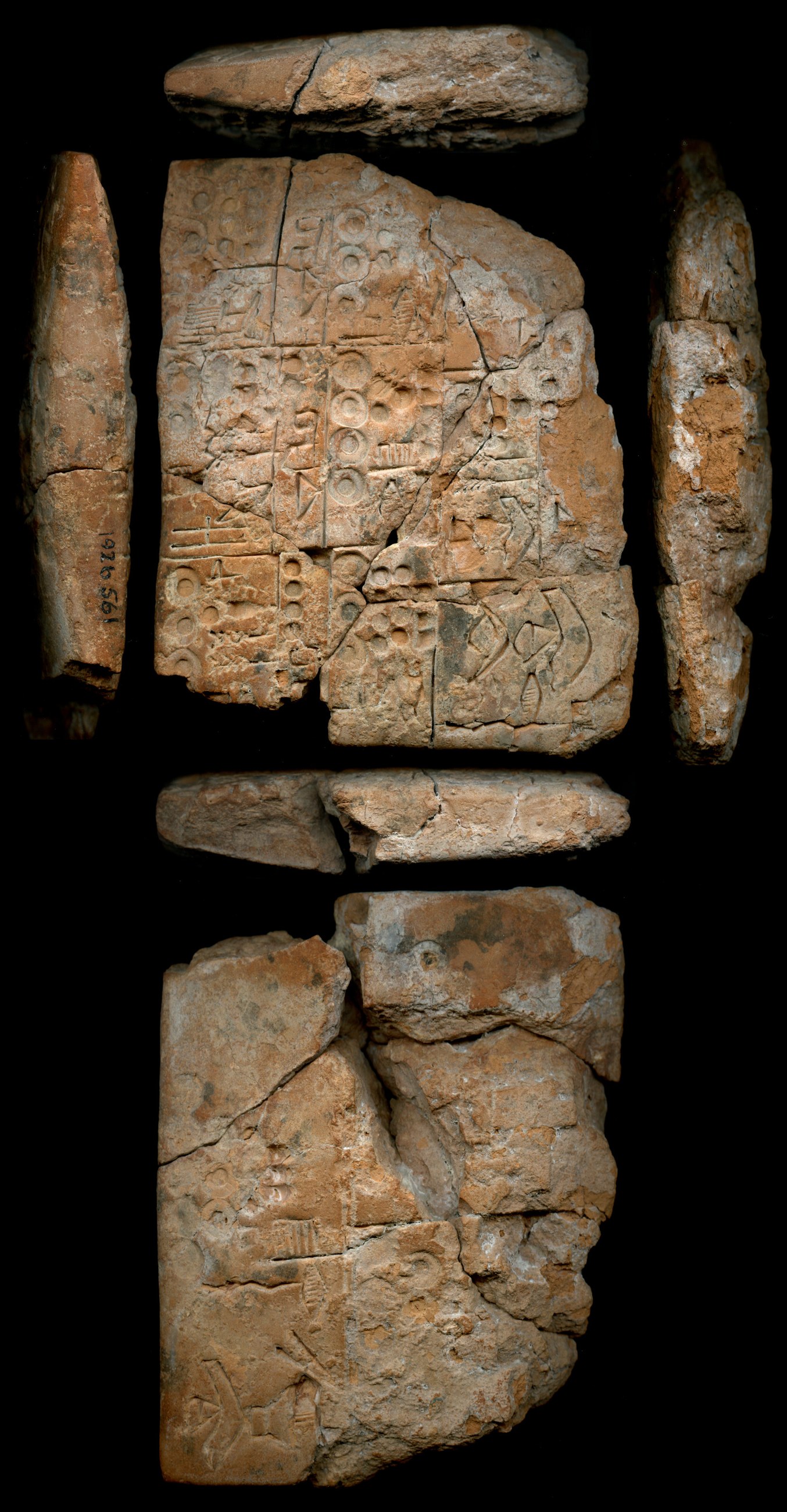
Where on the image
MSVO 1, 001 (Ashm 1926-0561), obverse, column 1. The photograph shows the whole tablet (obverse above, reverse below, edges beside); face and column as given in the CDLI transliteration, checked by eye on the photograph.
1.a2(N50) 4(N14)# 4(N01) , GAN2# |ŠE~a&ŠE~a|# GAL~a ŠAB~a
1.b2(N14)# , GURUŠ~a SAL
1.c4(N50)# 7(N14)# [N] , GAN2 KI A
2.a3(N50)#? 2(N22) 4(N01) , |ŠE~a&ŠE~a| GAN2# GIR3@g~b# PA~a
2.b2(N14) , GURUŠ~a SAL
2.c4(N50) 2(N14) 1(N22) 5(N01) , GAN2 KI# A#
3.a3(N50)# [...] 1(N14) 1(N01) , |ŠE~a&ŠE~a| BA [GAN2] NAM2# DI#
3.b4(N14) , GURUŠ~a# [SAL]
3.c3(N50)# 8(N14)# 1(N22)# 2(N01) , GAN2# KI# A#
1.a25 bur3 4 iku field, in barley, of the chief exchange agent,
1.b2 bur3, male and female laborers,
1.c47(+) bur3 field, irrigated;
2.a30 bur3 2 eše3 4 iku field, in barley, of the equid herder,
2.b2 bur3, male and female laborers,
2.c42 bur3 1 eše3 5 iku field, irrigated;
3.a31(+) bur3 1 iku field, in barley, of the chief justice,
3.b4 bur3, male and female laborers,
3.c38 bur3 1 eše3 2 iku field, irrigated;
Where on the image
MSVO 1, 001 (Ashm 1926-0561), obverse, column 2. The photograph shows the whole tablet (obverse above, reverse below, edges beside); face and column as given in the CDLI transliteration, checked by eye on the photograph.
1.a[2(N50) N] , [|ŠE~a&ŠE~a| GAN2] EN~c# SAL#
1.b[2(N14) N?] , [GURUŠ~a SAL]
1.c[N] , [GAN2 KI A]
2.a1(N50) [n?] 4(N14) 2(N22)# , |ŠE~a&ŠE~a|# ME~a# |NI~a.RU|
2.b2(N14)# [n?] , GURUŠ~a# SAL#
2.c[N] , [GAN2 KI A]
3, U4 |NI~a.RU| A#? KI BU~a AB~a#
1.a20(+) field, in barley, of the wife of the lord,
1.b2(+) bur3, male and female laborers,
1.c... field, irrigated;
2.a14(+) bur3 2 eše3 field, in barley, of the priest of NIRU (Jemdet Nasr),
2.b2 bur3 ... male and female laborers,
2.c... field, irrigated;
3... of NIRU, measured fields of the households;
Where on the image
MSVO 1, 001 (Ashm 1926-0561), reverse, column 1. The photograph shows the whole tablet (obverse above, reverse below, edges beside); face and column as given in the CDLI transliteration, checked by eye on the photograph. On the reverse the columns run from right to left: column 1 is the right-hand column.
1[1(N45)] 5(N50)# [N] , [GAN2 |ŠE~a&ŠE~a|]
21(N50)# [2(N14) n] , [GURUŠ~a SAL]
33(N45)# 2(N50)# 5(N14)# [N] , [GAN2 KI A]
11 šar2 50 ... bur3 field, in barley,
212(+) bur3, male and female laborers,
33 šar2 25(+) bur3 field, irrigated;
Where on the image
MSVO 1, 001 (Ashm 1926-0561), reverse, column 2. The photograph shows the whole tablet (obverse above, reverse below, edges beside); face and column as given in the CDLI transliteration, checked by eye on the photograph. On the reverse the columns run from right to left: column 1 is the right-hand column.
15(N45)# 3(N50)# 4(N14)# 3(N01) , LAGAB~b GAN2 BU~a KI |NI~a.RU| AB~a APIN~a#
15 šar2 34 bur3 3 iku, total field, measured land of NIRU, agricultural household.
Notes
- Transliteration: CDLI ATF (proto-cuneiform). Numerals are written as counts of numeral signs, e.g. 4(N14) = four N14 signs; ~a, ~b mark sign variants; [ ] broken, # damaged; sz is shown as š.
- English: CDLI's line-by-line translation (#tr.en lines of the ATF).
- CDLI notes: reverse, column 1, line 1: calculation: total of all “fields in barley”; reverse, column 1, line 2: calculation: total of all “fields of laborers”; reverse, column 1, line 3: calculation: total of all “irrigated fields”; reverse, column 2, line 1: calculation in bur3: 110(+) + 12(+) + 205(+) = 334 bur3 3 iku (only 7 bur3 missing)
Cite
Sources
- Source: Ashm 1926-0561 photograph, transliteration and English translation via CDLI (P005068) (holding institution)
- Critical edition: CDLI transliterations (MSVO 1 and MSVO 3 texts)
← previous · → next · v cycle view · l back to library