Pyramid Texts of Unas: Utterances 318-321 (corridor, east wall)
Introduction
The Pyramid Texts are the oldest large body of Egyptian religious writing: spells, called utterances, for the resurrection of the dead king, his protection, his meals and his ascent to the sky, cut in vertical columns of hieroglyphs on the walls of the burial apartments of late Old Kingdom pyramids. The pyramid of Unas at Saqqara, the last king of the 5th Dynasty (about 2375-2345 BCE), is the first to carry them. Its sarcophagus chamber, the passage to the antechamber, the antechamber and the corridor hold the columns of text that Sethe numbered W 1-649 (there is no W 129 or W 318). This library gives them wall by wall, in seventeen entries (227 different utterances, some of them inscribed more than once), with one gap: Utterance 271 (the end of W 492, all of W 493 and the top of W 494, on the south wall of the antechamber) is not in the Thesaurus Linguae Aegyptiae data used here, so it is not given. W 646 (corridor, east wall) has no column mark of its own in the TLA text; its words are given with W 645.
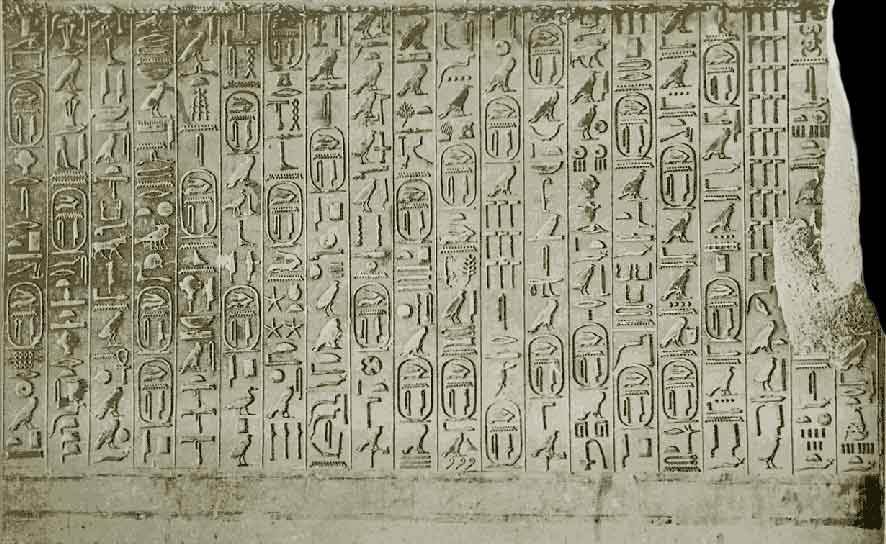
This entry is the east wall of the corridor: 20 columns of hieroglyphs, Sethe's W 630-649, which follow each other from the right-hand (south) edge of the photograph. It holds the utterances 318, 319, 320, 321. The TLA text of PT 320 has no marker for the start of W 646; the words of W 645 and 646 stand together under 645.
Each section is one utterance. The Egyptian is the transliteration of the Thesaurus Linguae Aegyptiae (edition by Doris Topmann), with Sethe's Unas column number (W) before each column; a number ending in 'a' marks the offering label at the foot of a column. Signs restored by the editor are in square brackets, signs the scribe left out in angle brackets, damaged signs in half brackets. The English is Samuel A. B. Mercer's translation of 1952. Mercer translates Sethe's composite text made from all the pyramids that have an utterance, so his wording can include clauses that are not in the Unas copy, and his section numbers (134a, 134b ...) are Sethe's paragraph numbers, not column numbers; he writes 'N.' where the wall has the king's name. The photograph shows the whole wall; each section's note gives its columns counted from the edge where the text on that wall begins.
How was this verified? (Provenance)
Where on the image
Unas W 630-635: W 630-635 are columns 1-6 of the 20 columns on the photograph of the corridor, east wall, counted from the right-hand (south) edge. Wall check (east wall): 20 columns, W 630 at the right-hand (south) edge to W 649 at the left. Checked on the image: the leftmost column has two cartouches (W 649), the third from the left shows the jackal and the ankh of W 647, and the seventh opens with a cartouche (W 643 'Wnjs grḥ'). The TLA gives no break for W 646, the fourth column from the left; its text runs on under 645. Mercer's English renders Sethe's composite text of this utterance from all pyramids; it can contain words that are not in the Unas copy.
630[ḏ〈d〉-mdw] [Wnjs] [pj] [nꜥ,w] [kꜣ] [j:sšm] ꜥm jꜥr,t 7.t =f
631ḫpr.n sfḫ.t{t} =f nḥb.⸢w⸣,t ⸢wḏ-mdw⸣ n sfḫ,t{t} =f
632psḏ,t.pl sḏm.t mdw jtj,w
633jyi̯.n Wnjs j:ꜥm =f ꜥnt,w šzp Wnjs ꜥnt,w ꜥn,y =f
634m ꜥnt,w ꜥn,t Wnjs m ꜥnt,w nḥm.n Wnjs wsr,t =ṯn
635nṯr.pl pẖr n Wnjs nḥb.t〈j〉 =f kꜣ.pl =ṯn
511aTo say: N. is the n‘w-serpent, the bull which leadeth, which swallowed its seven uraeus-serpents,
511bthrough which came into being its seven neck-vertebrae,
511cwhich commands its Seven Enneads who hear the words of the king.
511dAnd the mother of N. is Ḥnw.t; N. is her son.
512aN. has come that he may swallow myrrh,
512bthat N. may take myrrh, his nostrils (?) being full of myrrh; the finger-nail of N. being full of myrrh.
512cN. has taken away your neck, O gods;
512dServe N. who will confer (upon you) your valour.
Where on the image
Unas W 635-642: W 635-642 are columns 6-13 of the 20 columns on the photograph of the corridor, east wall, counted from the right-hand (south) edge. Wall check (east wall): 20 columns, W 630 at the right-hand (south) edge to W 649 at the left. Checked on the image: the leftmost column has two cartouches (W 649), the third from the left shows the jackal and the ankh of W 647, and the seventh opens with a cartouche (W 643 'Wnjs grḥ'). The TLA gives no break for W 646, the fourth column from the left; its text runs on under 645. Mercer's English renders Sethe's composite text of this utterance from all pyramids; it can contain words that are not in the Unas copy.
635ḏ〈d〉-mdw Wnjs pj
636kꜣ jꜣḫ,w.du ḥr〈,j〉-jb jr,t =f wḏꜣ rʾ Wnjs m hh
637tp Wnjs m wp,t nb šmꜥ〈,w〉 sšmi̯ Wnjs nṯr
638sḫm Wnjs m psḏ,t srd Wnjs
639ḫsbd ꜣg Wnjs twn šmꜥ〈,w〉 jw ṯꜣz.n Wnjs ꜥqꜣ.pl
640šmšm,t zmꜣ.n Wnjs p,t.pl sḫm Wnjs m tꜣ.pl
641rs〈,j〉.w mḥ,t〈j〉.w nṯr jm〈,j〉.w-bꜣḥ jw qd.n Wnjs nʾ,t nṯr
642r sḏꜣ =s Wnjs pj ḫmt,nw m ḫꜥ =f
513aTo say: N. is the bull of the two splendours which are in the middle of his eye.
513bThe mouth of N. is immune because of a flaming breath, the head of N. because of horns, (as) lord of the South (Haroëris of Ḳuṣ).
513cN. leads the god; N. rules over the Ennead.
5 1 3d. N. makes the lapis lazuli grow; N. causes the Upper Egyptian twn-plant to sprout.
514aN. has tied the cords of the šmšm.t-plant.
514bN. has united the heavens; N. rules over the lands, the southern and the northern,
514c(as) the gods who were before.
514dN. built a divine city, according to its merits.
Where on the image
Unas W 642-647: W 642-647 are columns 13-18 of the 20 columns on the photograph of the corridor, east wall, counted from the right-hand (south) edge. Wall check (east wall): 20 columns, W 630 at the right-hand (south) edge to W 649 at the left. Checked on the image: the leftmost column has two cartouches (W 649), the third from the left shows the jackal and the ankh of W 647, and the seventh opens with a cartouche (W 643 'Wnjs grḥ'). The TLA gives no break for W 646, the fourth column from the left; its text runs on under 645. Mercer's English renders Sethe's composite text of this utterance from all pyramids; it can contain words that are not in the Unas copy.
642ḏ〈d〉-mdw ḏsr.n
643Wnjs grḥ zbi̯.n Wnjs wn,w.tpl ḫꜥi̯ sḫm.pl
644sꜥḥ =sn Wnjs m Bꜣby Wnjs pj zꜣ pw
645n〈,j〉 j:ḫm.t msi̯.n =s Wnjs n qnj-ḥr nb šsꜣ,t.pl wr ṯn nb.w jmn ṯn rḫ,t tp-ꜥ Wnjs Wnjs pj
647bꜣby nb šsꜣ,t kꜣ jꜥn.w ꜥnḫ m ḫm =f
515aTo say: N. has regulated the night; N. has sent the hours on their way.
515bThe powers (stars) dawn; they proclaim N. as Bȝ-bii.
515cN. is that son of her who knew not that
515dshe had borne N., to him of powerful visage, as lord of nights.
516aHumble (?) yourselves, ye lords; hide yourselves, ye subjects, in the presence of N.,
516b(for) N. is Bȝ-bii, lord of night,
516cthe bull, without whom life would cease.
Where on the image
Unas W 648-649: W 648-649 are columns 19-20 of the 20 columns on the photograph of the corridor, east wall, counted from the right-hand (south) edge. Wall check (east wall): 20 columns, W 630 at the right-hand (south) edge to W 649 at the left. Checked on the image: the leftmost column has two cartouches (W 649), the third from the left shows the jackal and the ankh of W 647, and the seventh opens with a cartouche (W 643 'Wnjs grḥ'). The TLA gives no break for W 646, the fourth column from the left; its text runs on under 645. Mercer's English renders Sethe's composite text of this utterance from all pyramids; it can contain words that are not in the Unas copy.
648ḏ〈d〉-mdw Ḥꜣ≡f-m-ḥꜣ≡f jni̯ n Wnjs sfr,t ḥtp,t ḥr.t psḏ.pl
649〈W〉sjr pri̯ Wnjs ḥr =s r p,t stp Wnjs zꜣ r Rꜥw m p,t
517aTo say: O Thou-whose-back-is-behind-him, bring to N. the śfr.t-ḥtp.t, which was upon the back of Osiris,
517bthat N. may ascend to heaven upon it; that N. may do service of courtier to Rē‘ in heaven.
Notes
- Mercer's separate headings, postscripts and variants taken from other pyramids are left out.
- Letters follow the sacred-texts transcription of Mercer: ȝ stands for aleph and ‘ for ayin; letters underlined in the printed book are given as ḏ, ṯ, ẖ.
- Sethe's section numbers are kept as printed in that transcription, including a few misprints (for example '146.' for 141b in Utterance 215).
- The TLA has no hieroglyphic encoding for these texts, so only the transliteration is shown.
Cite
Sources
- Source: Pyramid of Unas, Saqqara, corridor, east wall (photograph: L. F. Husson for A. Piankoff 1968, via Pyramid Texts Online) + TLA transliteration (ed. D. Topmann, CC BY-SA 4.0) + English of S. A. B. Mercer (1952, public domain in the US) (holding institution)
- Critical edition: Thesaurus Linguae Aegyptiae, ed. Doris Topmann (2018 data, AED-TEI)
← previous · → next · v cycle view · l back to library