Pyramid Texts of Unas: Utterances 313-317 (corridor, west wall)
Introduction
The Pyramid Texts are the oldest large body of Egyptian religious writing: spells, called utterances, for the resurrection of the dead king, his protection, his meals and his ascent to the sky, cut in vertical columns of hieroglyphs on the walls of the burial apartments of late Old Kingdom pyramids. The pyramid of Unas at Saqqara, the last king of the 5th Dynasty (about 2375-2345 BCE), is the first to carry them. Its sarcophagus chamber, the passage to the antechamber, the antechamber and the corridor hold the columns of text that Sethe numbered W 1-649 (there is no W 129 or W 318). This library gives them wall by wall, in seventeen entries (227 different utterances, some of them inscribed more than once), with one gap: Utterance 271 (the end of W 492, all of W 493 and the top of W 494, on the south wall of the antechamber) is not in the Thesaurus Linguae Aegyptiae data used here, so it is not given. W 646 (corridor, east wall) has no column mark of its own in the TLA text; its words are given with W 645.
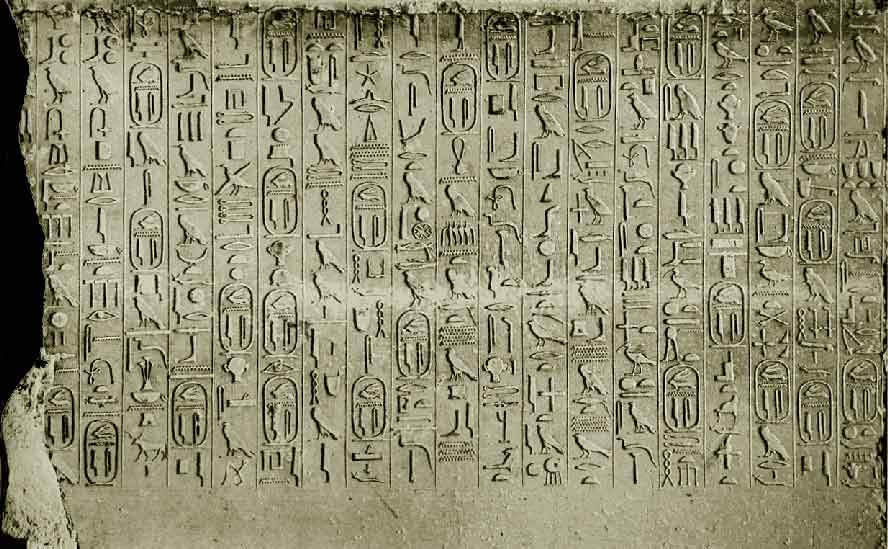
This entry is the west wall of the corridor: 20 columns of hieroglyphs, Sethe's W 610-629, which follow each other from the left-hand (south) edge of the photograph. It holds the utterances 313, 314, 315, 316, 317. The southern end of the wall is broken: W 610, the first column of PT 313, is almost entirely lost on the photograph, and the TLA restores most of its words.
Each section is one utterance. The Egyptian is the transliteration of the Thesaurus Linguae Aegyptiae (edition by Doris Topmann), with Sethe's Unas column number (W) before each column; a number ending in 'a' marks the offering label at the foot of a column. Signs restored by the editor are in square brackets, signs the scribe left out in angle brackets, damaged signs in half brackets. The English is Samuel A. B. Mercer's translation of 1952. Mercer translates Sethe's composite text made from all the pyramids that have an utterance, so his wording can include clauses that are not in the Unas copy, and his section numbers (134a, 134b ...) are Sethe's paragraph numbers, not column numbers; he writes 'N.' where the wall has the king's name. The photograph shows the whole wall; each section's note gives its columns counted from the edge where the text on that wall begins.
How was this verified? (Provenance)
Where on the image
Unas W 610-613: W 610 lies in the broken area at the left-hand edge of the photograph and is almost entirely lost; W 611-613 are columns 1-3 of the 19 visible columns on the photograph of the corridor, west wall, counted from the left-hand (south) edge. Wall check (west wall): W 610 lies in the broken area at the left-hand (south) edge and is almost entirely lost (the TLA restores most of it); the 19 visible columns are W 611-629. Checked on the image: the sixth visible column from the left has four cartouches (W 616 'Wnjs jmꜣḫ Wnjs ḥr-tp Wnjs jri̯ Wnjs'), the third two (W 613) and the rightmost one (W 629). Mercer's English renders Sethe's composite text of this utterance from all pyramids; it can contain words that are not in the Unas copy.
610[s]ṯ〈ꜣ〉 〈ḥ〉⸢nn⸣ Bꜣby [j:]⸢wn⸣ ⸢ꜥꜣ.du⸣ [p,t] [ḫt〈m〉] [ꜥꜣ.du] […] wn Wnjs [wꜣ,t]
611ḥr bḫḫ,w ẖr jkn,t nṯr.pl zbn.t Ḥr,w zp 2 zbn Wnjs [j]m
612m bḫḫ,w pn ẖr jkn,t nṯr.pl jri̯ =sn wꜣ,t n Wnjs
613swꜣ Wnjs jm =s Wnjs pj Ḥr,w
502aTo say: The phallus of Bȝ-bii is drawn; the double doors of heaven are opened.
502bThe double doors of heaven are locked; the way goes over the flames under that which the gods create,
503awhich allows each Horus to glide through, in which N. will glide through, in this flame under that which the gods create.
503bThey make a way for N., that N. may pass by it. N. is a Horus.
Where on the image
Unas W 613-614: W 613-614 are columns 3-4 of the 19 visible columns on the photograph of the corridor, west wall, counted from the left-hand (south) edge. Wall check (west wall): W 610 lies in the broken area at the left-hand (south) edge and is almost entirely lost (the TLA restores most of it); the 19 visible columns are W 611-629. Checked on the image: the sixth visible column from the left has four cartouches (W 616 'Wnjs jmꜣḫ Wnjs ḥr-tp Wnjs jri̯ Wnjs'), the third two (W 613) and the rightmost one (W 629). Mercer's English renders Sethe's composite text of this utterance from all pyramids; it can contain words that are not in the Unas copy.
613ḏ〈d〉-mdw ḥꜣ =k ng〈ꜣ,w〉
614ngꜣ ḏbꜥ.pl Ꜣkr m wp,t =f j:ḫr zbn
504aTo say: Back, thou ox, which shall be killed, on whose horns the fingers of the earth-god shall be.
504bFall, glide away.
Where on the image
Unas W 614-617: W 614-617 are columns 4-7 of the 19 visible columns on the photograph of the corridor, west wall, counted from the left-hand (south) edge. Wall check (west wall): W 610 lies in the broken area at the left-hand (south) edge and is almost entirely lost (the TLA restores most of it); the 19 visible columns are W 611-629. Checked on the image: the sixth visible column from the left has four cartouches (W 616 'Wnjs jmꜣḫ Wnjs ḥr-tp Wnjs jri̯ Wnjs'), the third two (W 613) and the rightmost one (W 629). Mercer's English renders Sethe's composite text of this utterance from all pyramids; it can contain words that are not in the Unas copy.
614Wnjs pj
615jꜥn hṯt pꜣṯṯ ꜥr,t Wnjs ḥr sꜣ
616Wnjs jmꜣḫ Wnjs ḥr-tp Wnjs jri̯ Wnjs hn,j
617hnt,t ḥmsi̯ =f mm =tn ḥꜥꜣ,t〈j〉.w
505aIt is N., O ’i‘n-ape, O hṯt-ape, O pȝṯṯ-ape.
505bThe death (?) of N. is upon the desire of N.; the beatitude of N. (has come) on N. (of himself).
505cN. will do homage, the same homage (which ye do); he will sit among you, O ye ḥ‘ȝ.tiw.
Where on the image
Unas W 617-619: W 617-619 are columns 7-9 of the 19 visible columns on the photograph of the corridor, west wall, counted from the left-hand (south) edge. Wall check (west wall): W 610 lies in the broken area at the left-hand (south) edge and is almost entirely lost (the TLA restores most of it); the 19 visible columns are W 611-629. Checked on the image: the sixth visible column from the left has four cartouches (W 616 'Wnjs jmꜣḫ Wnjs ḥr-tp Wnjs jri̯ Wnjs'), the third two (W 613) and the rightmost one (W 629). Mercer's English renders Sethe's composite text of this utterance from all pyramids; it can contain words that are not in the Unas copy.
617j ḥmj
618sḥd n rḏi̯.n n =ṯn Wnjs ḥkꜣ =f ḥmsi̯ Wnjs sꜣ =f
619jr ḏsr,t m Jwn,w šdi̯.w Wnjs r p,t
506aO Ḥmi; O Śḥd, N. has not given to you his magic.
506bN. will sit on the side of him who is revered in Heliopolis.
506cTake N. with (you) to heaven.
Where on the image
Unas W 619-629: W 619-629 are columns 9-19 of the 19 visible columns on the photograph of the corridor, west wall, counted from the left-hand (south) edge. Wall check (west wall): W 610 lies in the broken area at the left-hand (south) edge and is almost entirely lost (the TLA restores most of it); the 19 visible columns are W 611-629. Checked on the image: the sixth visible column from the left has four cartouches (W 616 'Wnjs jmꜣḫ Wnjs ḥr-tp Wnjs jri̯ Wnjs'), the third two (W 613) and the rightmost one (W 629). Mercer's English renders Sethe's composite text of this utterance from all pyramids; it can contain words that are not in the Unas copy.
619ḏ〈d〉-mdw
620jyi̯.n Wnjs mjn m-ḫnt mḥi̯,t ꜣgb,j
621Wnjs pj Sbk wꜣḏ šw,t rs ḥr ṯzi̯ ḥꜣ,t
622ꜥbš pri̯ m sbq ḫbz,t wr,t jm.t jꜣḫ〈,w〉
623jyi̯.n Wnjs r mr.pl =f jm〈,j〉.w jdb ꜣgb〈,w〉 mḥi̯,t wr.t
624r s,t ḥtp,w wꜣḏ.t sḫ,t.pl jm.t ꜣḫ,t s〈w〉ꜣḏ
625Wnjs sm〈,w〉 ḥr jdb.du ꜣḫ,t jnt Wnjs ṯḥn,t
626n jr,t wr.t ḥr.t-jb sḫ,t šzp Wnjs s,t =f jm.t
627ꜣḫ,t ḫꜥi̯ Wnjs m Sbk zꜣ Nj,t wnm Wnjs m rʾ =f
628wzš Wnjs nk Wnjs m ḥnn =f Wnjs pj
629nb mtw,t jṯi̯ ḥʾm,t.pl m-ꜥ h =sn r s,t mrr Wnjs ḫft šzp jb =f
507aTo say: N. is come forth to-day at the head of the inundation of the flood.
507bN. is a crocodile god, with green feather, with vigilant countenance, with forehead erect;
507ceffervescent, proceeding from leg and tail of the Great (One) who is in splendour.
508aN. is come to his watercourses, which are in the land of the flood, in Mḥ.t-wr.t,
508bto the places of satisfaction, with green fields, which are in the horizon,
509athat N. may make green the herbs in both lands of the horizon,
509b(and) that N. may bring the green to the great eye which is in the midst of the field.
509cN. takes his throne which is in the horizon;
510aN. appears as Sebek, son of Neit;
510bN. eats with his mouth, N. urinates, N. cohabits with his phallus;
510cN. is lord of semen, which women receive from their husband.
510dwherever N. wishes, according to the desire of his heart,
Notes
- Mercer's separate headings, postscripts and variants taken from other pyramids are left out.
- Letters follow the sacred-texts transcription of Mercer: ȝ stands for aleph and ‘ for ayin; letters underlined in the printed book are given as ḏ, ṯ, ẖ.
- Sethe's section numbers are kept as printed in that transcription, including a few misprints (for example '146.' for 141b in Utterance 215).
- The TLA has no hieroglyphic encoding for these texts, so only the transliteration is shown.
Cite
Sources
- Source: Pyramid of Unas, Saqqara, corridor, west wall (photograph: L. F. Husson for A. Piankoff 1968, via Pyramid Texts Online) + TLA transliteration (ed. D. Topmann, CC BY-SA 4.0) + English of S. A. B. Mercer (1952, public domain in the US) (holding institution)
- Critical edition: Thesaurus Linguae Aegyptiae, ed. Doris Topmann (2018 data, AED-TEI)
← previous · → next · v cycle view · l back to library