Rigveda 1.1: To Agni, the opening hymn
Introduction
Rigveda 1.1 is a hymn of 9 verses addressed to Agni. It stands in book (maṇḍala) 1, a collection of hymns by many families of poets. The Rigveda is the oldest collection of Sanskrit hymns, composed in the second half of the second millennium BCE and handed down orally for many centuries before it was written down.
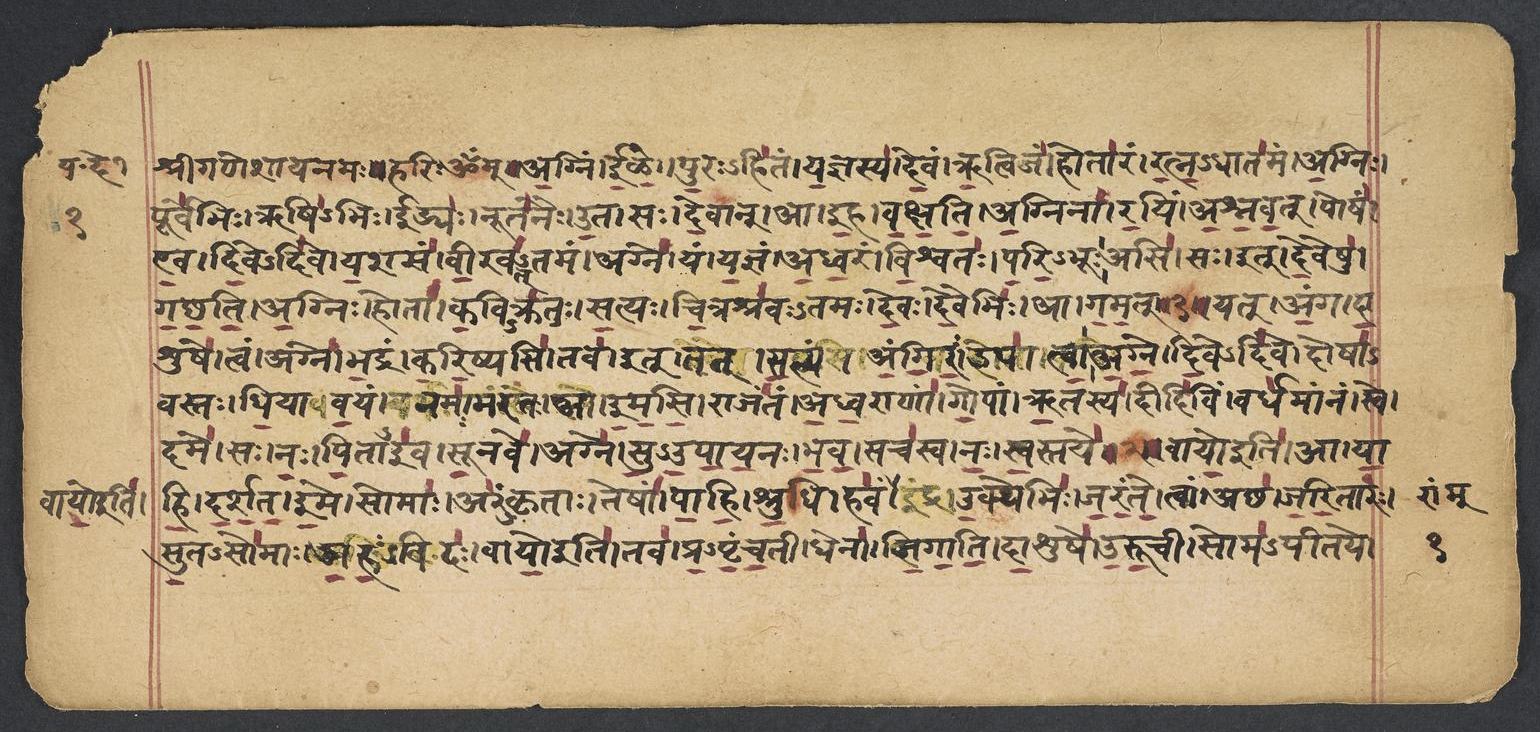
The manuscript shown is Penn Ms. Coll. 390 Item 41 (University of Pennsylvania), an undated paper manuscript of the padapāṭha (the word-by-word recitation text, in which every word is written separately and compounds are split) of the whole Ṛgveda in Devanāgarī, 884 leaves in fascicles, 7-9 lines to the page, accents in red; this hymn stands on fol. 1v. Each section below gives the verses that end on one page; the page boundaries were read on the images (the opening words of every page), not counted out. Where the manuscript is a padapāṭha (the word-by-word recitation text), the section shows Aufrecht's continuous (saṃhitā) text first and, as the edition text, the padapāṭha of the same verses, which is the form written on the page.
How was this verified? (Provenance)
Where on the image
Penn Ms. Coll. 390 Item 41, fol. 1v (OPenn image 3, upper leaf). Checked on the image: the Rigveda text on this page begins in RV 1.1.1 ‹agnim īḷe puraḥ-hitam yajñasya›. Line 1 opens with the invocation śrīgaṇeśāya namaḥ hariḥ oṃ, then agnim īḷe puraḥhitam (1.1.1); the left margin is marked pa. ṛ. 1; 1.1.9 ends in line 7 (the line opening dame) with the varga number, followed by 1.2.1 (vāyo iti ā yā-, continued in line 8); the ninth and last line ends with 1.2.3 (soma-pītaye) (line count rechecked 2026-11-12). The next page with Rigveda text, fol. 2r, begins in RV 1.2.4 ‹indravāyūiti ime sutāḥ upa›. Verses 1.1.1-9 end on this page.
1a̱gnim ī̍ḻe pu̱rohi̍taṁ ya̱jñasya̍ de̱vam ṛ̱tvija̍m | hotā̍raṁ ratna̱dhāta̍mam ||
2a̱gniḥ pūrve̍bhi̱r ṛṣi̍bhi̱r īḍyo̱ nūta̍nair u̱ta | sa de̱vām̐ eha va̍kṣati ||
3a̱gninā̍ ra̱yim a̍śnava̱t poṣa̍m e̱va di̱ve-di̍ve | ya̱śasa̍ṁ vī̱rava̍ttamam ||
4agne̱ yaṁ ya̱jñam a̍dhva̱raṁ vi̱śvata̍ḥ pari̱bhūr asi̍ | sa id de̱veṣu̍ gacchati ||
5a̱gnir hotā̍ ka̱vikra̍tuḥ sa̱tyaś ci̱traśra̍vastamaḥ | de̱vo de̱vebhi̱r ā ga̍mat ||
6yad a̱ṅga dā̱śuṣe̱ tvam agne̍ bha̱draṁ ka̍ri̱ṣyasi̍ | tavet tat sa̱tyam a̍ṅgiraḥ ||
7upa̍ tvāgne di̱ve-di̍ve̱ doṣā̍vastar dhi̱yā va̱yam | namo̱ bhara̍nta̱ ema̍si ||
8rāja̍ntam adhva̱rāṇā̍ṁ go̱pām ṛ̱tasya̱ dīdi̍vim | vardha̍māna̱ṁ sve dame̍ ||
9sa na̍ḥ pi̱teva̍ sū̱nave 'gne̍ sūpāya̱no bha̍va | saca̍svā naḥ sva̱staye̍ ||
Compare: Padapāṭha (word-by-word text written in the manuscript; Sansknet e-text via GRETIL)
1agnim | īḷe | puraḥ-hitam | yajñasya | devam | ṛtvijam | hotāram | ratna-dhātamam
2agniḥ | pūrvebhiḥ | ṛṣi-bhiḥ | īḍyaḥ | nūtanaiḥ | uta | saḥ | devān | ā | iha | vakṣati
3agninā | rayim | aśnavat | poṣam | eva | dive--dive | yaśasam | vīravat-tamam
4agne | yam | yajñam | adhvaram | viśvataḥ | pari-bhūḥ | asi | saḥ | it | deveṣu | gacchati
5agniḥ | hotā | kavi-kratuḥ | satyaḥ | citraśravaḥ-tamaḥ | devaḥ | devebhiḥ | ā | gamat
6yat | aṅga | dāśuṣe | tvam | agne | bhadram | kariṣyasi | tava | it | tat | satyam | aṅgiraḥ
7upa | tvā | agne | dive--dive | doṣāvastaḥ | dhiyā | vayam | namaḥ | bharantaḥ | ā | imasi
8rājantam | adhvarāṇām | gopām | ṛtasya | dīdivim | vardhamānam | sve | dame
9saḥ | naḥ | pitāiva | sūnave | agne | su-upāyanaḥ | bhava | sacasva | naḥ | svastaye
1I Laud Agni, the chosen Priest, God, minister of sacrifice, The hotar, lavishest of wealth.
2Worthy is Agni to be praised by living as by ancient seers. He shall bring hitherward the Gods.
3Through Agni man obtaineth wealth, yea, plenty waxing day by day, Most rich in heroes, glorious.
4Agni, the perfect sacrifice which thou encompassest about Verily goeth to the Gods.
5May Agni, sapient-minded Priest, truthful, most gloriously great, The God, come hither with the Gods.
6Whatever blessing, Agni, thou wilt grant unto thy worshipper, That, Angiras, is indeed thy truth.
7To thee, dispeller of the night, O Agni, day by day with prayer Bringing thee reverence, we come
8Ruler of sacrifices, guard of Law eternal, radiant One, Increasing in thine own abode.
9Be to us easy of approach, even as a father to his son: Agni, be with us for our weal.
Notes
- Sanskrit: Aufrecht's edition (1877) with the Vedic accents, as entered by van Nooten and Holland (GRETIL).
- English: Ralph T. H. Griffith, The Hymns of the Rigveda (1889-1892; 2nd ed. 1896-1897), from the VedaWeb digital text; OCR slips in that text were corrected against the printed 2nd edition (data/sources/rigveda/griffith_errata.json).
- Padapāṭha (edition text): Sansknet e-text via GRETIL (CC BY-NC-SA 4.0).
Cite
Sources
- Source: Penn Ms. Coll. 390 Item 41 (undated (catalogued with Penn's 18th-19th c. Vedic manuscripts)), OPenn, Public Domain Mark + Aufrecht's accented text (GRETIL) + Griffith's English (VedaWeb) (holding institution)
- Critical edition: Aufrecht (1877), accented e-text via GRETIL
← previous · → next · v cycle view · l back to library