Rigveda 1.2: To Vayu, Indra and Vayu, Mitra and Varuna
Introduction
Rigveda 1.2 is a hymn of 9 verses addressed to Vayu, Indra and Vayu, Mitra and Varuna. It stands in book (maṇḍala) 1, a collection of hymns by many families of poets. The Rigveda is the oldest collection of Sanskrit hymns, composed in the second half of the second millennium BCE and handed down orally for many centuries before it was written down.
The manuscript shown is Penn Ms. Coll. 390 Item 41 (University of Pennsylvania), an undated paper manuscript of the padapāṭha (the word-by-word recitation text, in which every word is written separately and compounds are split) of the whole Ṛgveda in Devanāgarī, 884 leaves in fascicles, 7-9 lines to the page, accents in red; this hymn stands on fol. 1v-2r. Each section below gives the verses that end on one page; the page boundaries were read on the images (the opening words of every page), not counted out. Where the manuscript is a padapāṭha (the word-by-word recitation text), the section shows Aufrecht's continuous (saṃhitā) text first and, as the edition text, the padapāṭha of the same verses, which is the form written on the page.
How was this verified? (Provenance)
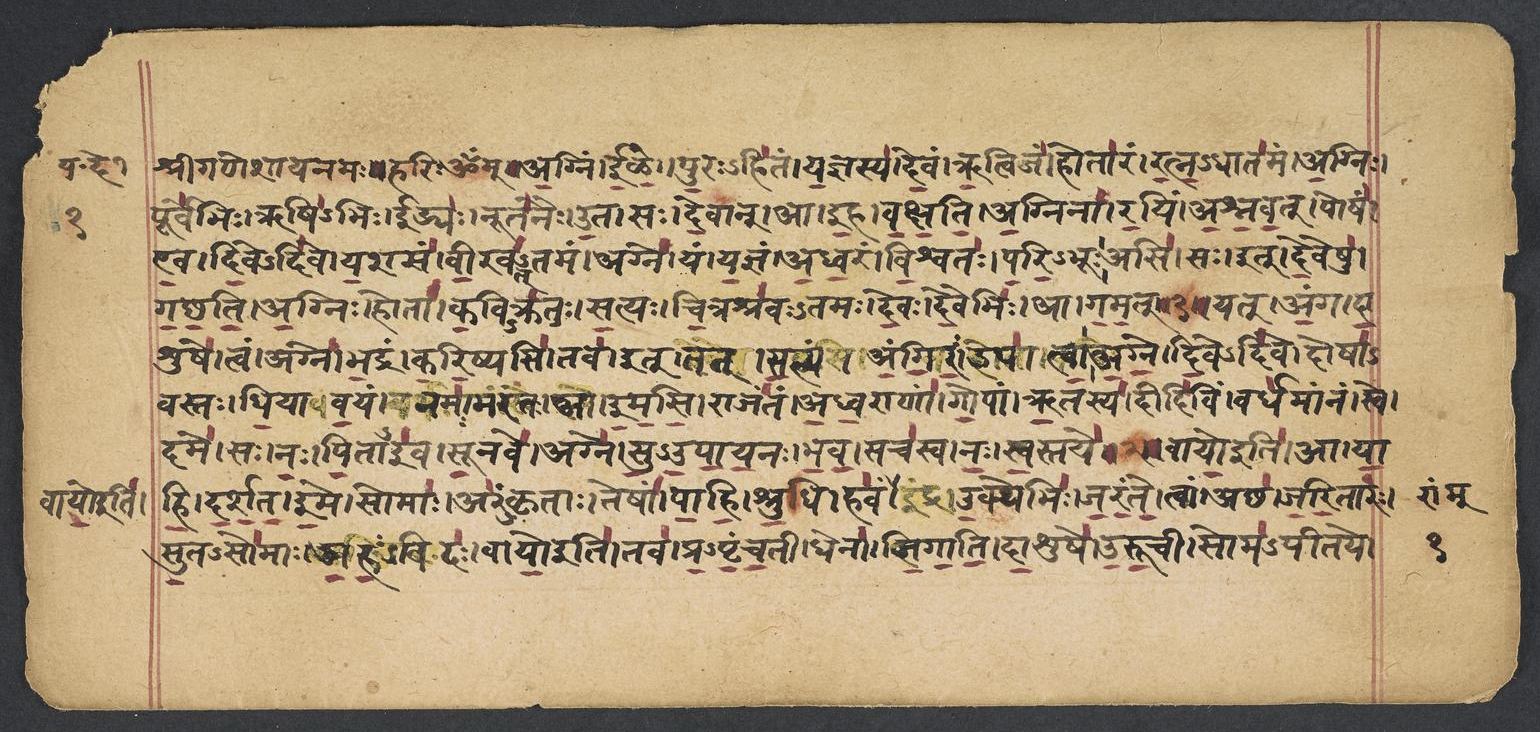
Where on the image
Penn Ms. Coll. 390 Item 41, fol. 1v (OPenn image 3, upper leaf). Checked on the image: the Rigveda text on this page begins in RV 1.1.1 ‹agnim īḷe puraḥ-hitam yajñasya›. Line 1 opens with the invocation śrīgaṇeśāya namaḥ hariḥ oṃ, then agnim īḷe puraḥhitam (1.1.1); the left margin is marked pa. ṛ. 1; 1.1.9 ends in line 7 (the line opening dame) with the varga number, followed by 1.2.1 (vāyo iti ā yā-, continued in line 8); the ninth and last line ends with 1.2.3 (soma-pītaye) (line count rechecked 2026-11-12). The next page with Rigveda text, fol. 2r, begins in RV 1.2.4 ‹indravāyūiti ime sutāḥ upa›. Verses 1.2.1-3 end on this page.
1vāya̱v ā yā̍hi darśate̱me somā̱ ara̍ṁkṛtāḥ | teṣā̍m pāhi śru̱dhī hava̍m ||
2vāya̍ u̱kthebhi̍r jarante̱ tvām acchā̍ jari̱tāra̍ḥ | su̱taso̍mā aha̱rvida̍ḥ ||
3vāyo̱ tava̍ prapṛñca̱tī dhenā̍ jigāti dā̱śuṣe̍ | u̱rū̱cī soma̍pītaye ||
Compare: Padapāṭha (word-by-word text written in the manuscript; Sansknet e-text via GRETIL)
1vāyo iti | ā | yāhi | darśata | ime | somāḥ | araṃ-kṛtāḥ | teṣām | pāhi | śrudhi | havam
2vāyo iti | ukthebhiḥ | jarante | tvām | accha | jaritāraḥ | suta-somāḥ | ahaḥ-vidaḥ
3vāyo iti | tava | pra-pṛñcatī | dhenā | jigāti | dāśuṣe | urūcī | soma-pītaye
1BEAUTIFUL Vâyu, come, for thee these Soma drops have been prepared: Drink of them, hearken to our call.
2Knowing the days, with Soma juice poured forth, the singers glorify Thee, Vâyu, with their hymns of praise.
3Vâyu, thy penetrating stream goes forth unto the worshipper, Far-spreading for the Soma draught.
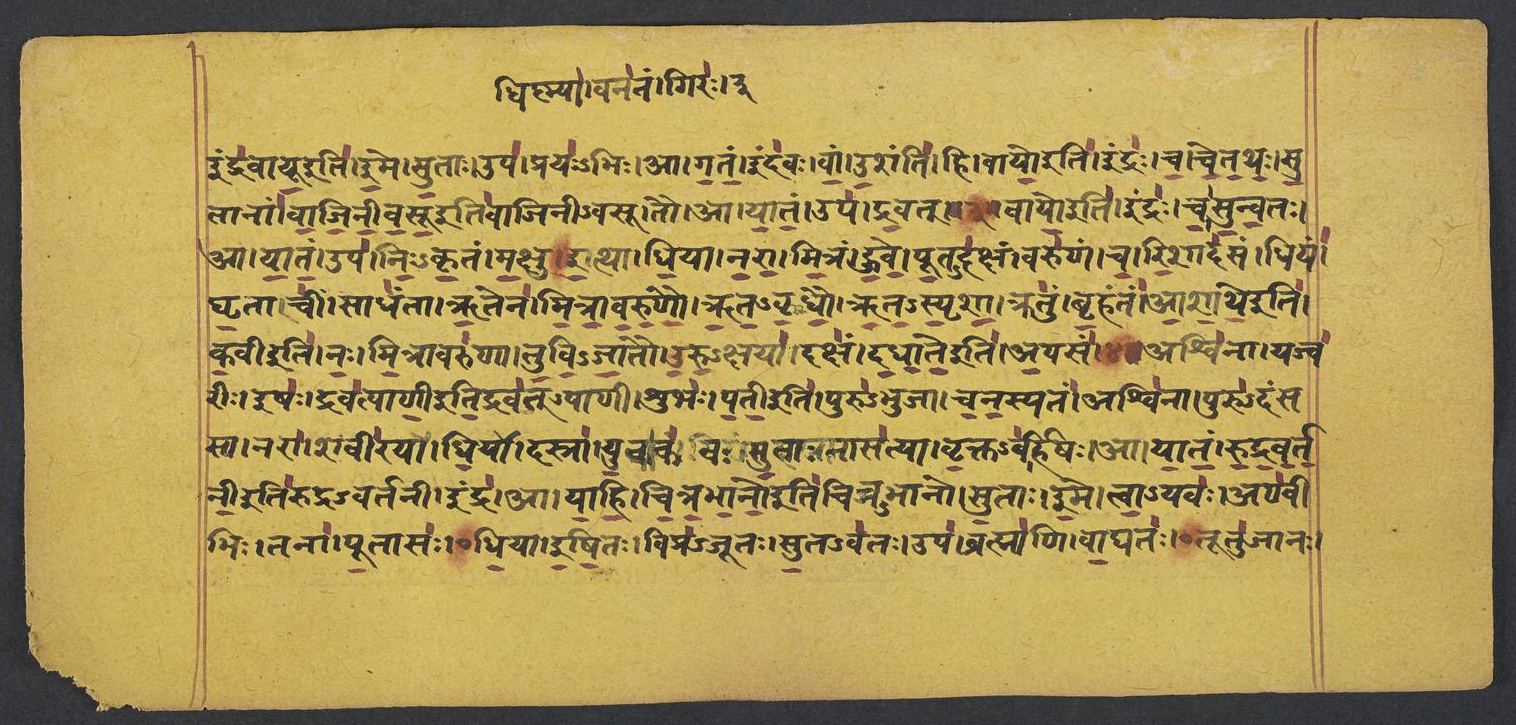
Where on the image
Penn Ms. Coll. 390 Item 41, fol. 2r (OPenn image 3, lower leaf). Checked on the image: the Rigveda text on this page begins in RV 1.2.4 ‹indravāyūiti ime sutāḥ upa›. The next page with Rigveda text, fol. 2v, begins in RV 1.3.6 ‹upa brahmāṇi hari-vaḥ sute›. Verses 1.2.4-9 end on this page.
4indra̍vāyū i̱me su̱tā upa̱ prayo̍bhi̱r ā ga̍tam | inda̍vo vām u̱śanti̱ hi ||
5vāya̱v indra̍ś ca cetathaḥ su̱tānā̍ṁ vājinīvasū | tāv ā yā̍ta̱m upa̍ dra̱vat ||
6vāya̱v indra̍ś ca sunva̱ta ā yā̍ta̱m upa̍ niṣkṛ̱tam | ma̱kṣv i1̱̍tthā dhi̱yā na̍rā ||
7mi̱traṁ hu̍ve pū̱tada̍kṣa̱ṁ varu̍ṇaṁ ca ri̱śāda̍sam | dhiya̍ṁ ghṛ̱tācī̱ṁ sādha̍ntā ||
8ṛ̱tena̍ mitrāvaruṇāv ṛtāvṛdhāv ṛtaspṛśā | kratu̍m bṛ̱hanta̍m āśāthe ||
9ka̱vī no̍ mi̱trāvaru̍ṇā tuvijā̱tā u̍ru̱kṣayā̍ | dakṣa̍ṁ dadhāte a̱pasa̍m ||
Compare: Padapāṭha (word-by-word text written in the manuscript; Sansknet e-text via GRETIL)
4indravāyūiti | ime | sutāḥ | upa | prayaḥ-bhiḥ | ā | gatam | indavaḥ | vām | uśanti | hi
5vāyo iti | indraḥ | ca | cetathaḥ | sutānām | vājinīvasūitivājinī-vasū | tau | ā | yātam | upa | dravat
6vāyo iti | indraḥ | ca | sunvataḥ | ā | yātam | upa | niḥ-kṛtam | makṣu | itthā | dhiyā | narā
7mitram | huve | pūta-dakṣam | varuṇam | ca | riśādasam | dhiyam | ghṛtācīm | sādhantā
8ṛtena | mitrāvaruṇau | ṛtāvṛdhau | ṛta-spṛśā | kratum | bṛhantam | āśātheiti
9kavī iti | naḥ | mitrāvaruṇā | tuvi-jātau | uru-kṣayā | dakṣam | dadhāteiti | apasam
4These, Indra-Vâyu, have been shed; come for our offered dainties' sake: The drops are yearning for you both.
5Well do ye mark libations, ye Vâyu and Indra, rich in spoil So come ye swiftly hitherward.
6Vâyu and Indra, come to what the Soma. presser hath prepared: Soon, Heroes, thus I make my prayer.
7Mitra, of holy strength, I call, and foe-destroying Varuṇa, Who make the oil-fed rite complete.
8Mitra and Varuṇa, through Law, lovers and cherishers of Law, Have ye obtained your might power
9Our Sages, Mitra-Varuṇa, wide dominion, strong by birth, Vouchsafe us strength that worketh well.
Notes
- Sanskrit: Aufrecht's edition (1877) with the Vedic accents, as entered by van Nooten and Holland (GRETIL).
- English: Ralph T. H. Griffith, The Hymns of the Rigveda (1889-1892; 2nd ed. 1896-1897), from the VedaWeb digital text; OCR slips in that text were corrected against the printed 2nd edition (data/sources/rigveda/griffith_errata.json).
- Padapāṭha (edition text): Sansknet e-text via GRETIL (CC BY-NC-SA 4.0).
Cite
Sources
- Source: Penn Ms. Coll. 390 Item 41 (undated (catalogued with Penn's 18th-19th c. Vedic manuscripts)), OPenn, Public Domain Mark + Aufrecht's accented text (GRETIL) + Griffith's English (VedaWeb) (holding institution)
- Critical edition: Aufrecht (1877), accented e-text via GRETIL
← previous · → next · v cycle view · l back to library