Rigveda 1.105: To all the gods (Trita in the well)
Introduction
Rigveda 1.105 is a hymn of 19 verses addressed to all the gods (Trita in the well). It stands in book (maṇḍala) 1, a collection of hymns by many families of poets. The Rigveda is the oldest collection of Sanskrit hymns, composed in the second half of the second millennium BCE and handed down orally for many centuries before it was written down.
The manuscript shown is Penn Ms. Coll. 390 Item 41 (University of Pennsylvania), an undated paper manuscript of the padapāṭha (the word-by-word recitation text, in which every word is written separately and compounds are split) of the whole Ṛgveda in Devanāgarī, 884 leaves in fascicles, 7-9 lines to the page, accents in red; this hymn stands on fol. 73r-74v. Each section below gives the verses that end on one page; the page boundaries were read on the images (the opening words of every page), not counted out. Where the manuscript is a padapāṭha (the word-by-word recitation text), the section shows Aufrecht's continuous (saṃhitā) text first and, as the edition text, the padapāṭha of the same verses, which is the form written on the page.
How was this verified? (Provenance)
Where on the image
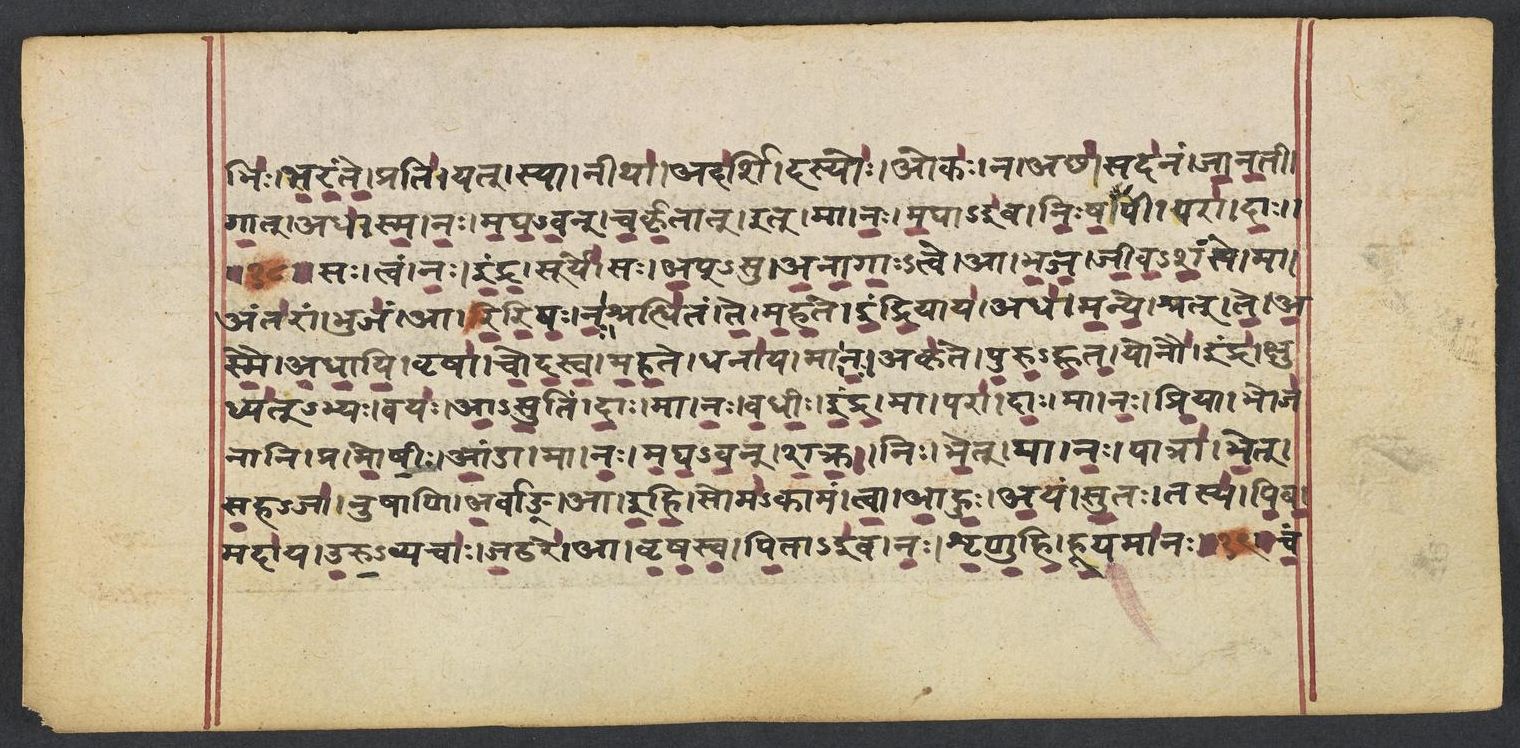
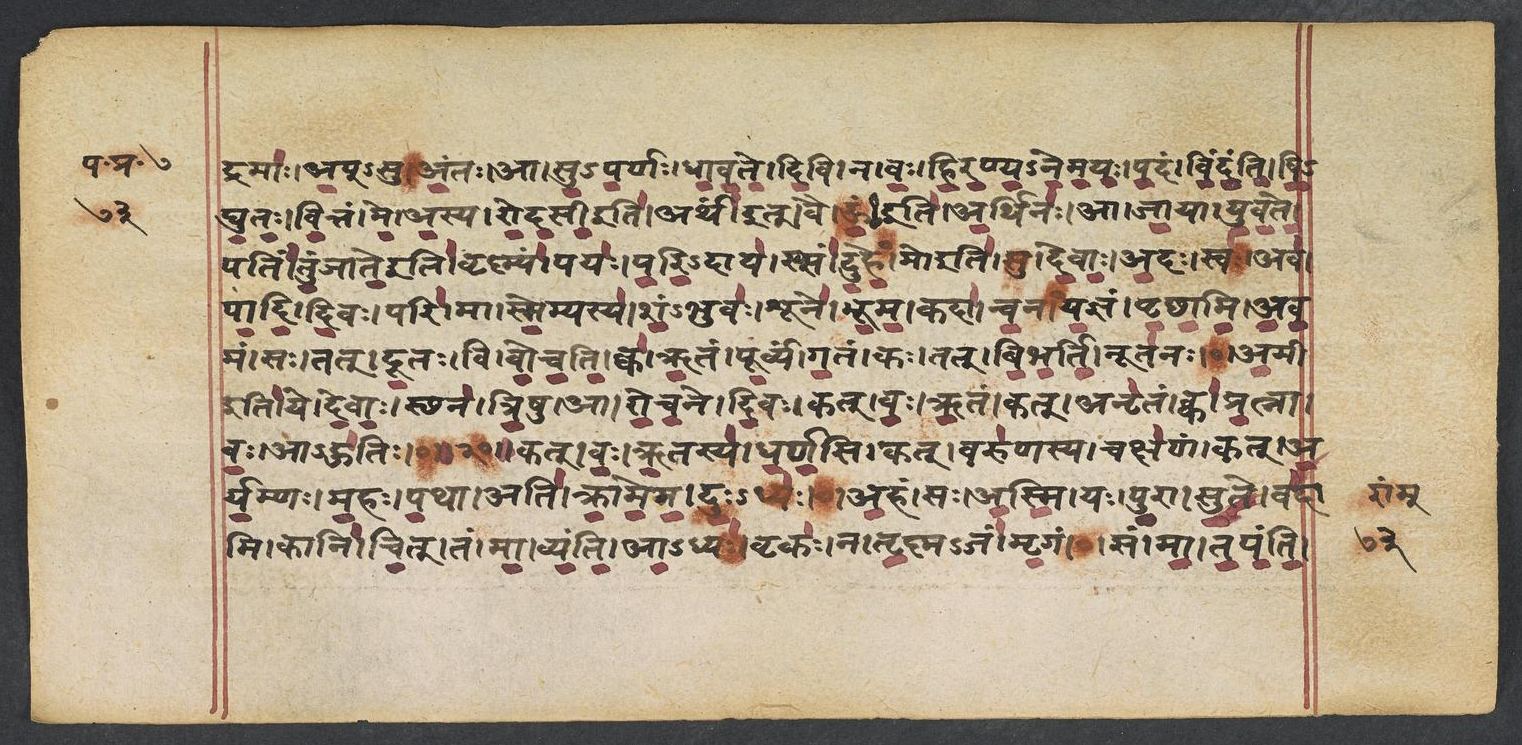
Penn Ms. Coll. 390 Item 41, fol. 73v (OPenn image 75, upper leaf). Checked on the image: the Rigveda text on this page begins in RV 1.105.1 ‹-candramāḥ ap-su antaḥ ā›. The next page with Rigveda text, fol. 74r, begins in RV 1.105.8 ‹abhitaḥ sapatnīḥ-iva parśavaḥ mūṣaḥ›. Verses 1.105.1-7 end on this page; 1.105.1 begins on fol. 73r.
1ca̱ndramā̍ a̱psv a1̱̍ntar ā su̍pa̱rṇo dhā̍vate di̱vi | na vo̍ hiraṇyanemayaḥ pa̱daṁ vi̍ndanti vidyuto vi̱ttam me̍ a̱sya ro̍dasī ||
2artha̱m id vā u̍ a̱rthina̱ ā jā̱yā yu̍vate̱ pati̍m | tu̱ñjāte̱ vṛṣṇya̱m paya̍ḥ pari̱dāya̱ rasa̍ṁ duhe vi̱ttam me̍ a̱sya ro̍dasī ||
3mo ṣu de̍vā a̱daḥ sva1̱̍r ava̍ pādi di̱vas pari̍ | mā so̱myasya̍ śa̱mbhuva̱ḥ śūne̍ bhūma̱ kadā̍ ca̱na vi̱ttam me̍ a̱sya ro̍dasī ||
4ya̱jñam pṛ̍cchāmy ava̱maṁ sa tad dū̱to vi vo̍cati | kva̍ ṛ̱tam pū̱rvyaṁ ga̱taṁ kas tad bi̍bharti̱ nūta̍no vi̱ttam me̍ a̱sya ro̍dasī ||
5a̱mī ye de̍vā̱ḥ sthana̍ tri̱ṣv ā ro̍ca̱ne di̱vaḥ | kad va̍ ṛ̱taṁ kad anṛ̍ta̱ṁ kva̍ pra̱tnā va̱ āhu̍tir vi̱ttam me̍ a̱sya ro̍dasī ||
6kad va̍ ṛ̱tasya̍ dharṇa̱si kad varu̍ṇasya̱ cakṣa̍ṇam | kad a̍rya̱mṇo ma̱has pa̱thāti̍ krāmema dū̱ḍhyo̍ vi̱ttam me̍ a̱sya ro̍dasī ||
7a̱haṁ so a̍smi̱ yaḥ pu̱rā su̱te vadā̍mi̱ kāni̍ cit | tam mā̍ vyanty ā̱dhyo̱3̱̍ vṛko̱ na tṛ̱ṣṇaja̍m mṛ̱gaṁ vi̱ttam me̍ a̱sya ro̍dasī ||
Compare: Padapāṭha (word-by-word text written in the manuscript; Sansknet e-text via GRETIL)
1candramāḥ | ap-su | antaḥ | ā | su-parṇaḥ | dhāvate | divi | na | vaḥ | hiraṇya-nemayaḥ | padam | vindanti | vi-dyutaḥ | vittam | me | asya | rodasī iti
2artham | it | vai | oṃ iti | arthinaḥ | ā | jāyā | yuvate | patim | tuñjāteiti | vṛṣṇyam | payaḥ | pari-dāya | rasam | duhe | vittam | me | asya | rodasī iti
3mo iti | su | devāḥ | adaḥ | svaḥ | ava | pādi | divaḥ | pari | mā | somyasya | śam-bhuvaḥ | śūne | bhūma | kadā | cana | vittam | me | asya | rodasī iti
4yajñam | pṛcchāmi | avamam | saḥ | tat | dūtaḥ | vi | vocati | kva | ṛtam | pūrvyam | gatam | kaḥ | tat | bibharti | nūtanaḥ | vittam | me | asya | rodasī iti
5amī iti | ye | devaḥ | sthana | triṣu | ā | rocane | divaḥ | kat | vaḥ | ṛtam | kat | anṛtam | kva | pratnā | vaḥ | āhutiḥ | vittam | me | asya | rodasī iti
6kat | vaḥ | ṛtasya | dharṇasi | kat | varuṇasya | cakṣaṇam | kat | aryamṇaḥ | mahaḥ | pathā | ati | krāmema | duḥ-ḍhyaḥ | vittam | me | asya | rodasī iti
7aham | saḥ | asmi | yaḥ | purā | sute | vadāmi | kāni | cit | tam | mā | vyanti | ādhyaḥ | vṛkaḥ | na | tṛṣṇa-jam | mṛgam | vittam | me | asya | rodasī iti
1WITHIN the waters runs the Moon, he with the beauteous wings in heaven. Ye lightnings with your golden wheels, men find not your abiding-place. Mark this my woe, ye Earth and Heaven.
2Surely men crave and gain their wish. Close to her husband clings the wife. And, in embraces intertwined, both give and take the bliss of love. Mark this my woe, ye Earth and Heaven.
3O never may that light , ye Gods, fall from its station in the sky. Ne'er fail us one like Soma sweet, the spring of our felicity. Mark this my woe ye Earth and Heaven.
4I ask the last of sacrifice. As envoy he shall tell it forth. Where is the ancient law divine? Who is its new diffuser now? Mark this my woe, ye Earth and Heaven.
5Ye Gods who yonder have your home in the three lucid realms of heaven, What count ye truth and what untruth? Where is mine ancient call on you? Mark this my woe, ye Earth and Heaven.
6What is your firm support of Law? What Varuṇa's observant eye? How may we pass the wicked on the path of mighty Aryaman? Mark this my woe, ye Earth and Heaven.
7I am the man who sang of old full many a laud when Soma flowed. Yet torturing cares consume me as the wolf assails the thirsty deer. Mark this my woe, ye Earth and Heaven.
Where on the image
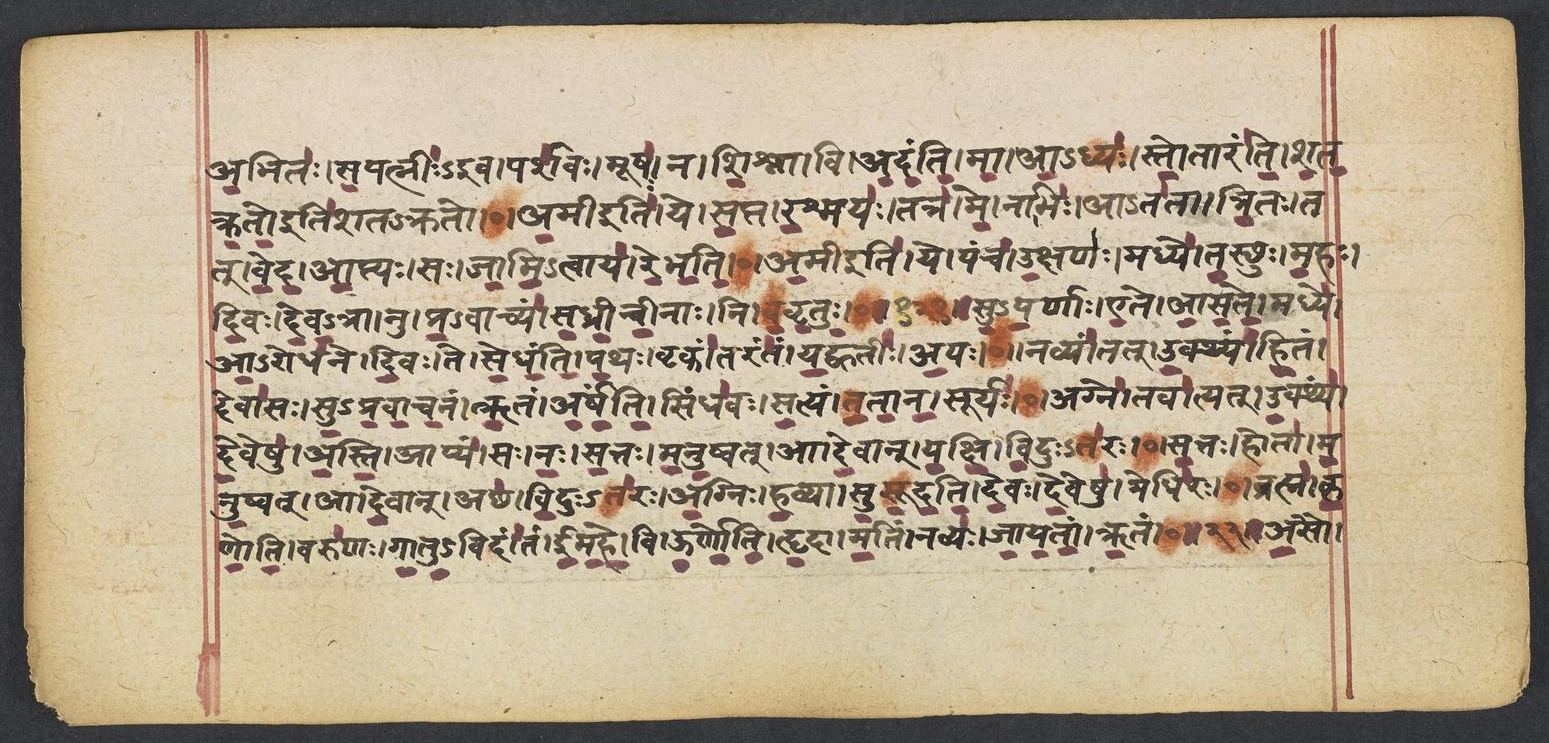
Penn Ms. Coll. 390 Item 41, fol. 74r (OPenn image 75, lower leaf). Checked on the image: the Rigveda text on this page begins in RV 1.105.8 ‹abhitaḥ sapatnīḥ-iva parśavaḥ mūṣaḥ›. The next page with Rigveda text, fol. 74v, begins in RV 1.105.16 ‹yaḥ panthāḥ ādityaḥ divi›. Verses 1.105.8-15 end on this page; 1.105.8 begins on fol. 73v.
8sam mā̍ tapanty a̱bhita̍ḥ sa̱patnī̍r iva̱ parśa̍vaḥ | mūṣo̱ na śi̱śnā vy a̍danti mā̱dhya̍ḥ sto̱tāra̍ṁ te śatakrato vi̱ttam me̍ a̱sya ro̍dasī ||
9a̱mī ye sa̱pta ra̱śmaya̱s tatrā̍ me̱ nābhi̱r āta̍tā | tri̱tas tad ve̍dā̱ptyaḥ sa jā̍mi̱tvāya̍ rebhati vi̱ttam me̍ a̱sya ro̍dasī ||
10a̱mī ye pañco̱kṣaṇo̱ madhye̍ ta̱sthur ma̱ho di̱vaḥ | de̱va̱trā nu pra̱vācya̍ṁ sadhrīcī̱nā ni vā̍vṛtur vi̱ttam me̍ a̱sya ro̍dasī ||
11su̱pa̱rṇā e̱ta ā̍sate̱ madhya̍ ā̱rodha̍ne di̱vaḥ | te se̍dhanti pa̱tho vṛka̱ṁ tara̍ntaṁ ya̱hvatī̍r a̱po vi̱ttam me̍ a̱sya ro̍dasī ||
12navya̱ṁ tad u̱kthya̍ṁ hi̱taṁ devā̍saḥ supravāca̱nam | ṛ̱tam a̍rṣanti̱ sindha̍vaḥ sa̱tyaṁ tā̍tāna̱ sūryo̍ vi̱ttam me̍ a̱sya ro̍dasī ||
13agne̱ tava̱ tyad u̱kthya̍ṁ de̱veṣv a̱sty āpya̍m | sa na̍ḥ sa̱tto ma̍nu̱ṣvad ā de̱vān ya̍kṣi vi̱duṣṭa̍ro vi̱ttam me̍ a̱sya ro̍dasī ||
14sa̱tto hotā̍ manu̱ṣvad ā de̱vām̐ acchā̍ vi̱duṣṭa̍raḥ | a̱gnir ha̱vyā su̍ṣūdati de̱vo de̱veṣu̱ medhi̍ro vi̱ttam me̍ a̱sya ro̍dasī ||
15brahmā̍ kṛṇoti̱ varu̍ṇo gātu̱vida̱ṁ tam ī̍mahe | vy ū̍rṇoti hṛ̱dā ma̱tiṁ navyo̍ jāyatām ṛ̱taṁ vi̱ttam me̍ a̱sya ro̍dasī ||
Compare: Padapāṭha (word-by-word text written in the manuscript; Sansknet e-text via GRETIL)
8sam | mā | tapanti | abhitaḥ sapatnīḥ-iva | parśavaḥ | mūṣaḥ | na | śiśnā | vi | adanti | mā | ādhyaḥ | stotāram | te | śata-krato itiśata-krato | vittam | me | asya | rodasī iti
9amī iti | ye | sapta | raśmayaḥ | tatra | me | nābhiḥ | ātatā | tritaḥ | tat | veda | āptyaḥ | saḥ | jāmi-tvāya | rebhati | vittam | me | asya | rodasī iti
10amī iti | ye | pañca | ukṣaṇaḥ | madhye | tasthuḥ | mahaḥ | divaḥ | deva-trā | nu | pra-vācyam | sadhrīcīnāḥ | ni | vavṛtuḥ | vittam | me | asya | rodasī iti
11su-parṇāḥ | ete | āsate | madhye | ārodhane | divaḥ | te | sedhanti | pathaḥ | vṛkam | tarantam | yahvatīḥ | apaḥ | vittam | me | asya | rodasī iti
12navyam | tat | ukthyam | hitam | devāsaḥ | su-pravācanam | ṛtam | arṣantisindhavaḥ | satyam | tatāna | sūryaḥ | vittam | me | asya | rodasī iti
13agne | tava | tyat | ukthyam | deveṣu | asti | āpyam | saḥ | naḥ | sattaḥ | manuṣvat | ā | devān | yakṣi | viduḥ-taraḥ | vittam | me | asya | rodasī iti
14sattaḥ | hotā | manuṣvat | ā | devān | accha | viduḥ-taraḥ | agniḥ | havyā | susūdati | devaḥ | deveṣu | medhiraḥ | vittam | me | asya | rodasī iti
15brahmā | kṛṇoti | varuṇaḥ | gātu-vidam | tam | īmahe | vi | ūrṇoti | hṛdā | matim | navyaḥ | jāyatām | ṛtam | vittam | me | asya | rodasī iti
8Like rival wives on every side enclosing ribs oppress me sore. O Ṣatakratu, biting cares devour me, singer of thy praise, as rats devour the weaver's threads. Mark this my woe, ye Earth and Heaven.
9Where those seven rays are shining, thence my home and family extend. This Trita Âptya knoweth well, and speaketh out for brotherhood. Mark this my woe, ye Earth and Heaven.
10May those five Bulls which stand on high full in the midst of mighty heaven, Having together swiftly borne my praises to the Gods, return. Mark this my woe, ye Earth and Heaven.
11High in the mid ascent of heaven those Birds of beauteous pinion sit. Back from his path they drive the wolf as he would cross the restless floods. Mark this my woe, ye Earth and Heaven.
12Firm is this new-wrought hymn of praise, and meet to be told forth, O Gods. The flowing of the floods is Law, Truth is the Sun's extended light. Mark this my woe, ye Earth and Heaven.
13Worthy of laud, O Agni, is that kinship which thou hast with Gods. Here seat thee like a man: most wise, bring thou the Gods for sacrifice. Mark this my woe, ye Earth and Heaven.
14Here seated, man-like as a priest shall wisest Agni to the Gods Speed onward our oblations, God among the Gods, intelligent. Mark this my woe, ye Earth and Heaven.
15Varuṇa makes the holy prayer. To him who finds the path we pray. He in the heart reveals his thought. Let sacred worship rise anew. Mark this my woe, ye Earth and Heaven.
Where on the image
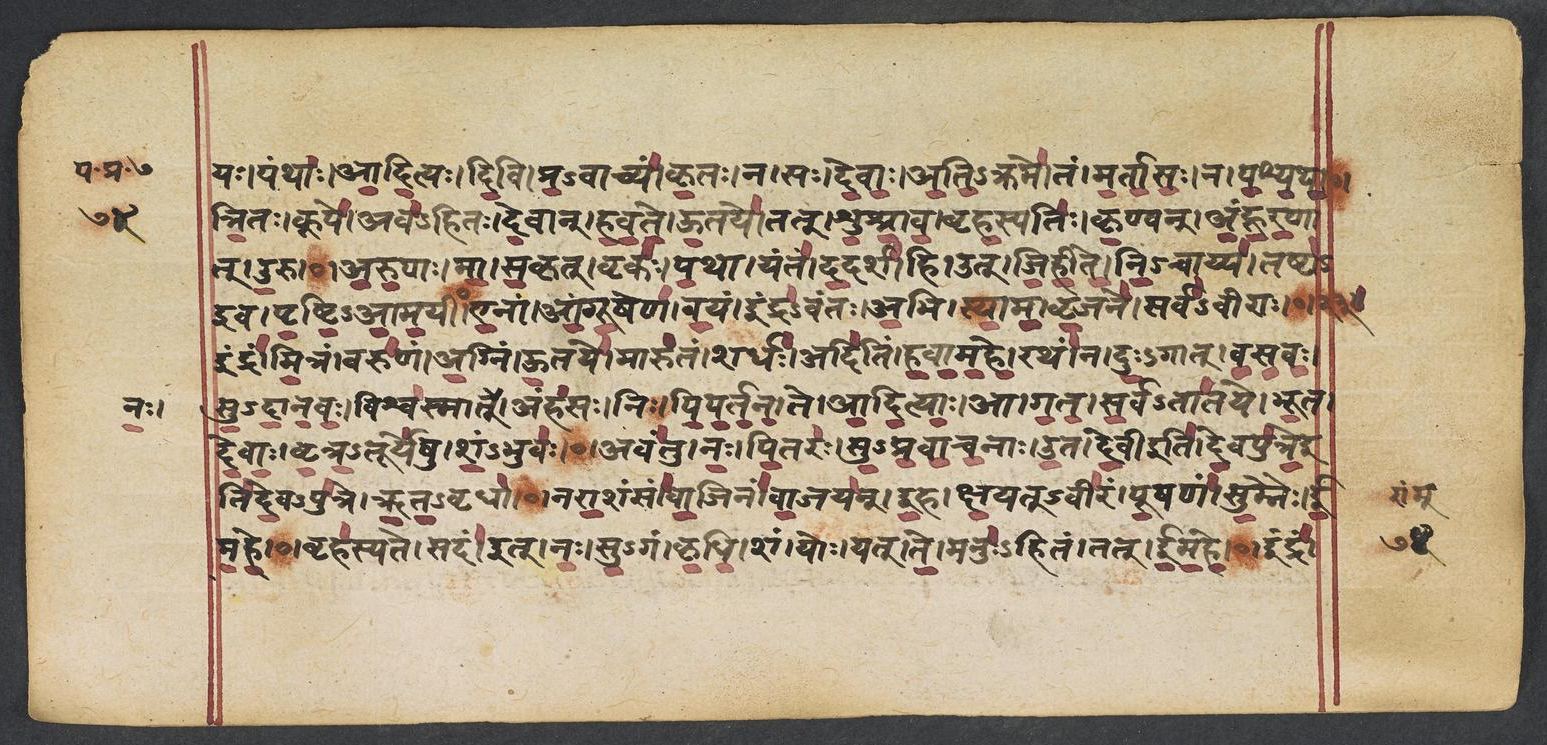
Penn Ms. Coll. 390 Item 41, fol. 74v (OPenn image 76, upper leaf). Checked on the image: the Rigveda text on this page begins in RV 1.105.16 ‹yaḥ panthāḥ ādityaḥ divi›. The next page with Rigveda text, fol. 75r, begins in RV 1.106.6 ‹kutsaḥ vṛtra-hanam śacī-patim kāṭe›. Verses 1.105.16-19 end on this page; 1.105.16 begins on fol. 74r.
16a̱sau yaḥ panthā̍ ādi̱tyo di̱vi pra̱vācya̍ṁ kṛ̱taḥ | na sa de̍vā ati̱krame̱ tam ma̍rtāso̱ na pa̍śyatha vi̱ttam me̍ a̱sya ro̍dasī ||
17tri̱taḥ kūpe 'va̍hito de̱vān ha̍vata ū̱taye̍ | tac chu̍śrāva̱ bṛha̱spati̍ḥ kṛ̱ṇvann a̍ṁhūra̱ṇād u̱ru vi̱ttam me̍ a̱sya ro̍dasī ||
18a̱ru̱ṇo mā̍ sa̱kṛd vṛka̍ḥ pa̱thā yanta̍ṁ da̱darśa̱ hi | uj ji̍hīte ni̱cāyyā̱ taṣṭe̍va pṛṣṭyāma̱yī vi̱ttam me̍ a̱sya ro̍dasī ||
19e̱nāṅgū̱ṣeṇa̍ va̱yam indra̍vanto̱ 'bhi ṣyā̍ma vṛ̱jane̱ sarva̍vīrāḥ | tan no̍ mi̱tro varu̍ṇo māmahantā̱m adi̍ti̱ḥ sindhu̍ḥ pṛthi̱vī u̱ta dyauḥ ||
Compare: Padapāṭha (word-by-word text written in the manuscript; Sansknet e-text via GRETIL)
16asau | yaḥ | panthāḥ | ādityaḥ | divi | pra-vācyam | kṛtaḥ | na | saḥ | devāḥ | ati-krame | tam | martāsaḥ | na | paśyatha | vittam | me | asya | rodasī iti
17tritaḥ | kūpe | ava-hitaḥ | devān | havate | ūtaye | tat | śuśrāva | bṛhaspatiḥ | kṛṇvan | aṃhūraṇāt | uru | vittam | me | asya | rodasī iti
18aruṇaḥ | mā | sakṛt | vṛkaḥ | pathā | yantam | dadarśa | hi | ut | jihīte | ni-cāyya | taṣṭāiva | pṛṣṭi-āmayī | vittam | me | asya | rodasī iti
19enā | āṅgūṣeṇa | vayam | indra-vantaḥ | abhi | syāma | vṛjane | sarva-vīrāḥ | tat | naḥ | mitraḥ | varuṇaḥ | mamahantām | aditiḥ | sindhuḥ | pṛthivī | uta | dyauḥ
16That pathway of the Sun in heaven, made to be highly glorified, Is not to be transgressed, O Gods. O mortals, ye behold it not. Mark this my woe, ye Earth and Heaven.
17Trita, when buried in the well, calls on the Gods to succour him. That call of his Br̥ihaspati heard and released him from distress. Mark this my woe, ye Earth and Heaven.
18A ruddy wolf beheld me once, as I was faring on my path. He, like a carpenter whose back is aching crouched and slunk away. Mark this my woe, ye Earth and Heaven.
19Through this our song may we, allied with Indra, with all our heroes conquer in the battle. This prayer of ours may Varuṇa grant, and Mitra, and Aditi and Sindhu, Earth and Heaven.
Notes
- Sanskrit: Aufrecht's edition (1877) with the Vedic accents, as entered by van Nooten and Holland (GRETIL).
- English: Ralph T. H. Griffith, The Hymns of the Rigveda (1889-1892; 2nd ed. 1896-1897), from the VedaWeb digital text; OCR slips in that text were corrected against the printed 2nd edition (data/sources/rigveda/griffith_errata.json).
- Padapāṭha (edition text): Sansknet e-text via GRETIL (CC BY-NC-SA 4.0).
Cite
Sources
- Source: Penn Ms. Coll. 390 Item 41 (undated (catalogued with Penn's 18th-19th c. Vedic manuscripts)), OPenn, Public Domain Mark + Aufrecht's accented text (GRETIL) + Griffith's English (VedaWeb) (holding institution)
- Critical edition: Aufrecht (1877), accented e-text via GRETIL
← previous · → next · v cycle view · l back to library