Rigveda 1.13: Apri hymn
Introduction
Rigveda 1.13 is a hymn of 12 verses addressed to Apri hymn. It stands in book (maṇḍala) 1, a collection of hymns by many families of poets. The Rigveda is the oldest collection of Sanskrit hymns, composed in the second half of the second millennium BCE and handed down orally for many centuries before it was written down.
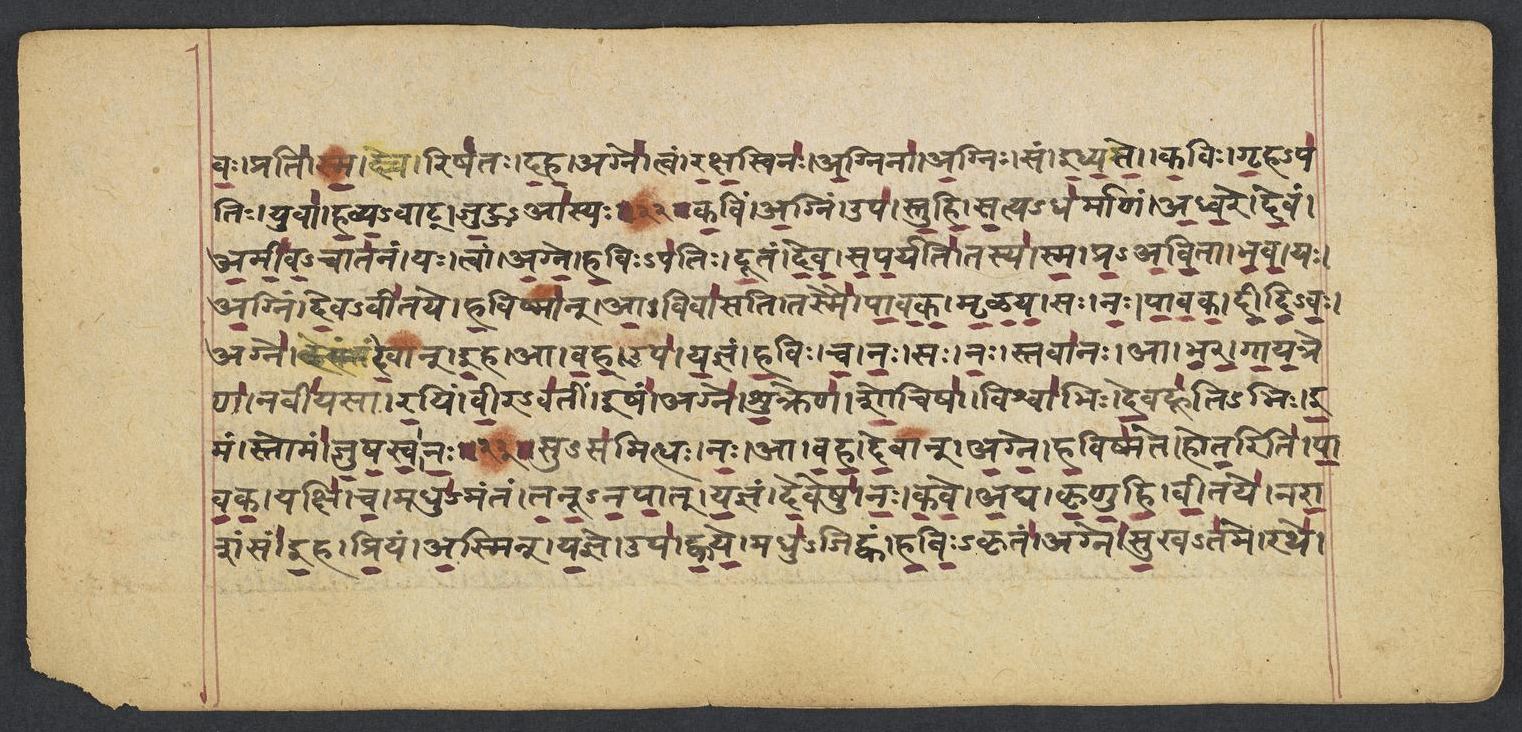
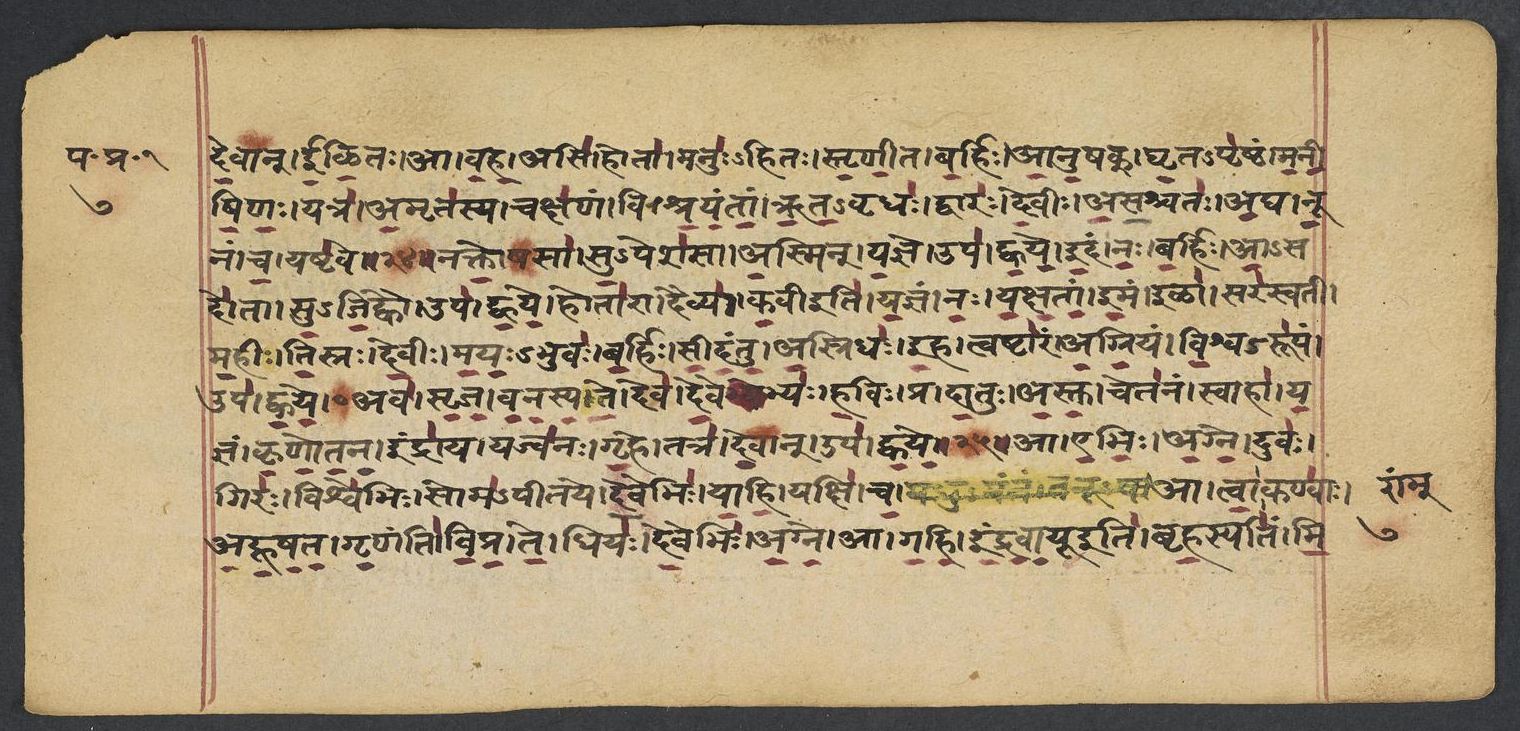
The manuscript shown is Penn Ms. Coll. 390 Item 41 (University of Pennsylvania), an undated paper manuscript of the padapāṭha (the word-by-word recitation text, in which every word is written separately and compounds are split) of the whole Ṛgveda in Devanāgarī, 884 leaves in fascicles, 7-9 lines to the page, accents in red; this hymn stands on fol. 7r-7v. Each section below gives the verses that end on one page; the page boundaries were read on the images (the opening words of every page), not counted out. Where the manuscript is a padapāṭha (the word-by-word recitation text), the section shows Aufrecht's continuous (saṃhitā) text first and, as the edition text, the padapāṭha of the same verses, which is the form written on the page.
How was this verified? (Provenance)
Where on the image
Penn Ms. Coll. 390 Item 41, fol. 7r (OPenn image 8, lower leaf). Checked on the image: the Rigveda text on this page begins in RV 1.12.5 ‹-dīdi-vaḥ prati sma riṣataḥ›. The next page with Rigveda text, fol. 7v, begins in RV 1.13.4 ‹devān iḷitaḥ ā vaha›. Verses 1.13.1-3 end on this page.
1susa̍middho na̱ ā va̍ha de̱vām̐ a̍gne ha̱viṣma̍te | hota̍ḥ pāvaka̱ yakṣi̍ ca ||
2madhu̍mantaṁ tanūnapād ya̱jñaṁ de̱veṣu̍ naḥ kave | a̱dyā kṛ̍ṇuhi vī̱taye̍ ||
3narā̱śaṁsa̍m i̱ha pri̱yam a̱smin ya̱jña upa̍ hvaye | madhu̍jihvaṁ havi̱ṣkṛta̍m ||
Compare: Padapāṭha (word-by-word text written in the manuscript; Sansknet e-text via GRETIL)
1su-samiddhaḥ | naḥ | ā | vaha | devān | agne | haviṣmate | hotariti | pāvaka | yakṣi | ca
2madhu-mantam | tanū-napāt | yajñam | deveṣu | naḥ | kave | adya | kṛṇuhi | vītaye
3narāśaṃsam | iha | priyam | asmin | yajñe | upa | hvaye | madhu-jihvam | haviḥ-kṛtam
1AGNI, well-kindled, bring the Gods for him who offers holy gifts. Worship them, Purifier, Priest.
2Son of Thyself, present, O Sage, our sacrifice to the Gods today. Sweet to the taste, that they may feast.
3Dear Narâṣansa, sweet of tongue, the giver of oblations, I Invoke to this our sacrifice.
Where on the image
Penn Ms. Coll. 390 Item 41, fol. 7v (OPenn image 9, upper leaf). Checked on the image: the Rigveda text on this page begins in RV 1.13.4 ‹devān iḷitaḥ ā vaha›. The next page with Rigveda text, fol. 8r, begins in RV 1.14.3 ‹-mitrā agnim pūṣaṇam bhagam›. Verses 1.13.4-12 end on this page; 1.13.4 begins on fol. 7r.
4agne̍ su̱khata̍me̱ rathe̍ de̱vām̐ ī̍ḻi̱ta ā va̍ha | asi̱ hotā̱ manu̍rhitaḥ ||
5stṛ̱ṇī̱ta ba̱rhir ā̍nu̱ṣag ghṛ̱tapṛ̍ṣṭham manīṣiṇaḥ | yatrā̱mṛta̍sya̱ cakṣa̍ṇam ||
6vi śra̍yantām ṛtā̱vṛdho̱ dvāro̍ de̱vīr a̍sa̱ścata̍ḥ | a̱dyā nū̱naṁ ca̱ yaṣṭa̍ve ||
7nakto̱ṣāsā̍ su̱peśa̍sā̱smin ya̱jña upa̍ hvaye | i̱daṁ no̍ ba̱rhir ā̱sade̍ ||
8tā su̍ji̱hvā upa̍ hvaye̱ hotā̍rā̱ daivyā̍ ka̱vī | ya̱jñaṁ no̍ yakṣatām i̱mam ||
9iḻā̱ sara̍svatī ma̱hī ti̱sro de̱vīr ma̍yo̱bhuva̍ḥ | ba̱rhiḥ sī̍dantv a̱sridha̍ḥ ||
10i̱ha tvaṣṭā̍ram agri̱yaṁ vi̱śvarū̍pa̱m upa̍ hvaye | a̱smāka̍m astu̱ keva̍laḥ ||
11ava̍ sṛjā vanaspate̱ deva̍ de̱vebhyo̍ ha̱viḥ | pra dā̱tur a̍stu̱ ceta̍nam ||
12svāhā̍ ya̱jñaṁ kṛ̍ṇota̱nendrā̍ya̱ yajva̍no gṛ̱he | tatra̍ de̱vām̐ upa̍ hvaye ||
Compare: Padapāṭha (word-by-word text written in the manuscript; Sansknet e-text via GRETIL)
4agne | sukha-tame | rathe | devān | iḷitaḥ | ā | vaha | asi | hotā | manuḥ-hitaḥ
5stṛṇīta | barhiḥ | ānuṣak | ghṛta-pṛṣṭham | manīṣiṇaḥ | yatra | amṛtasya | cakṣaṇam
6vi | śrayantām | ṛta-vṛdhaḥ | dvāraḥ | devīḥ | asaścataḥ | adya | nūnam | ca | yaṣṭave
7naktoṣāsā | su-peśasā | asmin | yajñe | upa | hvaye | idam | naḥ | barhiḥ | āsade
8tā | su-jihvau | upa | hvaye | hotārā | daivyā | kavī iti | yajñam naḥ | yakṣatām | imam
9iḷā | sarasvatī | mahī | tisraḥ | devīḥ | mayaḥ-bhuvaḥ | barhiḥ | sīdantu | asridhaḥ
10iha | tvaṣṭāram | agriyam | viśva-rūpam | upa | hvaye | asmākam | astu | kevalaḥ
11ava | sṛja | vanaspate | deva | devebhyaḥ | haviḥ | pra | dātuḥ | astu | cetanam
12svāhā | yajñam | kṛṇotana | indrāya | yajvanaḥ | gṛhe | tatra | devān | upa | hvaye
4Agni, on thy most easy car, glorified, hither bring the Gods: Manu appointed thee as Priest.
5Strew, O ye wise, the sacred grass that drips with oil, in order due, Where the Immortal is beheld.
6Thrown open be the Doors Divine, unfailing, that assist the rite, For sacrifice this day and now.
7I call the lovely Night and Dawn to seat them on the holy grass At this our solemn sacrifice.
8The two Invokers I invite, the wise, divine and sweet of tongue, To celebrate this our sacrifice.
9Iḷâ, Sarasvatî, Mahi, three Goddesses who bring delight, Be seated, peaceful, on the grass.
10Tvashṭar I call, the earliest born, the wearer of all forms at will: May he be ours and ours alone.
11God, Sovran of the Wood, present this our oblation to the Gods, And let the giver be renowned.
12With Svâhâ pay the sacrifice to Indra in the offerer's house: Thither I call the Deities.
Notes
- Sanskrit: Aufrecht's edition (1877) with the Vedic accents, as entered by van Nooten and Holland (GRETIL).
- English: Ralph T. H. Griffith, The Hymns of the Rigveda (1889-1892; 2nd ed. 1896-1897), from the VedaWeb digital text; OCR slips in that text were corrected against the printed 2nd edition (data/sources/rigveda/griffith_errata.json).
- Padapāṭha (edition text): Sansknet e-text via GRETIL (CC BY-NC-SA 4.0).
Cite
Sources
- Source: Penn Ms. Coll. 390 Item 41 (undated (catalogued with Penn's 18th-19th c. Vedic manuscripts)), OPenn, Public Domain Mark + Aufrecht's accented text (GRETIL) + Griffith's English (VedaWeb) (holding institution)
- Critical edition: Aufrecht (1877), accented e-text via GRETIL
← previous · → next · v cycle view · l back to library