Rigveda 1.12: To Agni
Introduction
Rigveda 1.12 is a hymn of 12 verses addressed to Agni. It stands in book (maṇḍala) 1, a collection of hymns by many families of poets. The Rigveda is the oldest collection of Sanskrit hymns, composed in the second half of the second millennium BCE and handed down orally for many centuries before it was written down.
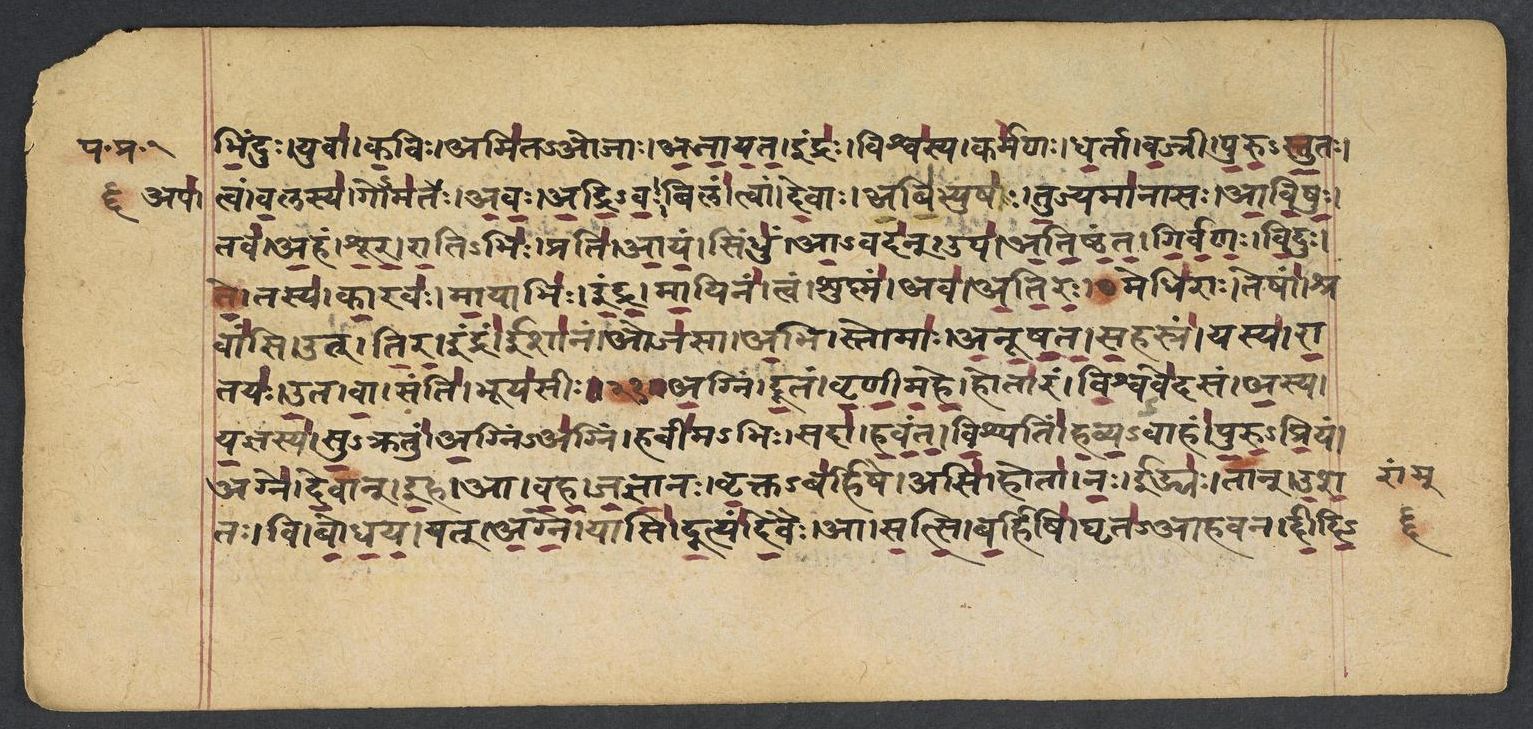
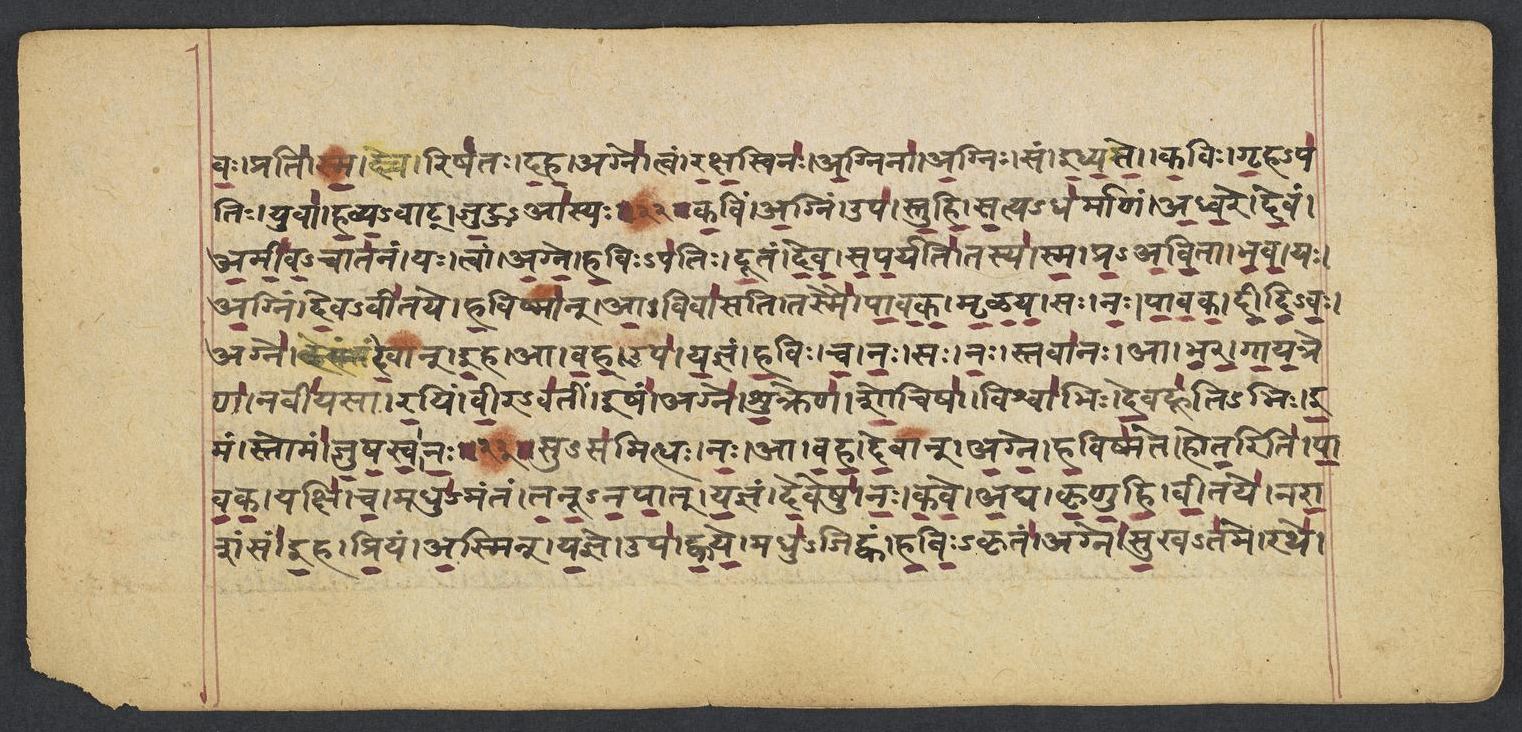
The manuscript shown is Penn Ms. Coll. 390 Item 41 (University of Pennsylvania), an undated paper manuscript of the padapāṭha (the word-by-word recitation text, in which every word is written separately and compounds are split) of the whole Ṛgveda in Devanāgarī, 884 leaves in fascicles, 7-9 lines to the page, accents in red; this hymn stands on fol. 6v-7r. Each section below gives the verses that end on one page; the page boundaries were read on the images (the opening words of every page), not counted out. Where the manuscript is a padapāṭha (the word-by-word recitation text), the section shows Aufrecht's continuous (saṃhitā) text first and, as the edition text, the padapāṭha of the same verses, which is the form written on the page.
How was this verified? (Provenance)
Where on the image
Penn Ms. Coll. 390 Item 41, fol. 6v (OPenn image 8, upper leaf). Checked on the image: the Rigveda text on this page begins in RV 1.11.4 ‹bhinduḥ yuvā kaviḥ amita-ojāḥ›. The next page with Rigveda text, fol. 7r, begins in RV 1.12.5 ‹-dīdi-vaḥ prati sma riṣataḥ›. Verses 1.12.1-4 end on this page.
1a̱gniṁ dū̱taṁ vṛ̍ṇīmahe̱ hotā̍raṁ vi̱śvave̍dasam | a̱sya ya̱jñasya̍ su̱kratu̍m ||
2a̱gnim-a̍gni̱ṁ havī̍mabhi̱ḥ sadā̍ havanta vi̱śpati̍m | ha̱vya̱vāha̍m purupri̱yam ||
3agne̍ de̱vām̐ i̱hā va̍ha jajñā̱no vṛ̱ktaba̍rhiṣe | asi̱ hotā̍ na̱ īḍya̍ḥ ||
4tām̐ u̍śa̱to vi bo̍dhaya̱ yad a̍gne̱ yāsi̍ dū̱tya̍m | de̱vair ā sa̍tsi ba̱rhiṣi̍ ||
Compare: Padapāṭha (word-by-word text written in the manuscript; Sansknet e-text via GRETIL)
1agnim | dūtam | vṛṇīmahe | hotāram | viśva-vedasam | asya | yajñasya | su-kratum
2agnim-agnim | havīma-bhiḥ | sadā | havanta | viśpatim | havya-vāham | puru-priyam
3agne | devān | iha | ā | vaha | jajñānaḥ | vṛkta-barhiṣe | asi | hotā | naḥ | īḍyaḥ
4tān | uśataḥ | vi | bodhaya | yat | agne | yāsi | dūtyam | devaiḥ | ā | satsi | barhiṣi
1WE choose Agni the messenger, the herald, master of all wealth, Well skilled in this our sacrifice.
2With callings ever they invoke Agni, Agni, Lord of the House, Oblation-bearer, much beloved.
3Bring the Gods hither, Agni, born for him who strews the sacred grass: Thou art our herald, meet for praise.
4Wake up the willing Gods, since thou, Agni, performest embassage: Sit on the sacred grass with Gods.
Where on the image
Penn Ms. Coll. 390 Item 41, fol. 7r (OPenn image 8, lower leaf). Checked on the image: the Rigveda text on this page begins in RV 1.12.5 ‹-dīdi-vaḥ prati sma riṣataḥ›. The next page with Rigveda text, fol. 7v, begins in RV 1.13.4 ‹devān iḷitaḥ ā vaha›. Verses 1.12.5-12 end on this page; 1.12.5 begins on fol. 6v.
5ghṛtā̍havana dīdiva̱ḥ prati̍ ṣma̱ riṣa̍to daha | agne̱ tvaṁ ra̍kṣa̱svina̍ḥ ||
6a̱gninā̱gniḥ sam i̍dhyate ka̱vir gṛ̱hapa̍ti̱r yuvā̍ | ha̱vya̱vāḍ ju̱hvā̍syaḥ ||
7ka̱vim a̱gnim upa̍ stuhi sa̱tyadha̍rmāṇam adhva̱re | de̱vam a̍mīva̱cāta̍nam ||
8yas tvām a̍gne ha̱viṣpa̍tir dū̱taṁ de̍va sapa̱ryati̍ | tasya̍ sma prāvi̱tā bha̍va ||
9yo a̱gniṁ de̱vavī̍taye ha̱viṣmā̍m̐ ā̱vivā̍sati | tasmai̍ pāvaka mṛḻaya ||
10sa na̍ḥ pāvaka dīdi̱vo 'gne̍ de̱vām̐ i̱hā va̍ha | upa̍ ya̱jñaṁ ha̱viś ca̍ naḥ ||
11sa na̱ḥ stavā̍na̱ ā bha̍ra gāya̱treṇa̱ navī̍yasā | ra̱yiṁ vī̱rava̍tī̱m iṣa̍m ||
12agne̍ śu̱kreṇa̍ śo̱ciṣā̱ viśvā̍bhir de̱vahū̍tibhiḥ | i̱maṁ stoma̍ṁ juṣasva naḥ ||
Compare: Padapāṭha (word-by-word text written in the manuscript; Sansknet e-text via GRETIL)
5ghṛta-āhavana | dīdi-vaḥ | prati | sma | riṣataḥ | daha | agne | tvam | rakṣasvinaḥ
6agninā | agniḥ | sam | idhyate | kaviḥ | gṛha-patiḥ | yuvā | havya-vāṭ | juhu-āsyaḥ
7kavim | agnim | upa | stuhi | satya-dharmāṇam | adhvare | devam | amīva-cātanam
8yaḥ | tvām | agne | haviḥ-patiḥ | dūtam | deva | saparyati | tasya | sma | pra-avitā | bhava
9yaḥ | agnim | deva-vītaye | haviṣmān | āvivāsati | tasmai | pāvaka | mṛḷaya
10saḥ | naḥ | pāvaka | dīdi-vaḥ | agne | devān | iha | ā | vaha | upa | yajñam | haviḥ | ca | naḥ
11saḥ | naḥ | stavānaḥ | ā | bhara | gāyatreṇa | navīyasā | rayim | vīra-vatīm | iṣam
12agne | śukreṇa | śociṣā | viśvābhiḥ | devahūti-bhiḥ | imam | stomam | juṣasva | naḥ
5O Agni, radiant One, to whom the holy oil is poured, bum up Our enemies whom fiends protect.
6By Agni Agni is inflamed, Lord of the House, wise, young, who bears The gift: the ladle is his mouth.
7Praise Agni in the sacrifice, the Sage whose ways are ever true, The God who driveth grief away.
8God, Agni, be his strong defence who lord of sacrificial gifts, Worshippeth thee the messenger.
9Whoso with sacred gift would fain call Agni to the feast of Gods, O Purifier, favour him.
10Such, Agni, Purifier, bright, bring hither to our sacrifice, To our oblation bring the Gods.
11So lauded by our newest song of praise bring opulence to us, And food, with heroes for our sons.
12O Agni, by effulgent flame, by all invokings of the Gods, Show pleasure in this laud of ours.
Notes
- Sanskrit: Aufrecht's edition (1877) with the Vedic accents, as entered by van Nooten and Holland (GRETIL).
- English: Ralph T. H. Griffith, The Hymns of the Rigveda (1889-1892; 2nd ed. 1896-1897), from the VedaWeb digital text; OCR slips in that text were corrected against the printed 2nd edition (data/sources/rigveda/griffith_errata.json).
- Padapāṭha (edition text): Sansknet e-text via GRETIL (CC BY-NC-SA 4.0).
Cite
Sources
- Source: Penn Ms. Coll. 390 Item 41 (undated (catalogued with Penn's 18th-19th c. Vedic manuscripts)), OPenn, Public Domain Mark + Aufrecht's accented text (GRETIL) + Griffith's English (VedaWeb) (holding institution)
- Critical edition: Aufrecht (1877), accented e-text via GRETIL
← previous · → next · v cycle view · l back to library