Rigveda 1.138: To Pusan
Introduction
Rigveda 1.138 is a hymn of 4 verses addressed to Pusan. It stands in book (maṇḍala) 1, a collection of hymns by many families of poets. The Rigveda is the oldest collection of Sanskrit hymns, composed in the second half of the second millennium BCE and handed down orally for many centuries before it was written down.
The manuscript shown is Penn Ms. Coll. 390 Item 41 (University of Pennsylvania), an undated paper manuscript of the padapāṭha (the word-by-word recitation text, in which every word is written separately and compounds are split) of the whole Ṛgveda in Devanāgarī, 884 leaves in fascicles, 7-9 lines to the page, accents in red; this hymn stands on fol. 107r-107v. Each section below gives the verses that end on one page; the page boundaries were read on the images (the opening words of every page), not counted out. Where the manuscript is a padapāṭha (the word-by-word recitation text), the section shows Aufrecht's continuous (saṃhitā) text first and, as the edition text, the padapāṭha of the same verses, which is the form written on the page.
How was this verified? (Provenance)
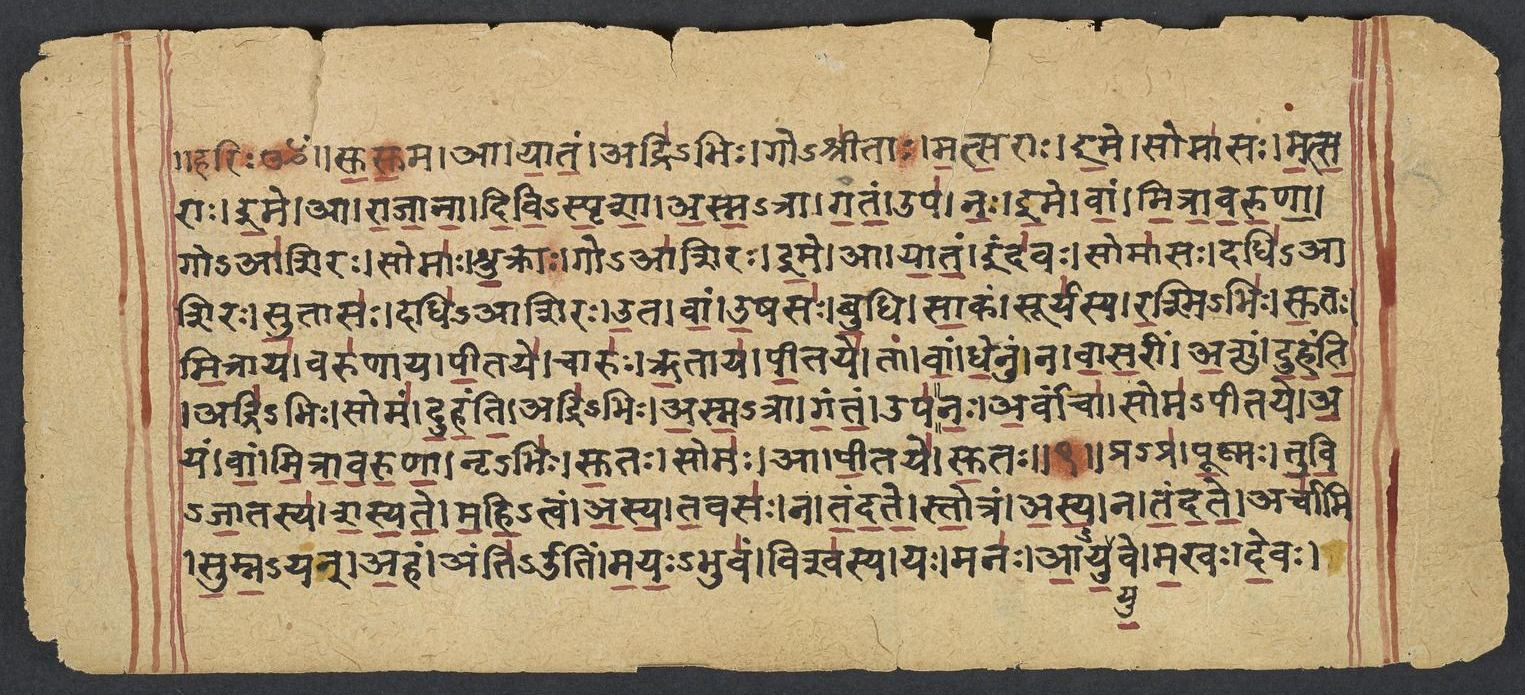
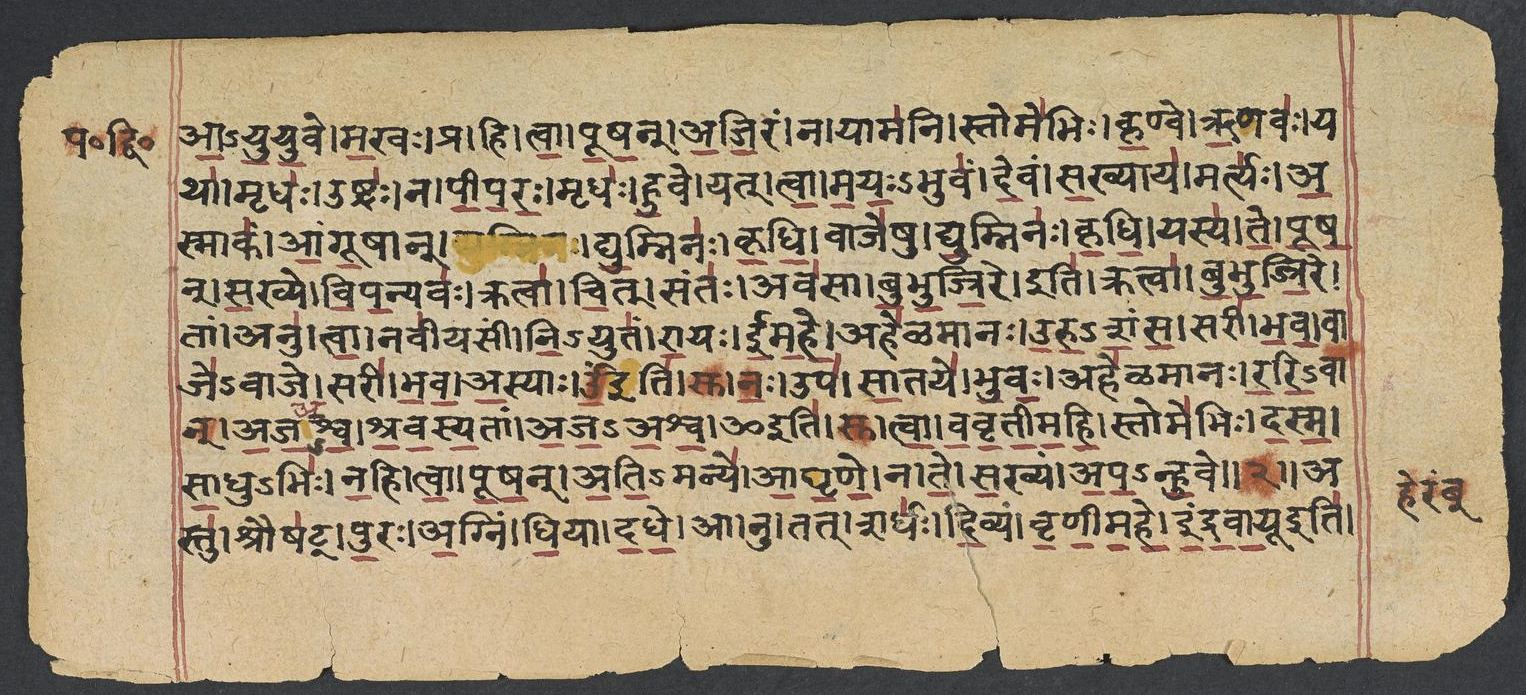
Where on the image
Penn Ms. Coll. 390 Item 41, fol. 107v (numbered 1v by the scribe) (OPenn image 109, upper leaf). Checked on the image: the Rigveda text on this page begins in RV 1.138.1 ‹āyuyuve makhaḥ›. The next page with Rigveda text, fol. 108r (numbered 2r by the scribe), begins in RV 1.139.1 ‹vṛṇīmahe yat ha krāṇā›. Verses 1.138.1-4 end on this page; 1.138.1 begins on fol. 107r (numbered 1r by the scribe).
1pra-pra̍ pū̱ṣṇas tu̍vijā̱tasya̍ śasyate mahi̱tvam a̍sya ta̱vaso̱ na ta̍ndate sto̱tram a̍sya̱ na ta̍ndate | arcā̍mi sumna̱yann a̱ham antyū̍tim mayo̱bhuva̍m | viśva̍sya̱ yo mana̍ āyuyu̱ve ma̱kho de̱va ā̍yuyu̱ve ma̱khaḥ ||
2pra hi tvā̍ pūṣann aji̱raṁ na yāma̍ni̱ stome̍bhiḥ kṛ̱ṇva ṛ̱ṇavo̱ yathā̱ mṛdha̱ uṣṭro̱ na pī̍paro̱ mṛdha̍ḥ | hu̱ve yat tvā̍ mayo̱bhuva̍ṁ de̱vaṁ sa̱khyāya̱ martya̍ḥ | a̱smāka̍m āṅgū̱ṣān dyu̱mnina̍s kṛdhi̱ vāje̍ṣu dyu̱mnina̍s kṛdhi ||
3yasya̍ te pūṣan sa̱khye vi̍pa̱nyava̱ḥ kratvā̍ ci̱t santo 'va̍sā bubhujri̱ra iti̱ kratvā̍ bubhujri̱re | tām anu̍ tvā̱ navī̍yasīṁ ni̱yuta̍ṁ rā̱ya ī̍mahe | ahe̍ḻamāna uruśaṁsa̱ sarī̍ bhava̱ vāje̍-vāje̱ sarī̍ bhava ||
4a̱syā ū̱ ṣu ṇa̱ upa̍ sā̱taye̍ bhu̱vo 'he̍ḻamāno rari̱vām̐ a̍jāśva śravasya̱tām a̍jāśva | o ṣu tvā̍ vavṛtīmahi̱ stome̍bhir dasma sā̱dhubhi̍ḥ | na̱hi tvā̍ pūṣann ati̱manya̍ āghṛṇe̱ na te̍ sa̱khyam a̍pahnu̱ve ||
Compare: Padapāṭha (word-by-word text written in the manuscript; Sansknet e-text via GRETIL)
1pra-pra | pūṣṇaḥ | tuvi-jātasya | śasyate | mahi-tvam | asya | tavasaḥ | na | tandate | stotram | asya | na | tandate | arcāmi | sumna-yan | aham | anti-ūtim | mayaḥ-bhuvam | viśvasya | yaḥ | manaḥ | āyuyuve | makhaḥ | devaḥ | āyuyuve | makhaḥ
2pra | hi | tvā | pūṣan | ajiram | na | yāmani | stomebhiḥ | kṛṇve | ṛṇavaḥ | yathā | mṛdhaḥ | uṣṭraḥ | na | pīparaḥ | mṛdhaḥ | huve | yat | tvā | mayaḥ-bhuvam | devam | sakhyāya | martyaḥ | asmākam | āṅgūṣām | dyumninaḥ | kṛdhi | vājeṣu | dyumninaḥ | kṛdhi
3yasya | te | pūṣan | sakhye | vipanyavaḥ | kratvā | cit | santaḥ | avasā | bubhujr ire | iti | kratvā | bubhujrire | tām | anu | tvā | navīyasīm | ni-yutam | rāyaḥ | īmahe | aheḷamānaḥ | uru-śaṃsa | sarī | bhava | vāje--vāje | sarī | bhava
4asyāḥ | oṃ iti | su | naḥ | upa | sātaye | bhuvaḥ | aheḷamānaḥ | rari-vān | aja-aśva | śravasyatām | aja-aśva | o iti | su | tvā | vavṛtīmahi | stome--bhiḥ | dasma | sādhu-bhiḥ | nahi | tvā | pūṣan | ati-manye | āghṛṇe | na | te | sakhyam | apa-hnute
1STRONG Pûshan's majesty is lauded evermore, the glory of his lordly might is never faint, his song of praise is never faint. Seeking felicity I laud him nigh to help, the source, of bliss, Who, Vigorous one, hath drawn to him the hearts of all, drawn them, the Vigorous One, the God.
2Thee, then, O Pûshan, like a swift one on his way, I urge with lauds that thou mayst make the foemen flee, drive, camel-like, our foes afar. As I, a man, call thee, a God, giver of bliss, to be my Friend, So make our loudly-chanted praises glorious, in battles make them glorious.
3Thou, Pûshan, in whose friendship they who sing forth praise enjoy advantage, even in wisdom, through thy grace, in wisdom even they are advanced. So, after this most recent course, we come to thee with prayers for wealth. Not stirred to anger, O Wide-Ruler, come to us, come thou to us in every fight.
4Not stirred to anger, come, Free-giver, nigh to us, to take this gift of ours, thou who hast goats for steeds, Goat-borne! their gift who long for fame. So, Wonder-Worker! may we turn thee hither with effectual lauds. I slight thee not, O Pûshan, thou Resplendent One: thy friendship may not be despised.
Notes
- Sanskrit: Aufrecht's edition (1877) with the Vedic accents, as entered by van Nooten and Holland (GRETIL).
- English: Ralph T. H. Griffith, The Hymns of the Rigveda (1889-1892; 2nd ed. 1896-1897), from the VedaWeb digital text; OCR slips in that text were corrected against the printed 2nd edition (data/sources/rigveda/griffith_errata.json).
- Padapāṭha (edition text): Sansknet e-text via GRETIL (CC BY-NC-SA 4.0).
Cite
Sources
- Source: Penn Ms. Coll. 390 Item 41 (undated (catalogued with Penn's 18th-19th c. Vedic manuscripts)), OPenn, Public Domain Mark + Aufrecht's accented text (GRETIL) + Griffith's English (VedaWeb) (holding institution)
- Critical edition: Aufrecht (1877), accented e-text via GRETIL
← previous · → next · v cycle view · l back to library