Rigveda 1.154: The three strides of Vishnu
Introduction
Rigveda 1.154 is a hymn of 6 verses addressed to Vishnu. It stands in book (maṇḍala) 1, a collection of hymns by many families of poets. The Rigveda is the oldest collection of Sanskrit hymns, composed in the second half of the second millennium BCE and handed down orally for many centuries before it was written down.
The manuscript shown is Penn Ms. Coll. 390 Item 41 (University of Pennsylvania), an undated paper manuscript of the padapāṭha (the word-by-word recitation text, in which every word is written separately and compounds are split) of the whole Ṛgveda in Devanāgarī, 884 leaves in fascicles, 7-9 lines to the page, accents in red; this hymn stands on fol. 117v-118v. Each section below gives the verses that end on one page; the page boundaries were read on the images (the opening words of every page), not counted out. Where the manuscript is a padapāṭha (the word-by-word recitation text), the section shows Aufrecht's continuous (saṃhitā) text first and, as the edition text, the padapāṭha of the same verses, which is the form written on the page.
How was this verified? (Provenance)
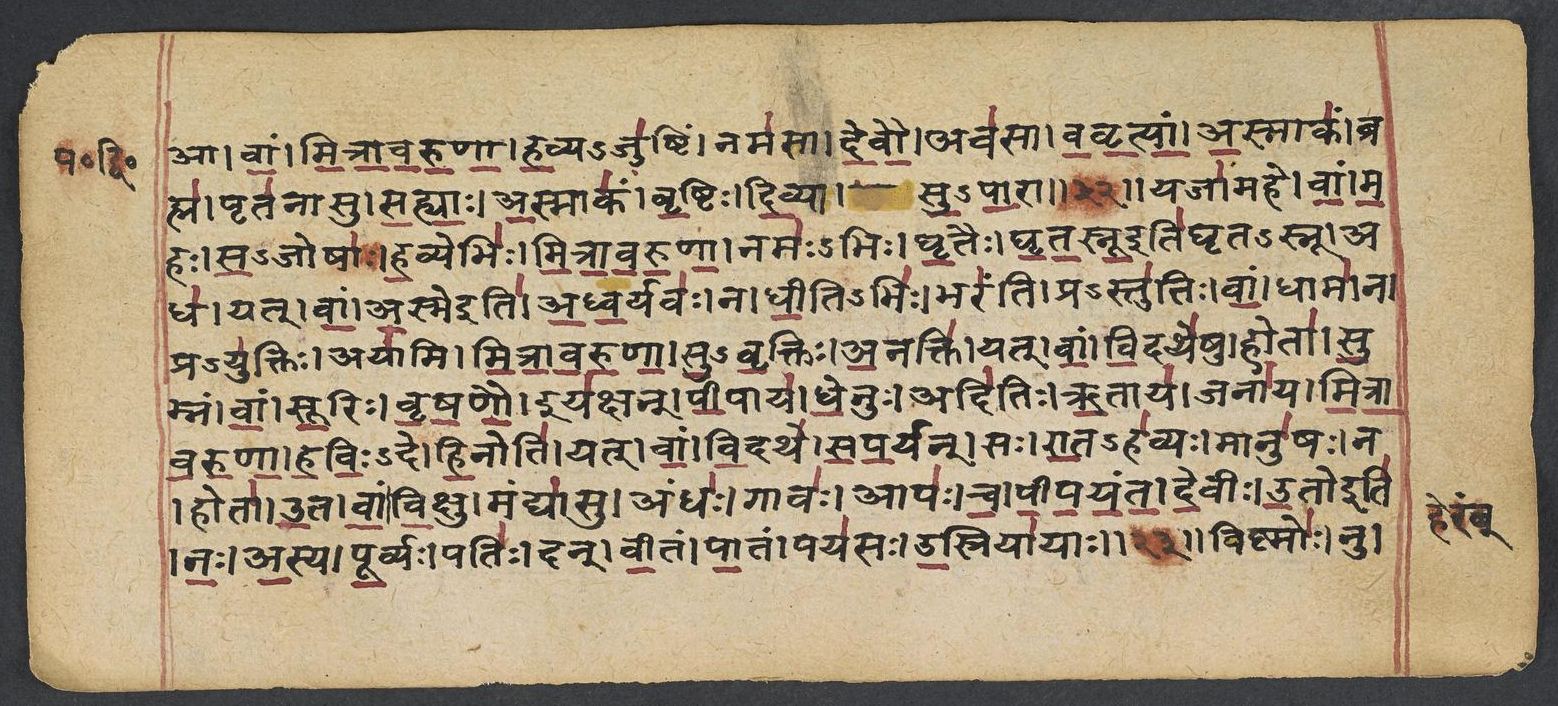
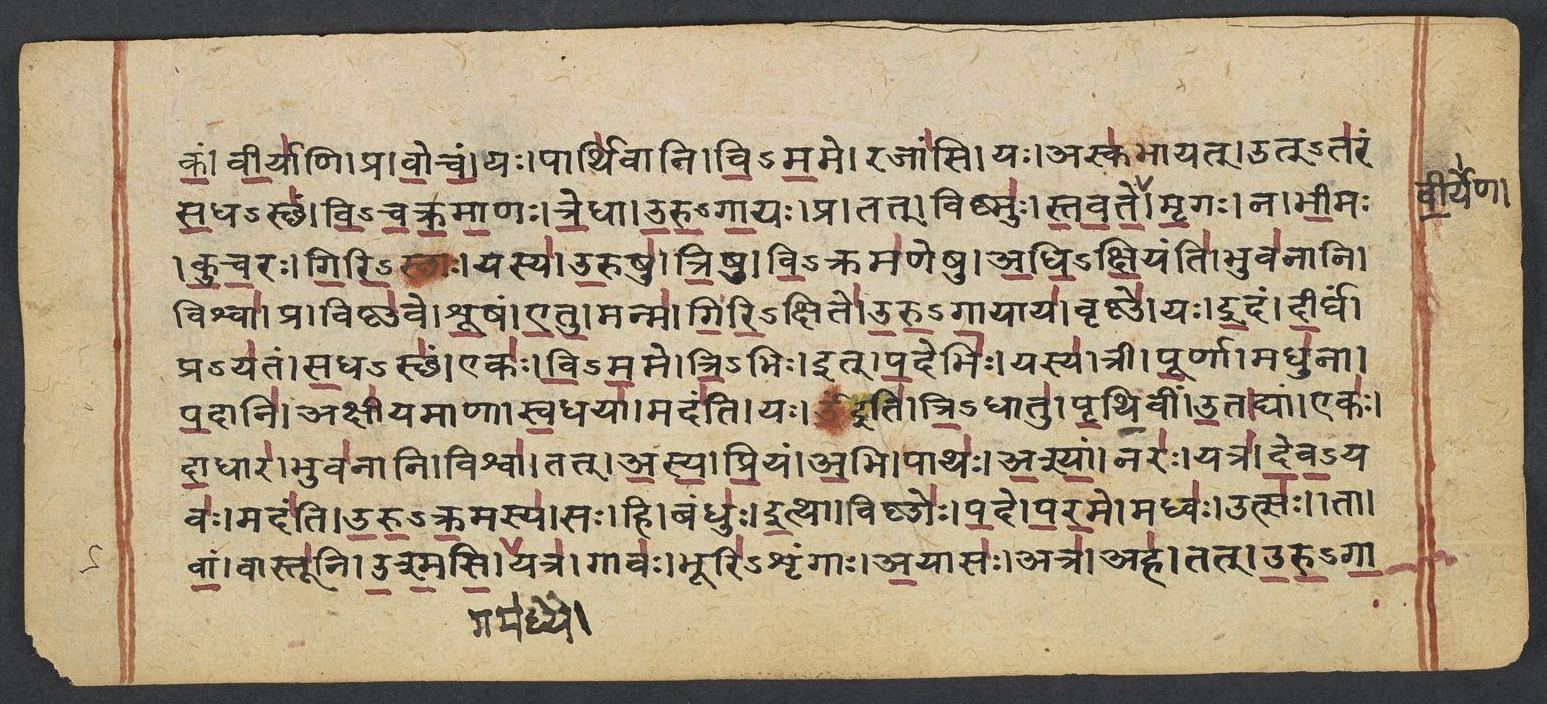
Where on the image
Penn Ms. Coll. 390 Item 41, fol. 118r (numbered 12r by the scribe) (OPenn image 119, lower leaf). Checked on the image: the Rigveda text on this page begins in RV 1.154.1 ‹kam vīryāṇi pra vocam›. The next page with Rigveda text, fol. 118v (numbered 12v by the scribe), begins in RV 1.154.6 ‹-uru-gāyasya vṛṣṇaḥ paramam padam›. Verses 1.154.1-5 end on this page; 1.154.1 begins on fol. 117v (numbered 11v by the scribe).
1viṣṇo̱r nu ka̍ṁ vī̱ryā̍ṇi̱ pra vo̍ca̱ṁ yaḥ pārthi̍vāni vima̱me rajā̍ṁsi | yo aska̍bhāya̱d utta̍raṁ sa̱dhastha̍ṁ vicakramā̱ṇas tre̱dhoru̍gā̱yaḥ ||
2pra tad viṣṇu̍ḥ stavate vī̱rye̍ṇa mṛ̱go na bhī̱maḥ ku̍ca̱ro gi̍ri̱ṣṭhāḥ | yasyo̱ruṣu̍ tri̱ṣu vi̱krama̍ṇeṣv adhikṣi̱yanti̱ bhuva̍nāni̱ viśvā̍ ||
3pra viṣṇa̍ve śū̱ṣam e̍tu̱ manma̍ giri̱kṣita̍ urugā̱yāya̱ vṛṣṇe̍ | ya i̱daṁ dī̱rgham praya̍taṁ sa̱dhastha̱m eko̍ vima̱me tri̱bhir it pa̱debhi̍ḥ ||
4yasya̱ trī pū̱rṇā madhu̍nā pa̱dāny akṣī̍yamāṇā sva̱dhayā̱ mada̍nti | ya u̍ tri̱dhātu̍ pṛthi̱vīm u̱ta dyām eko̍ dā̱dhāra̱ bhuva̍nāni̱ viśvā̍ ||
5tad a̍sya pri̱yam a̱bhi pātho̍ aśyā̱ṁ naro̱ yatra̍ deva̱yavo̱ mada̍nti | u̱ru̱kra̱masya̱ sa hi bandhu̍r i̱tthā viṣṇo̍ḥ pa̱de pa̍ra̱me madhva̱ utsa̍ḥ ||
Compare: Padapāṭha (word-by-word text written in the manuscript; Sansknet e-text via GRETIL)
1viṣṇoḥ | nu | kam | vīryāṇi | pra | vocam | yaḥ | pārthivāni | vi-mame | rajāṃsi | yaḥ | askabhāyat | ut-taram | sadha-stham | vi-cakramāṇaḥ | tredhā | ūru-gāyaḥ
2pra | tat | viṣṇuḥ | stavate | vīryeṇa | mṛgaḥ | na | bhīmaḥ | kucaraḥ | giri-sthāḥ | yasya | uruṣu | triṣu | vi-kramaṇeṣu | adhi-kṣiyanti | bhuvanāni | viśvā
3pra | viṣṇave | śūṣam | etu | manma | giri-kṣite | uru-gāyāya | vṛṣṇe | yaḥ | idam | dīrgham | pra-yatam | sadha-stham | ekaḥ | vi-mame | tri-bhiḥ | it | pade--bhiḥ
4yasya | trī | pūrṇā | madhunā | padāni | akṣīyamāṇā | svadhayā | madanti | yaḥ | oṃ iti | tri-dhātu | pṛthivīm | uta | dyām | ekaḥ | dādhāra | bhuvanāni | viśvā
5tat | asya | priyam | abhi | pāthaḥ | aśyām | naraḥ | yatra | devayavaḥ | madanti | uru-kramasya | saḥ | hi | bandhuḥ | itthā | viṣṇoḥ | pade | parame | madhvaḥ | utsaḥ
1I WILL declare the mighty deeds of Vishṇu, of him who measured out the earthly regions, Who propped the highest place of congregation, thrice setting down his footstep, widely striding.
2For this his mighty deed is Vishṇu lauded, like some wild beast, dread, prowling, mountain-roaming; He within whose three wide-extended paces all living creatures have their habitation.
3Let the hymn lift itself as strength to Vishṇu, the Bull far-striding, dwelling on the mountains, Him who alone with triple step hath measured this common dwelling-place, long, far extended.
4Him whose three places that are filled with sweetness, imperishable, joy as it may list them, Who verily alone upholds the threefold, the earth, the heaven, and all living creatures.
5May I attain to that his well-loved mansion where men devoted to the Gods are happy. For there springs, close akin to the Wide-Strider, the well of meath in Vishṇu's highest footstep.
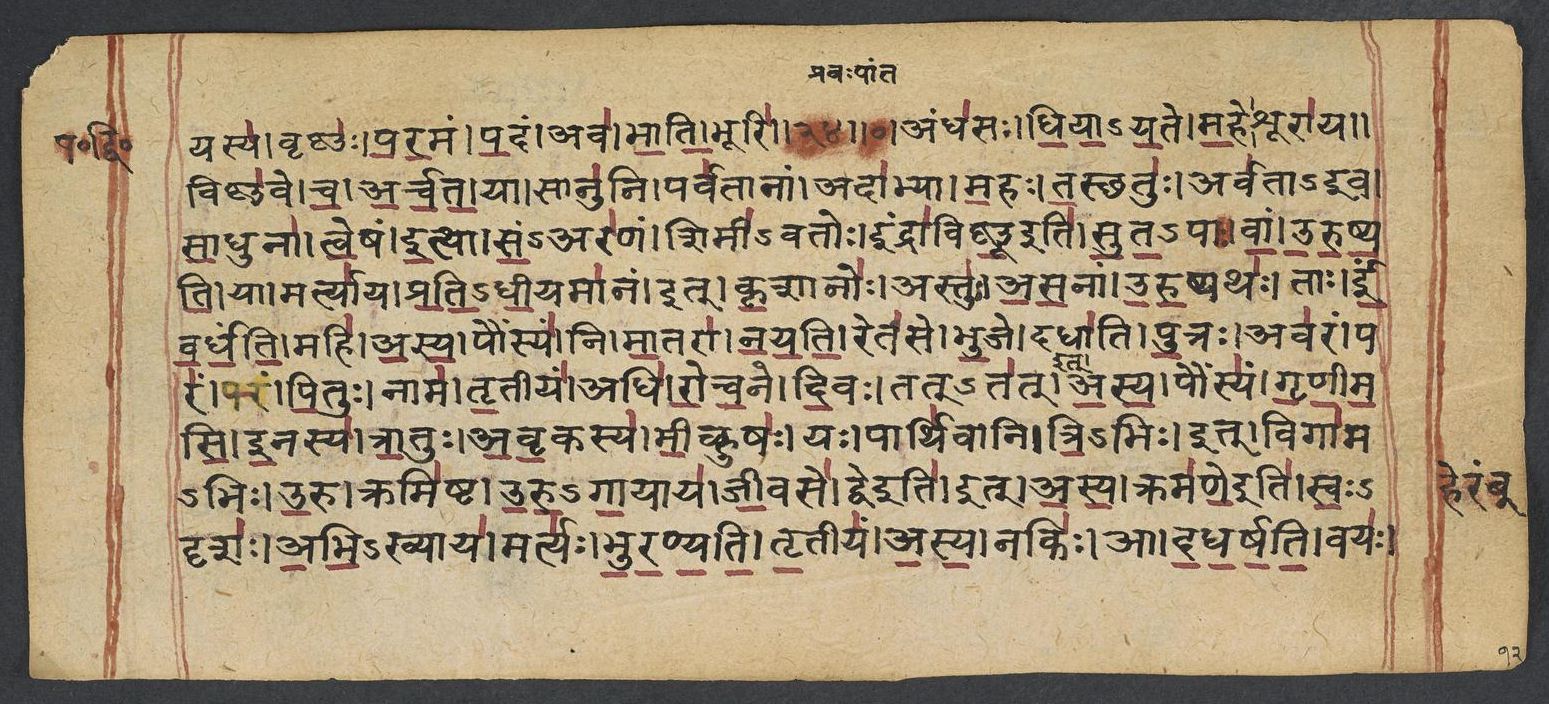
Where on the image
Penn Ms. Coll. 390 Item 41, fol. 118v (numbered 12v by the scribe) (OPenn image 120, upper leaf). Checked on the image: the Rigveda text on this page begins in RV 1.154.6 ‹-uru-gāyasya vṛṣṇaḥ paramam padam›. The next page with Rigveda text, fol. 119r (numbered 13r by the scribe), begins in RV 1.155.5 ‹cana patayantaḥ patatriṇaḥ›. Verse 1.154.6 ends on this page; 1.154.6 begins on fol. 118r (numbered 12r by the scribe).
6tā vā̱ṁ vāstū̍ny uśmasi̱ gama̍dhyai̱ yatra̱ gāvo̱ bhūri̍śṛṅgā a̱yāsa̍ḥ | atrāha̱ tad u̍rugā̱yasya̱ vṛṣṇa̍ḥ para̱mam pa̱dam ava̍ bhāti̱ bhūri̍ ||
Compare: Padapāṭha (word-by-word text written in the manuscript; Sansknet e-text via GRETIL)
6tā | vām | vāstūni | uśmasi | gamadhyai | yatra | gāvaḥ | bhūri-śṛṅgāḥ | ayāsaḥ | atra | aha | tat | uru-gāyasya | vṛṣṇaḥ | paramam | padam | ava | bhāti | bhūri
6Fain would we go unto your dwelling-places where there are many-horned and nimble oxen, For mightily, there, shineth down upon us the widely-striding Bull's sublimest mansion.
Notes
- Sanskrit: Aufrecht's edition (1877) with the Vedic accents, as entered by van Nooten and Holland (GRETIL).
- English: Ralph T. H. Griffith, The Hymns of the Rigveda (1889-1892; 2nd ed. 1896-1897), from the VedaWeb digital text; OCR slips in that text were corrected against the printed 2nd edition (data/sources/rigveda/griffith_errata.json).
- Padapāṭha (edition text): Sansknet e-text via GRETIL (CC BY-NC-SA 4.0).
Cite
Sources
- Source: Penn Ms. Coll. 390 Item 41 (undated (catalogued with Penn's 18th-19th c. Vedic manuscripts)), OPenn, Public Domain Mark + Aufrecht's accented text (GRETIL) + Griffith's English (VedaWeb) (holding institution)
- Critical edition: Aufrecht (1877), accented e-text via GRETIL
← previous · → next · v cycle view · l back to library