Rigveda 1.18: To Brahmanaspati and Sadasaspati
Introduction
Rigveda 1.18 is a hymn of 9 verses addressed to Brahmanaspati and Sadasaspati. It stands in book (maṇḍala) 1, a collection of hymns by many families of poets. The Rigveda is the oldest collection of Sanskrit hymns, composed in the second half of the second millennium BCE and handed down orally for many centuries before it was written down.
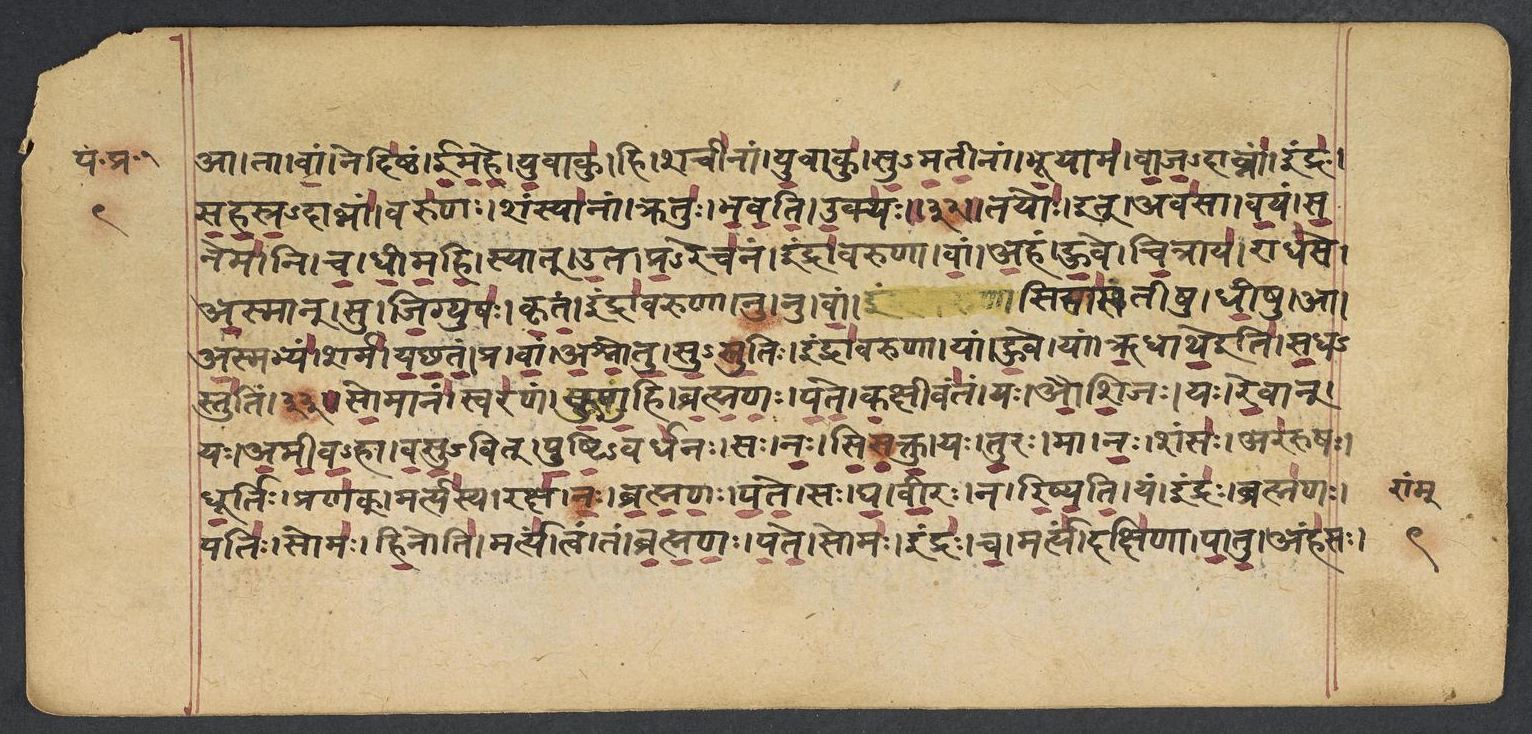
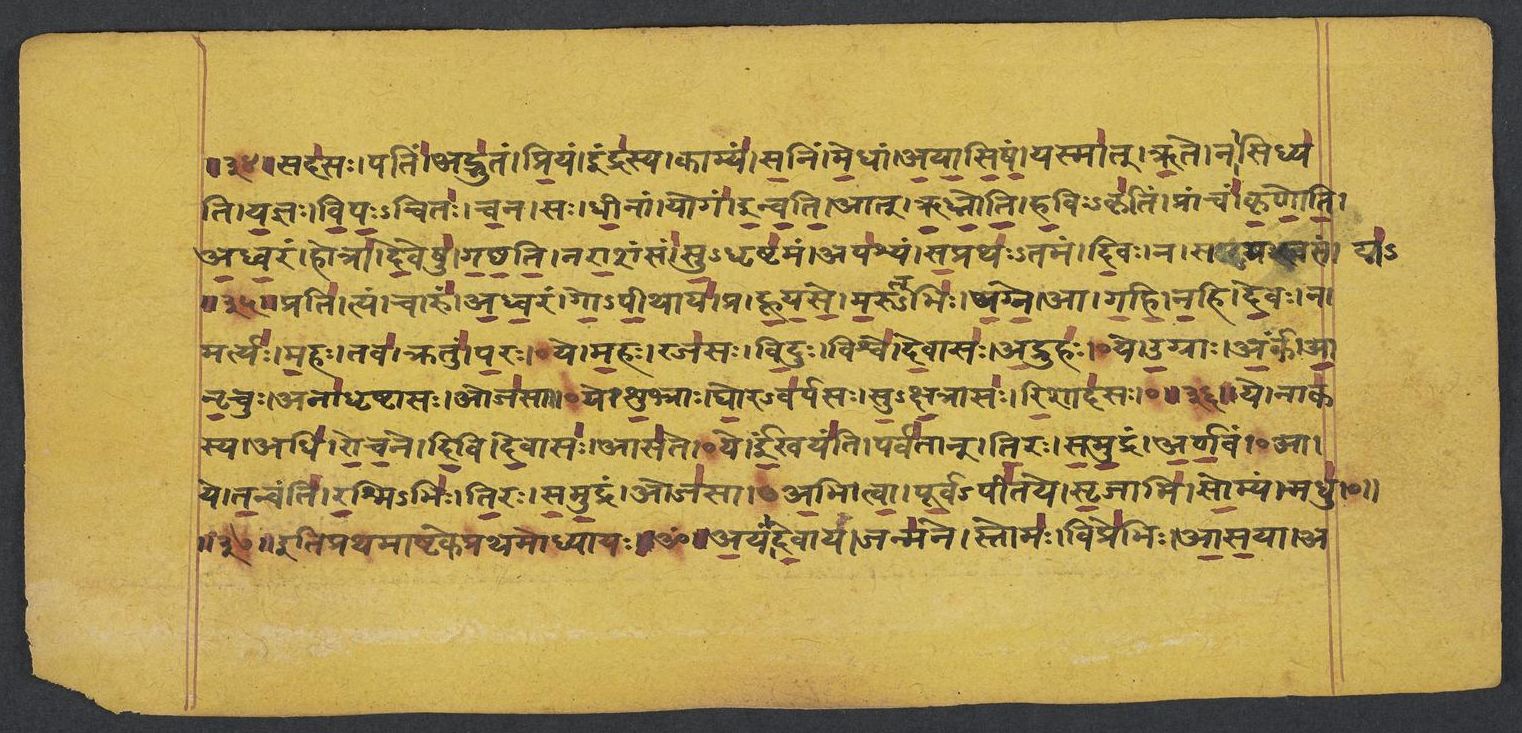
The manuscript shown is Penn Ms. Coll. 390 Item 41 (University of Pennsylvania), an undated paper manuscript of the padapāṭha (the word-by-word recitation text, in which every word is written separately and compounds are split) of the whole Ṛgveda in Devanāgarī, 884 leaves in fascicles, 7-9 lines to the page, accents in red; this hymn stands on fol. 9v-10r. Each section below gives the verses that end on one page; the page boundaries were read on the images (the opening words of every page), not counted out. Where the manuscript is a padapāṭha (the word-by-word recitation text), the section shows Aufrecht's continuous (saṃhitā) text first and, as the edition text, the padapāṭha of the same verses, which is the form written on the page.
How was this verified? (Provenance)
Where on the image
Penn Ms. Coll. 390 Item 41, fol. 9v (OPenn image 11, upper leaf). Checked on the image: the Rigveda text on this page begins in RV 1.17.3 ‹ā tā vām nediṣṭham›. The next page with Rigveda text, fol. 10r, begins in RV 1.18.6 ‹sadasaḥ patim adbhutam priyam›. Verses 1.18.1-5 end on this page.
1so̱māna̱ṁ svara̍ṇaṁ kṛṇu̱hi bra̍hmaṇas pate | ka̱kṣīva̍nta̱ṁ ya au̍śi̱jaḥ ||
2yo re̱vān yo a̍mīva̱hā va̍su̱vit pu̍ṣṭi̱vardha̍naḥ | sa na̍ḥ siṣaktu̱ yas tu̱raḥ ||
3mā na̱ḥ śaṁso̱ ara̍ruṣo dhū̱rtiḥ praṇa̱ṅ martya̍sya | rakṣā̍ ṇo brahmaṇas pate ||
4sa ghā̍ vī̱ro na ri̍ṣyati̱ yam indro̱ brahma̍ṇa̱s pati̍ḥ | somo̍ hi̱noti̱ martya̍m ||
5tvaṁ tam bra̍hmaṇas pate̱ soma̱ indra̍ś ca̱ martya̍m | dakṣi̍ṇā pā̱tv aṁha̍saḥ ||
Compare: Padapāṭha (word-by-word text written in the manuscript; Sansknet e-text via GRETIL)
1somānam | svaraṇam | kṛṇuhi | brahmaṇaḥ | pate | kakṣīvantam | yaḥ | auśijaḥ
2yaḥ | revān | yaḥ | amīva-hā | vasu-vit | puṣṭi-vardhanaḥ | saḥ | naḥ | sisaktu | yaḥ | turaḥ
3mā | naḥ | śaṃsaḥ | araruṣaḥ | dhūrtiḥ | praṇak | martyasya | rakṣa | naḥ | brahmaṇaḥ | pate
4saḥ | gha | vīraḥ | na | riṣyati | yam | indraḥ | brahmaṇaḥ | patiḥ | somaḥ | hinoti | martyam
5tvam | tam | brahmaṇaḥ | pate | somaḥ | indraḥ | ca | martyam | dakṣiṇā | pātu | aṃhasaḥ
1O BRAHMANAPSATI, make him who presses Soma glorious, Even Kakshîvân Auṣija.
2The rich, the healer of disease, who giveth wealth, increaseth store, The prompt,– may he be with us still.
3Let not the foeman's curse, let not a mortal's onslaught fall on us Preserve us, Brahmaṇaspati.
4Ne'er is the mortal hero harmed whom Indra, Brahmaṇaspati, And Soma graciously inspire.
5Do, thou, O Brahmaṇaspati, and Indra, Soma, Dakshina, Preserve that mortal from distress.
Where on the image
Penn Ms. Coll. 390 Item 41, fol. 10r (OPenn image 11, lower leaf). Checked on the image: the Rigveda text on this page begins in RV 1.18.6 ‹sadasaḥ patim adbhutam priyam›. The next page with Rigveda text, fol. 10v, begins in RV 1.20.1 ‹-akāri ratna-dhātamaḥ›. Verses 1.18.6-9 end on this page.
6sada̍sa̱s pati̱m adbhu̍tam pri̱yam indra̍sya̱ kāmya̍m | sa̱nim me̱dhām a̍yāsiṣam ||
7yasmā̍d ṛ̱te na sidhya̍ti ya̱jño vi̍pa̱ścita̍ś ca̱na | sa dhī̱nāṁ yoga̍m invati ||
8ād ṛ̍dhnoti ha̱viṣkṛ̍ti̱m prāñca̍ṁ kṛṇoty adhva̱ram | hotrā̍ de̱veṣu̍ gacchati ||
9narā̱śaṁsa̍ṁ su̱dhṛṣṭa̍ma̱m apa̍śyaṁ sa̱pratha̍stamam | di̱vo na sadma̍makhasam ||
Compare: Padapāṭha (word-by-word text written in the manuscript; Sansknet e-text via GRETIL)
6sadasaḥ | patim | adbhutam | priyam | indrasya | kāmyam | sanim | medhām | ayāsiṣam
7yasmāt | ṛte | na | sidhyati | yajñaḥ | vipaḥ-citaḥ | cana | saḥ | dhīnām | yogam | invati
8āt | ṛdhnoti | haviḥ-kṛtim | prāñcam | kṛṇoti | adhvaram | hotrā | deveṣu | gacchati
9narāśaṃsam | sudhṛṣṭamam | apaśyam | saprathaḥ-tamam | divaḥ | na | sadma-makhasam
6To the Assembly's wondrous Lord, to Indra's lovely Friend who gives Wisdom, have I drawn near in prayer.
7He without whom no sacrifice, e'en of the wise man, prospers; he Stirs up the series of thoughts.
8He makes the oblation prosper, he promotes the course of sacrifice: Our voice of praise goes to the Gods.
9I have seen Narâṣansa, him most resolute, most widely famed, As 'twere the Household Priest of heaven.
Notes
- Sanskrit: Aufrecht's edition (1877) with the Vedic accents, as entered by van Nooten and Holland (GRETIL).
- English: Ralph T. H. Griffith, The Hymns of the Rigveda (1889-1892; 2nd ed. 1896-1897), from the VedaWeb digital text; OCR slips in that text were corrected against the printed 2nd edition (data/sources/rigveda/griffith_errata.json).
- Padapāṭha (edition text): Sansknet e-text via GRETIL (CC BY-NC-SA 4.0).
Cite
Sources
- Source: Penn Ms. Coll. 390 Item 41 (undated (catalogued with Penn's 18th-19th c. Vedic manuscripts)), OPenn, Public Domain Mark + Aufrecht's accented text (GRETIL) + Griffith's English (VedaWeb) (holding institution)
- Critical edition: Aufrecht (1877), accented e-text via GRETIL
← previous · → next · v cycle view · l back to library