Rigveda 1.74: To Agni
Introduction
Rigveda 1.74 is a hymn of 9 verses addressed to Agni. It stands in book (maṇḍala) 1, a collection of hymns by many families of poets. The Rigveda is the oldest collection of Sanskrit hymns, composed in the second half of the second millennium BCE and handed down orally for many centuries before it was written down.
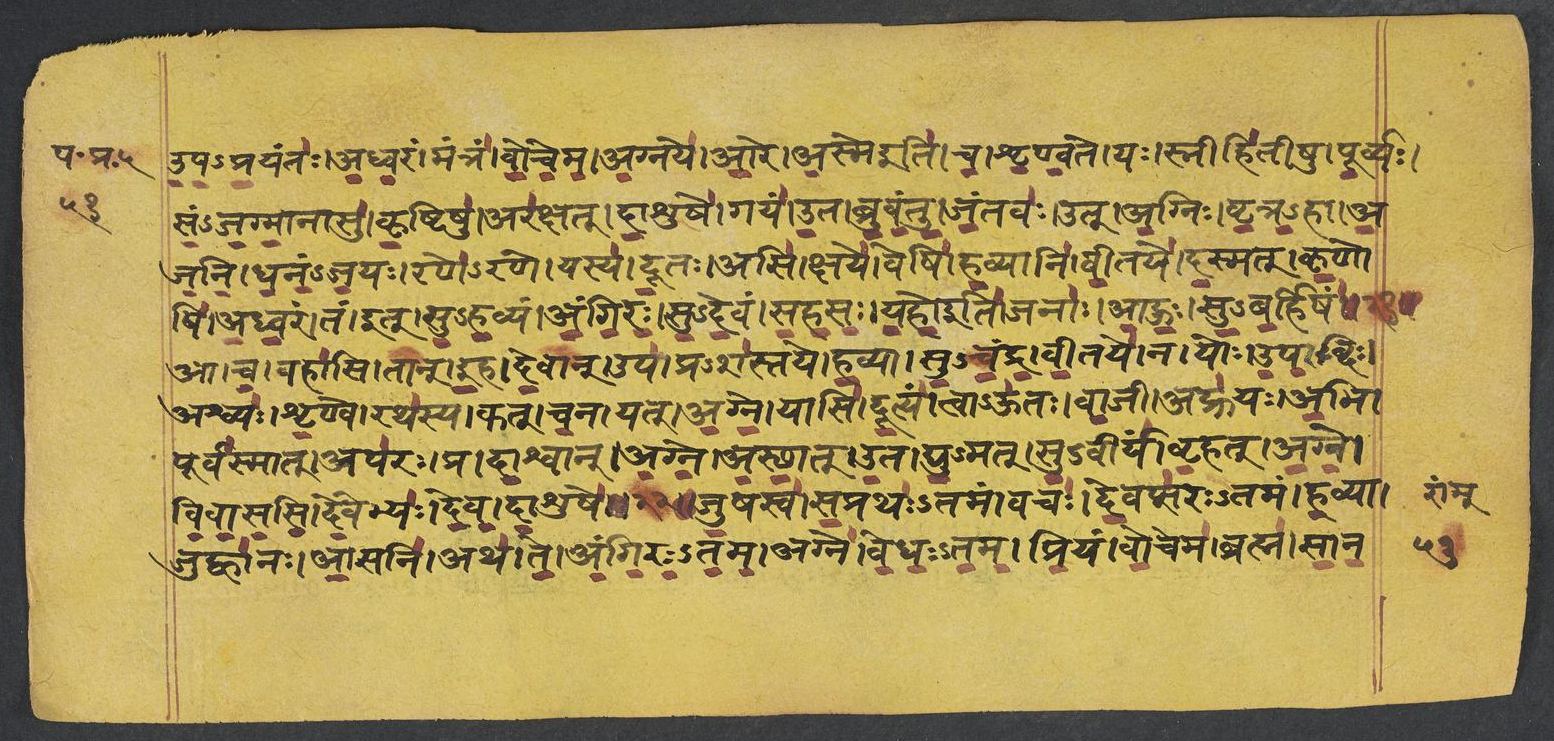
The manuscript shown is Penn Ms. Coll. 390 Item 41 (University of Pennsylvania), an undated paper manuscript of the padapāṭha (the word-by-word recitation text, in which every word is written separately and compounds are split) of the whole Ṛgveda in Devanāgarī, 884 leaves in fascicles, 7-9 lines to the page, accents in red; this hymn stands on fol. 51v. Each section below gives the verses that end on one page; the page boundaries were read on the images (the opening words of every page), not counted out. Where the manuscript is a padapāṭha (the word-by-word recitation text), the section shows Aufrecht's continuous (saṃhitā) text first and, as the edition text, the padapāṭha of the same verses, which is the form written on the page.
How was this verified? (Provenance)
Where on the image
Penn Ms. Coll. 390 Item 41, fol. 51v (OPenn image 53, upper leaf). Checked on the image: the Rigveda text on this page begins in RV 1.74.1 ‹upa-prayantaḥ adhvaram mantram vocema›. The next page with Rigveda text, fol. 52r, begins in RV 1.75.2 ‹-sānasi›. Verses 1.74.1-9 end on this page.
1u̱pa̱pra̱yanto̍ adhva̱ram mantra̍ṁ vocemā̱gnaye̍ | ā̱re a̱sme ca̍ śṛṇva̱te ||
2yaḥ snīhi̍tīṣu pū̱rvyaḥ sa̍ṁjagmā̱nāsu̍ kṛ̱ṣṭiṣu̍ | ara̍kṣad dā̱śuṣe̱ gaya̍m ||
3u̱ta bru̍vantu ja̱ntava̱ ud a̱gnir vṛ̍tra̱hāja̍ni | dha̱na̱ṁja̱yo raṇe̍-raṇe ||
4yasya̍ dū̱to asi̱ kṣaye̱ veṣi̍ ha̱vyāni̍ vī̱taye̍ | da̱smat kṛ̱ṇoṣy a̍dhva̱ram ||
5tam it su̍ha̱vyam a̍ṅgiraḥ sude̱vaṁ sa̍haso yaho | janā̍ āhuḥ suba̱rhiṣa̍m ||
6ā ca̱ vahā̍si̱ tām̐ i̱ha de̱vām̐ upa̱ praśa̍staye | ha̱vyā su̍ścandra vī̱taye̍ ||
7na yor u̍pa̱bdir aśvya̍ḥ śṛ̱ṇve ratha̍sya̱ kac ca̱na | yad a̍gne̱ yāsi̍ dū̱tya̍m ||
8tvoto̍ vā̱jy ahra̍yo̱ 'bhi pūrva̍smā̱d apa̍raḥ | pra dā̱śvām̐ a̍gne asthāt ||
9u̱ta dyu̱mat su̱vīrya̍m bṛ̱had a̍gne vivāsasi | de̱vebhyo̍ deva dā̱śuṣe̍ ||
Compare: Padapāṭha (word-by-word text written in the manuscript; Sansknet e-text via GRETIL)
1upa-prayantaḥ | adhvaram | mantram | vocema | agnaye | āre | asme iti | ca | śṛṇvate
2yaḥ | snīhitīṣu | pūrvyaḥ | sam-jagmānāsu | kṛṣṭiṣu | arakṣat | dāśuṣe | gayam
3uta | bruvantu | jantavaḥ | ut | agniḥ | vṛtra-hā | ajani | dhanam-jayaḥ | raṇe--raṇe
4yasya | dūtaḥ | asi | kṣaye | veṣi | havyāni | vītaye | dasmat | kṛṇoṣi | adhvaram
5tam | it | su-havyam | aṅgiraḥ | su-devam | sahasaḥ | yaho iti | janāḥ | āhuḥ | su-barhiṣam
6ā | ca | vahāsi | tān | iha | devān | upa | pra-śastaye | havyā | su-candra | vītaye
7na | yoḥ | upabdiḥ | aśvyaḥ | śṛṇve | rathasya | kat | cana | yat | agne | yāsi | dūtyam
8tvāūtaḥ | vājī | ahrayaḥ | abhi | pūrvasmāt | aparaḥ | pra | dāśvān | agne | asthāt
9uta | dyu-mat | su-vīryam | bṛhat | agne | vivāsasi | devebhyaḥ | deva | dāśuṣe
1As forth to sacrifice we go, a hymn to a hymn let us say, Who hears us even when afar;
2Who, from of old, in carnage, when the people gathered, hath preserved His household for the worshipper.
3And let men say, Agni is born, e'en he who slayeth Vr̥itra, he Who winneth wealth in every fight.
4Him in whose house an envoy thou lovest to taste his offered gifts, And strengthenest his sacrifice,
5Him, Angiras, thou Son of Strength, all men call happy in his God, His offerings, and his sacred grass.
6Hitherward shalt thou bring these Gods to our laudation and to taste. These offered gifts, fair-shining One.
7When, Agni, on thine embassage thou goest not a sound is heard of steed or straining of thy car.
8Aided by thee uninjured, strong, one after other, goes he forth: Agni, the offerer forward steps.
9And splendid strength, heroic, high, Agni, thou grantest from the Gods, Thou God, to him who offers gifts.
Notes
- Sanskrit: Aufrecht's edition (1877) with the Vedic accents, as entered by van Nooten and Holland (GRETIL).
- English: Ralph T. H. Griffith, The Hymns of the Rigveda (1889-1892; 2nd ed. 1896-1897), from the VedaWeb digital text; OCR slips in that text were corrected against the printed 2nd edition (data/sources/rigveda/griffith_errata.json).
- Padapāṭha (edition text): Sansknet e-text via GRETIL (CC BY-NC-SA 4.0).
Cite
Sources
- Source: Penn Ms. Coll. 390 Item 41 (undated (catalogued with Penn's 18th-19th c. Vedic manuscripts)), OPenn, Public Domain Mark + Aufrecht's accented text (GRETIL) + Griffith's English (VedaWeb) (holding institution)
- Critical edition: Aufrecht (1877), accented e-text via GRETIL
← previous · → next · v cycle view · l back to library