Rigveda 1.77: To Agni
Introduction
Rigveda 1.77 is a hymn of 5 verses addressed to Agni. It stands in book (maṇḍala) 1, a collection of hymns by many families of poets. The Rigveda is the oldest collection of Sanskrit hymns, composed in the second half of the second millennium BCE and handed down orally for many centuries before it was written down.
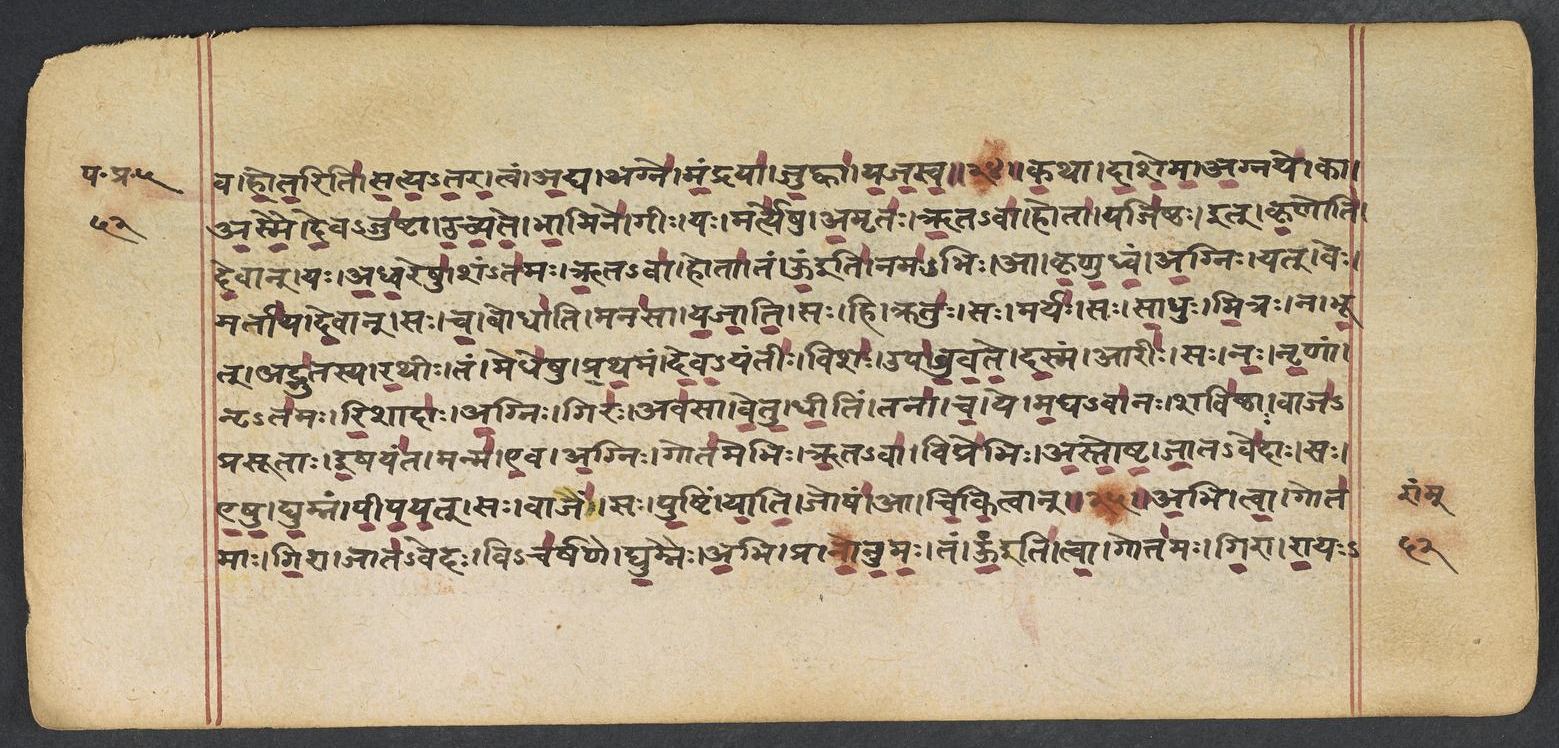
The manuscript shown is Penn Ms. Coll. 390 Item 41 (University of Pennsylvania), an undated paper manuscript of the padapāṭha (the word-by-word recitation text, in which every word is written separately and compounds are split) of the whole Ṛgveda in Devanāgarī, 884 leaves in fascicles, 7-9 lines to the page, accents in red; this hymn stands on fol. 52v. Each section below gives the verses that end on one page; the page boundaries were read on the images (the opening words of every page), not counted out. Where the manuscript is a padapāṭha (the word-by-word recitation text), the section shows Aufrecht's continuous (saṃhitā) text first and, as the edition text, the padapāṭha of the same verses, which is the form written on the page.
How was this verified? (Provenance)
Where on the image
Penn Ms. Coll. 390 Item 41, fol. 52v (OPenn image 54, upper leaf). Checked on the image: the Rigveda text on this page begins in RV 1.76.5 ‹-eva hotariti satya-tara tvam›. The next page with Rigveda text, fol. 53r, begins in RV 1.78.2 ‹-rāyaḥ-kāmaḥ duvasyati dyumnaiḥ abhi›. Verses 1.77.1-5 end on this page.
1ka̱thā dā̍śemā̱gnaye̱ kāsmai̍ de̱vaju̍ṣṭocyate bhā̱mine̱ gīḥ | yo martye̍ṣv a̱mṛta̍ ṛ̱tāvā̱ hotā̱ yaji̍ṣṭha̱ it kṛ̱ṇoti̍ de̱vān ||
2yo a̍dhva̱reṣu̱ śaṁta̍ma ṛ̱tāvā̱ hotā̱ tam ū̱ namo̍bhi̱r ā kṛ̍ṇudhvam | a̱gnir yad ver martā̍ya de̱vān sa cā̱ bodhā̍ti̱ mana̍sā yajāti ||
3sa hi kratu̱ḥ sa marya̱ḥ sa sā̱dhur mi̱tro na bhū̱d adbhu̍tasya ra̱thīḥ | tam medhe̍ṣu pratha̱maṁ de̍va̱yantī̱r viśa̱ upa̍ bruvate da̱smam ārī̍ḥ ||
4sa no̍ nṛ̱ṇāṁ nṛta̍mo ri̱śādā̍ a̱gnir giro 'va̍sā vetu dhī̱tim | tanā̍ ca̱ ye ma̱ghavā̍na̱ḥ śavi̍ṣṭhā̱ vāja̍prasūtā i̱ṣaya̍nta̱ manma̍ ||
5e̱vāgnir gota̍mebhir ṛ̱tāvā̱ vipre̍bhir astoṣṭa jā̱tave̍dāḥ | sa e̍ṣu dyu̱mnam pī̍paya̱t sa vāja̱ṁ sa pu̱ṣṭiṁ yā̍ti̱ joṣa̱m ā ci̍ki̱tvān ||
Compare: Padapāṭha (word-by-word text written in the manuscript; Sansknet e-text via GRETIL)
1kathā | dāśema | agnaye | kā | asmai | deva-juṣṭā | ucyate | bhāmine | gīḥ | yaḥ | martyeṣu | amṛtaḥ | ṛta-vā | hotā | yajiṣṭhaḥ | it | kṛṇoti | devān
2yaḥ | adhvareṣu | śam-tamaḥ | ṛta-vā | hotā | tam | oṃ iti | namaḥ-bhiḥ | ā | kṛṇudhvam | agniḥ | yat | veḥ | martāya | devān | saḥ | ca | bodhāti | manasā | yajāti
3saḥ | hi | kratuḥ | saḥ | maryaḥ | saḥ | sādhuḥ | mitraḥ | na | bhūt | adbhutasya | rathīḥ | tam | medheṣu | prathamam | deva-yantīḥ | viśaḥ | upa | bruvate | dasmam | ārīḥ
4saḥ | naḥ | nṛṇām | nṛ-tamaḥ | riśādāḥ | agniḥ | giraḥ | avasā | vetu | dhītim | tanā | ca | ye | magha-vānaḥ | śaviṣṭhāḥ | vāja-prasūtāḥ | iṣayanta | manma
5eva | agniḥ | gotamebhiḥ | ṛta-vā | viprebhiḥ | astoṣṭa | jāta-vedāḥ | saḥ | eṣu | dyumnam | pīpayat | saḥ | vājam | saḥ | puṣṭim | yāti | joṣam | ā | cikitvān
1How shall we pay oblation unto Agni? What hymn, Godloved, is said to him refulgent? Who, deathless, true to Law, mid men a herald, bringeth the Gods as best of sacrificers?
2Bring him with reverence hither, most propitious in sacrifices, true to Law, the herald; For Agni, when he seeks the Gods for mortals, knows them full well and worships them in spirit.
3For he is mental power, a man, and perfect; he is the bringer, friend-,like, of the wondrous. The pious Aryan tribes at sacrifices address them first to him who doeth marvels.
4May Agni, foe-destroyer, manliest Hero, accept with love our hymns and our devotion. So may the liberal lords whose strength is strongest, urged by their riches, stir our thoughts with vigour.
5Thus Agni Jâtavedas, true to Order, hath by the priestly Gotamas been lauded. May he augment in them splendour and vigour: observant, as he lists, he gathers increase.
Notes
- Sanskrit: Aufrecht's edition (1877) with the Vedic accents, as entered by van Nooten and Holland (GRETIL).
- English: Ralph T. H. Griffith, The Hymns of the Rigveda (1889-1892; 2nd ed. 1896-1897), from the VedaWeb digital text; OCR slips in that text were corrected against the printed 2nd edition (data/sources/rigveda/griffith_errata.json).
- Padapāṭha (edition text): Sansknet e-text via GRETIL (CC BY-NC-SA 4.0).
Cite
Sources
- Source: Penn Ms. Coll. 390 Item 41 (undated (catalogued with Penn's 18th-19th c. Vedic manuscripts)), OPenn, Public Domain Mark + Aufrecht's accented text (GRETIL) + Griffith's English (VedaWeb) (holding institution)
- Critical edition: Aufrecht (1877), accented e-text via GRETIL
← previous · → next · v cycle view · l back to library