Rigveda 1.78: To Agni
Introduction
Rigveda 1.78 is a hymn of 5 verses addressed to Agni. It stands in book (maṇḍala) 1, a collection of hymns by many families of poets. The Rigveda is the oldest collection of Sanskrit hymns, composed in the second half of the second millennium BCE and handed down orally for many centuries before it was written down.
The manuscript shown is Penn Ms. Coll. 390 Item 41 (University of Pennsylvania), an undated paper manuscript of the padapāṭha (the word-by-word recitation text, in which every word is written separately and compounds are split) of the whole Ṛgveda in Devanāgarī, 884 leaves in fascicles, 7-9 lines to the page, accents in red; this hymn stands on fol. 52v-53r. Each section below gives the verses that end on one page; the page boundaries were read on the images (the opening words of every page), not counted out. Where the manuscript is a padapāṭha (the word-by-word recitation text), the section shows Aufrecht's continuous (saṃhitā) text first and, as the edition text, the padapāṭha of the same verses, which is the form written on the page.
How was this verified? (Provenance)
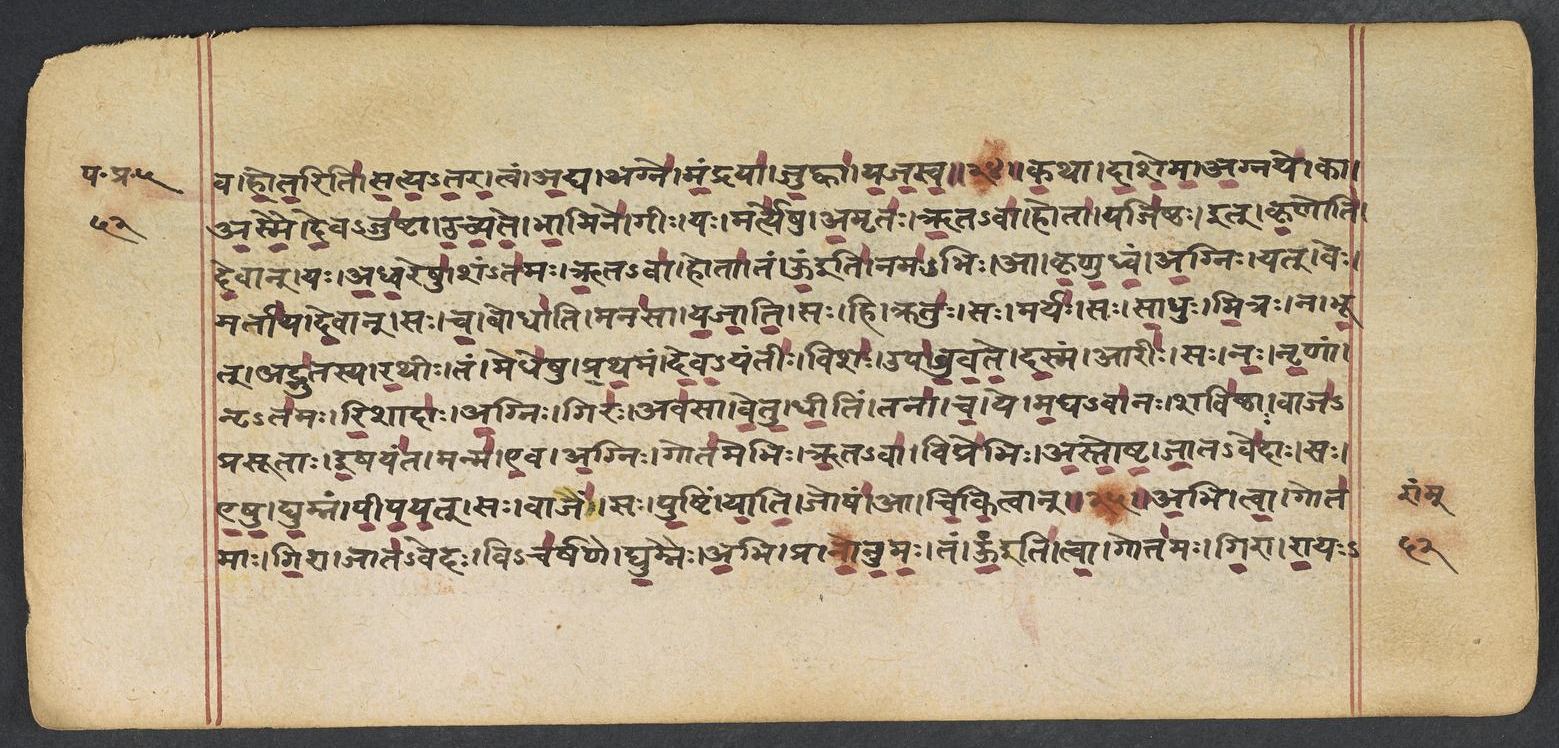
Where on the image
Penn Ms. Coll. 390 Item 41, fol. 52v (OPenn image 54, upper leaf). Checked on the image: the Rigveda text on this page begins in RV 1.76.5 ‹-eva hotariti satya-tara tvam›. The next page with Rigveda text, fol. 53r, begins in RV 1.78.2 ‹-rāyaḥ-kāmaḥ duvasyati dyumnaiḥ abhi›. Verse 1.78.1 ends on this page.
1a̱bhi tvā̱ gota̍mā gi̱rā jāta̍vedo̱ vica̍rṣaṇe | dyu̱mnair a̱bhi pra ṇo̍numaḥ ||
Compare: Padapāṭha (word-by-word text written in the manuscript; Sansknet e-text via GRETIL)
1abhi | tvā | gotamāḥ | girā | jāta-vedaḥ | vi-carṣaṇe | dyumnaiḥ | abhi | pra | nonumaḥ
1O JâtavEDAS, keen and swift, we Gotamas with sacred song exalt thee for thy glories' sake.
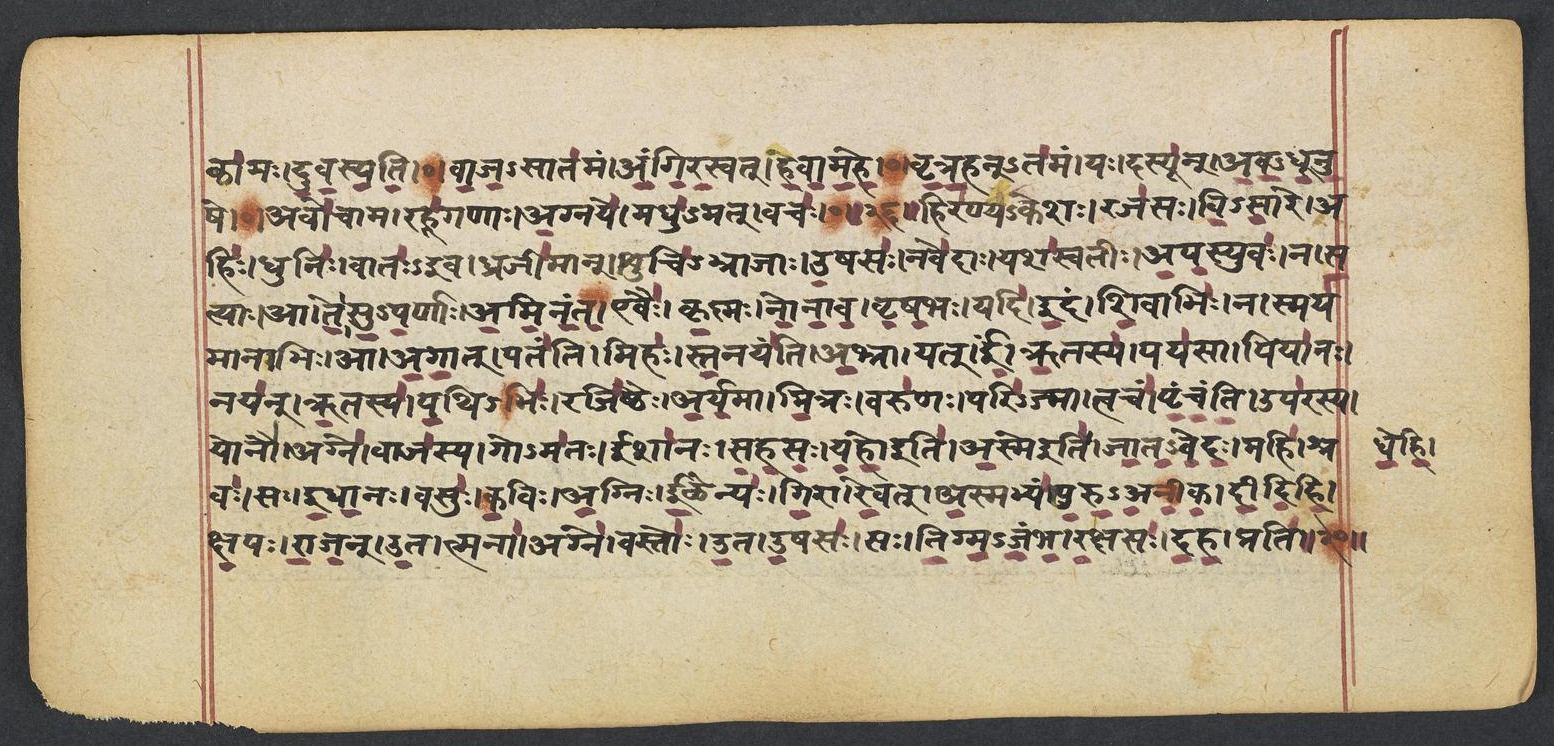
Where on the image
Penn Ms. Coll. 390 Item 41, fol. 53r (OPenn image 54, lower leaf). Checked on the image: the Rigveda text on this page begins in RV 1.78.2 ‹-rāyaḥ-kāmaḥ duvasyati dyumnaiḥ abhi›. The next page with Rigveda text, fol. 53v, begins in RV 1.79.7 ‹ava naḥ agne ūti-bhiḥ›. Verses 1.78.2-5 end on this page; 1.78.2 begins on fol. 52v.
2tam u̍ tvā̱ gota̍mo gi̱rā rā̱yaskā̍mo duvasyati | dyu̱mnair a̱bhi pra ṇo̍numaḥ ||
3tam u̍ tvā vāja̱sāta̍mam aṅgira̱svad dha̍vāmahe | dyu̱mnair a̱bhi pra ṇo̍numaḥ ||
4tam u̍ tvā vṛtra̱hanta̍ma̱ṁ yo dasyū̍m̐r avadhūnu̱ṣe | dyu̱mnair a̱bhi pra ṇo̍numaḥ ||
5avo̍cāma̱ rahū̍gaṇā a̱gnaye̱ madhu̍ma̱d vaca̍ḥ | dyu̱mnair a̱bhi pra ṇo̍numaḥ ||
Compare: Padapāṭha (word-by-word text written in the manuscript; Sansknet e-text via GRETIL)
2tam | oṃ iti | tvā | gotamaḥ | girā | rāyaḥ-kāmaḥ | duvasyati | dyumnaiḥ | abhi | pra | nonumaḥ
3tam | oṃ iti | tvā | vāja-sātamam | aṅgirasvat | havāmahe | dyumnaiḥ | abhi | pra | nonumaḥ
4tam | oṃ iti | tvā | vṛtrahan-tamam | yaḥ | dasyūn | ava-dhūnuṣe | dyumnaiḥ | abhi | pra | nonumaḥ
5avocāma | rahūgaṇāḥ | agnaye | madhu-mat | vacaḥ | dyumnaiḥ | abhi | pra | nonumaḥ
2Thee, as thou art, desiring wealth Gotama worships with his song: We laud thee for thy glories' sake.
3As such, like Angiras we call on thee best winner of the spoil: We laud thee for thy glories' sake.
4Thee, best of Vr̥itra-slayers, thee who shakest off our Dasyu foes: We laud thee for thy glories' sake.
5A pleasant song to Agni we, sons of Rahûgaṇa, have sung: We laud thee for thy glories' sake.
Notes
- Sanskrit: Aufrecht's edition (1877) with the Vedic accents, as entered by van Nooten and Holland (GRETIL).
- English: Ralph T. H. Griffith, The Hymns of the Rigveda (1889-1892; 2nd ed. 1896-1897), from the VedaWeb digital text; OCR slips in that text were corrected against the printed 2nd edition (data/sources/rigveda/griffith_errata.json).
- Padapāṭha (edition text): Sansknet e-text via GRETIL (CC BY-NC-SA 4.0).
Cite
Sources
- Source: Penn Ms. Coll. 390 Item 41 (undated (catalogued with Penn's 18th-19th c. Vedic manuscripts)), OPenn, Public Domain Mark + Aufrecht's accented text (GRETIL) + Griffith's English (VedaWeb) (holding institution)
- Critical edition: Aufrecht (1877), accented e-text via GRETIL
← previous · → next · v cycle view · l back to library