Rigveda 10.118: To Agni, killer of raksas
Introduction
Rigveda 10.118 is a hymn of 9 verses addressed to Agni, killer of raksas. It stands in book (maṇḍala) 10, the last and latest book. The Rigveda is the oldest collection of Sanskrit hymns, composed in the second half of the second millennium BCE and handed down orally for many centuries before it was written down.
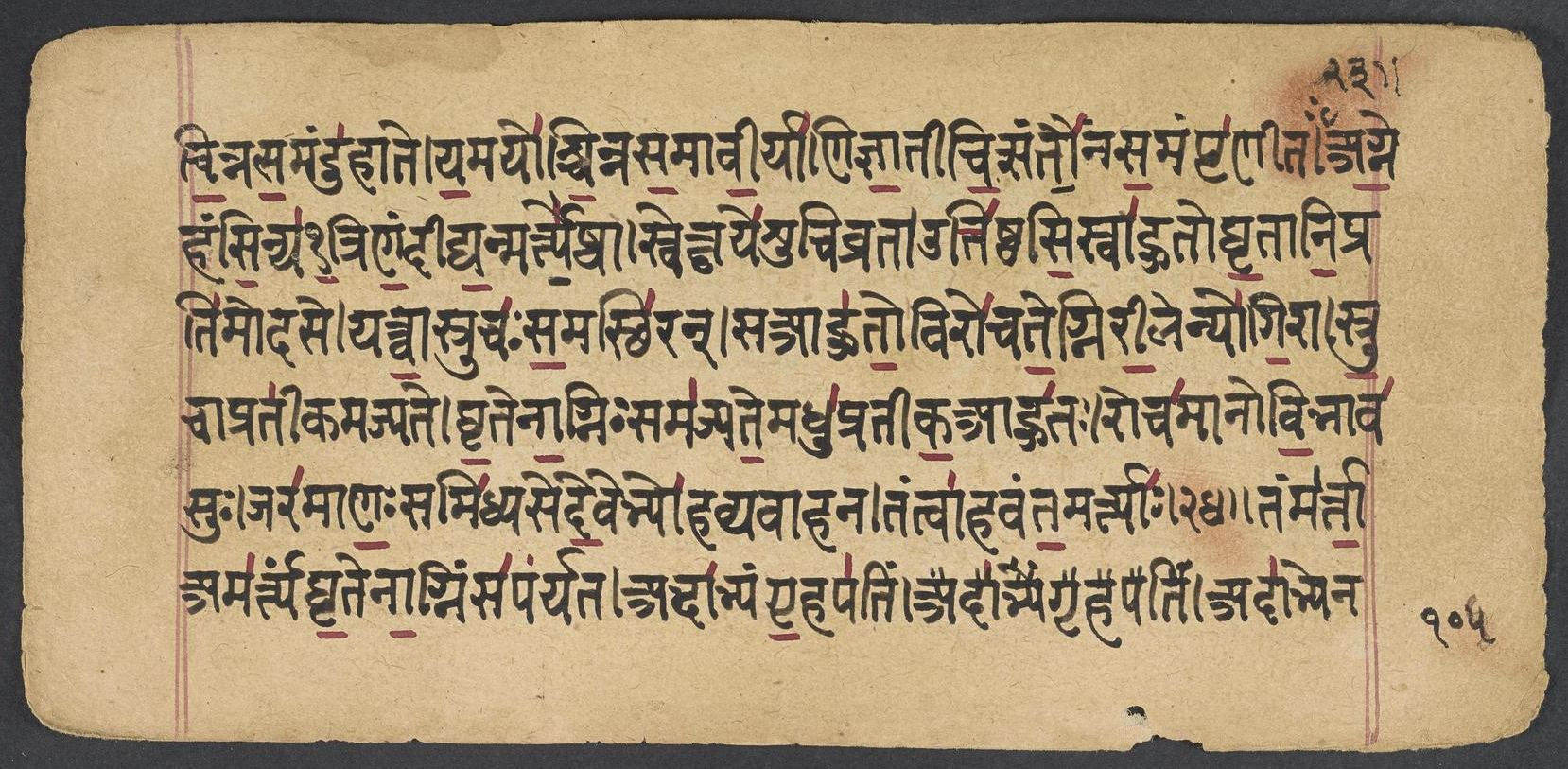
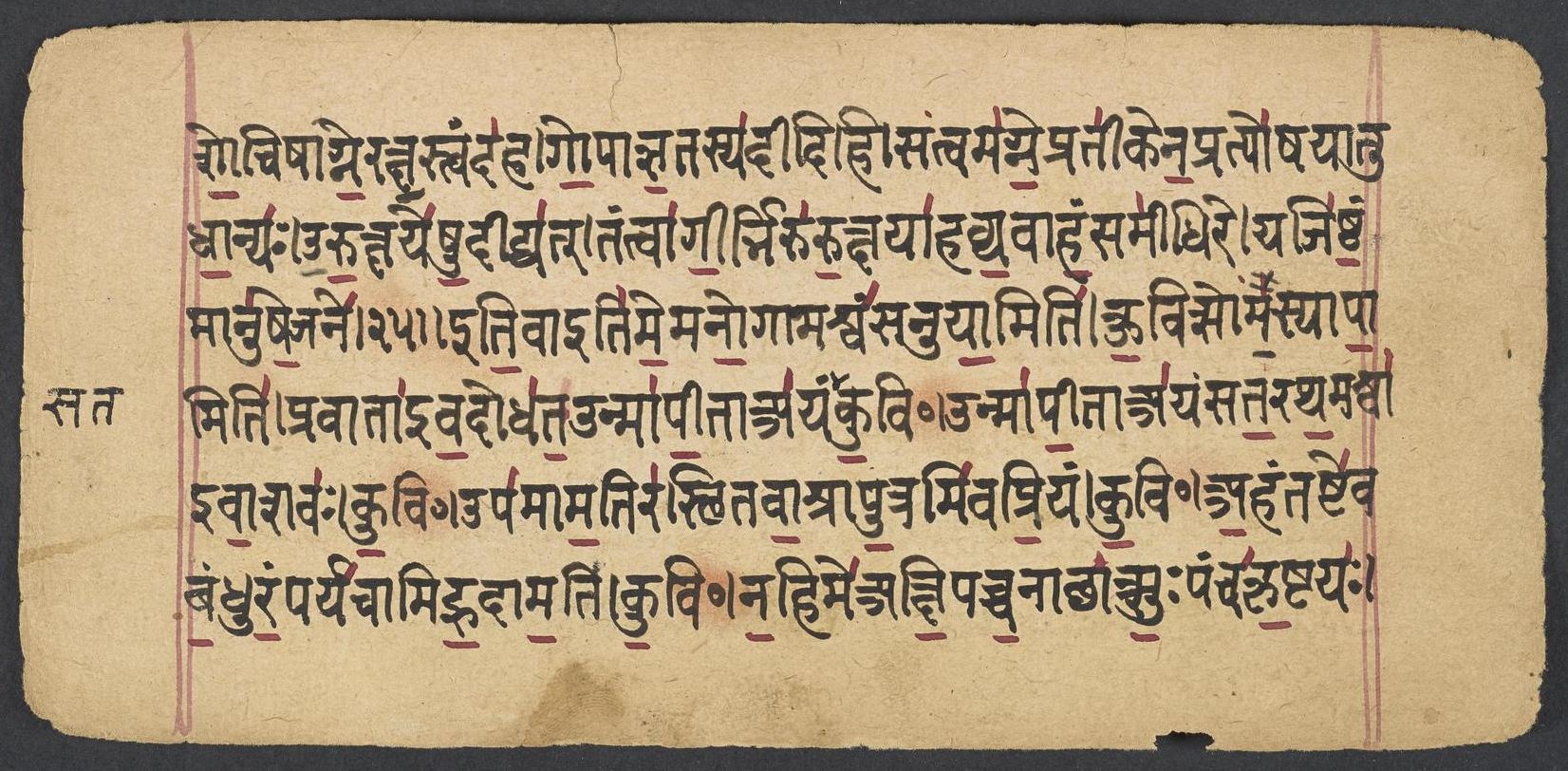
The manuscript shown is Penn Ms. Coll. 390 Item 48 (University of Pennsylvania), a paper manuscript of the eighth aṣṭaka (RV 10.46-10.191) of the Ṛgveda Saṃhitā in Devanāgarī, 158 leaves, 6 lines to the page, with the accents marked in red; the scribe's colophon on fol. 158 gives Saṃvat 1768 (1711 CE); this hymn stands on fol. 105v-106r. Each section below gives the verses that end on one page; the page boundaries were read on the images (the opening words of every page), not counted out. Like most Rigveda manuscripts, Penn Ms. Coll. 390 Item 48 writes a repeated refrain in short form after its first occurrence (for example kasmai° for kasmai devāya haviṣā vidhema); the Sanskrit shown is the full text of Aufrecht's edition.
How was this verified? (Provenance)
Where on the image
Penn Ms. Coll. 390 Item 48, fol. 105v (OPenn image 105, upper leaf). Checked on the image: the Rigveda text on this page begins in RV 10.117.9 ‹-sammātarā cin na samaṁ›. The next page with Rigveda text, fol. 106r, begins in RV 10.118.7 ‹śociṣāgne rakṣas tvaṁ daha›. Verses 10.118.1-6 end on this page.
1agne̱ haṁsi̱ ny a1̱̍triṇa̱ṁ dīdya̱n martye̱ṣv ā | sve kṣaye̍ śucivrata ||
2ut ti̍ṣṭhasi̱ svā̍huto ghṛ̱tāni̱ prati̍ modase | yat tvā̱ sruca̍ḥ sa̱masthi̍ran ||
3sa āhu̍to̱ vi ro̍cate̱ 'gnir ī̱ḻenyo̍ gi̱rā | sru̱cā pratī̍kam ajyate ||
4ghṛ̱tenā̱gniḥ sam a̍jyate̱ madhu̍pratīka̱ āhu̍taḥ | roca̍māno vi̱bhāva̍suḥ ||
5jara̍māṇa̱ḥ sam i̍dhyase de̱vebhyo̍ havyavāhana | taṁ tvā̍ havanta̱ martyā̍ḥ ||
6tam ma̍rtā̱ ama̍rtyaṁ ghṛ̱tenā̱gniṁ sa̍paryata | adā̍bhyaṁ gṛ̱hapa̍tim ||
1AGNI, refulgent among men thou slayest the devouring fiend, Bright Ruler in thine own abode.
2Thou springest up when worshipped well the drops of butter are thy joy When ladles are brought near to thee.
3Honoured with gifts he shines afar, Agni adorable with song: The dripping ladle balms his face.
4Agni with honey in his mouth, honoured with gifts, is balmed with oil, Refulgent in his wealth of light.
5Praised by our hymns thou kindlest thee, Oblation-bearer, for the Gods As such do mortals call on thee.
6To that Immortal Agni pay worship with oil, ye mortal men,– Lord of the house, whom none deceives.
Where on the image
Penn Ms. Coll. 390 Item 48, fol. 106r (OPenn image 105, lower leaf). Checked on the image: the Rigveda text on this page begins in RV 10.118.7 ‹śociṣāgne rakṣas tvaṁ daha›. The next page with Rigveda text, fol. 106v, begins in RV 10.119.6 ‹-somasyāpām iti›. Verses 10.118.7-9 end on this page; 10.118.7 begins on fol. 105v.
7adā̍bhyena śo̱ciṣāgne̱ rakṣa̱s tvaṁ da̍ha | go̱pā ṛ̱tasya̍ dīdihi ||
8sa tvam a̍gne̱ pratī̍kena̱ praty o̍ṣa yātudhā̱nya̍ḥ | u̱ru̱kṣaye̍ṣu̱ dīdya̍t ||
9taṁ tvā̍ gī̱rbhir u̍ru̱kṣayā̍ havya̱vāha̱ṁ sam ī̍dhire | yaji̍ṣṭha̱m mānu̍ṣe̱ jane̍ ||
7O Agni, burn the Raksasas with thine unconquerable flame Shine guardian of Eternal Law.
8So, Agni, with thy glowing face burn fierce against the female fiends, Shining among Urukshayas.
9Urukshayas have kindled thee, Oblation-bearer, thee, with hymns. Best Worshipper among mankind.
Notes
- Sanskrit: Aufrecht's edition (1877) with the Vedic accents, as entered by van Nooten and Holland (GRETIL).
- English: Ralph T. H. Griffith, The Hymns of the Rigveda (1889-1892; 2nd ed. 1896-1897), from the VedaWeb digital text; OCR slips in that text were corrected against the printed 2nd edition (data/sources/rigveda/griffith_errata.json).
Cite
Sources
- Source: Penn Ms. Coll. 390 Item 48 (1711 CE (colophon: Saṃvat 1768)), OPenn, Public Domain Mark + Aufrecht's accented text (GRETIL) + Griffith's English (VedaWeb) (holding institution)
- Critical edition: Aufrecht (1877), accented e-text via GRETIL
← previous · → next · v cycle view · l back to library