Rigveda 10.121: Hiranyagarbha, the golden germ
Introduction
Rigveda 10.121 is a hymn of 10 verses addressed to which god. It stands in book (maṇḍala) 10, the last and latest book. The Rigveda is the oldest collection of Sanskrit hymns, composed in the second half of the second millennium BCE and handed down orally for many centuries before it was written down.
The manuscript shown is Penn Ms. Coll. 390 Item 48 (University of Pennsylvania), a paper manuscript of the eighth aṣṭaka (RV 10.46-10.191) of the Ṛgveda Saṃhitā in Devanāgarī, 158 leaves, 6 lines to the page, with the accents marked in red; the scribe's colophon on fol. 158 gives Saṃvat 1768 (1711 CE); this hymn stands on fol. 108r-109r. Each section below gives the verses that end on one page; the page boundaries were read on the images (the opening words of every page), not counted out. Like most Rigveda manuscripts, Penn Ms. Coll. 390 Item 48 writes a repeated refrain in short form after its first occurrence (for example kasmai° for kasmai devāya haviṣā vidhema); the Sanskrit shown is the full text of Aufrecht's edition.
How was this verified? (Provenance)
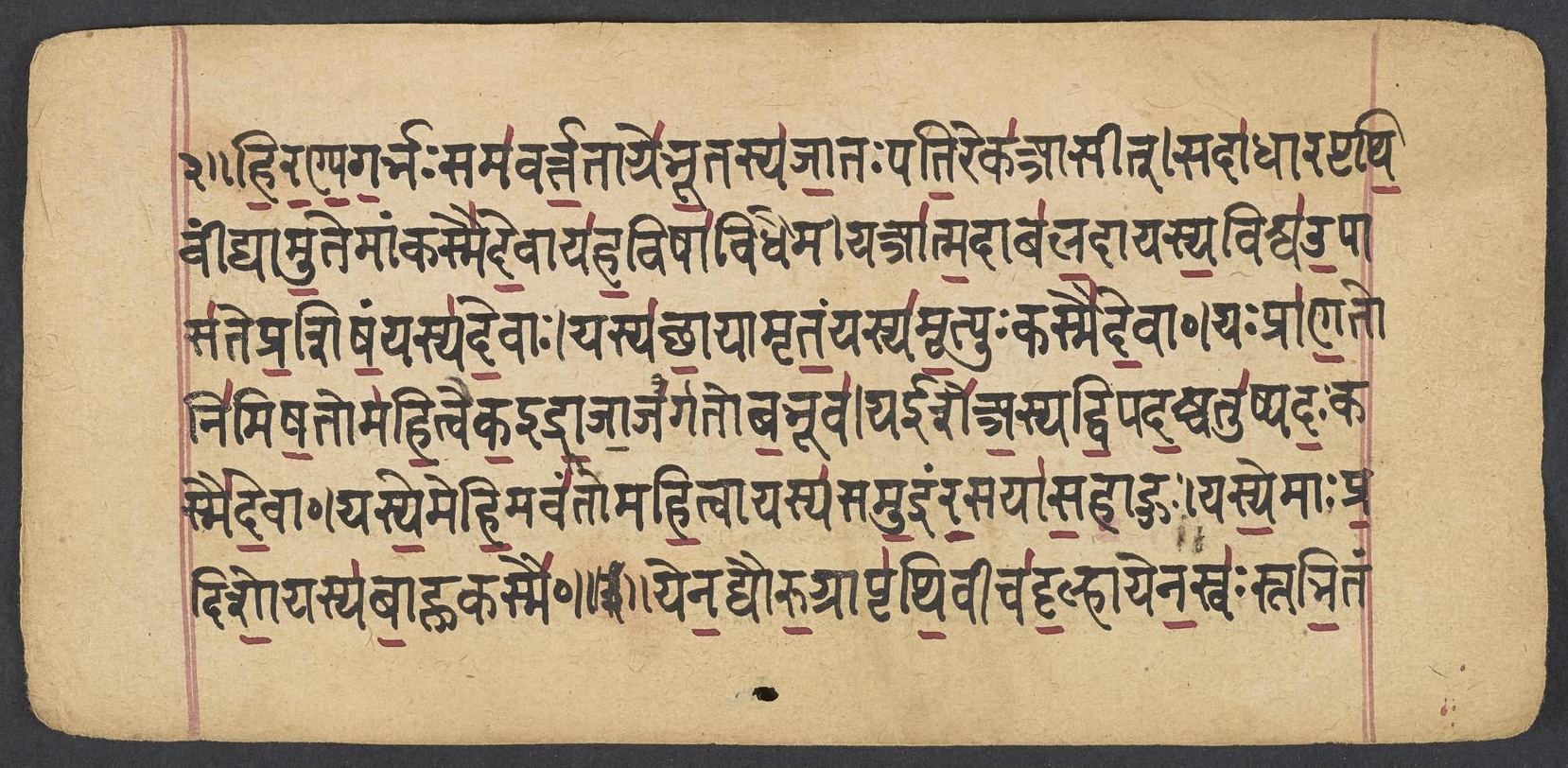
Where on the image
Penn Ms. Coll. 390 Item 48, fol. 108r (OPenn image 107, lower leaf). Checked on the image: the Rigveda text on this page begins in RV 10.121.1 ‹hiraṇyagarbhaḥ sam avartatāgre bhūtasya›. Line 1 opens with the varga number 2, then 10.121.1. The next page with Rigveda text, fol. 108v, begins in RV 10.121.5 ‹yena nākaḥ›. Verses 10.121.1-4 end on this page.
1hi̱ra̱ṇya̱ga̱rbhaḥ sam a̍varta̱tāgre̍ bhū̱tasya̍ jā̱taḥ pati̱r eka̍ āsīt | sa dā̍dhāra pṛthi̱vīṁ dyām u̱temāṁ kasmai̍ de̱vāya̍ ha̱viṣā̍ vidhema ||
2ya ā̍tma̱dā ba̍la̱dā yasya̱ viśva̍ u̱pāsa̍te pra̱śiṣa̱ṁ yasya̍ de̱vāḥ | yasya̍ chā̱yāmṛta̱ṁ yasya̍ mṛ̱tyuḥ kasmai̍ de̱vāya̍ ha̱viṣā̍ vidhema ||
3yaḥ prā̍ṇa̱to ni̍miṣa̱to ma̍hi̱tvaika̱ id rājā̱ jaga̍to ba̱bhūva̍ | ya īśe̍ a̱sya dvi̱pada̱ś catu̍ṣpada̱ḥ kasmai̍ de̱vāya̍ ha̱viṣā̍ vidhema ||
4yasye̱me hi̱mava̍nto mahi̱tvā yasya̍ samu̱draṁ ra̱sayā̍ sa̱hāhuḥ | yasye̱māḥ pra̱diśo̱ yasya̍ bā̱hū kasmai̍ de̱vāya̍ ha̱viṣā̍ vidhema ||
1IN the beginning rose Hiranyagarbha, born Only Lord of all created beings. He fixed and holdeth up this earth and heaven. What God shall we adore with our oblation?
2Giver of vital breath, of power and vigour, he whose commandments all the Gods acknowledge -. The Lord of death, whose shade is life immortal. What God shall we adore with our oblation?
3Who by his grandeur hath become Sole Ruler of all the moving world that breathes and slumbers; He who is Lord of men and Lord of cattle. What God shall we adore with our oblation?
4His, through his might, are these snow-covered mountains, and men call sea and Rasâ his possession: His arms are these, his are these heavenly regions. What God shall we adore with our oblation?
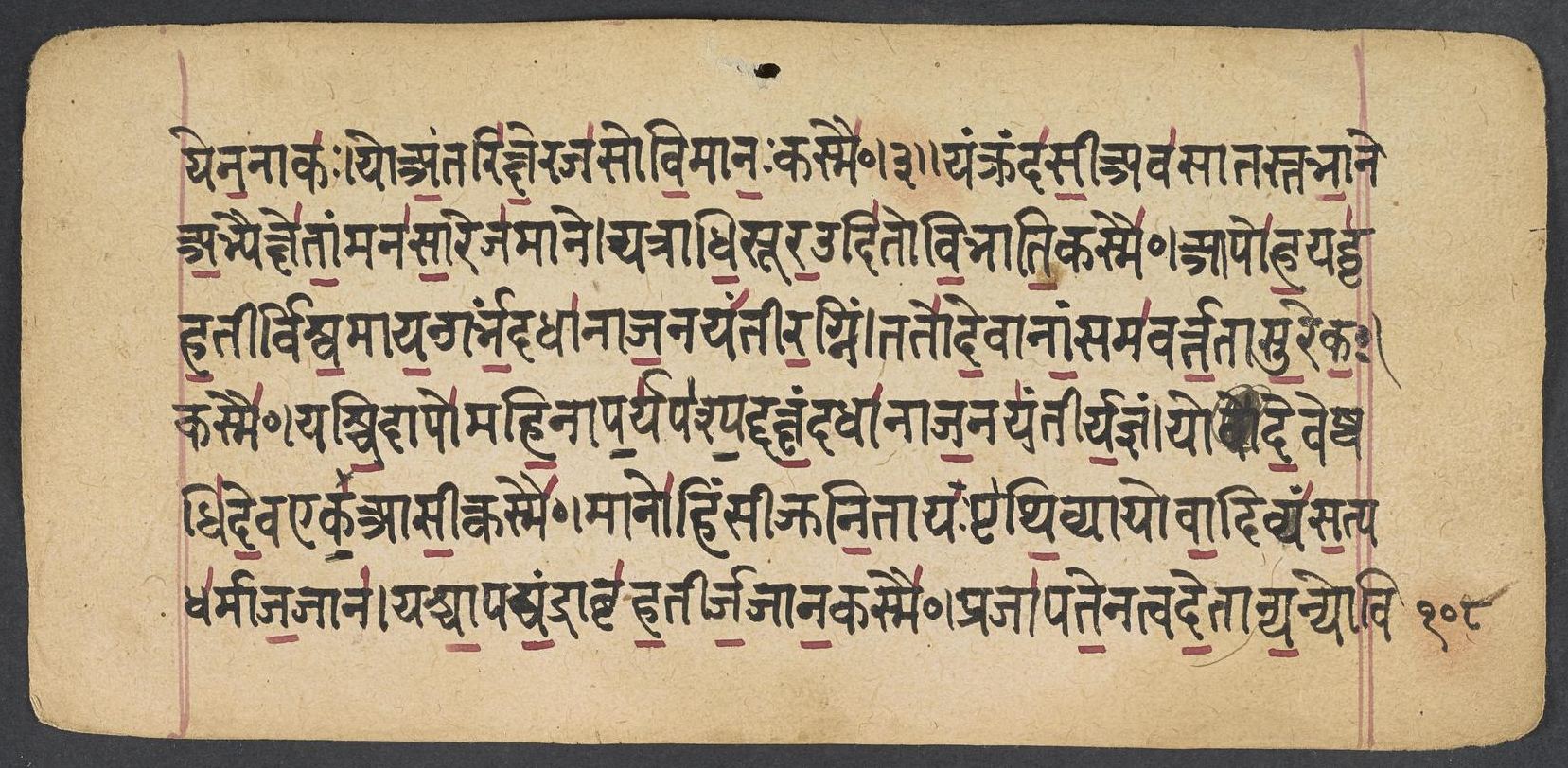
Where on the image
Penn Ms. Coll. 390 Item 48, fol. 108v (OPenn image 108, upper leaf). Checked on the image: the Rigveda text on this page begins in RV 10.121.5 ‹yena nākaḥ›. The next page with Rigveda text, fol. 109r, begins in RV 10.121.10 ‹-viśvā jātāni pari tā›. Verses 10.121.5-9 end on this page; 10.121.5 begins on fol. 108r.
5yena̱ dyaur u̱grā pṛ̍thi̱vī ca̍ dṛ̱ḻhā yena̱ sva̍ḥ stabhi̱taṁ yena̱ nāka̍ḥ | yo a̱ntari̍kṣe̱ raja̍so vi̱māna̱ḥ kasmai̍ de̱vāya̍ ha̱viṣā̍ vidhema ||
6yaṁ kranda̍sī̱ ava̍sā tastabhā̱ne a̱bhy aikṣe̍tā̱m mana̍sā̱ reja̍māne | yatrādhi̱ sūra̱ udi̍to vi̱bhāti̱ kasmai̍ de̱vāya̍ ha̱viṣā̍ vidhema ||
7āpo̍ ha̱ yad bṛ̍ha̱tīr viśva̱m āya̱n garbha̱ṁ dadhā̍nā ja̱naya̍ntīr a̱gnim | tato̍ de̱vānā̱ṁ sam a̍varta̱tāsu̱r eka̱ḥ kasmai̍ de̱vāya̍ ha̱viṣā̍ vidhema ||
8yaś ci̱d āpo̍ mahi̱nā pa̱ryapa̍śya̱d dakṣa̱ṁ dadhā̍nā ja̱naya̍ntīr ya̱jñam | yo de̱veṣv adhi̍ de̱va eka̱ āsī̱t kasmai̍ de̱vāya̍ ha̱viṣā̍ vidhema ||
9mā no̍ hiṁsīj jani̱tā yaḥ pṛ̍thi̱vyā yo vā̱ diva̍ṁ sa̱tyadha̍rmā ja̱jāna̍ | yaś cā̱paś ca̱ndrā bṛ̍ha̱tīr ja̱jāna̱ kasmai̍ de̱vāya̍ ha̱viṣā̍ vidhema ||
5By him the heavens are strong and earth is stedfast, by him light's realm and sky-vault are supported: By him the regions in mid-air were measured. What God shall we adore with our oblation?
6To him, supported by his help, two armies embattled look while trembling in their spirit, When over them the risen Sun is shining. What God shall we adore with our oblation?
7What time the mighty waters came, containing the universal germ, producing Agni, Thence sprang the Gods' one spirit into being. What God shall we adore with our oblation?
8He in his might surveyed the floods containing productive force and generating Worship. He is the God of gods, and none beside him. What God shall we adore with our oblation?
9Neer may he harm us who is earth's Begetter, nor he whose laws are sure, the heavens' Creator, He who brought forth the great and lucid waters. What God shall we adore with our oblation?
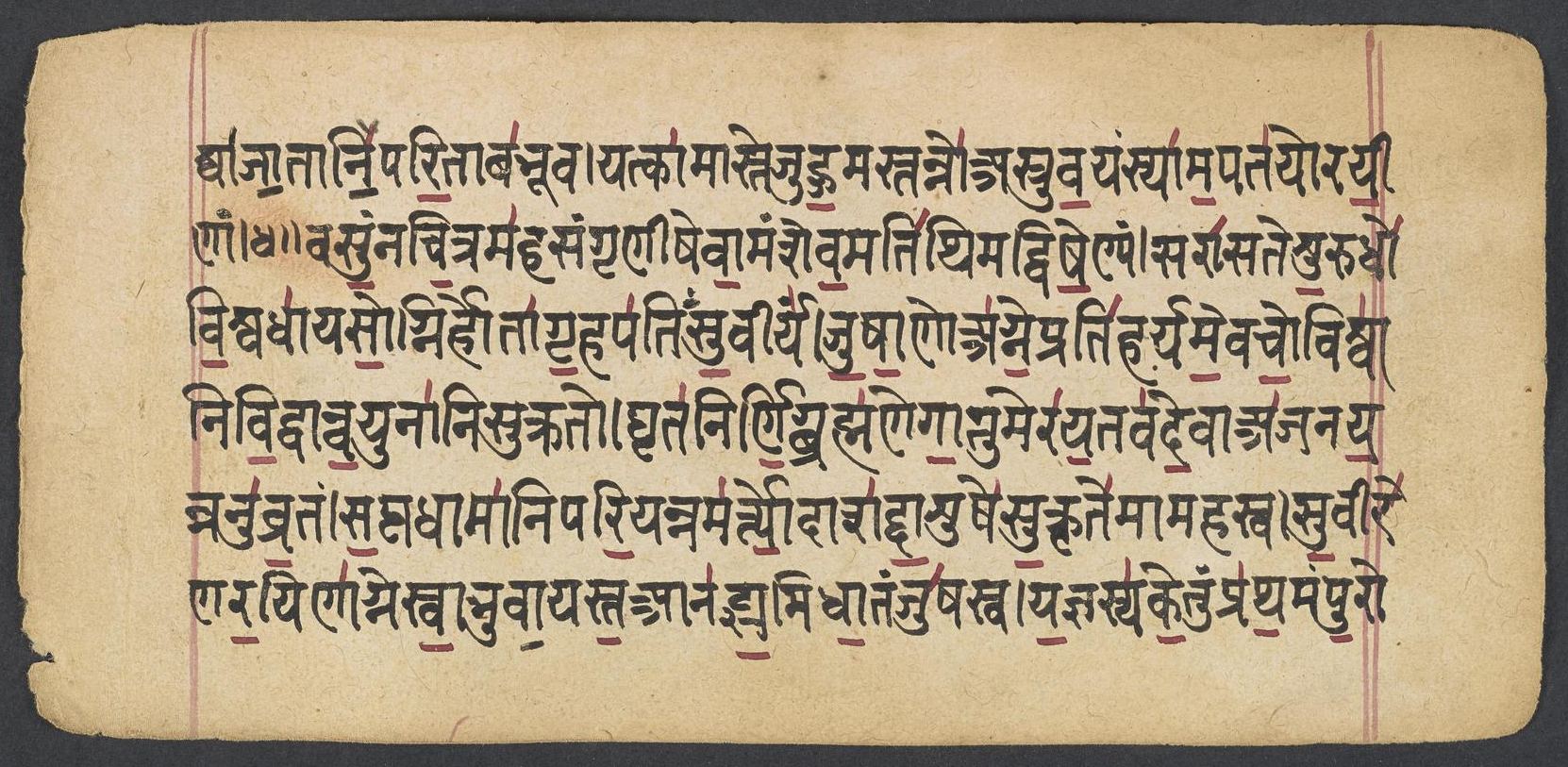
Where on the image
Penn Ms. Coll. 390 Item 48, fol. 109r (OPenn image 108, lower leaf). Checked on the image: the Rigveda text on this page begins in RV 10.121.10 ‹-viśvā jātāni pari tā›. The next page with Rigveda text, fol. 109v, begins in RV 10.122.4 ‹-purohitaṁ haviṣmanta īḻate sapta›. Verse 10.121.10 ends on this page; 10.121.10 begins on fol. 108v.
10prajā̍pate̱ na tvad e̱tāny a̱nyo viśvā̍ jā̱tāni̱ pari̱ tā ba̍bhūva | yatkā̍mās te juhu̱mas tan no̍ astu va̱yaṁ syā̍ma̱ pata̍yo rayī̱ṇām ||
10Prajâpati! thou only comprehendest all these created things, and none beside thee. Grant us our hearts' desire when we invoke thee: may we have store of riches in possession.
Notes
- Sanskrit: Aufrecht's edition (1877) with the Vedic accents, as entered by van Nooten and Holland (GRETIL).
- English: Ralph T. H. Griffith, The Hymns of the Rigveda (1889-1892; 2nd ed. 1896-1897), from the VedaWeb digital text; OCR slips in that text were corrected against the printed 2nd edition (data/sources/rigveda/griffith_errata.json).
Cite
Sources
- Source: Penn Ms. Coll. 390 Item 48 (1711 CE (colophon: Saṃvat 1768)), OPenn, Public Domain Mark + Aufrecht's accented text (GRETIL) + Griffith's English (VedaWeb) (holding institution)
- Critical edition: Aufrecht (1877), accented e-text via GRETIL
← previous · → next · v cycle view · l back to library