Rigveda 10.165: Against the bird of ill omen
Introduction
Rigveda 10.165 is a hymn of 5 verses addressed to against the bird of ill omen. It stands in book (maṇḍala) 10, the last and latest book. The Rigveda is the oldest collection of Sanskrit hymns, composed in the second half of the second millennium BCE and handed down orally for many centuries before it was written down.
The manuscript shown is Penn Ms. Coll. 390 Item 48 (University of Pennsylvania), a paper manuscript of the eighth aṣṭaka (RV 10.46-10.191) of the Ṛgveda Saṃhitā in Devanāgarī, 158 leaves, 6 lines to the page, with the accents marked in red; the scribe's colophon on fol. 158 gives Saṃvat 1768 (1711 CE); this hymn stands on fol. 142r-143r. Each section below gives the verses that end on one page; the page boundaries were read on the images (the opening words of every page), not counted out. Like most Rigveda manuscripts, Penn Ms. Coll. 390 Item 48 writes a repeated refrain in short form after its first occurrence (for example kasmai° for kasmai devāya haviṣā vidhema); the Sanskrit shown is the full text of Aufrecht's edition.
How was this verified? (Provenance)
Where on the image
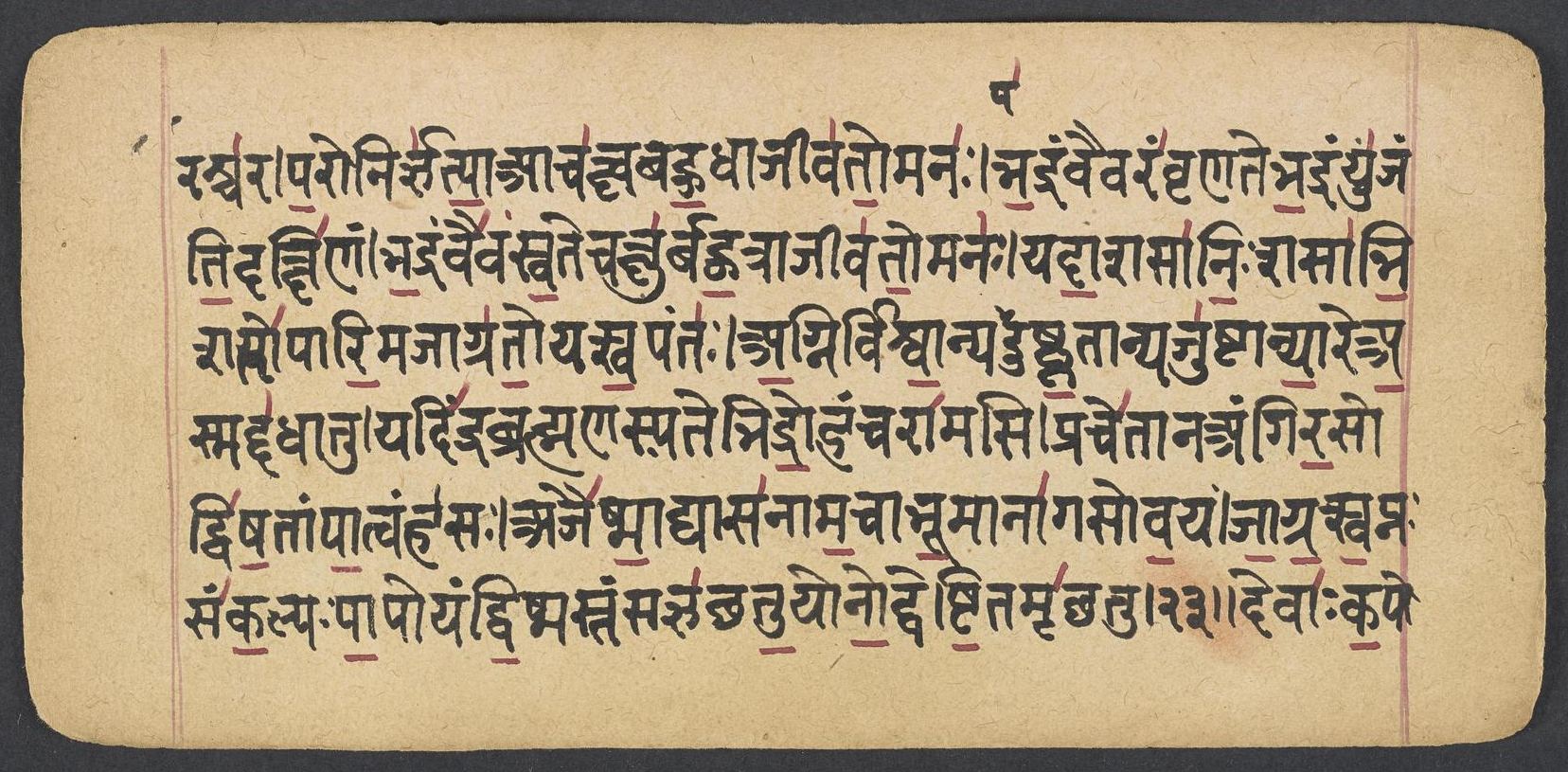
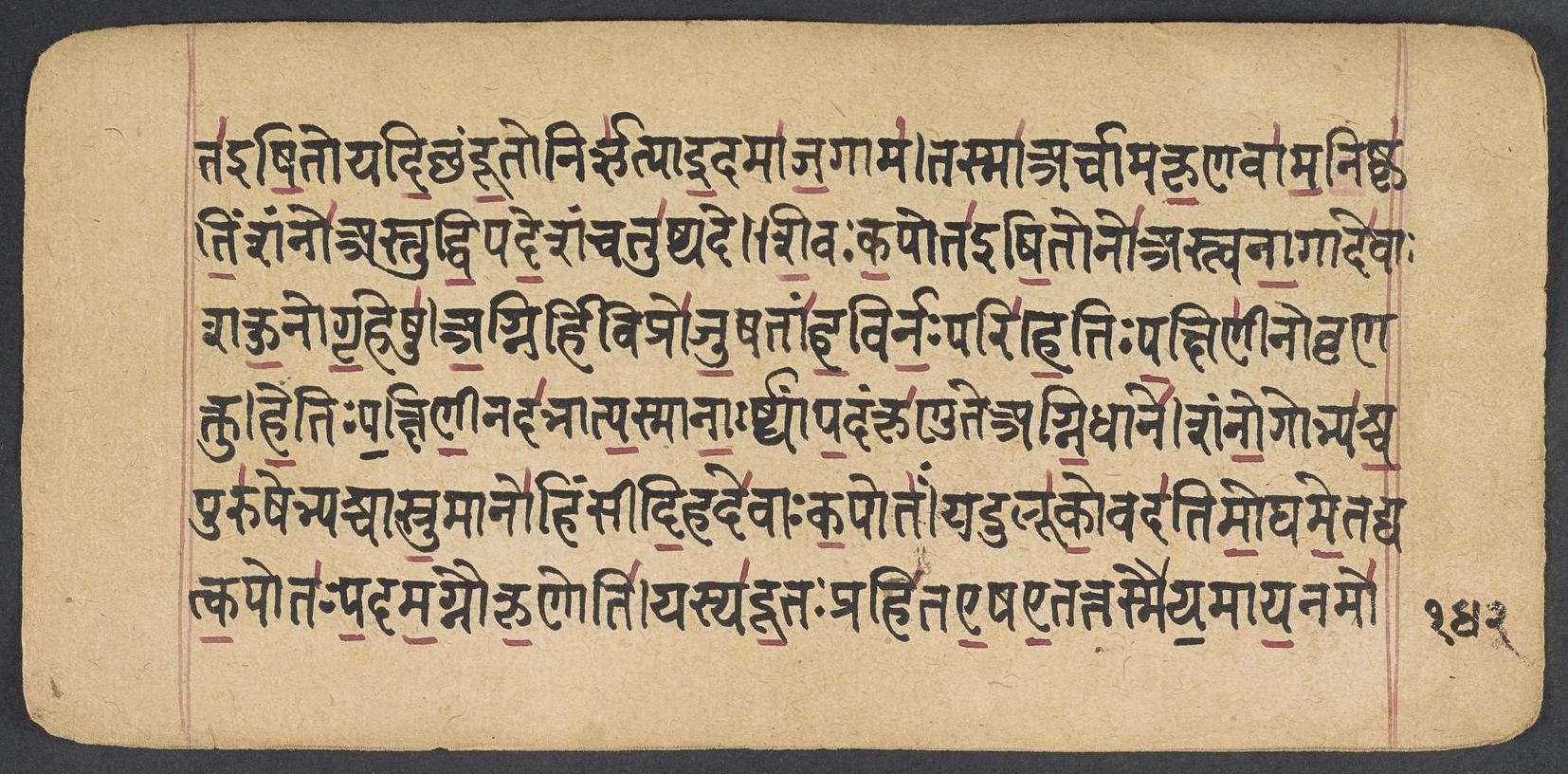
Penn Ms. Coll. 390 Item 48, fol. 142v (OPenn image 142, upper leaf). Checked on the image: the Rigveda text on this page begins in RV 10.165.1 ‹-kapota iṣito yad icchan›. The next page with Rigveda text, fol. 143r, begins in RV 10.165.4 ‹-namo astu mṛtyave›. Verses 10.165.1-3 end on this page; 10.165.1 begins on fol. 142r.
1devā̍ḥ ka̱pota̍ iṣi̱to yad i̱cchan dū̱to nirṛ̍tyā i̱dam ā̍ja̱gāma̍ | tasmā̍ arcāma kṛ̱ṇavā̍ma̱ niṣkṛ̍ti̱ṁ śaṁ no̍ astu dvi̱pade̱ śaṁ catu̍ṣpade ||
2śi̱vaḥ ka̱pota̍ iṣi̱to no̍ astv anā̱gā de̍vāḥ śaku̱no gṛ̱heṣu̍ | a̱gnir hi vipro̍ ju̱ṣatā̍ṁ ha̱vir na̱ḥ pari̍ he̱tiḥ pa̱kṣiṇī̍ no vṛṇaktu ||
3he̱tiḥ pa̱kṣiṇī̱ na da̍bhāty a̱smān ā̱ṣṭryām pa̱daṁ kṛ̍ṇute agni̱dhāne̍ | śaṁ no̱ gobhya̍ś ca̱ puru̍ṣebhyaś cāstu̱ mā no̍ hiṁsīd i̱ha de̍vāḥ ka̱pota̍ḥ ||
1GODS, whatsoe'er the Dove came hither seeking, sent to us as the envoy of Destruction, For that let us sing hymns and make atonement. Well be it with our quadrupeds and bipeds.
2Auspicious be the Dove that hath been sent us, a harmless bird, ye Gods, within our dwelling. May Agni, Sage, be pleased with our oblation, and may the Missile borne on wings avoid us.
3Let not the Arrow that hath wings distract us: beside the fire-place, on the hearth it settles. May, it bring welfare to our men and cattle: here let the Dove, ye Gods, forbear to harm us.
Where on the image
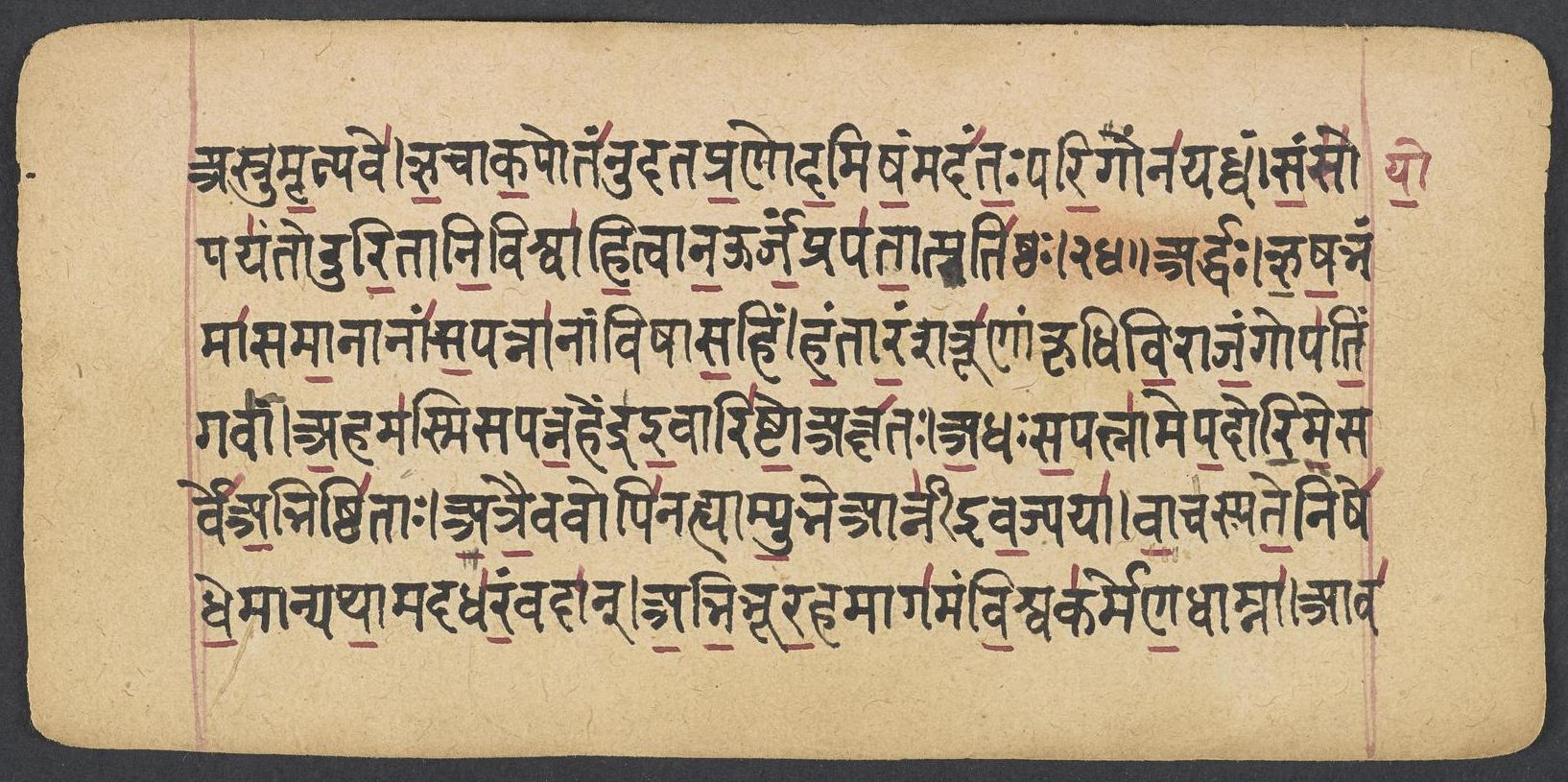
Penn Ms. Coll. 390 Item 48, fol. 143r (OPenn image 142, lower leaf). Checked on the image: the Rigveda text on this page begins in RV 10.165.4 ‹-namo astu mṛtyave›. The next page with Rigveda text, fol. 143v, begins in RV 10.166.4 ‹-vaś cittam ā vo›. Verses 10.165.4-5 end on this page; 10.165.4 begins on fol. 142v.
4yad ulū̍ko̱ vada̍ti mo̱gham e̱tad yat ka̱pota̍ḥ pa̱dam a̱gnau kṛ̱ṇoti̍ | yasya̍ dū̱taḥ prahi̍ta e̱ṣa e̱tat tasmai̍ ya̱māya̱ namo̍ astu mṛ̱tyave̍ ||
5ṛ̱cā ka̱pota̍ṁ nudata pra̱ṇoda̱m iṣa̱m mada̍nta̱ḥ pari̱ gāṁ na̍yadhvam | sa̱ṁyo̱paya̍nto duri̱tāni̱ viśvā̍ hi̱tvā na̱ ūrja̱m pra pa̍tā̱t pati̍ṣṭhaḥ ||
4The screeching of the owl is ineffective and when beside the fire the Dove hath settled, To him who sent it hither as an envoy, to him be reverence paid, to Death, to Yama.
5Drive forth the Dove, chase it with holy verses: rejoicing, bring ye hither food and cattle, Barring the way against all grief and trouble. Let the swift bird fly forth and leave us vigour.
Notes
- Sanskrit: Aufrecht's edition (1877) with the Vedic accents, as entered by van Nooten and Holland (GRETIL).
- English: Ralph T. H. Griffith, The Hymns of the Rigveda (1889-1892; 2nd ed. 1896-1897), from the VedaWeb digital text; OCR slips in that text were corrected against the printed 2nd edition (data/sources/rigveda/griffith_errata.json).
Cite
Sources
- Source: Penn Ms. Coll. 390 Item 48 (1711 CE (colophon: Saṃvat 1768)), OPenn, Public Domain Mark + Aufrecht's accented text (GRETIL) + Griffith's English (VedaWeb) (holding institution)
- Critical edition: Aufrecht (1877), accented e-text via GRETIL
← previous · → next · v cycle view · l back to library