Rigveda 10.167: To Indra
Introduction
Rigveda 10.167 is a hymn of 4 verses addressed to Indra. It stands in book (maṇḍala) 10, the last and latest book. The Rigveda is the oldest collection of Sanskrit hymns, composed in the second half of the second millennium BCE and handed down orally for many centuries before it was written down.
The manuscript shown is Penn Ms. Coll. 390 Item 48 (University of Pennsylvania), a paper manuscript of the eighth aṣṭaka (RV 10.46-10.191) of the Ṛgveda Saṃhitā in Devanāgarī, 158 leaves, 6 lines to the page, with the accents marked in red; the scribe's colophon on fol. 158 gives Saṃvat 1768 (1711 CE); this hymn stands on fol. 146r-146v. Each section below gives the verses that end on one page; the page boundaries were read on the images (the opening words of every page), not counted out. Like most Rigveda manuscripts, Penn Ms. Coll. 390 Item 48 writes a repeated refrain in short form after its first occurrence (for example kasmai° for kasmai devāya haviṣā vidhema); the Sanskrit shown is the full text of Aufrecht's edition.
How was this verified? (Provenance)
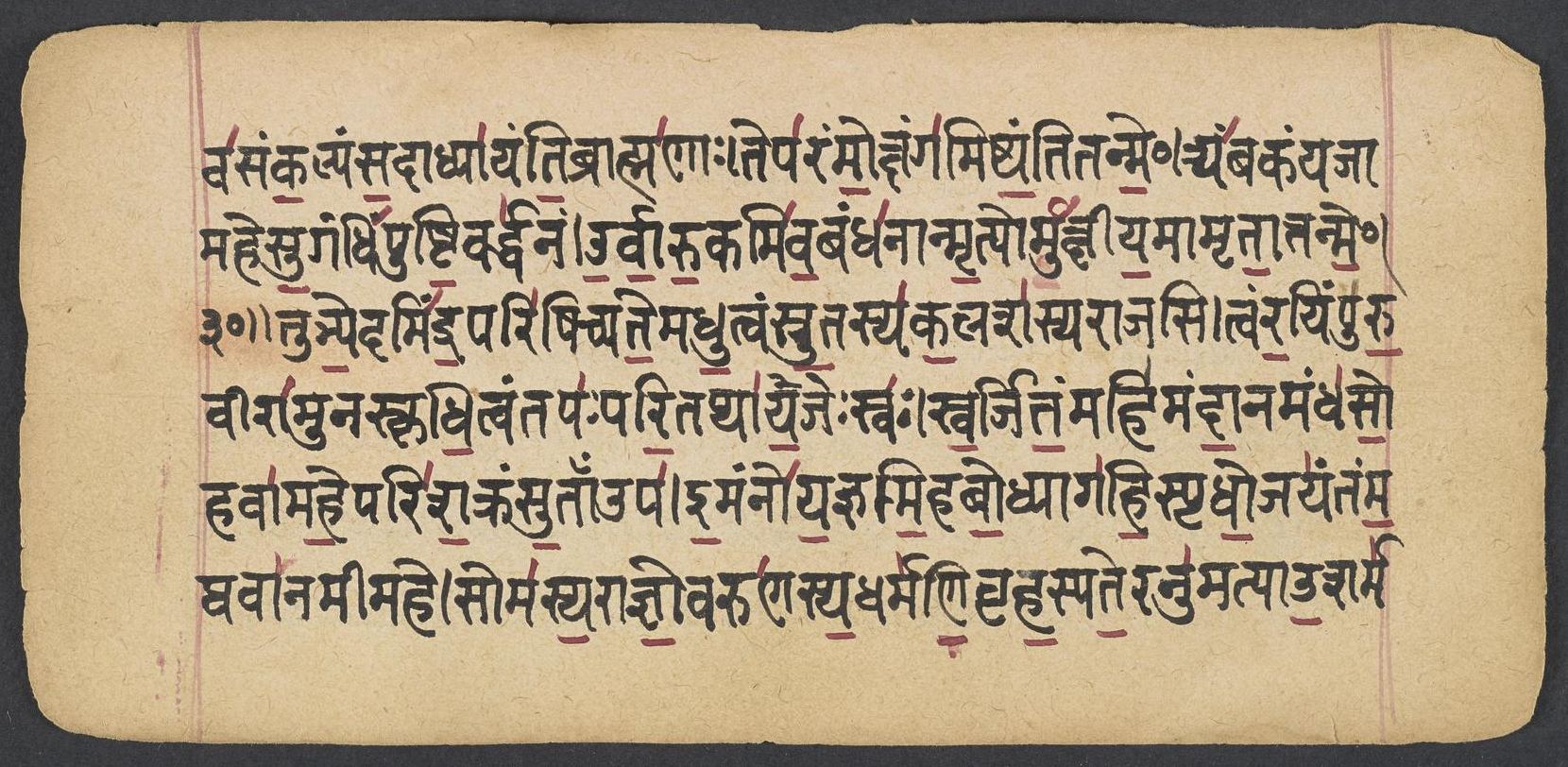
Where on the image
Penn Ms. Coll. 390 Item 48, fol. 146r (OPenn image 145, lower leaf). Checked on the image: the Rigveda text on this page begins in RV 10.167.1 ‹tubhyedam indra pari ṣicyate›. Lines 1-3 end the khila (tryambakaṃ yajāmahe) with a varga number; 10.167.1 begins in line 3. The next page with Rigveda text, fol. 146v, begins in RV 10.167.3 ‹-upastutau dhātar vidhātaḥ kalaśām̐›. Verses 10.167.1-2 end on this page.
1tubhye̱dam i̍ndra̱ pari̍ ṣicyate̱ madhu̱ tvaṁ su̱tasya̍ ka̱laśa̍sya rājasi | tvaṁ ra̱yim pu̍ru̱vīrā̍m u nas kṛdhi̱ tvaṁ tapa̍ḥ pari̱tapyā̍jaya̱ḥ sva̍ḥ ||
2sva̱rjita̱m mahi̍ mandā̱nam andha̍so̱ havā̍mahe̱ pari̍ śa̱kraṁ su̱tām̐ upa̍ | i̱maṁ no̍ ya̱jñam i̱ha bo̱dhy ā ga̍hi̱ spṛdho̱ jaya̍ntam ma̱ghavā̍nam īmahe ||
1THIS pleasant meath, O Indra, is effused for thee: thou art the ruling Lord of beaker and of juice. Bestow upon us wealth with many hero sons: thou, having glowed with Fervour, wortnest heavenly light.
2Let us call Ṣakra to libations here effused, winner of light who joyeth in the potent juice. Mark well this sacrifice of ours and come to us: we pray to Maghavan the Vanquisher of hosts.
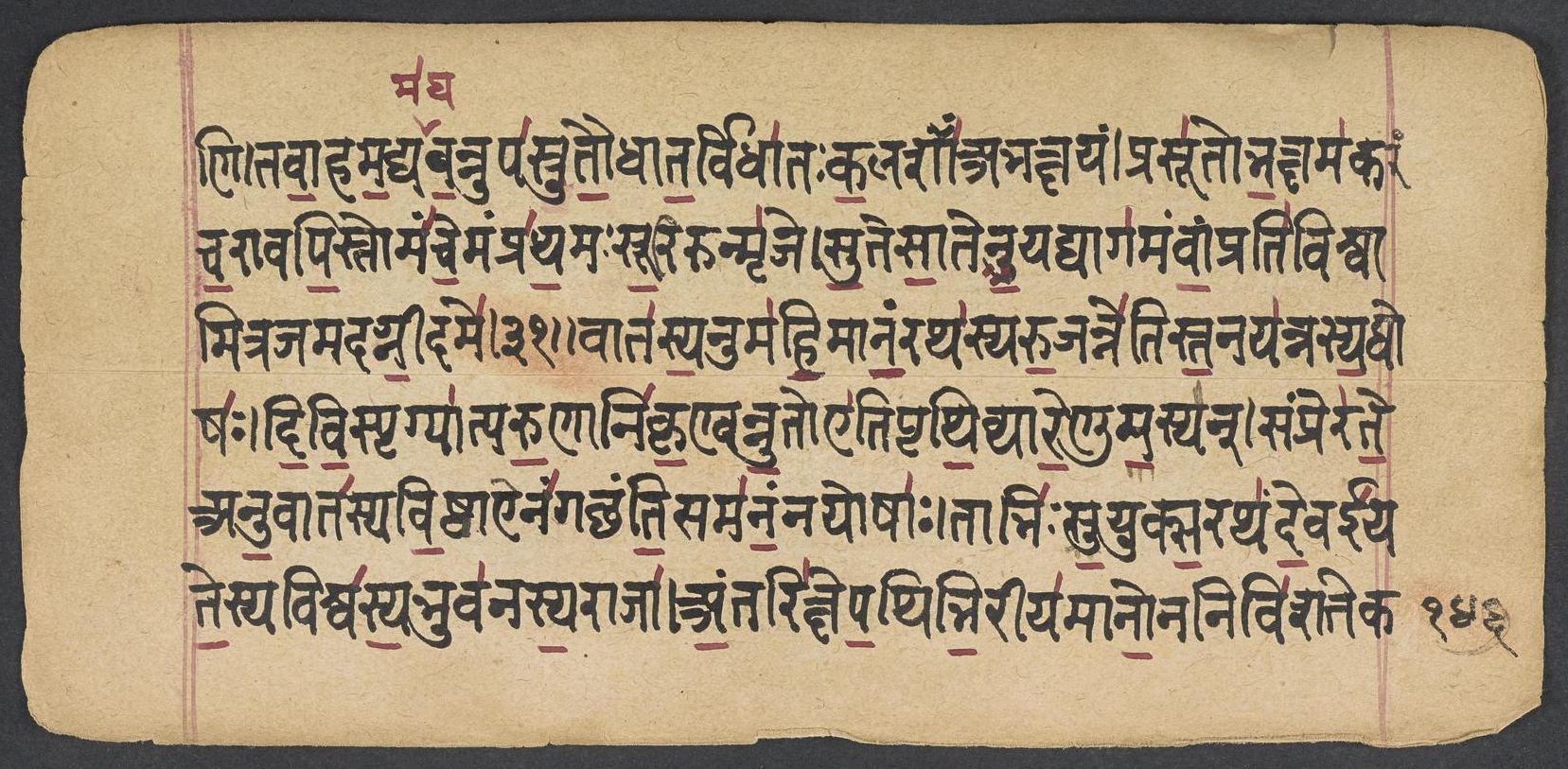
Where on the image
Penn Ms. Coll. 390 Item 48, fol. 146v (OPenn image 146, upper leaf). Checked on the image: the Rigveda text on this page begins in RV 10.167.3 ‹-upastutau dhātar vidhātaḥ kalaśām̐›. The next page with Rigveda text, fol. 147r, begins in RV 10.168.3 ‹-katamac canāhaḥ›. Verses 10.167.3-4 end on this page; 10.167.3 begins on fol. 146r.
3soma̍sya̱ rājño̱ varu̍ṇasya̱ dharma̍ṇi̱ bṛha̱spate̱r anu̍matyā u̱ śarma̍ṇi | tavā̱ham a̱dya ma̍ghava̱nn upa̍stutau̱ dhāta̱r vidhā̍taḥ ka̱laśā̍m̐ abhakṣayam ||
4prasū̍to bha̱kṣam a̍karaṁ ca̱rāv api̱ stoma̍ṁ ce̱mam pra̍tha̱maḥ sū̱rir un mṛ̍je | su̱te sā̱tena̱ yady āga̍maṁ vā̱m prati̍ viśvāmitrajamadagnī̱ dame̍ ||
3By royal Soma's and by Varuṇa's decree, under Br̥ihaspati's and Anumati's guard, This day by thine authority, O Maghavan, Maker, Disposer thou! have I enjoyed the jars.
4I, too, urged on, have had my portion, in the bowl, and as first Prince I drew forth this my hymn of praise, When with the prize I came unto the flowing juice, O Viṣvâmitra, Jamadagni, to your home.
Notes
- Sanskrit: Aufrecht's edition (1877) with the Vedic accents, as entered by van Nooten and Holland (GRETIL).
- English: Ralph T. H. Griffith, The Hymns of the Rigveda (1889-1892; 2nd ed. 1896-1897), from the VedaWeb digital text; OCR slips in that text were corrected against the printed 2nd edition (data/sources/rigveda/griffith_errata.json).
- This manuscript inserts khila verses (supplementary hymns outside Aufrecht's text) at some hymn ends; they are noted in the section notes and not reproduced.
Cite
Sources
- Source: Penn Ms. Coll. 390 Item 48 (1711 CE (colophon: Saṃvat 1768)), OPenn, Public Domain Mark + Aufrecht's accented text (GRETIL) + Griffith's English (VedaWeb) (holding institution)
- Critical edition: Aufrecht (1877), accented e-text via GRETIL
← previous · → next · v cycle view · l back to library