Rigveda 10.183: For the birth of a son
Introduction
Rigveda 10.183 is a hymn of 3 verses addressed to for the birth of a son. It stands in book (maṇḍala) 10, the last and latest book. The Rigveda is the oldest collection of Sanskrit hymns, composed in the second half of the second millennium BCE and handed down orally for many centuries before it was written down.
The manuscript shown is Penn Ms. Coll. 390 Item 48 (University of Pennsylvania), a paper manuscript of the eighth aṣṭaka (RV 10.46-10.191) of the Ṛgveda Saṃhitā in Devanāgarī, 158 leaves, 6 lines to the page, with the accents marked in red; the scribe's colophon on fol. 158 gives Saṃvat 1768 (1711 CE); this hymn stands on fol. 152v-153r. Each section below gives the verses that end on one page; the page boundaries were read on the images (the opening words of every page), not counted out. Like most Rigveda manuscripts, Penn Ms. Coll. 390 Item 48 writes a repeated refrain in short form after its first occurrence (for example kasmai° for kasmai devāya haviṣā vidhema); the Sanskrit shown is the full text of Aufrecht's edition.
How was this verified? (Provenance)
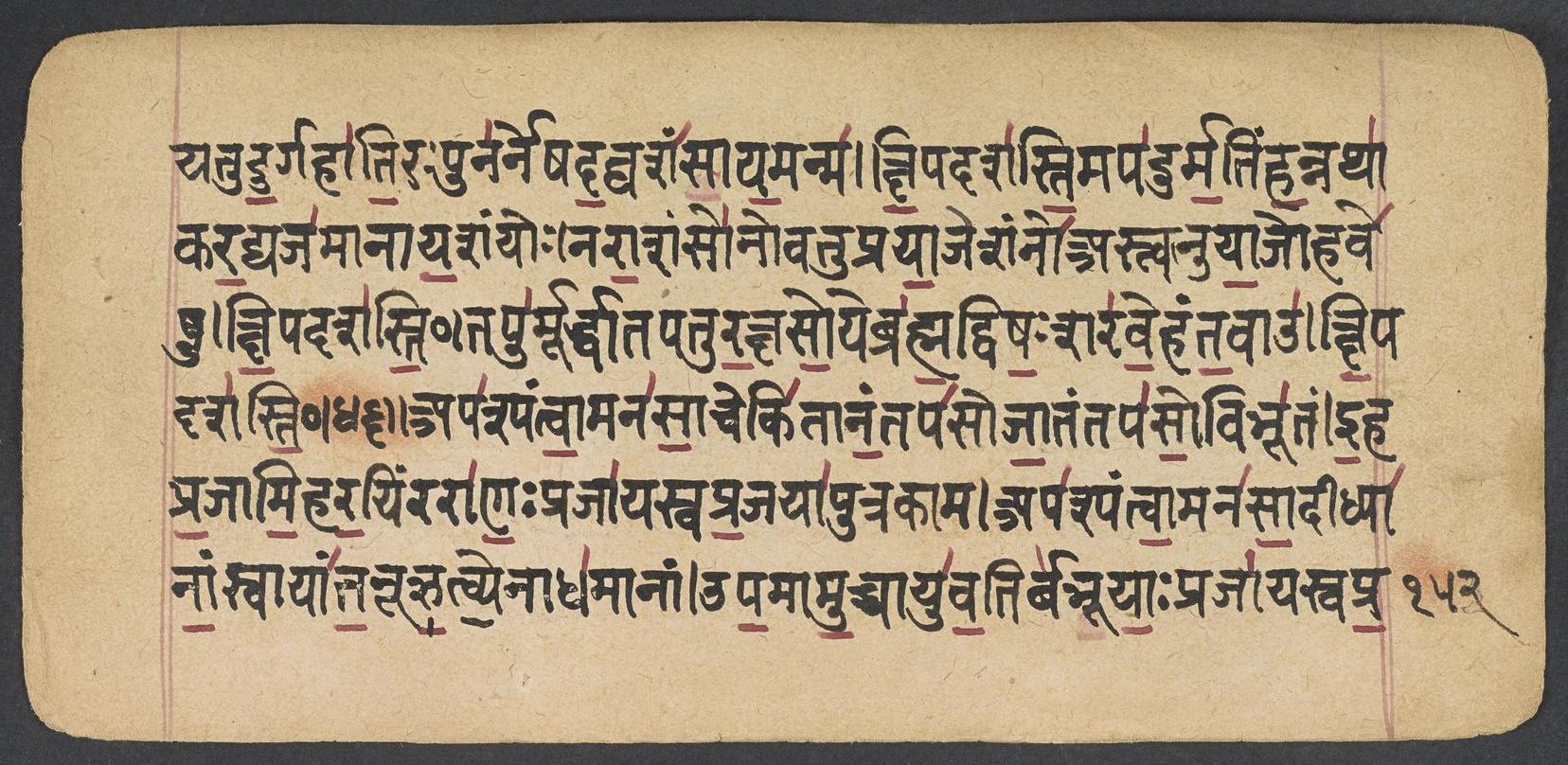
Where on the image
Penn Ms. Coll. 390 Item 48, fol. 152v (OPenn image 152, upper leaf). Checked on the image: the Rigveda text on this page begins in RV 10.182.1 ‹nayatu durgahā tiraḥ punar›. The next page with Rigveda text, fol. 153r, begins in RV 10.183.2 ‹-prajayā putrakāme›. Verse 10.183.1 ends on this page.
1apa̍śyaṁ tvā̱ mana̍sā̱ ceki̍tāna̱ṁ tapa̍so jā̱taṁ tapa̍so̱ vibhū̍tam | i̱ha pra̱jām i̱ha ra̱yiṁ rarā̍ṇa̱ḥ pra jā̍yasva pra̱jayā̍ putrakāma ||
1I SAW thee meditating in thy spirit what sprang from Fervour and hath thence developed. Bestowing offspring here, bestowing riches, spread in thine offspring, thou who cravest children.
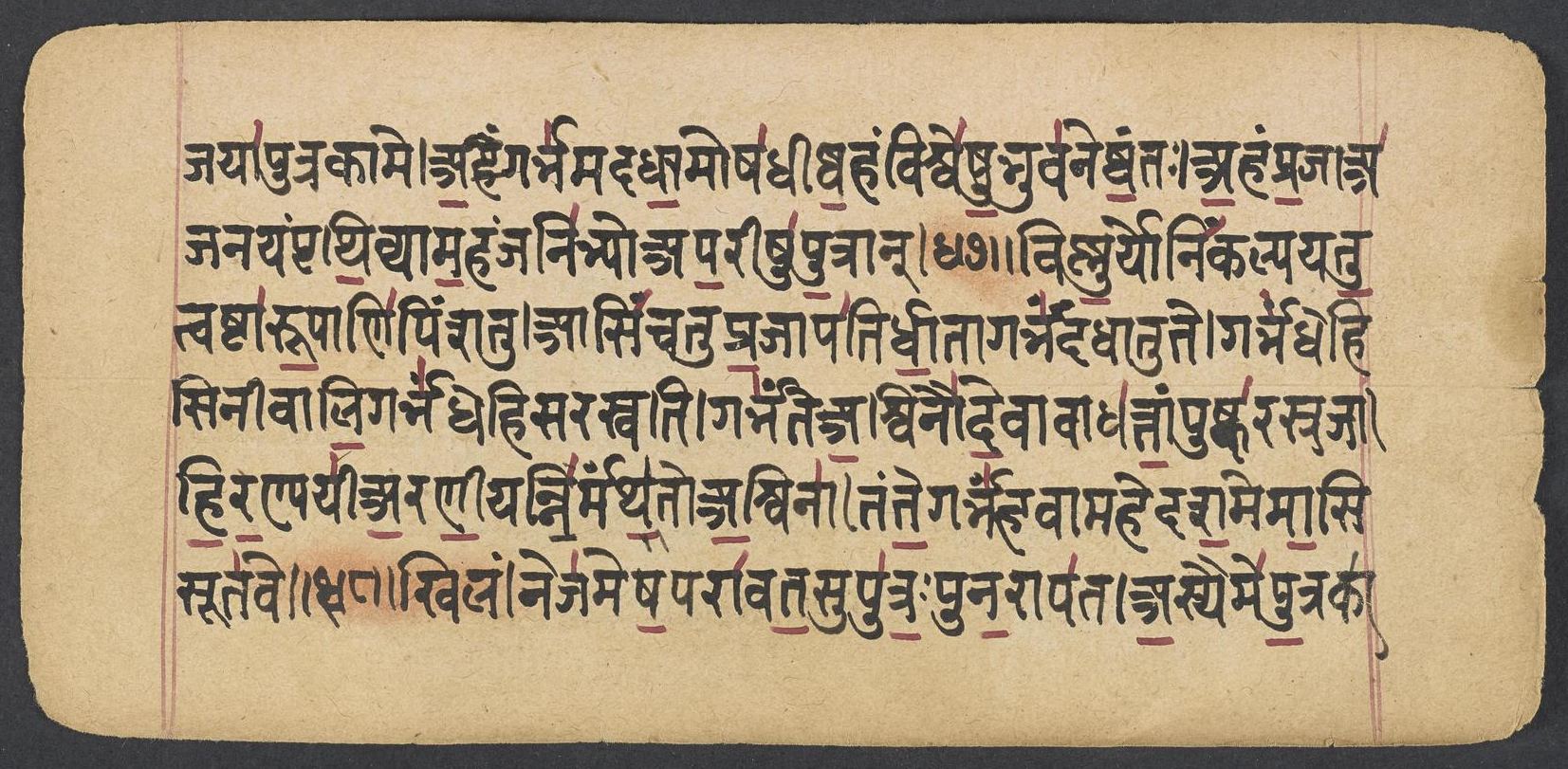
Where on the image
Penn Ms. Coll. 390 Item 48, fol. 153r (OPenn image 152, lower leaf). Checked on the image: the Rigveda text on this page begins in RV 10.183.2 ‹-prajayā putrakāme›. 10.184.3 ends in line 6 with a varga number, followed by the heading khilaṃ and a khila (nejameṣa parā pata) that runs to 153v line 3. The next page with Rigveda text, fol. 153v, begins in RV 10.185.1 ‹mahi trīṇām avo 'stu›. Verses 10.183.2-3 end on this page; 10.183.2 begins on fol. 152v.
2apa̍śyaṁ tvā̱ mana̍sā̱ dīdhyā̍nā̱ṁ svāyā̍ṁ ta̱nū ṛtvye̱ nādha̍mānām | upa̱ mām u̱ccā yu̍va̱tir ba̍bhūyā̱ḥ pra jā̍yasva pra̱jayā̍ putrakāme ||
3a̱haṁ garbha̍m adadhā̱m oṣa̍dhīṣv a̱haṁ viśve̍ṣu̱ bhuva̍neṣv a̱ntaḥ | a̱ham pra̱jā a̍janayam pṛthi̱vyām a̱haṁ jani̍bhyo apa̱rīṣu̍ pu̱trān ||
2I saw thee pondering in thine heart, and praying that in due time thy body might be fruitful. Come as a youthful woman, rise to meet me: spread in thine offspring, thou who cravest children.
3In plants and herbs, in all existent beings I have deposited the germ of increase. All progeny on earth have I engendered, and sons in women who will be hereafter.
Notes
- Sanskrit: Aufrecht's edition (1877) with the Vedic accents, as entered by van Nooten and Holland (GRETIL).
- English: Ralph T. H. Griffith, The Hymns of the Rigveda (1889-1892; 2nd ed. 1896-1897), from the VedaWeb digital text; OCR slips in that text were corrected against the printed 2nd edition (data/sources/rigveda/griffith_errata.json).
- This manuscript inserts khila verses (supplementary hymns outside Aufrecht's text) at some hymn ends; they are noted in the section notes and not reproduced.
Cite
Sources
- Source: Penn Ms. Coll. 390 Item 48 (1711 CE (colophon: Saṃvat 1768)), OPenn, Public Domain Mark + Aufrecht's accented text (GRETIL) + Griffith's English (VedaWeb) (holding institution)
- Critical edition: Aufrecht (1877), accented e-text via GRETIL
← previous · → next · v cycle view · l back to library