Rigveda 10.184: Prayer for good conception and birth
Introduction
Rigveda 10.184 is a hymn of 3 verses addressed to prayer for good conception and birth. It stands in book (maṇḍala) 10, the last and latest book. The Rigveda is the oldest collection of Sanskrit hymns, composed in the second half of the second millennium BCE and handed down orally for many centuries before it was written down.
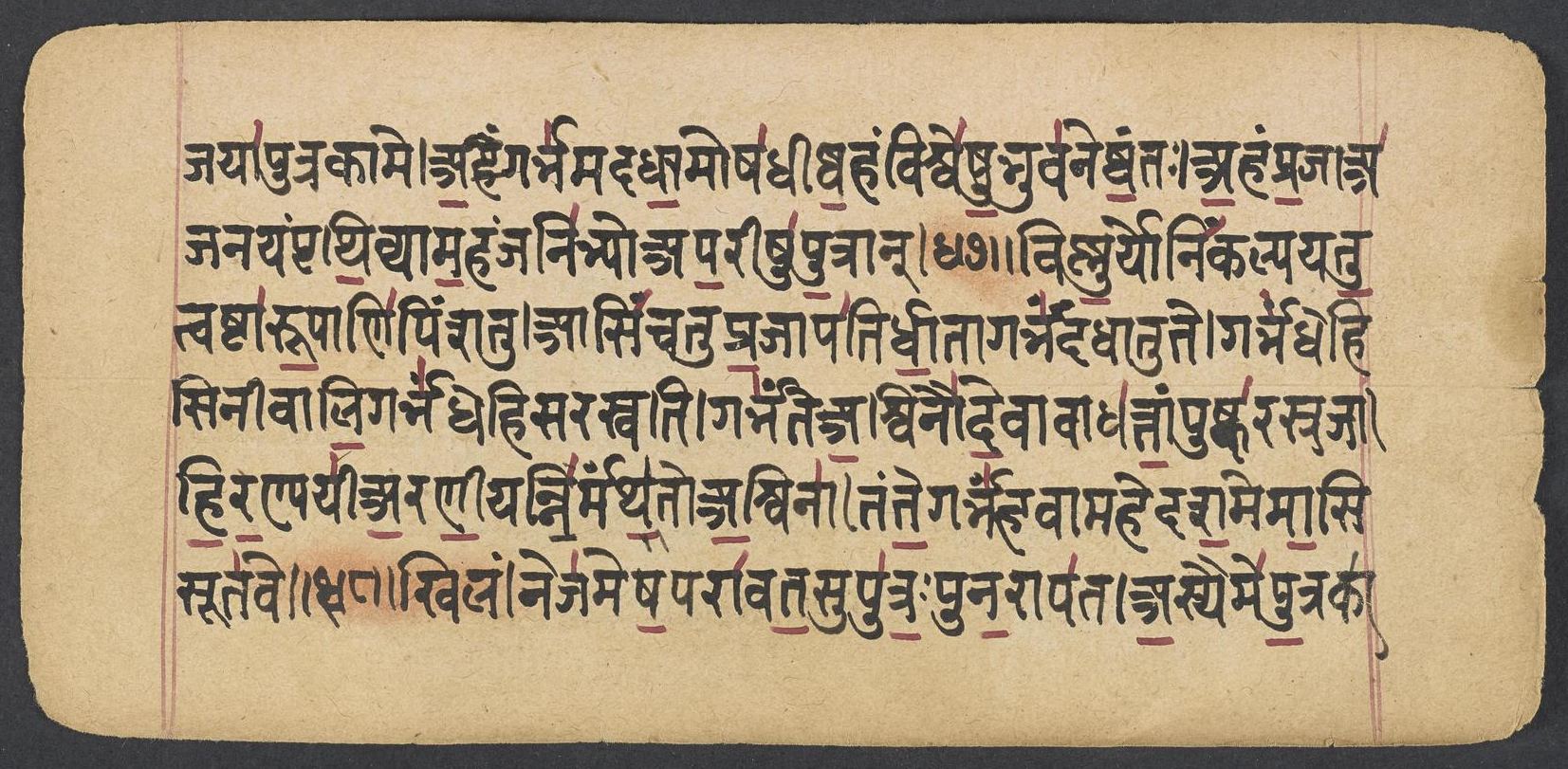
The manuscript shown is Penn Ms. Coll. 390 Item 48 (University of Pennsylvania), a paper manuscript of the eighth aṣṭaka (RV 10.46-10.191) of the Ṛgveda Saṃhitā in Devanāgarī, 158 leaves, 6 lines to the page, with the accents marked in red; the scribe's colophon on fol. 158 gives Saṃvat 1768 (1711 CE); this hymn stands on fol. 153r. Each section below gives the verses that end on one page; the page boundaries were read on the images (the opening words of every page), not counted out. Like most Rigveda manuscripts, Penn Ms. Coll. 390 Item 48 writes a repeated refrain in short form after its first occurrence (for example kasmai° for kasmai devāya haviṣā vidhema); the Sanskrit shown is the full text of Aufrecht's edition.
How was this verified? (Provenance)
Where on the image
Penn Ms. Coll. 390 Item 48, fol. 153r (OPenn image 152, lower leaf). Checked on the image: the Rigveda text on this page begins in RV 10.183.2 ‹-prajayā putrakāme›. 10.184.3 ends in line 6 with a varga number, followed by the heading khilaṃ and a khila (nejameṣa parā pata) that runs to 153v line 3. The next page with Rigveda text, fol. 153v, begins in RV 10.185.1 ‹mahi trīṇām avo 'stu›. Verses 10.184.1-3 end on this page.
1viṣṇu̱r yoni̍ṁ kalpayatu̱ tvaṣṭā̍ rū̱pāṇi̍ piṁśatu | ā si̍ñcatu pra̱jāpa̍tir dhā̱tā garbha̍ṁ dadhātu te ||
2garbha̍ṁ dhehi sinīvāli̱ garbha̍ṁ dhehi sarasvati | garbha̍ṁ te a̱śvinau̍ de̱vāv ā dha̍ttā̱m puṣka̍rasrajā ||
3hi̱ra̱ṇyayī̍ a̱raṇī̱ yaṁ ni̱rmantha̍to a̱śvinā̍ | taṁ te̱ garbha̍ṁ havāmahe daśa̱me mā̱si sūta̍ve ||
1MAY Vishṇu form and mould the womb, may Tvashṭar duly shape the forms, Prajâpati infuse the stream, and Dhatar lay the germ for thee.
2O Sinîvâlî, set the germ, set thou the germ, Sarasvatî: May the Twain Gods bestow the germ, the Aṣvins crowned with lotuses.
3That which the Aṣvins Twain rub forth with the attrition-sticks of gold,– That germ of thine we invocate, that in the tenth month thou mayst bear.
Notes
- Sanskrit: Aufrecht's edition (1877) with the Vedic accents, as entered by van Nooten and Holland (GRETIL).
- English: Ralph T. H. Griffith, The Hymns of the Rigveda (1889-1892; 2nd ed. 1896-1897), from the VedaWeb digital text; OCR slips in that text were corrected against the printed 2nd edition (data/sources/rigveda/griffith_errata.json).
- This manuscript inserts khila verses (supplementary hymns outside Aufrecht's text) at some hymn ends; they are noted in the section notes and not reproduced.
Cite
Sources
- Source: Penn Ms. Coll. 390 Item 48 (1711 CE (colophon: Saṃvat 1768)), OPenn, Public Domain Mark + Aufrecht's accented text (GRETIL) + Griffith's English (VedaWeb) (holding institution)
- Critical edition: Aufrecht (1877), accented e-text via GRETIL
← previous · → next · v cycle view · l back to library