Rigveda 10.185: To Aditi
Introduction
Rigveda 10.185 is a hymn of 3 verses addressed to Aditi. It stands in book (maṇḍala) 10, the last and latest book. The Rigveda is the oldest collection of Sanskrit hymns, composed in the second half of the second millennium BCE and handed down orally for many centuries before it was written down.
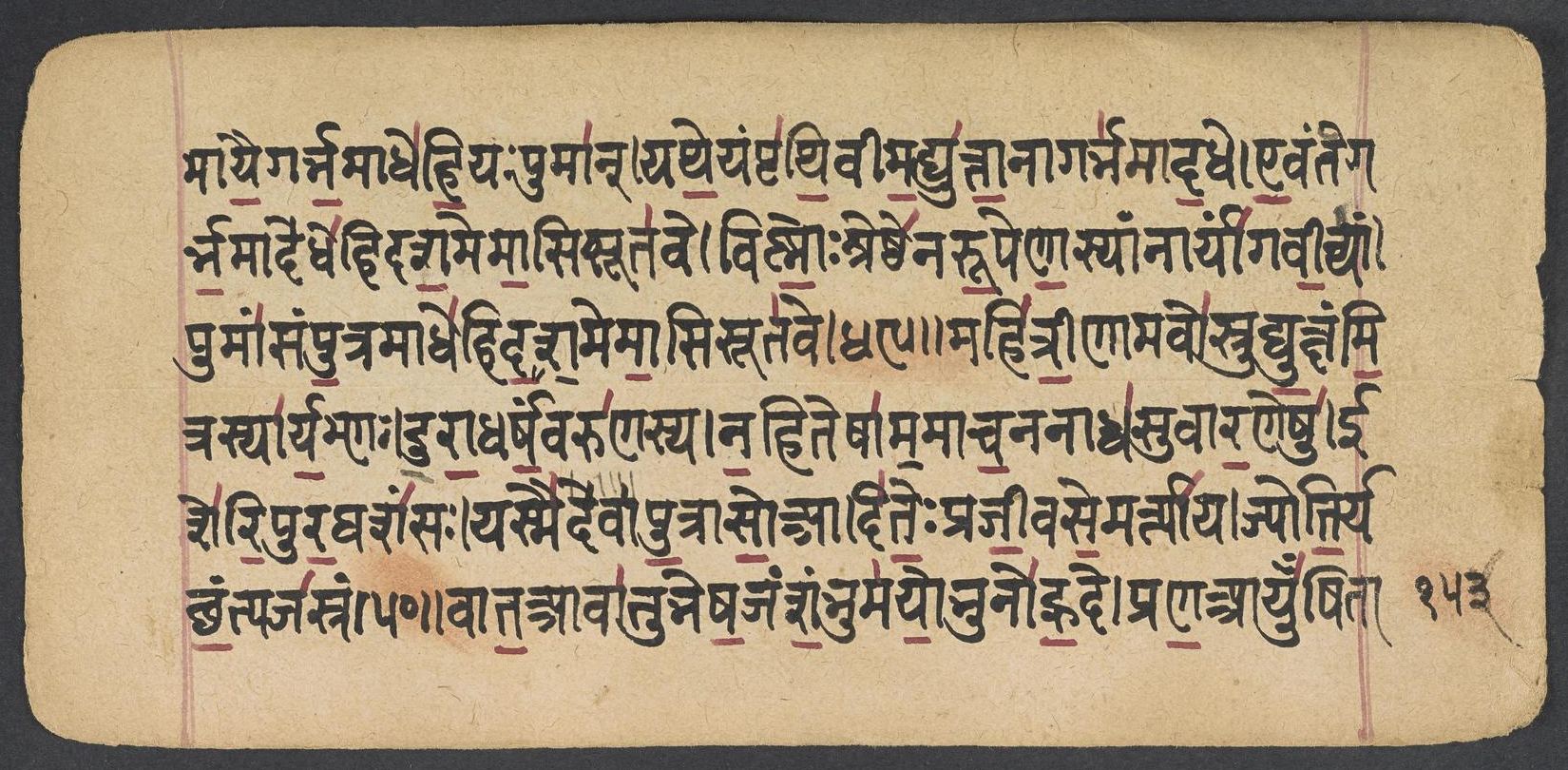
The manuscript shown is Penn Ms. Coll. 390 Item 48 (University of Pennsylvania), a paper manuscript of the eighth aṣṭaka (RV 10.46-10.191) of the Ṛgveda Saṃhitā in Devanāgarī, 158 leaves, 6 lines to the page, with the accents marked in red; the scribe's colophon on fol. 158 gives Saṃvat 1768 (1711 CE); this hymn stands on fol. 153v. Each section below gives the verses that end on one page; the page boundaries were read on the images (the opening words of every page), not counted out. Like most Rigveda manuscripts, Penn Ms. Coll. 390 Item 48 writes a repeated refrain in short form after its first occurrence (for example kasmai° for kasmai devāya haviṣā vidhema); the Sanskrit shown is the full text of Aufrecht's edition.
How was this verified? (Provenance)
Where on the image
Penn Ms. Coll. 390 Item 48, fol. 153v (OPenn image 153, upper leaf). Checked on the image: the Rigveda text on this page begins in RV 10.185.1 ‹mahi trīṇām avo 'stu›. Lines 1-3 continue the khila begun on 153r with a varga number; 10.185.1 begins in line 3. The next page with Rigveda text, fol. 154r, begins in RV 10.186.1 ‹-tāriṣat›. Verses 10.185.1-3 end on this page.
1mahi̍ trī̱ṇām avo̍ 'stu dyu̱kṣam mi̱trasyā̍rya̱mṇaḥ | du̱rā̱dharṣa̱ṁ varu̍ṇasya ||
2na̱hi teṣā̍m a̱mā ca̱na nādhva̍su vāra̱ṇeṣu̍ | īśe̍ ri̱pur a̱ghaśa̍ṁsaḥ ||
3yasmai̍ pu̱trāso̱ adi̍te̱ḥ pra jī̱vase̱ martyā̍ya | jyoti̱r yaccha̱nty aja̍sram ||
1GREAT, unassailable must he the heavenly favour of' Three Gods, Varuṇa, Mitra, Aryaman.
2O'er these, neither at home nor yet abroad or pathways that are Strange, The evil-minded foe hath power
3Nor over him,. the man on whom the Sons of Aditi bestow Eternal light that he may live.
Notes
- Sanskrit: Aufrecht's edition (1877) with the Vedic accents, as entered by van Nooten and Holland (GRETIL).
- English: Ralph T. H. Griffith, The Hymns of the Rigveda (1889-1892; 2nd ed. 1896-1897), from the VedaWeb digital text; OCR slips in that text were corrected against the printed 2nd edition (data/sources/rigveda/griffith_errata.json).
- This manuscript inserts khila verses (supplementary hymns outside Aufrecht's text) at some hymn ends; they are noted in the section notes and not reproduced.
Cite
Sources
- Source: Penn Ms. Coll. 390 Item 48 (1711 CE (colophon: Saṃvat 1768)), OPenn, Public Domain Mark + Aufrecht's accented text (GRETIL) + Griffith's English (VedaWeb) (holding institution)
- Critical edition: Aufrecht (1877), accented e-text via GRETIL
← previous · → next · v cycle view · l back to library