Rigveda 10.50: To Indra
Introduction
Rigveda 10.50 is a hymn of 7 verses addressed to Indra. It stands in book (maṇḍala) 10, the last and latest book. The Rigveda is the oldest collection of Sanskrit hymns, composed in the second half of the second millennium BCE and handed down orally for many centuries before it was written down.
The manuscript shown is Penn Ms. Coll. 390 Item 48 (University of Pennsylvania), a paper manuscript of the eighth aṣṭaka (RV 10.46-10.191) of the Ṛgveda Saṃhitā in Devanāgarī, 158 leaves, 6 lines to the page, with the accents marked in red; the scribe's colophon on fol. 158 gives Saṃvat 1768 (1711 CE); this hymn stands on fol. 6v-7r. Each section below gives the verses that end on one page; the page boundaries were read on the images (the opening words of every page), not counted out. Like most Rigveda manuscripts, Penn Ms. Coll. 390 Item 48 writes a repeated refrain in short form after its first occurrence (for example kasmai° for kasmai devāya haviṣā vidhema); the Sanskrit shown is the full text of Aufrecht's edition.
How was this verified? (Provenance)
Where on the image
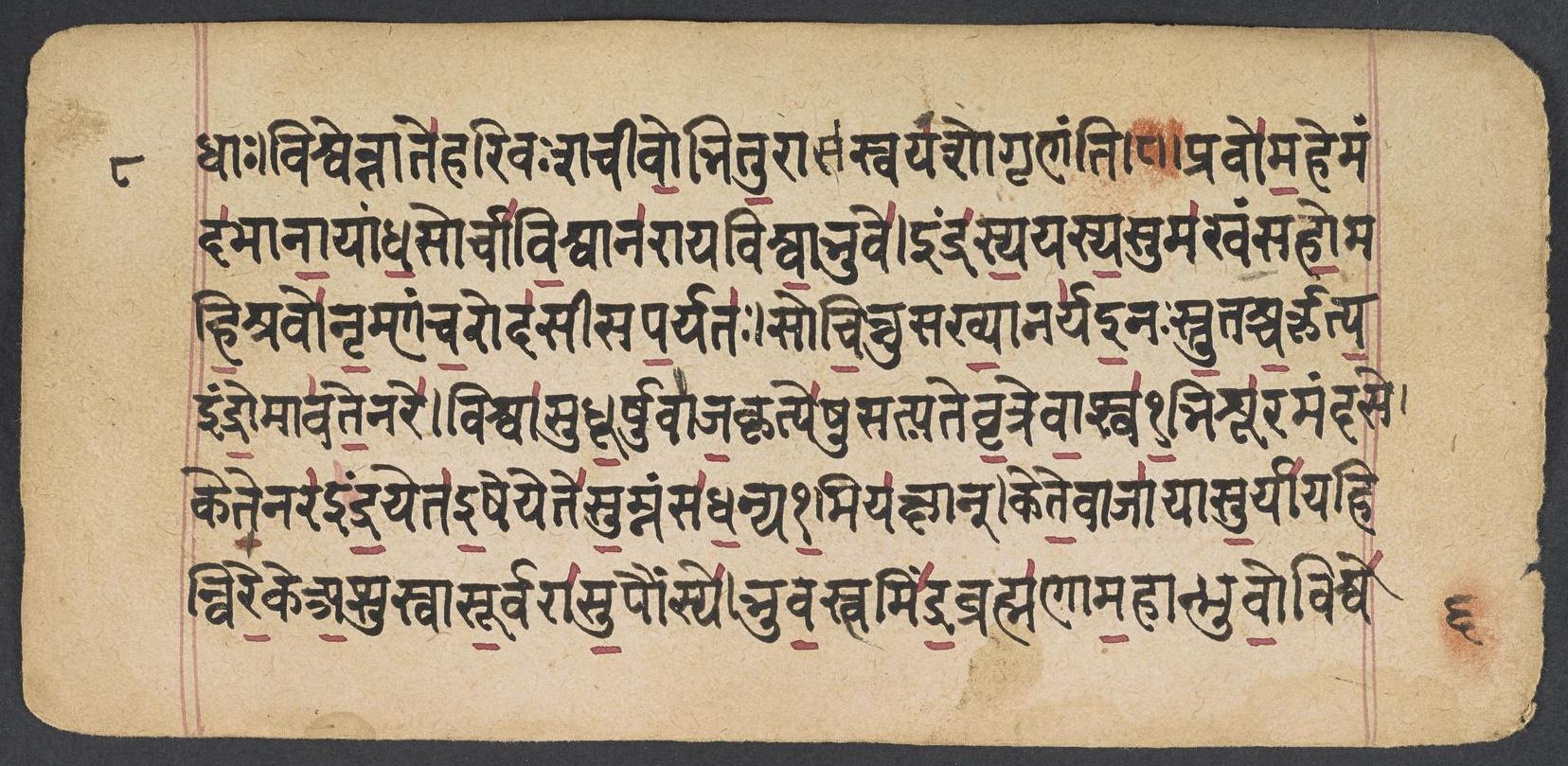
Penn Ms. Coll. 390 Item 48, fol. 6v (OPenn image 6, upper leaf). Checked on the image: the Rigveda text on this page begins in RV 10.49.11 ‹-satyarādhāḥ›. The next page with Rigveda text, fol. 7r, begins in RV 10.50.4 ‹-viśveṣu savaneṣu yajñiyaḥ›. Verses 10.50.1-3 end on this page.
1pra vo̍ ma̱he manda̍mānā̱yāndha̱so 'rcā̍ vi̱śvāna̍rāya viśvā̱bhuve̍ | indra̍sya̱ yasya̱ suma̍kha̱ṁ saho̱ mahi̱ śravo̍ nṛ̱mṇaṁ ca̱ roda̍sī sapa̱ryata̍ḥ ||
2so ci̱n nu sakhyā̱ narya̍ i̱naḥ stu̱taś ca̱rkṛtya̱ indro̱ māva̍te̱ nare̍ | viśvā̍su dhū̱rṣu vā̍ja̱kṛtye̍ṣu satpate vṛ̱tre vā̱psv a1̱̍bhi śū̍ra mandase ||
3ke te nara̍ indra̱ ye ta̍ i̱ṣe ye te̍ su̱mnaṁ sa̍dha̱nya1̱̍m iya̍kṣān | ke te̱ vājā̍yāsu̱ryā̍ya hinvire̱ ke a̱psu svāsū̱rvarā̍su̱ pauṁsye̍ ||
1I LAUD your Mighty One who joyeth in the juice, him who is shared by all men, who created all; Indra, whose conquering strength is powerful in war, whose fame and manly vigour Heaven and Earth revere.
2He with his friend is active, lauded, good to man, Indra who must be glorified by one like me. Hero, Lord of the brave, all cars are thy delight, warring with Vr̥itra, or for waters, or for spoil.
3Who are the men whom thou wilt further, Indra, who strive to win thy bliss allied with riches? Who urged thee forward to exert thy power divine, to valour, in the war for waters on their fields?
Where on the image
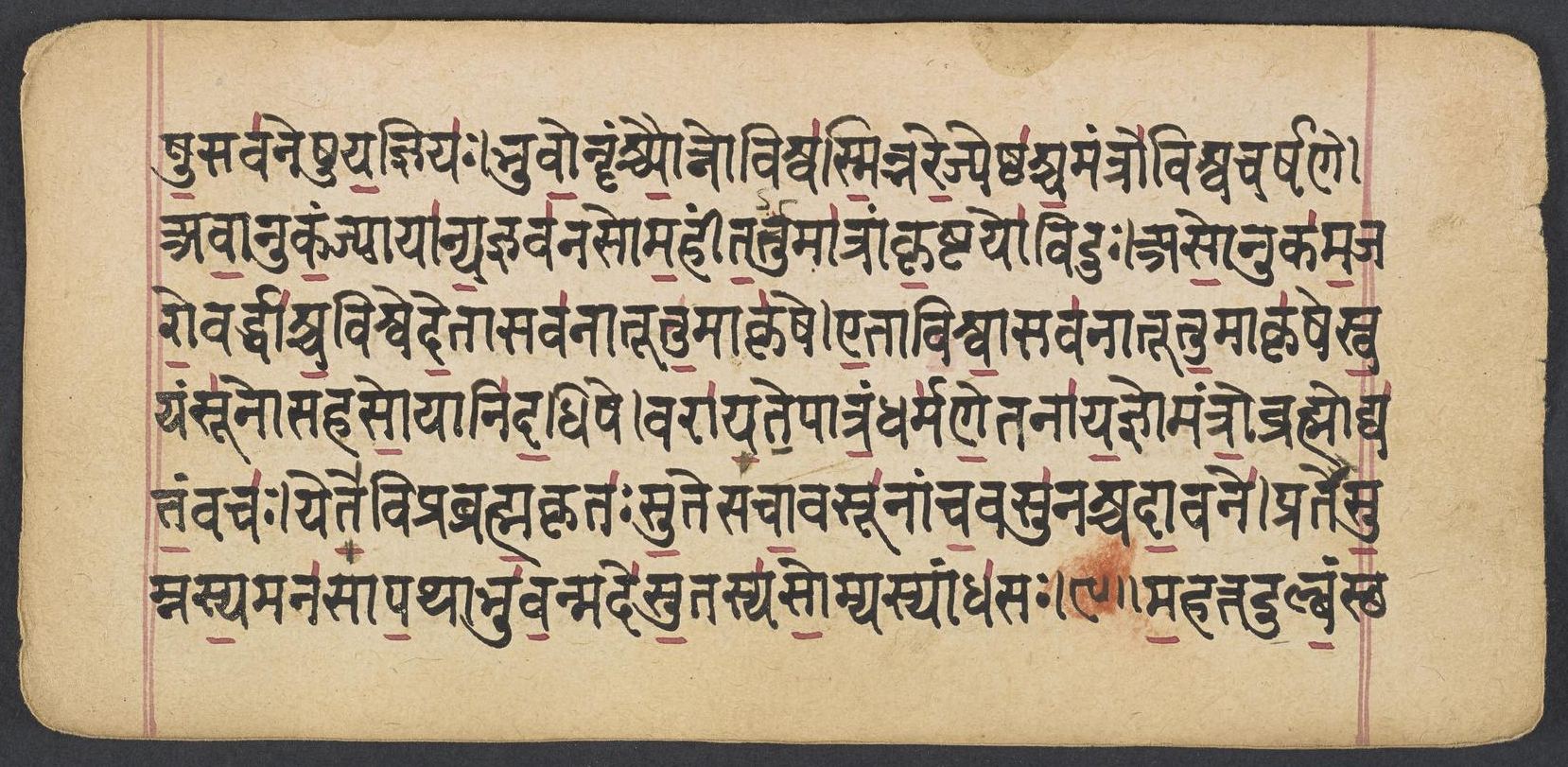
Penn Ms. Coll. 390 Item 48, fol. 7r (OPenn image 6, lower leaf). Checked on the image: the Rigveda text on this page begins in RV 10.50.4 ‹-viśveṣu savaneṣu yajñiyaḥ›. The next page with Rigveda text, fol. 7v, begins in RV 10.51.1 ‹-sthaviraṁ tad āsīd yenāviṣṭitaḥ›. Verses 10.50.4-7 end on this page; 10.50.4 begins on fol. 6v.
4bhuva̱s tvam i̍ndra̱ brahma̍ṇā ma̱hān bhuvo̱ viśve̍ṣu̱ sava̍neṣu ya̱jñiya̍ḥ | bhuvo̱ nṝm̐ś cyau̱tno viśva̍smi̱n bhare̱ jyeṣṭha̍ś ca̱ mantro̍ viśvacarṣaṇe ||
5avā̱ nu ka̱ṁ jyāyā̍n ya̱jñava̍naso ma̱hīṁ ta̱ omā̍trāṁ kṛ̱ṣṭayo̍ viduḥ | aso̱ nu ka̍m a̱jaro̱ vardhā̍ś ca̱ viśved e̱tā sava̍nā tūtu̱mā kṛ̍ṣe ||
6e̱tā viśvā̱ sava̍nā tūtu̱mā kṛ̍ṣe sva̱yaṁ sū̍no sahaso̱ yāni̍ dadhi̱ṣe | varā̍ya te̱ pātra̱ṁ dharma̍ṇe̱ tanā̍ ya̱jño mantro̱ brahmodya̍ta̱ṁ vaca̍ḥ ||
7ye te̍ vipra brahma̱kṛta̍ḥ su̱te sacā̱ vasū̍nāṁ ca̱ vasu̍naś ca dā̱vane̍ | pra te su̱mnasya̱ mana̍sā pa̱thā bhu̍va̱n made̍ su̱tasya̍ so̱myasyāndha̍saḥ ||
4Thou, Indra, through the holy prayer art mighty, worthy of sacrifice at all libations. In every fight thou castest heroes on the ground: thou art the noblest song, O Lord of all the folk.
5Help now, as Highest, those who toil at sacrifice: well do the people know thy great protecting might. Thou shalt be Everlasting, Giver of success yea, on all these libations thou bestowest strength.
6All these libations thou makest effectual, of which thou art thyself supporter, Son of Power. Therefore thy vessel is to be esteemed the best, sacrifice, holy text, prayer, and exalted speech.
7They who with flowing Soma pray to thee, O Sage, to pour on them thy gifts of opulence and wealth, May they come forward, through their spirit, on the path of bliss, in the wild joy of Soma juice effused.
Notes
- Sanskrit: Aufrecht's edition (1877) with the Vedic accents, as entered by van Nooten and Holland (GRETIL).
- English: Ralph T. H. Griffith, The Hymns of the Rigveda (1889-1892; 2nd ed. 1896-1897), from the VedaWeb digital text; OCR slips in that text were corrected against the printed 2nd edition (data/sources/rigveda/griffith_errata.json).
Cite
Sources
- Source: Penn Ms. Coll. 390 Item 48 (1711 CE (colophon: Saṃvat 1768)), OPenn, Public Domain Mark + Aufrecht's accented text (GRETIL) + Griffith's English (VedaWeb) (holding institution)
- Critical edition: Aufrecht (1877), accented e-text via GRETIL
← previous · → next · v cycle view · l back to library