Rigveda 10.58: Bringing back the spirit
Introduction
Rigveda 10.58 is a hymn of 12 verses addressed to bringing back the spirit. It stands in book (maṇḍala) 10, the last and latest book. The Rigveda is the oldest collection of Sanskrit hymns, composed in the second half of the second millennium BCE and handed down orally for many centuries before it was written down.
The manuscript shown is Penn Ms. Coll. 390 Item 48 (University of Pennsylvania), a paper manuscript of the eighth aṣṭaka (RV 10.46-10.191) of the Ṛgveda Saṃhitā in Devanāgarī, 158 leaves, 6 lines to the page, with the accents marked in red; the scribe's colophon on fol. 158 gives Saṃvat 1768 (1711 CE); this hymn stands on fol. 14r-14v. Each section below gives the verses that end on one page; the page boundaries were read on the images (the opening words of every page), not counted out. Like most Rigveda manuscripts, Penn Ms. Coll. 390 Item 48 writes a repeated refrain in short form after its first occurrence (for example kasmai° for kasmai devāya haviṣā vidhema); the Sanskrit shown is the full text of Aufrecht's edition.
How was this verified? (Provenance)
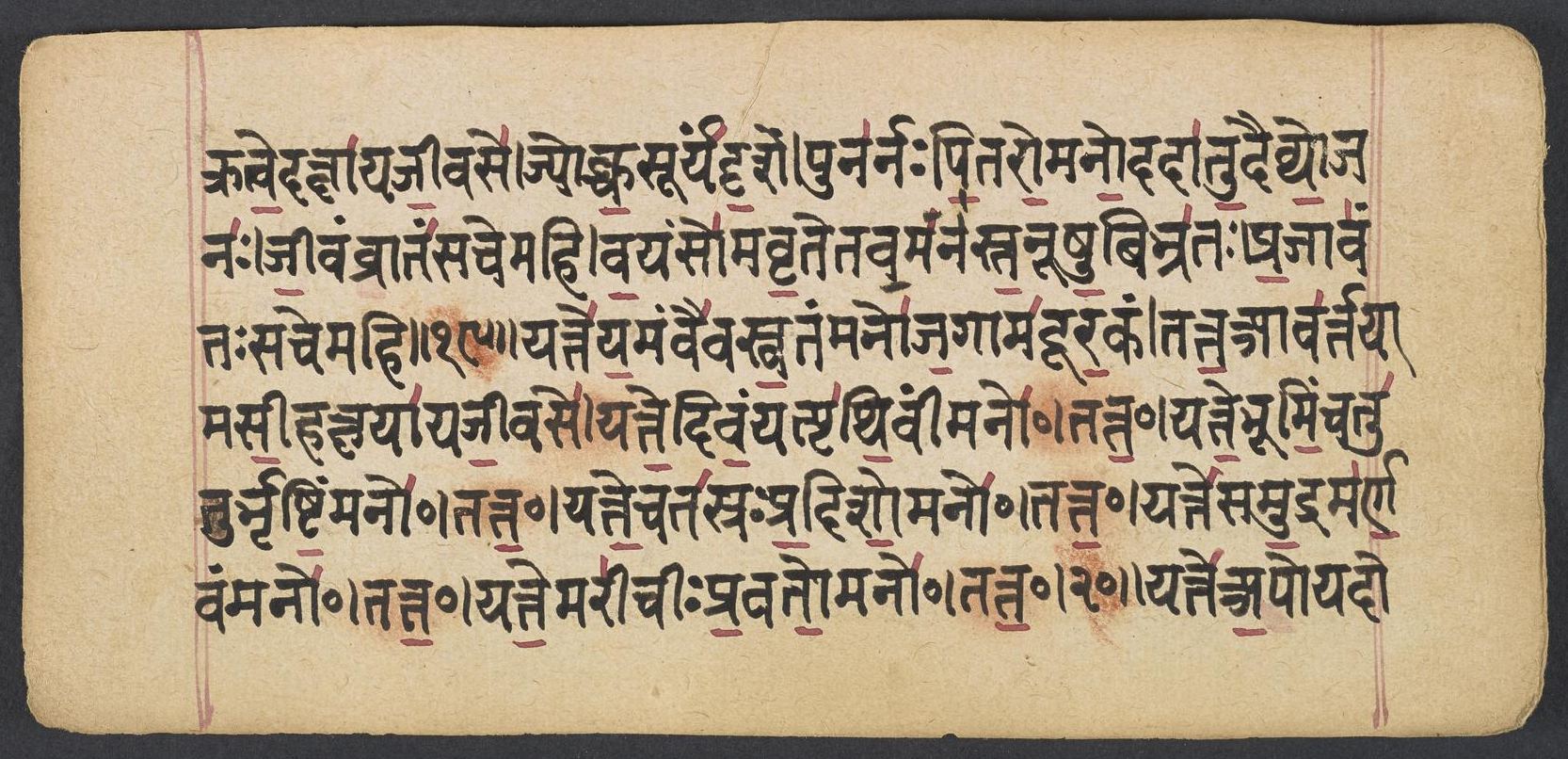
Where on the image
Penn Ms. Coll. 390 Item 48, fol. 14r (OPenn image 13, lower leaf). Checked on the image: the Rigveda text on this page begins in RV 10.57.4 ‹kratve dakṣāya jīvase›. The next page with Rigveda text, fol. 14v, begins in RV 10.58.7 ‹-yad oṣadhīr mano jagāma›. Verses 10.58.1-6 end on this page.
1yat te̍ ya̱maṁ vai̍vasva̱tam mano̍ ja̱gāma̍ dūra̱kam | tat ta̱ ā va̍rtayāmasī̱ha kṣayā̍ya jī̱vase̍ ||
2yat te̱ diva̱ṁ yat pṛ̍thi̱vīm mano̍ ja̱gāma̍ dūra̱kam | tat ta̱ ā va̍rtayāmasī̱ha kṣayā̍ya jī̱vase̍ ||
3yat te̱ bhūmi̱ṁ catu̍rbhṛṣṭi̱m mano̍ ja̱gāma̍ dūra̱kam | tat ta̱ ā va̍rtayāmasī̱ha kṣayā̍ya jī̱vase̍ ||
4yat te̱ cata̍sraḥ pra̱diśo̱ mano̍ ja̱gāma̍ dūra̱kam | tat ta̱ ā va̍rtayāmasī̱ha kṣayā̍ya jī̱vase̍ ||
5yat te̍ samu̱dram a̍rṇa̱vam mano̍ ja̱gāma̍ dūra̱kam | tat ta̱ ā va̍rtayāmasī̱ha kṣayā̍ya jī̱vase̍ ||
6yat te̱ marī̍cīḥ pra̱vato̱ mano̍ ja̱gāma̍ dūra̱kam | tat ta̱ ā va̍rtayāmasī̱ha kṣayā̍ya jī̱vase̍ ||
1THY spirit, that went far away to Yama to Vivasvan's Son, We cause to come to thee again that thou mayst live and sojourn here.
2Thy spirit, that went far away, that passed away to earth and heaven, We cause to come to thee again that thou mayst live and sojourn here.
3Thy spirit, that went far away, away to the four-cornered earth, We cause to come to thee again that thou mayst live and sojourn here.
4Thy spirit, that went far away to the four quarters of the world, We cause to come to thee again that thou mayst live and sojourn here.
5Thy spirit, that went far away, away unto the billowy sea, We cause to come to thee again that thou mayst live and sojourn here.
6Thy spirit, that went far away to beams of light that flash and flow, We cause to come to thee again that thou mayst live and sojourn here.
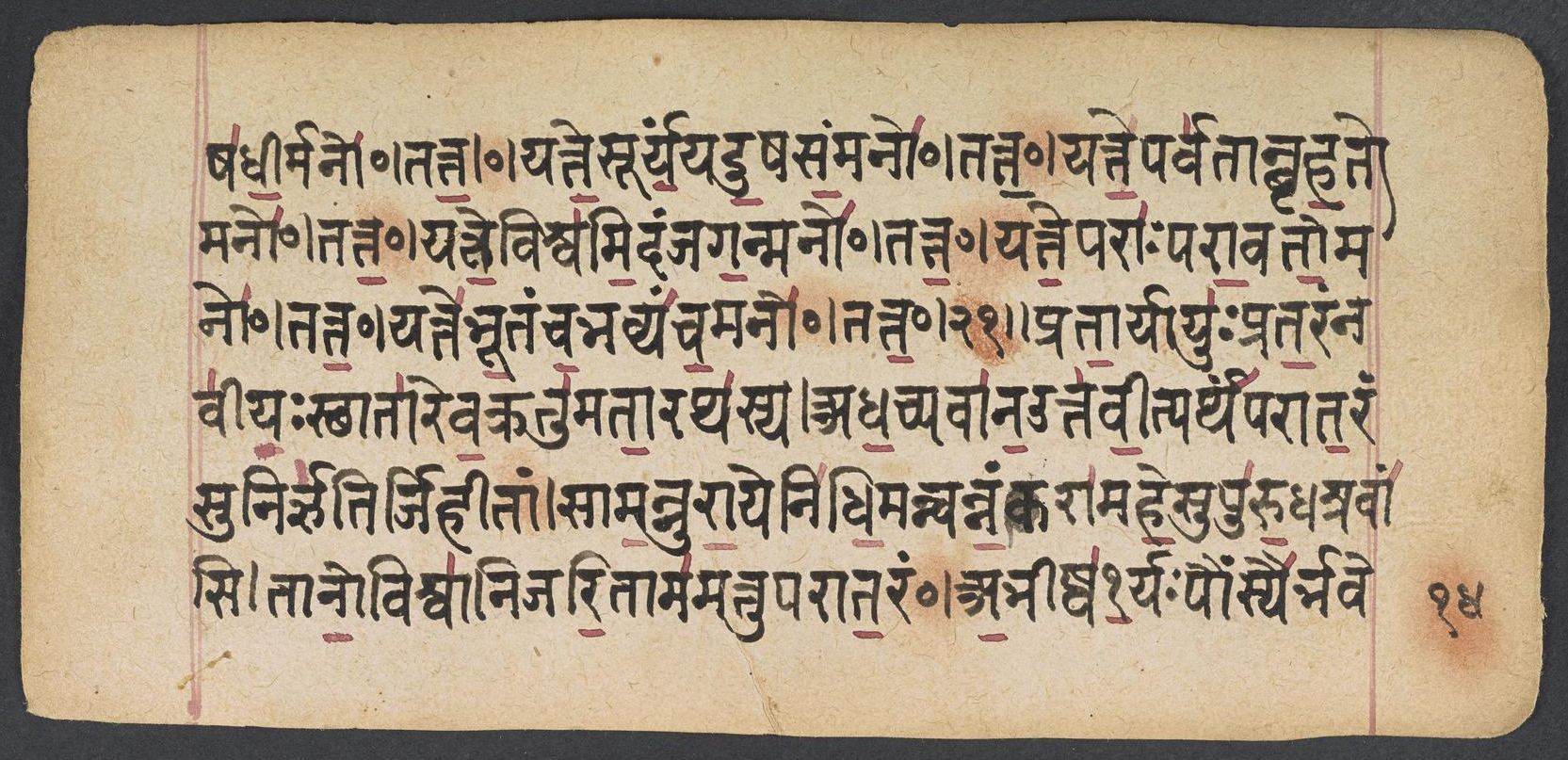
Where on the image
Penn Ms. Coll. 390 Item 48, fol. 14v (OPenn image 14, upper leaf). Checked on the image: the Rigveda text on this page begins in RV 10.58.7 ‹-yad oṣadhīr mano jagāma›. The next page with Rigveda text, fol. 15r, begins in RV 10.59.3 ‹dyaur na bhūmiṁ girayo›. Verses 10.58.7-12 end on this page; 10.58.7 begins on fol. 14r.
7yat te̍ a̱po yad oṣa̍dhī̱r mano̍ ja̱gāma̍ dūra̱kam | tat ta̱ ā va̍rtayāmasī̱ha kṣayā̍ya jī̱vase̍ ||
8yat te̱ sūrya̱ṁ yad u̱ṣasa̱m mano̍ ja̱gāma̍ dūra̱kam | tat ta̱ ā va̍rtayāmasī̱ha kṣayā̍ya jī̱vase̍ ||
9yat te̱ parva̍tān bṛha̱to mano̍ ja̱gāma̍ dūra̱kam | tat ta̱ ā va̍rtayāmasī̱ha kṣayā̍ya jī̱vase̍ ||
10yat te̱ viśva̍m i̱daṁ jaga̱n mano̍ ja̱gāma̍ dūra̱kam | tat ta̱ ā va̍rtayāmasī̱ha kṣayā̍ya jī̱vase̍ ||
11yat te̱ parā̍ḥ parā̱vato̱ mano̍ ja̱gāma̍ dūra̱kam | tat ta̱ ā va̍rtayāmasī̱ha kṣayā̍ya jī̱vase̍ ||
12yat te̍ bhū̱taṁ ca̱ bhavya̍ṁ ca̱ mano̍ ja̱gāma̍ dūra̱kam | tat ta̱ ā va̍rtayāmasī̱ha kṣayā̍ya jī̱vase̍ ||
7Thy spirit, that went far away, went to the waters and the plants, We cause to come to thee again that thou mayst live and sojourn here.
8Thy spirit, that went far away, that visited the Sun and Dawn. We cause to come to thee again that thou mayst live and sojourn here.
9Thy spirit, that went far away, away to lofty mountain heights, We cause to come to thee again that thou mayst live and sojourn here.
10Thy spirit, that went far away into this All, that lives and moves, We cause to come to thee again that thou mayst live and sojourn here.
11Thy spirit, that went far away to distant realms beyond our ken, We cause to come to thee again that thou mayst live and sojourn here.
12Thy spirit, that went far away to all that is and is to be, We cause to come to thee again that thou mayst live and sojourn heie.
Notes
- Sanskrit: Aufrecht's edition (1877) with the Vedic accents, as entered by van Nooten and Holland (GRETIL).
- English: Ralph T. H. Griffith, The Hymns of the Rigveda (1889-1892; 2nd ed. 1896-1897), from the VedaWeb digital text; OCR slips in that text were corrected against the printed 2nd edition (data/sources/rigveda/griffith_errata.json).
Cite
Sources
- Source: Penn Ms. Coll. 390 Item 48 (1711 CE (colophon: Saṃvat 1768)), OPenn, Public Domain Mark + Aufrecht's accented text (GRETIL) + Griffith's English (VedaWeb) (holding institution)
- Critical edition: Aufrecht (1877), accented e-text via GRETIL
← previous · → next · v cycle view · l back to library