Rigveda 10.82: Vishvakarman
Introduction
Rigveda 10.82 is a hymn of 7 verses addressed to Visvakarman. It stands in book (maṇḍala) 10, the last and latest book. The Rigveda is the oldest collection of Sanskrit hymns, composed in the second half of the second millennium BCE and handed down orally for many centuries before it was written down.
The manuscript shown is Penn Ms. Coll. 390 Item 48 (University of Pennsylvania), a paper manuscript of the eighth aṣṭaka (RV 10.46-10.191) of the Ṛgveda Saṃhitā in Devanāgarī, 158 leaves, 6 lines to the page, with the accents marked in red; the scribe's colophon on fol. 158 gives Saṃvat 1768 (1711 CE); this hymn stands on fol. 48r-48v. Each section below gives the verses that end on one page; the page boundaries were read on the images (the opening words of every page), not counted out. Like most Rigveda manuscripts, Penn Ms. Coll. 390 Item 48 writes a repeated refrain in short form after its first occurrence (for example kasmai° for kasmai devāya haviṣā vidhema); the Sanskrit shown is the full text of Aufrecht's edition.
How was this verified? (Provenance)
Where on the image
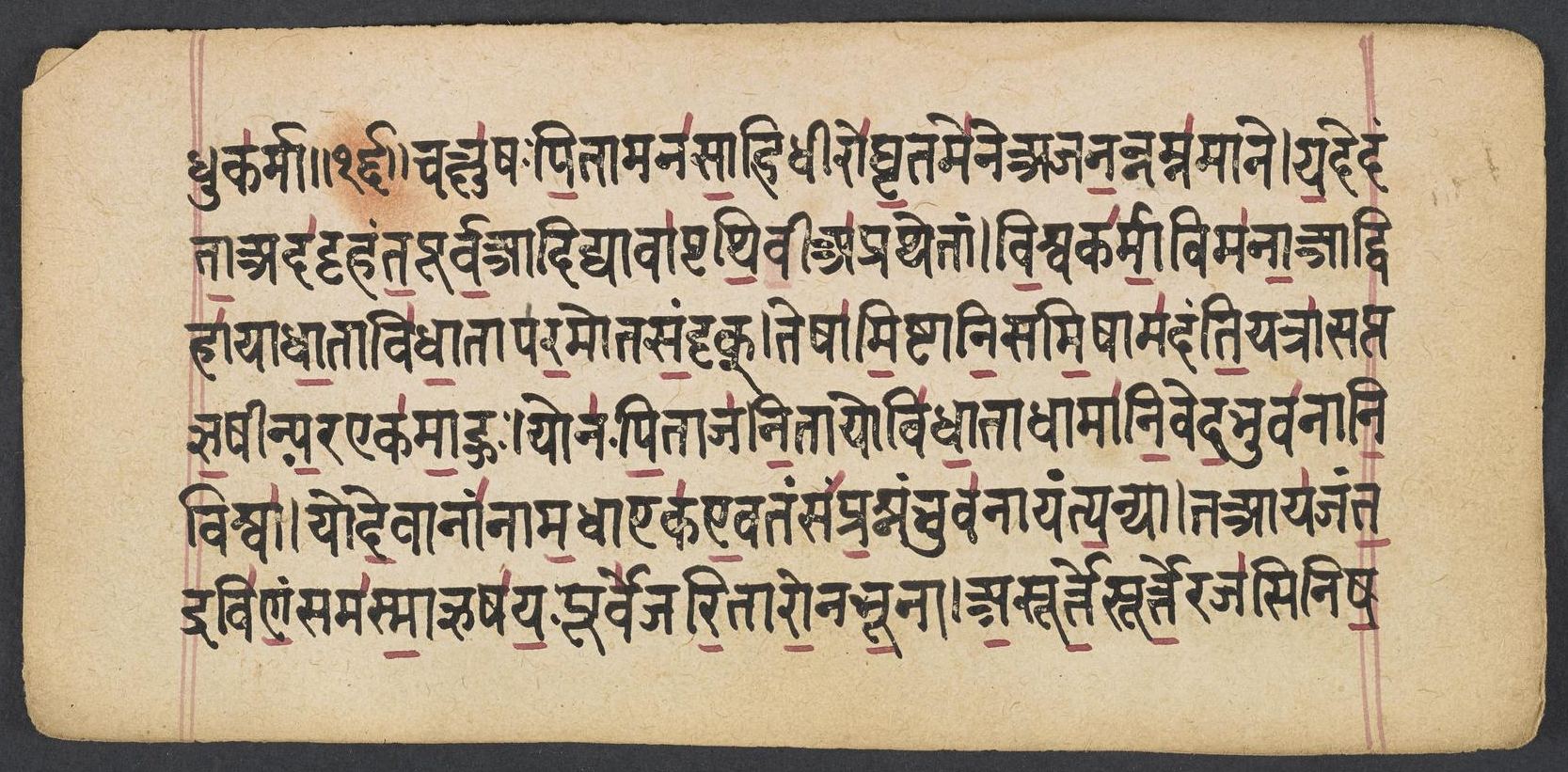
Penn Ms. Coll. 390 Item 48, fol. 48r (numbered 47r by the scribe) (OPenn image 47, lower leaf). Checked on the image: the Rigveda text on this page begins in RV 10.81.7 ‹-sādhukarmā›. The next page with Rigveda text, fol. 48v (numbered 47v by the scribe), begins in RV 10.82.4 ‹ye bhūtāni samakṛṇvann imāni›. Verses 10.82.1-3 end on this page.
1cakṣu̍ṣaḥ pi̱tā mana̍sā̱ hi dhīro̍ ghṛ̱tam e̍ne ajana̱n nanna̍māne | ya̱ded antā̱ ada̍dṛhanta̱ pūrva̱ ād id dyāvā̍pṛthi̱vī a̍prathetām ||
2vi̱śvaka̍rmā̱ vima̍nā̱ ād vihā̍yā dhā̱tā vi̍dhā̱tā pa̍ra̱mota sa̱ṁdṛk | teṣā̍m i̱ṣṭāni̱ sam i̱ṣā ma̍danti̱ yatrā̍ saptaṛ̱ṣīn pa̱ra eka̍m ā̱huḥ ||
3yo na̍ḥ pi̱tā ja̍ni̱tā yo vi̍dhā̱tā dhāmā̍ni̱ veda̱ bhuva̍nāni̱ viśvā̍ | yo de̱vānā̍ṁ nāma̱dhā eka̍ e̱va taṁ sa̍mpra̱śnam bhuva̍nā yanty a̱nyā ||
1THE Father of the eye, the Wise in spirit, created both these worlds submerged in fatness. Then when the eastern ends were firmly fastened, the heavens and the earth were far extended.
2Mighty in mind and power is Viṣvakarman, Maker, Disposer, and most lofty Presence. Their offerings joy in rich juice where they value One, only One, beyond the Seven R̥ishis.
3Father who made us, he who, as Disposer, knoweth all races and all things existing, Even he alone, the Deities' narne-giver,him other beings seek for information.
Where on the image
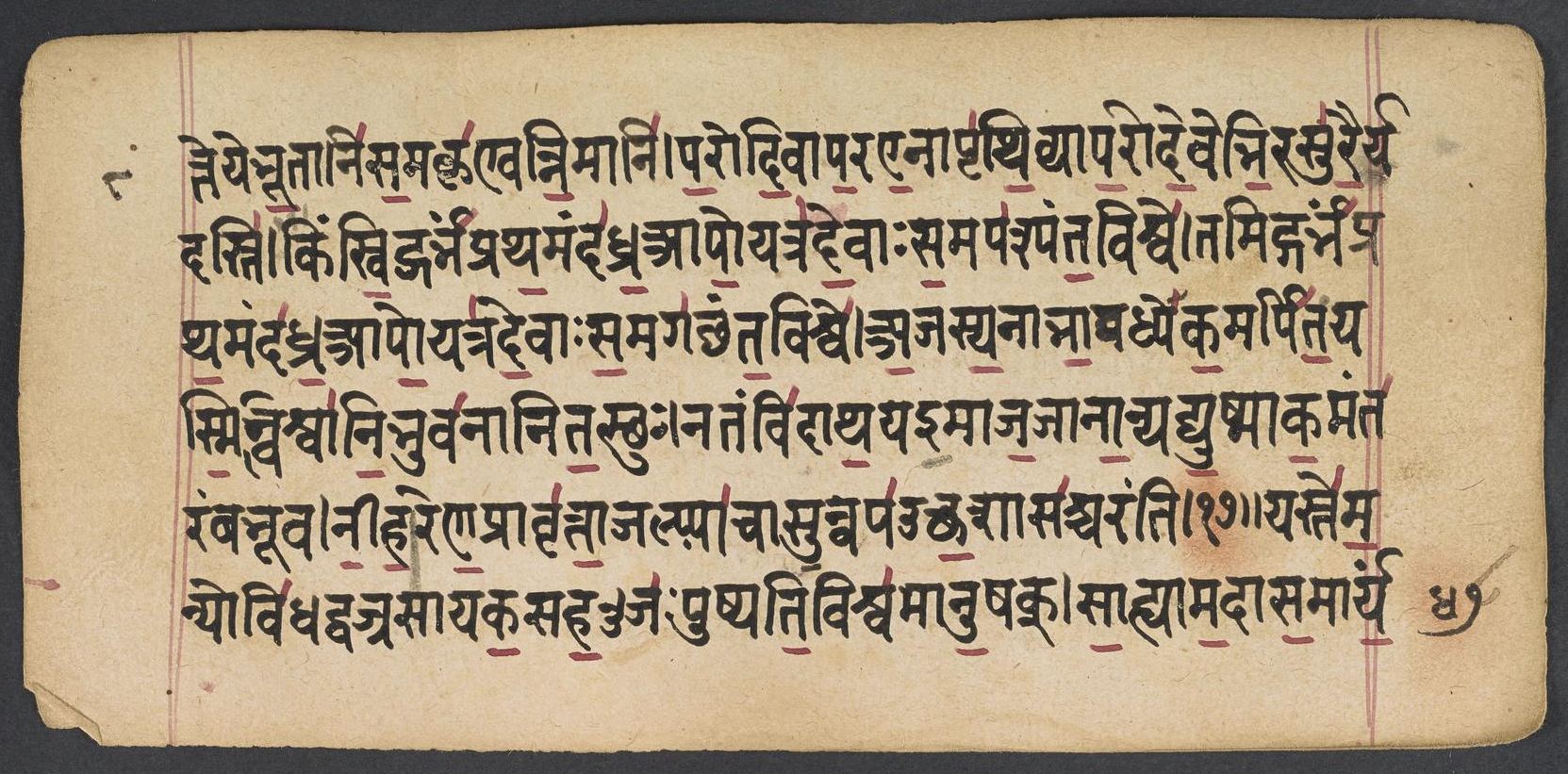
Penn Ms. Coll. 390 Item 48, fol. 48v (numbered 47v by the scribe) (OPenn image 48, upper leaf). Checked on the image: the Rigveda text on this page begins in RV 10.82.4 ‹ye bhūtāni samakṛṇvann imāni›. The next page with Rigveda text, fol. 49r (numbered 48r by the scribe), begins in RV 10.83.1 ‹tvayā yujā sahaskṛtena sahasā›. Verses 10.82.4-7 end on this page; 10.82.4 begins on fol. 48r (numbered 47r by the scribe).
4ta āya̍janta̱ dravi̍ṇa̱ṁ sam a̍smā̱ ṛṣa̍ya̱ḥ pūrve̍ jari̱tāro̱ na bhū̱nā | a̱sūrte̱ sūrte̱ raja̍si niṣa̱tte ye bhū̱tāni̍ sa̱makṛ̍ṇvann i̱māni̍ ||
5pa̱ro di̱vā pa̱ra e̱nā pṛ̍thi̱vyā pa̱ro de̱vebhi̱r asu̍rai̱r yad asti̍ | kaṁ svi̱d garbha̍m pratha̱maṁ da̍dhra̱ āpo̱ yatra̍ de̱vāḥ sa̱mapa̍śyanta̱ viśve̍ ||
6tam id garbha̍m pratha̱maṁ da̍dhra̱ āpo̱ yatra̍ de̱vāḥ sa̱maga̍cchanta̱ viśve̍ | a̱jasya̱ nābhā̱v adhy eka̱m arpi̍ta̱ṁ yasmi̱n viśvā̍ni̱ bhuva̍nāni ta̱sthuḥ ||
7na taṁ vi̍dātha̱ ya i̱mā ja̱jānā̱nyad yu̱ṣmāka̱m anta̍ram babhūva | nī̱hā̱reṇa̱ prāvṛ̍tā̱ jalpyā̍ cāsu̱tṛpa̍ uktha̱śāsa̍ś caranti ||
4To him in sacrifice they offered treasures,– R̥ishis of old, in numerous troops, as singers, Who, in the distant, near, and lower region, made ready all these things that have existence.
5That which is earlier than this earth and heaven, before the Asuras and Gods had being,– What was the germ primeval which the waters received where all the Gods were seen together?
6The waters, they received that germ primeval wherein the Gods were gathered all together. It rested set upon the Unborn's navel, that One wherein abide all things existing.
7Ye will not find him who produced these creatures: another thing hath risen up among you. Enwrapt in misty cloud, with lips that stammer, hymn-chanters wander and are discontented.
Notes
- Sanskrit: Aufrecht's edition (1877) with the Vedic accents, as entered by van Nooten and Holland (GRETIL).
- English: Ralph T. H. Griffith, The Hymns of the Rigveda (1889-1892; 2nd ed. 1896-1897), from the VedaWeb digital text; OCR slips in that text were corrected against the printed 2nd edition (data/sources/rigveda/griffith_errata.json).
Cite
Sources
- Source: Penn Ms. Coll. 390 Item 48 (1711 CE (colophon: Saṃvat 1768)), OPenn, Public Domain Mark + Aufrecht's accented text (GRETIL) + Griffith's English (VedaWeb) (holding institution)
- Critical edition: Aufrecht (1877), accented e-text via GRETIL
← previous · → next · v cycle view · l back to library