Rigveda 2.15: To Indra
Introduction
Rigveda 2.15 is a hymn of 10 verses addressed to Indra. It stands in book (maṇḍala) 2, the family book of Gṛtsamada. The Rigveda is the oldest collection of Sanskrit hymns, composed in the second half of the second millennium BCE and handed down orally for many centuries before it was written down.
The manuscript shown is Penn Ms. Coll. 390 Item 41 (University of Pennsylvania), an undated paper manuscript of the padapāṭha (the word-by-word recitation text, in which every word is written separately and compounds are split) of the whole Ṛgveda in Devanāgarī, 884 leaves in fascicles, 7-9 lines to the page, accents in red; this hymn stands on fol. 161r-161v. Each section below gives the verses that end on one page; the page boundaries were read on the images (the opening words of every page), not counted out. Where the manuscript is a padapāṭha (the word-by-word recitation text), the section shows Aufrecht's continuous (saṃhitā) text first and, as the edition text, the padapāṭha of the same verses, which is the form written on the page.
How was this verified? (Provenance)
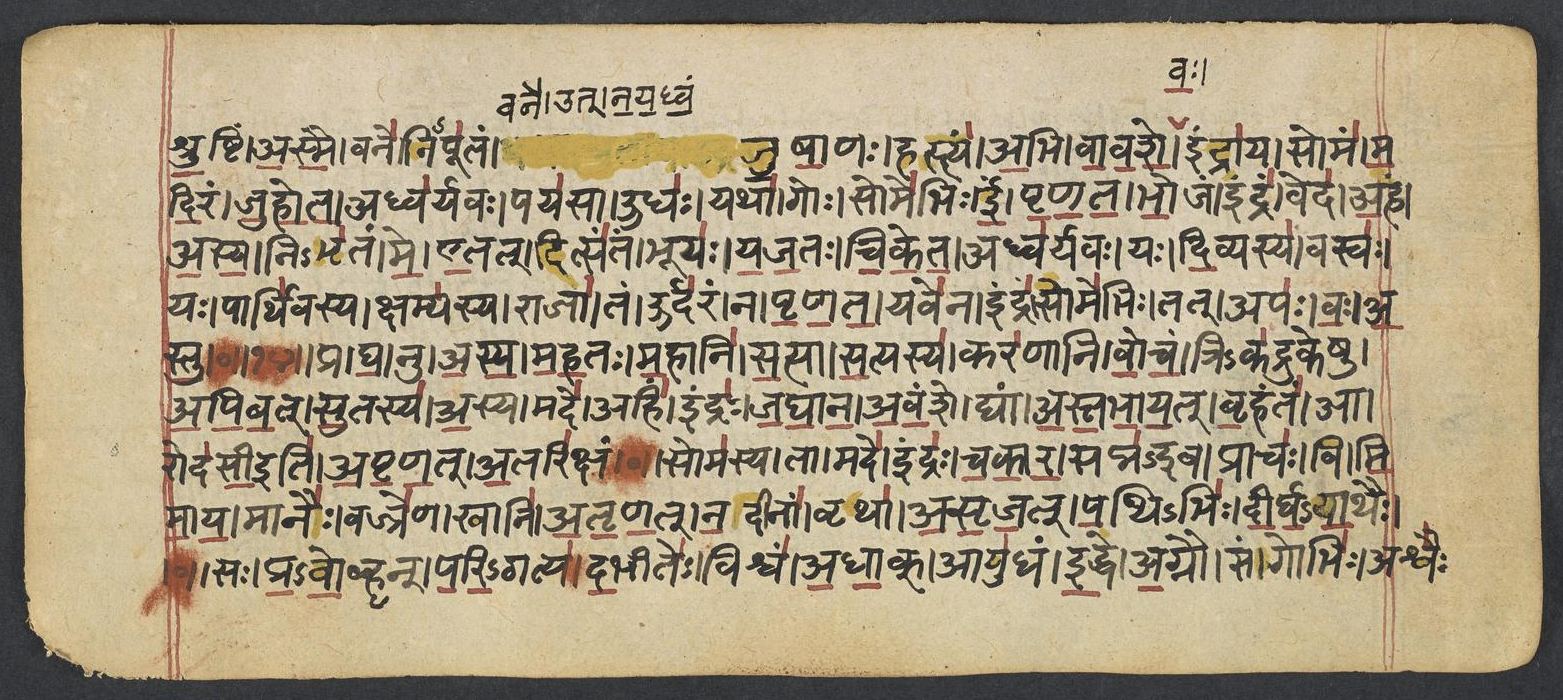
Where on the image
Penn Ms. Coll. 390 Item 41, fol. 161r (numbered 7r by the scribe) (OPenn image 162, lower leaf). Checked on the image: the Rigveda text on this page begins in RV 2.14.9 ‹śruṣṭim asmai vane ni-pūtam›. The next page with Rigveda text, fol. 161v (numbered 7v by the scribe), begins in RV 2.15.4 ‹asṛjat rathebhiḥ somasya tā›. Verses 2.15.1-3 end on this page.
1pra ghā̱ nv a̍sya maha̱to ma̱hāni̍ sa̱tyā sa̱tyasya̱ kara̍ṇāni vocam | trika̍drukeṣv apibat su̱tasyā̱sya made̱ ahi̱m indro̍ jaghāna ||
2a̱va̱ṁśe dyām a̍stabhāyad bṛ̱hanta̱m ā roda̍sī apṛṇad a̱ntari̍kṣam | sa dhā̍rayat pṛthi̱vīm pa̱pratha̍c ca̱ soma̍sya̱ tā mada̱ indra̍ś cakāra ||
3sadme̍va̱ prāco̱ vi mi̍māya̱ mānai̱r vajre̍ṇa̱ khāny a̍tṛṇan na̱dīnā̍m | vṛthā̍sṛjat pa̱thibhi̍r dīrghayā̱thaiḥ soma̍sya̱ tā mada̱ indra̍ś cakāra ||
Compare: Padapāṭha (word-by-word text written in the manuscript; Sansknet e-text via GRETIL)
1pra | gha | nu | asya | mahataḥ | mahāni | satyā | satyasya | karaṇāni | vocam | tr i-kadrukeṣu | apibat | sutasya | asya | made | ahim | indraḥ | jaghāna
2avaṃśe | dyām | astabhāyat | bṛhantam | ā | rodasī iti | apṛṇat | antarikṣam | saḥ | dhārayat | pṛthivīm | paprathat | ca | somasya | tā | made | indraḥ | cakāra
3sadma-iva | prācaḥ | vi | mimāya | mānaiḥ | vajreṇa | khāni | atṛṇat | nadīnām | vṛthā | asṛjat | pathi-bhiḥ | dīrgha-yāthaiḥ | somasya | tā | made | indraḥ | cakāra
1Now, verily, will I declare the exploits, mighty and true, of him the True and Mighty. In the Trikadrukas he drank the Soma then in its rapture Indra slew the Dragon.
2High heaven unsupported in space he stablished: he filled the two worlds and the air's mid-region. Earth he upheld, and gave it wide expansion. These things did Indra in the Soma's rapture.
3From front, as 'twere a house, he ruled and measured; pierced with his bolt the fountains of the rivers, And made them flow at ease by paths far-reaching, These things did Indra in the Soma's rapture.
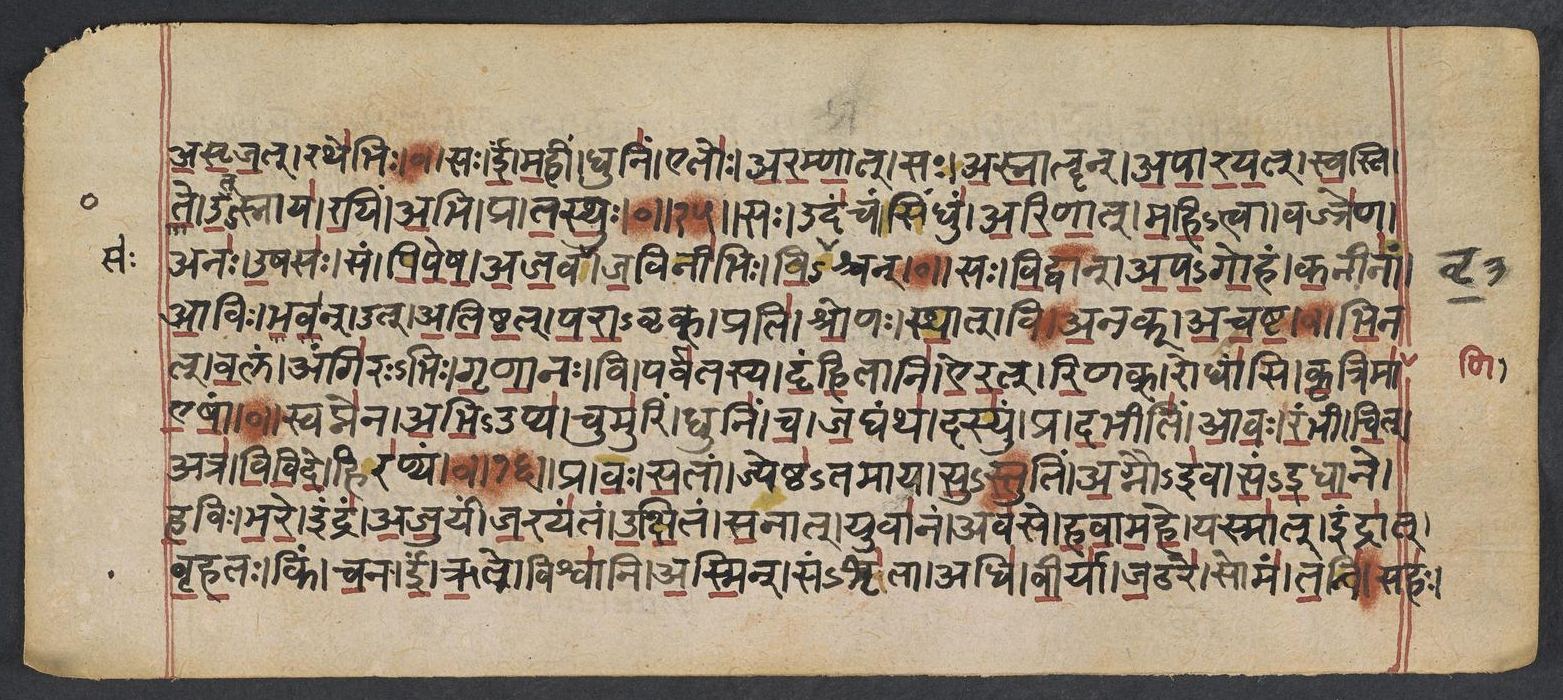
Where on the image
Penn Ms. Coll. 390 Item 41, fol. 161v (numbered 7v by the scribe) (OPenn image 163, upper leaf). Checked on the image: the Rigveda text on this page begins in RV 2.15.4 ‹asṛjat rathebhiḥ somasya tā›. The next page with Rigveda text, fol. 162r (numbered 8r by the scribe), begins in RV 2.16.2 ‹mahaḥ haste vajram bharati›. Verses 2.15.4-10 end on this page; 2.15.4 begins on fol. 161r (numbered 7r by the scribe).
4sa pra̍vo̱ḻhṝn pa̍ri̱gatyā̍ da̱bhīte̱r viśva̍m adhā̱g āyu̍dham i̱ddhe a̱gnau | saṁ gobhi̱r aśvai̍r asṛja̱d rathe̍bhi̱ḥ soma̍sya̱ tā mada̱ indra̍ś cakāra ||
5sa ī̍m ma̱hīṁ dhuni̱m eto̍r aramṇā̱t so a̍snā̱tṝn a̍pārayat sva̱sti | ta u̱tsnāya̍ ra̱yim a̱bhi pra ta̍sthu̱ḥ soma̍sya̱ tā mada̱ indra̍ś cakāra ||
6soda̍ñca̱ṁ sindhu̍m ariṇān mahi̱tvā vajre̱ṇāna̍ u̱ṣasa̱ḥ sam pi̍peṣa | a̱ja̱vaso̍ ja̱vinī̍bhir vivṛ̱ścan soma̍sya̱ tā mada̱ indra̍ś cakāra ||
7sa vi̱dvām̐ a̍pago̱haṁ ka̱nīnā̍m ā̱vir bhava̱nn ud a̍tiṣṭhat parā̱vṛk | prati̍ śro̱ṇaḥ sthā̱d vy a1̱̍nag a̍caṣṭa̱ soma̍sya̱ tā mada̱ indra̍ś cakāra ||
8bhi̱nad va̱lam aṅgi̍robhir gṛṇā̱no vi parva̍tasya dṛṁhi̱tāny ai̍rat | ri̱ṇag rodhā̍ṁsi kṛ̱trimā̍ṇy eṣā̱ṁ soma̍sya̱ tā mada̱ indra̍ś cakāra ||
9svapne̍nā̱bhyupyā̱ cumu̍ri̱ṁ dhuni̍ṁ ca ja̱ghantha̱ dasyu̱m pra da̱bhīti̍m āvaḥ | ra̱mbhī ci̱d atra̍ vivide̱ hira̍ṇya̱ṁ soma̍sya̱ tā mada̱ indra̍ś cakāra ||
10nū̱naṁ sā te̱ prati̱ vara̍ṁ jari̱tre du̍hī̱yad i̍ndra̱ dakṣi̍ṇā ma̱ghonī̍ | śikṣā̍ sto̱tṛbhyo̱ māti̍ dha̱g bhago̍ no bṛ̱had va̍dema vi̱dathe̍ su̱vīrā̍ḥ ||
Compare: Padapāṭha (word-by-word text written in the manuscript; Sansknet e-text via GRETIL)
4saḥ | pra-voḷhṛn | pari-gatya | dabhīteḥ | viśvam | adhāk | āyudham | iddhe | agnau | sam | gobhiḥ | aśvaiḥ | asṛjat | rathebhiḥ | somasya | tā | made | indraḥ | cakāra
5saḥ | īm | mahīm | dhunim | etoḥ | aramṇāt | saḥ | asnātṝn | apārayat | svasti | te | ut-snāya | rayim | abhi | pra | tasthuḥ | somasya | tā | made | indraḥ | cakāra
6saḥ | udañcam | sindhum | ariṇāt | mahitvā | vajreṇa | anaḥ | uṣasaḥ | sam | pipeṣa | ajavasaḥ | javinībhiḥ | vi-vṛścan | somasya | tā | made | indraḥ | cakāra
7saḥ | vidvān | apa-goham | kanīnām | āviḥ | bhavan | ut | atiṣṭhat | parāvṛk | prati | śroṇaḥ | sthāt | vi | anak | acaṣṭa | somasya | tā | made | indraḥ | cakāra
8bhinat | valam | aṅgiraḥ-bhiḥ | gṛṇānaḥ | vi | parvatasya | dṛṃhitāni | airat | riṇak | rodhāṃsi | kṛtrimāṇi | eṣām | somasya | tā | made | indraḥ | cakāra
9svapnena | abhi-upya | cumurim | dhunim | ca | jaghantha | dasyum | pra | dabhītim | āvaḥ | rambhī | cit | atra | vivide | hiraṇyam | somasya | tā | made | indraḥ | cakāra
10nūnam | sā | te | prati | varam | jaritre | duhīyat | indra | dakṣiṇā | maghonī | śikṣa | stotṛ-bhyaḥ | mā | ati | dhak | bhagaḥ | naḥ | bṛhat | vadema | vidathe | su-vīrāḥ
4Compassing those who bore away Dabhîti, in kindled fire he burnt up all their weapons. And made him rich with kine and cars and horses. These things did Indra in the Soma's rapture.
5The mighty roaring flood he stayed from flowing, and carried those who swam not safely over. They having crossed the stream attained to riches. These things did Indra in the Soma's rapture.
6With mighty power he made the stream flow upward, crushed with his thunderbolt the car of Ushas, Rending her slow steeds with his rapid coursers. These things did Indra in the Soma's rapture.
7Knowing the place wherein the maids were hiding, the outcast showed himself and stood before them. The cripple stood erect, the blind beheld them. These things did Indra in the Soma's rapture.
8Praised by the Angirases he slaughtered Vala, and burst apart the bulwarks of the mountain. He tore away their deftly-built defences. These things did Indra in the Soma's rapture.
9Thou, with sleep whelming Chumuri and Dhuni, slewest the Dasyu, keptest safe Dabhîti. There the staff-bearer found the golden treasure. These things did Indra in the Soma's rapture.
10Now let that wealthy Cow of thine, O Indra , yield in return a boon to him who lauds thee. Give to thy praisers: let not fortune fail us. Loud may we speak, with brave men, in assembly.
Notes
- Sanskrit: Aufrecht's edition (1877) with the Vedic accents, as entered by van Nooten and Holland (GRETIL).
- English: Ralph T. H. Griffith, The Hymns of the Rigveda (1889-1892; 2nd ed. 1896-1897), from the VedaWeb digital text; OCR slips in that text were corrected against the printed 2nd edition (data/sources/rigveda/griffith_errata.json).
- Padapāṭha (edition text): Sansknet e-text via GRETIL (CC BY-NC-SA 4.0).
Cite
Sources
- Source: Penn Ms. Coll. 390 Item 41 (undated (catalogued with Penn's 18th-19th c. Vedic manuscripts)), OPenn, Public Domain Mark + Aufrecht's accented text (GRETIL) + Griffith's English (VedaWeb) (holding institution)
- Critical edition: Aufrecht (1877), accented e-text via GRETIL
← previous · → next · v cycle view · l back to library