Rigveda 2.16: To Indra
Introduction
Rigveda 2.16 is a hymn of 9 verses addressed to Indra. It stands in book (maṇḍala) 2, the family book of Gṛtsamada. The Rigveda is the oldest collection of Sanskrit hymns, composed in the second half of the second millennium BCE and handed down orally for many centuries before it was written down.
The manuscript shown is Penn Ms. Coll. 390 Item 41 (University of Pennsylvania), an undated paper manuscript of the padapāṭha (the word-by-word recitation text, in which every word is written separately and compounds are split) of the whole Ṛgveda in Devanāgarī, 884 leaves in fascicles, 7-9 lines to the page, accents in red; this hymn stands on fol. 161v-162v. Each section below gives the verses that end on one page; the page boundaries were read on the images (the opening words of every page), not counted out. Where the manuscript is a padapāṭha (the word-by-word recitation text), the section shows Aufrecht's continuous (saṃhitā) text first and, as the edition text, the padapāṭha of the same verses, which is the form written on the page.
How was this verified? (Provenance)
Where on the image
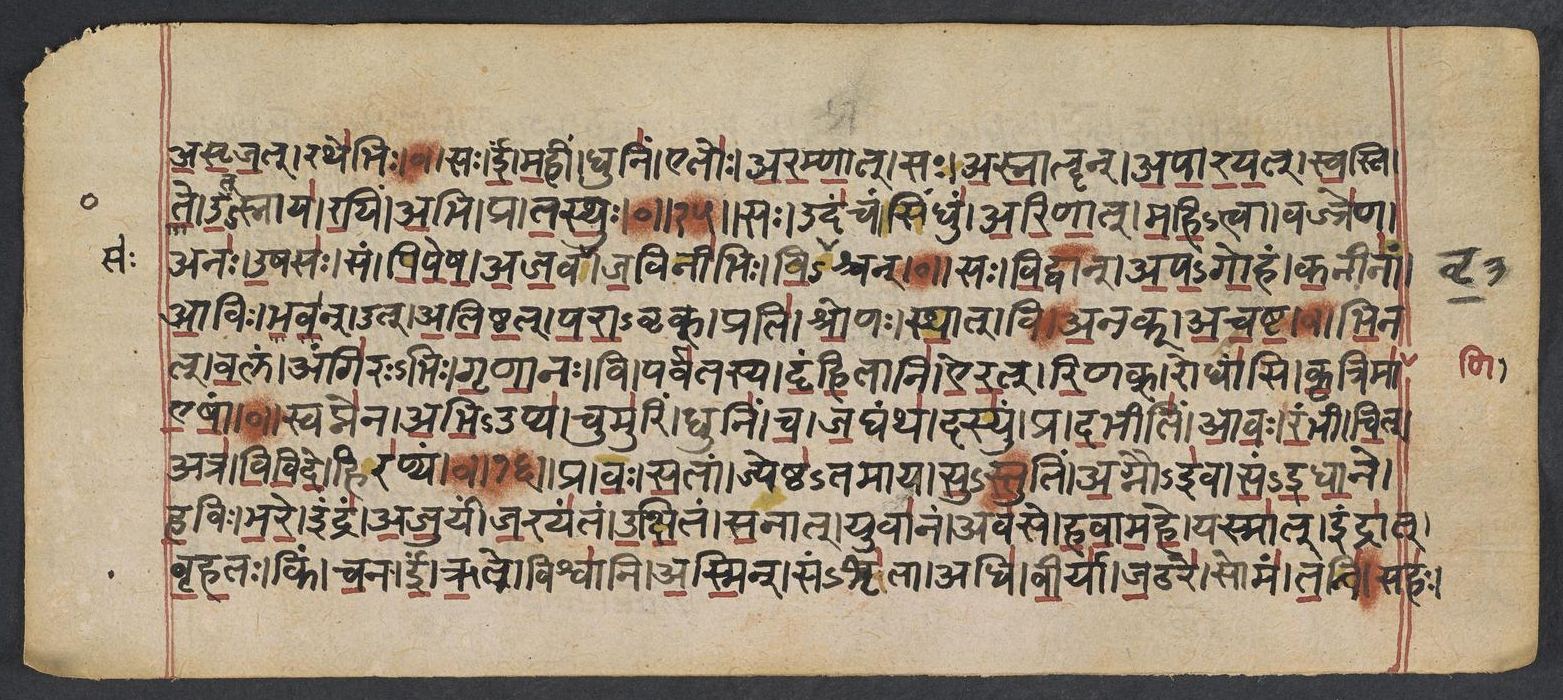
Penn Ms. Coll. 390 Item 41, fol. 161v (numbered 7v by the scribe) (OPenn image 163, upper leaf). Checked on the image: the Rigveda text on this page begins in RV 2.15.4 ‹asṛjat rathebhiḥ somasya tā›. The next page with Rigveda text, fol. 162r (numbered 8r by the scribe), begins in RV 2.16.2 ‹mahaḥ haste vajram bharati›. Verse 2.16.1 ends on this page.
1pra va̍ḥ sa̱tāṁ jyeṣṭha̍tamāya suṣṭu̱tim a̱gnāv i̍va samidhā̱ne ha̱vir bha̍re | indra̍m aju̱ryaṁ ja̱raya̍ntam ukṣi̱taṁ sa̱nād yuvā̍na̱m ava̍se havāmahe ||
Compare: Padapāṭha (word-by-word text written in the manuscript; Sansknet e-text via GRETIL)
1pra | vaḥ | satām | jyeṣṭhatamāya | su-stutim | agnau-iva | sam-idhāne | haviḥ | bhare | indram | ajuryam | jarayantam | ukṣitam | sanāt | yuvānam | avase | havāmahe
1To him, your own, the best among the good, I bring eulogy, like oblation in the kindled fire. We invocate for help Indra untouched by eld, who maketh all decay, strengthened, for ever young.
Where on the image
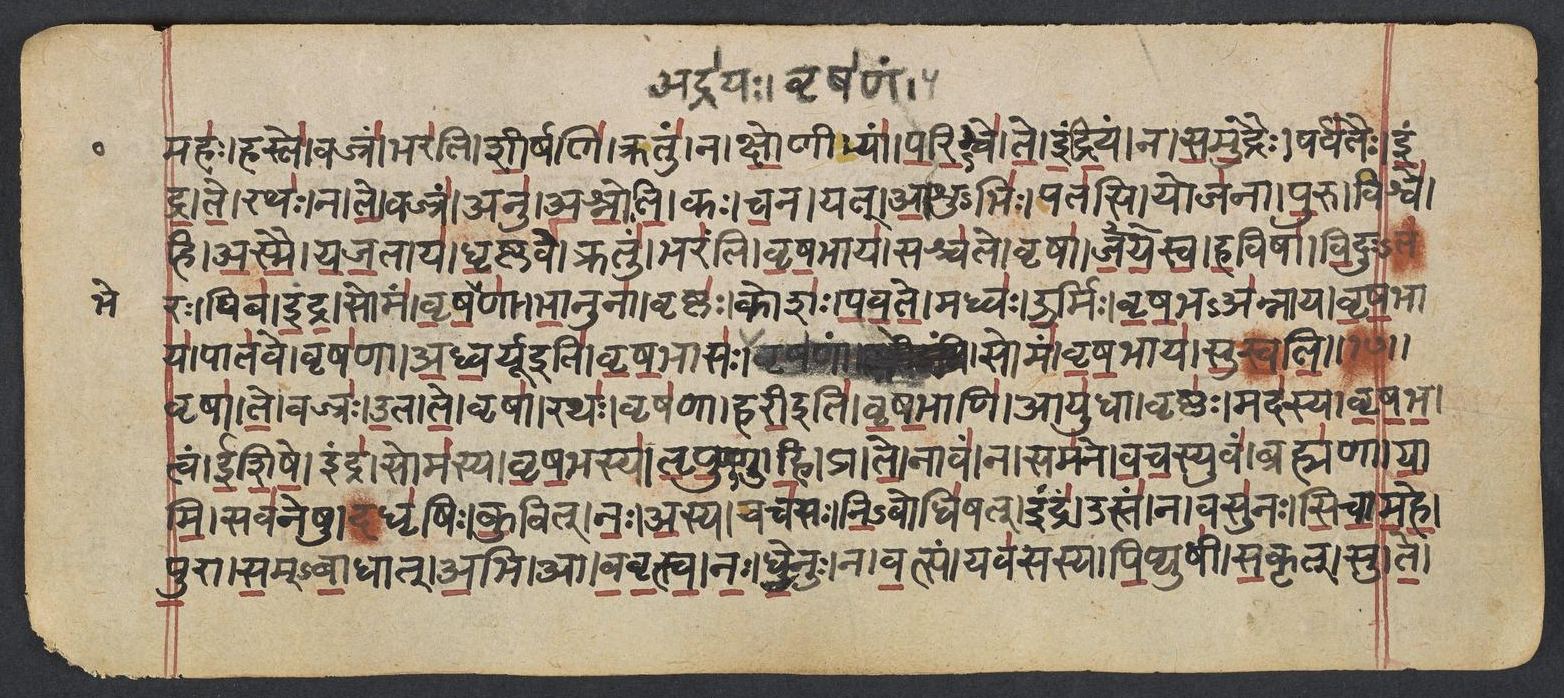
Penn Ms. Coll. 390 Item 41, fol. 162r (numbered 8r by the scribe) (OPenn image 163, lower leaf). Checked on the image: the Rigveda text on this page begins in RV 2.16.2 ‹mahaḥ haste vajram bharati›. The next page with Rigveda text, fol. 162v (numbered 8v by the scribe), begins in RV 2.16.8 ‹sumati-bhiḥ śatakrato itiśata-krato sam›. Verses 2.16.2-7 end on this page; 2.16.2 begins on fol. 161v (numbered 7v by the scribe).
2yasmā̱d indrā̍d bṛha̱taḥ kiṁ ca̱nem ṛ̱te viśvā̍ny asmi̱n sambhṛ̱tādhi̍ vī̱ryā̍ | ja̱ṭhare̱ soma̍ṁ ta̱nvī̱3̱̍ saho̱ maho̱ haste̱ vajra̱m bhara̍ti śī̱rṣaṇi̱ kratu̍m ||
3na kṣo̱ṇībhyā̍m pari̱bhve̍ ta indri̱yaṁ na sa̍mu̱draiḥ parva̍tair indra te̱ ratha̍ḥ | na te̱ vajra̱m anv a̍śnoti̱ kaś ca̱na yad ā̱śubhi̱ḥ pata̍si̱ yoja̍nā pu̱ru ||
4viśve̱ hy a̍smai yaja̱tāya̍ dhṛ̱ṣṇave̱ kratu̱m bhara̍nti vṛṣa̱bhāya̱ saśca̍te | vṛṣā̍ yajasva ha̱viṣā̍ vi̱duṣṭa̍ra̱ḥ pibe̍ndra̱ soma̍ṁ vṛṣa̱bheṇa̍ bhā̱nunā̍ ||
5vṛṣṇa̱ḥ kośa̍ḥ pavate̱ madhva̍ ū̱rmir vṛ̍ṣa̱bhānnā̍ya vṛṣa̱bhāya̱ pāta̍ve | vṛṣa̍ṇādhva̱ryū vṛ̍ṣa̱bhāso̱ adra̍yo̱ vṛṣa̍ṇa̱ṁ soma̍ṁ vṛṣa̱bhāya̍ suṣvati ||
6vṛṣā̍ te̱ vajra̍ u̱ta te̱ vṛṣā̱ ratho̱ vṛṣa̍ṇā̱ harī̍ vṛṣa̱bhāṇy āyu̍dhā | vṛṣṇo̱ mada̍sya vṛṣabha̱ tvam ī̍śiṣa̱ indra̱ soma̍sya vṛṣa̱bhasya̍ tṛpṇuhi ||
7pra te̱ nāva̱ṁ na sama̍ne vaca̱syuva̱m brahma̍ṇā yāmi̱ sava̍neṣu̱ dādhṛ̍ṣiḥ | ku̱vin no̍ a̱sya vaca̍so ni̱bodhi̍ṣa̱d indra̱m utsa̱ṁ na vasu̍naḥ sicāmahe ||
Compare: Padapāṭha (word-by-word text written in the manuscript; Sansknet e-text via GRETIL)
2yasmāt | indrāt | bṛhataḥ | kim | cana | īm | ṛte | viśvāni | asmin | sam-bhṛtā | adhi | vīryā | jaṭhare | somam | tanvi | sahaḥ | mahaḥ | haste | vajram | bharati | śīrṣaṇi | kratum
3na | kṣoṇībhyām | pari-bhve | te | indriyam | na | samudraiḥ | parvataiḥ | indra | te | rathaḥ | na | te | vajram | anu | aśnoti | kaḥ | cana | yat | āśu-bhiḥ | patasi | yojanā | puru
4viśve | hi | asmai | yajatāya | dhṛṣṇave | kratum | bharanti | vṛṣabhāya | saścate | vṛṣā | yajasva | haviṣā | viduḥ-taraḥ | piba | indra | somam | vṛṣabheṇa | bhānunā
5vṛṣṇaḥ | kośaḥ | pavate | madhvaḥ | ūrmiḥ | vṛṣabha-annāya | vṛṣabhāya | pātave | vṛṣaṇā | adhvaryū iti | vṛṣabhāsaḥ | adrayaḥ | vṛṣaṇam | somam | vṛṣabhāya | susvati
6vṛṣā | te | vajraḥ | uta | te | vṛṣā | rathaḥ | vṛṣaṇā | harī iti | vṛṣabhāṇi | āyudhā | vṛṣṇaḥ | madasya | vṛṣabha | tvam | īśiṣe | indra | somasya | vṛṣabhasya | tṛpṇuhi
7pra | te | nāvam | na | samane | vacasyuvam | brahmaṇā | yāmi | savaneṣu | dadhṛṣiḥ | kuvit | naḥ | asya | vacasaḥ | ni-bodhiṣat | indram | utsam | na | vasunaḥ | sicāmahe
2Without whom naught exists, Indra the Lofty One; in whom alone all powers heroic are combined. The Soma is within him, in his frame vast strength, the thunder in his hand and wisdom in his head.
3Not by both worlds is thine own power to be surpassed, nor may thy car be stayed by mountains or by seas. None cometh near, O Indra, to thy thunderbolt, when with swift steeds thou fliest over many a league.
4For all men bring their will to him the Resolute, to him the Holy One, to him the Strong they cleave. Pay worship with oblation, strong and passing wise. Drink thou the Soma, Indra, through the mighty blaze.
5The vessel of the strong flows forth, the flood of meath, unto the Strong who feeds upon the strong, for drink, Strong are the two Adhvaryus, strong are both the stones. They press the Soma that is strong for him the Strong.
6Strong is thy thunderbolt, yea, and thy car is strong; strong are thy Bay Steeds and thy weapons powerful. Thou, Indra, Bull, art Lord of the strong gladdening drink. with the strong Soma, Indra, satisfy thyself.
7I, bold by prayer, come near thee in thy sacred rites, thee like a saving ship, thee shouting in the war. Verily he will hear and mark this word of ours: we will pour Indra forth as 'twere a spring of wealth.
Where on the image
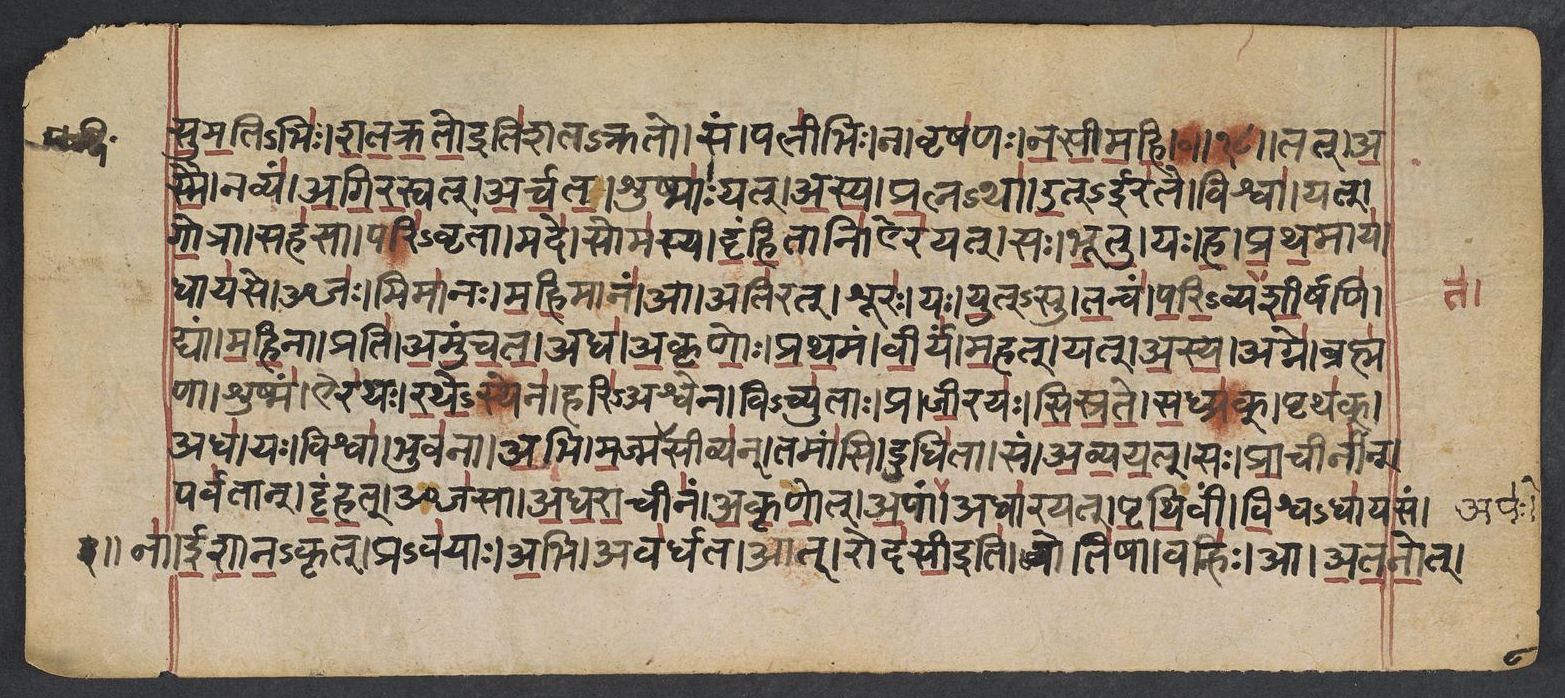
Penn Ms. Coll. 390 Item 41, fol. 162v (numbered 8v by the scribe) (OPenn image 164, upper leaf). Checked on the image: the Rigveda text on this page begins in RV 2.16.8 ‹sumati-bhiḥ śatakrato itiśata-krato sam›. The next page with Rigveda text, fol. 163r (numbered 9r by the scribe), begins in RV 2.17.5 ‹astabhnāt māyayā dyām ava-srasaḥ›. Verses 2.16.8-9 end on this page; 2.16.8 begins on fol. 162r (numbered 8r by the scribe).
8pu̱rā sa̍mbā̱dhād a̱bhy ā va̍vṛtsva no dhe̱nur na va̱tsaṁ yava̍sasya pi̱pyuṣī̍ | sa̱kṛt su te̍ suma̱tibhi̍ḥ śatakrato̱ sam patnī̍bhi̱r na vṛṣa̍ṇo nasīmahi ||
9nū̱naṁ sā te̱ prati̱ vara̍ṁ jari̱tre du̍hī̱yad i̍ndra̱ dakṣi̍ṇā ma̱ghonī̍ | śikṣā̍ sto̱tṛbhyo̱ māti̍ dha̱g bhago̍ no bṛ̱had va̍dema vi̱dathe̍ su̱vīrā̍ḥ ||
Compare: Padapāṭha (word-by-word text written in the manuscript; Sansknet e-text via GRETIL)
8purā | sam-bādhāt | abhi | ā | vavṛtsva | naḥ | dhenuḥ | na | vatsam | yavasasya | pipyuṣī | sakṛt | su | te | sumati-bhiḥ | śatakrato itiśata-krato | sam | patnībhiḥ | na | vṛṣaṇaḥ | nasīmahi
9nūnam | sā | te | prati | varam | jaritre | duhīyat | indra | dakṣiṇā | maghonī | śikṣa | stotṛ-bhyaḥ | mā | ati | dhak | bhagaḥ | naḥ | bṛhat | vadema | vidathe | su-vīrāḥ
8Turn thee unto us ere calamity come nigh, as a cow full of pasture turns her to her calf. Lord of a Hundred Powers, may we once firmly cling to thy fair favours even as husbands to their wives.
9Now let that wealthy Cow of thine, O Indra, yield in return a boon to him who lauds thee. Give to thy praisers: let not fortune fail us. Loud may we speak, with heroes, in assembly.
Notes
- Sanskrit: Aufrecht's edition (1877) with the Vedic accents, as entered by van Nooten and Holland (GRETIL).
- English: Ralph T. H. Griffith, The Hymns of the Rigveda (1889-1892; 2nd ed. 1896-1897), from the VedaWeb digital text; OCR slips in that text were corrected against the printed 2nd edition (data/sources/rigveda/griffith_errata.json).
- Padapāṭha (edition text): Sansknet e-text via GRETIL (CC BY-NC-SA 4.0).
Cite
Sources
- Source: Penn Ms. Coll. 390 Item 41 (undated (catalogued with Penn's 18th-19th c. Vedic manuscripts)), OPenn, Public Domain Mark + Aufrecht's accented text (GRETIL) + Griffith's English (VedaWeb) (holding institution)
- Critical edition: Aufrecht (1877), accented e-text via GRETIL
← previous · → next · v cycle view · l back to library