Rigveda 2.7: To Agni
Introduction
Rigveda 2.7 is a hymn of 6 verses addressed to Agni. It stands in book (maṇḍala) 2, the family book of Gṛtsamada. The Rigveda is the oldest collection of Sanskrit hymns, composed in the second half of the second millennium BCE and handed down orally for many centuries before it was written down.
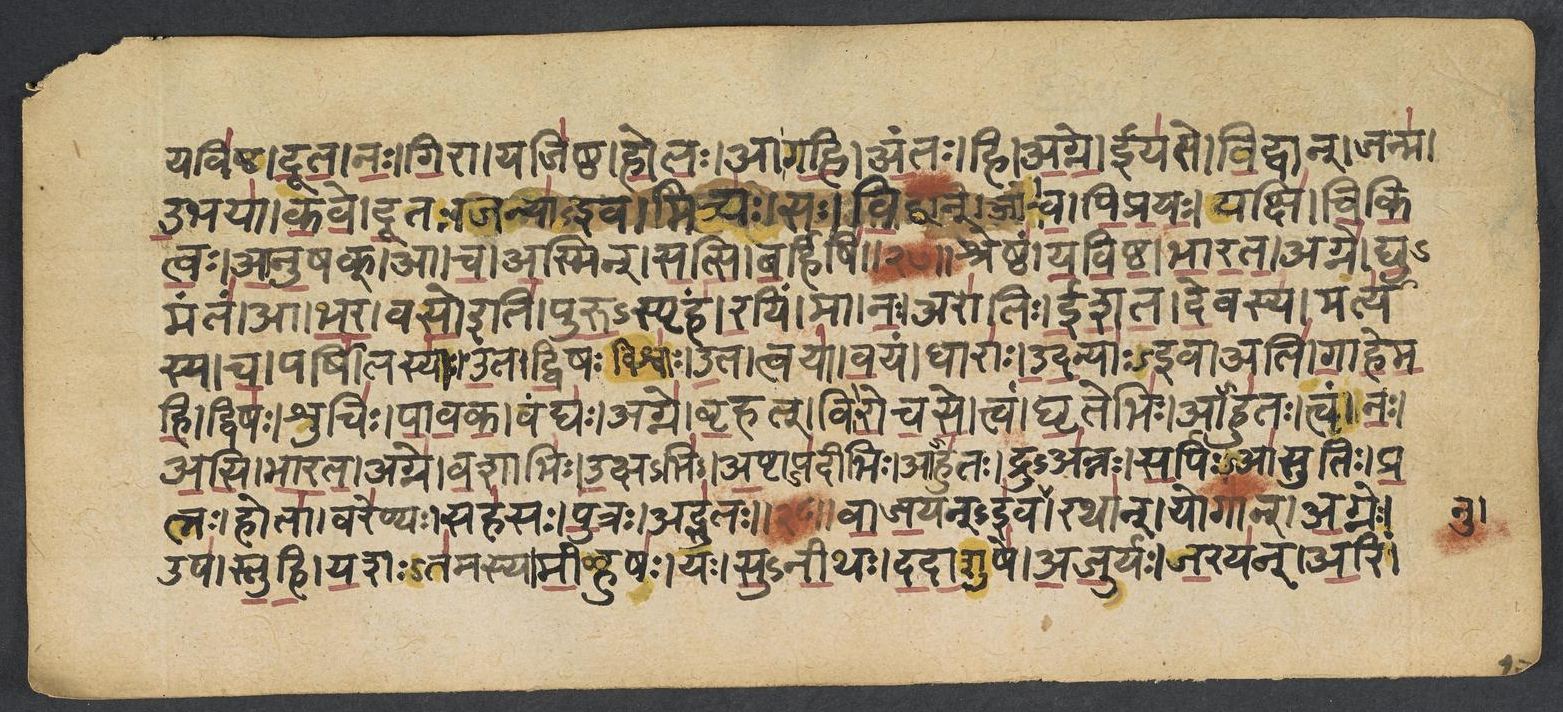
The manuscript shown is Penn Ms. Coll. 390 Item 41 (University of Pennsylvania), an undated paper manuscript of the padapāṭha (the word-by-word recitation text, in which every word is written separately and compounds are split) of the whole Ṛgveda in Devanāgarī, 884 leaves in fascicles, 7-9 lines to the page, accents in red; this hymn stands on fol. 154v. Each section below gives the verses that end on one page; the page boundaries were read on the images (the opening words of every page), not counted out. Where the manuscript is a padapāṭha (the word-by-word recitation text), the section shows Aufrecht's continuous (saṃhitā) text first and, as the edition text, the padapāṭha of the same verses, which is the form written on the page.
How was this verified? (Provenance)
Where on the image
Penn Ms. Coll. 390 Item 41, fol. 154v (numbered 12v by the scribe) (OPenn image 156, upper leaf). Checked on the image: the Rigveda text on this page begins in RV 2.6.6 ‹yaviṣṭha dūta naḥ girā›. The next page with Rigveda text, fol. 155r (numbered 1r by the scribe), begins in RV 2.8.2 ‹cāru-pratīkaḥ āhutaḥ›. Verses 2.7.1-6 end on this page.
1śreṣṭha̍ṁ yaviṣṭha bhāra̱tāgne̍ dyu̱manta̱m ā bha̍ra | vaso̍ puru̱spṛha̍ṁ ra̱yim ||
2mā no̱ arā̍tir īśata de̱vasya̱ martya̍sya ca | parṣi̱ tasyā̍ u̱ta dvi̱ṣaḥ ||
3viśvā̍ u̱ta tvayā̍ va̱yaṁ dhārā̍ uda̱nyā̍ iva | ati̍ gāhemahi̱ dviṣa̍ḥ ||
4śuci̍ḥ pāvaka̱ vandyo 'gne̍ bṛ̱had vi ro̍case | tvaṁ ghṛ̱tebhi̱r āhu̍taḥ ||
5tvaṁ no̍ asi bhāra̱tāgne̍ va̱śābhi̍r u̱kṣabhi̍ḥ | a̱ṣṭāpa̍dībhi̱r āhu̍taḥ ||
6drva̍nnaḥ sa̱rpirā̍sutiḥ pra̱tno hotā̱ vare̍ṇyaḥ | saha̍sas pu̱tro adbhu̍taḥ ||
Compare: Padapāṭha (word-by-word text written in the manuscript; Sansknet e-text via GRETIL)
1śreṣṭham | yaviṣṭha | bhārata | agne | dyu-mantam | ā | bhara | vaso iti | puru-spṛham | rayim
2mā | naḥ | arātiḥ | īśata | devasya | martyasya | ca | parṣi | tasyāḥ | uta | dviṣaḥ
3viśvāḥ | uta | tvayā | vayam | dhārāḥ | udanyāḥ-iva | ati | gāhemahi | dviṣaḥ
4śuciḥ | pāvaka | vandyaḥ | agne | bṛhat | vi | rocase | tvam | ghṛtebhiḥ | āhutaḥ
5tvam | naḥ | asi | bhārata | agne | vaśābhiḥ | ukṣa-bhiḥ | aṣṭāpadībhiḥ | āhutaḥ
6dru-annaḥ | sarpiḥ-āsutiḥ | pratnaḥ | hotā | vareṇyaḥ | sahasaḥ | putraḥ | adbhutaḥ
1VASU, thou most youthful God, Bharata, Agni, bring us wealth, Excellent, splendid, much-desired.
2Let no malignity prevail against us, either God's or man's. Save us from this and enmity.
3So through thy favour may we force through all our enemies a way, As 'twere through streaming water-floods.
4Thou, Purifier Agni, high shinest forth, bright, adorable, When worshipped with the sacred oil.
5Ours art thou, Agni, Bharata, honoured by us with barren cows, With bullocks and with kine in calf
6Wood-fed, bedewed with sacred oil, ancient, Invoker, excellent, The Son of Strength, the Wonderful.
Notes
- Sanskrit: Aufrecht's edition (1877) with the Vedic accents, as entered by van Nooten and Holland (GRETIL).
- English: Ralph T. H. Griffith, The Hymns of the Rigveda (1889-1892; 2nd ed. 1896-1897), from the VedaWeb digital text; OCR slips in that text were corrected against the printed 2nd edition (data/sources/rigveda/griffith_errata.json).
- Padapāṭha (edition text): Sansknet e-text via GRETIL (CC BY-NC-SA 4.0).
Cite
Sources
- Source: Penn Ms. Coll. 390 Item 41 (undated (catalogued with Penn's 18th-19th c. Vedic manuscripts)), OPenn, Public Domain Mark + Aufrecht's accented text (GRETIL) + Griffith's English (VedaWeb) (holding institution)
- Critical edition: Aufrecht (1877), accented e-text via GRETIL
← previous · → next · v cycle view · l back to library