Rigveda 2.6: To Agni
Introduction
Rigveda 2.6 is a hymn of 8 verses addressed to Agni. It stands in book (maṇḍala) 2, the family book of Gṛtsamada. The Rigveda is the oldest collection of Sanskrit hymns, composed in the second half of the second millennium BCE and handed down orally for many centuries before it was written down.
The manuscript shown is Penn Ms. Coll. 390 Item 41 (University of Pennsylvania), an undated paper manuscript of the padapāṭha (the word-by-word recitation text, in which every word is written separately and compounds are split) of the whole Ṛgveda in Devanāgarī, 884 leaves in fascicles, 7-9 lines to the page, accents in red; this hymn stands on fol. 154r-154v. Each section below gives the verses that end on one page; the page boundaries were read on the images (the opening words of every page), not counted out. Where the manuscript is a padapāṭha (the word-by-word recitation text), the section shows Aufrecht's continuous (saṃhitā) text first and, as the edition text, the padapāṭha of the same verses, which is the form written on the page.
How was this verified? (Provenance)
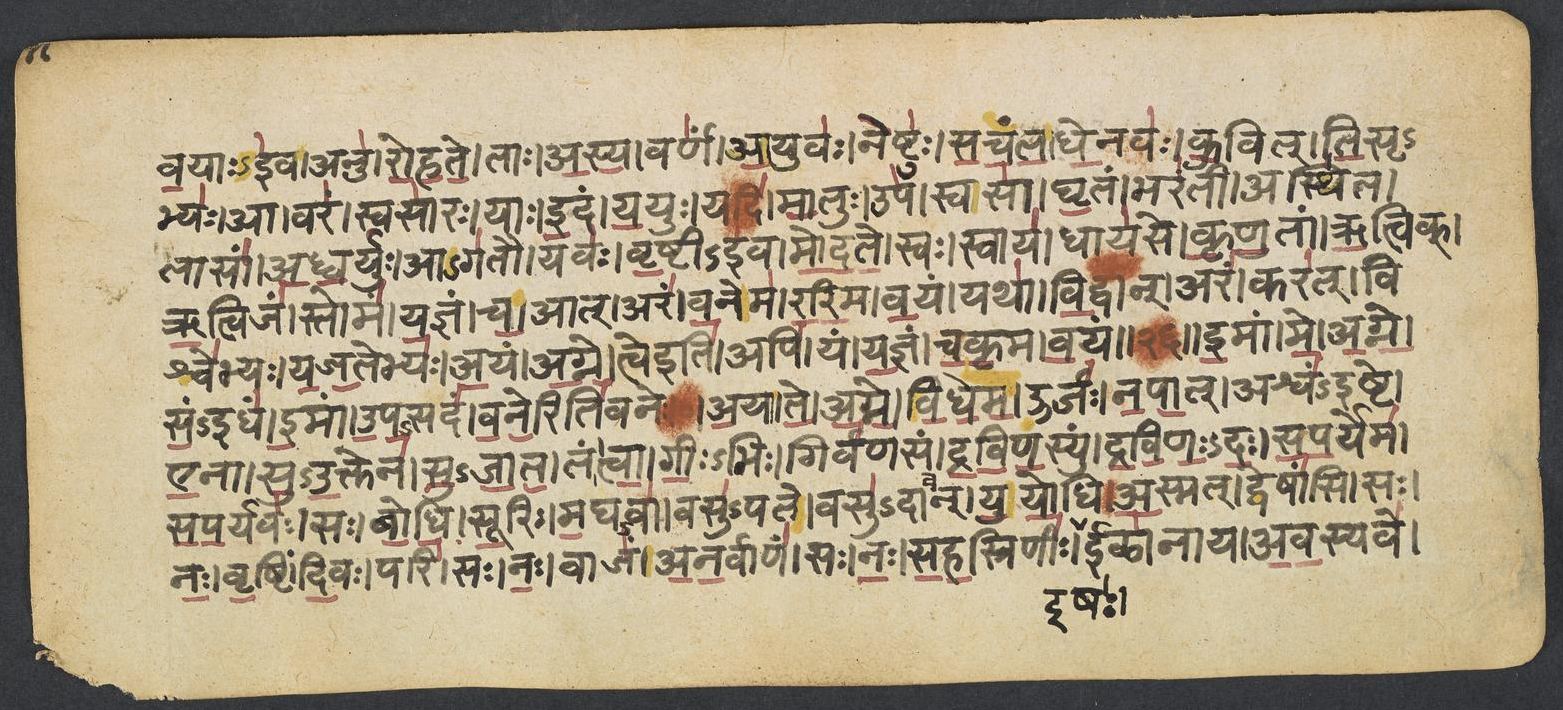
Where on the image
Penn Ms. Coll. 390 Item 41, fol. 154r (numbered 12r by the scribe) (OPenn image 155, lower leaf). Checked on the image: the Rigveda text on this page begins in RV 2.5.4 ‹vayāḥ-iva anu rohate›. The next page with Rigveda text, fol. 154v (numbered 12v by the scribe), begins in RV 2.6.6 ‹yaviṣṭha dūta naḥ girā›. Verses 2.6.1-5 end on this page.
1i̱mām me̍ agne sa̱midha̍m i̱mām u̍pa̱sada̍ṁ vaneḥ | i̱mā u̱ ṣu śru̍dhī̱ gira̍ḥ ||
2a̱yā te̍ agne vidhe̱morjo̍ napā̱d aśva̍miṣṭe | e̱nā sū̱ktena̍ sujāta ||
3taṁ tvā̍ gī̱rbhir girva̍ṇasaṁ draviṇa̱syuṁ dra̍viṇodaḥ | sa̱pa̱ryema̍ sapa̱ryava̍ḥ ||
4sa bo̍dhi sū̱rir ma̱ghavā̱ vasu̍pate̱ vasu̍dāvan | yu̱yo̱dhy a1̱̍smad dveṣā̍ṁsi ||
5sa no̍ vṛ̱ṣṭiṁ di̱vas pari̱ sa no̱ vāja̍m ana̱rvāṇa̍m | sa na̍ḥ saha̱sriṇī̱r iṣa̍ḥ ||
Compare: Padapāṭha (word-by-word text written in the manuscript; Sansknet e-text via GRETIL)
1imām | me | agne | sam-idham | imām | upa-sadam | vaneritivaneḥ | imāḥ | oṃ iti | su | śrudhi | giraḥ
2ayā | te | agne | vidhema | ūrjaḥ | napāt | aśvam-iṣṭe | enā | su-uktena | su-jāta
3tam | tvā | gīḥ-bhiḥ | girvaṇasam | draviṇasyum | draviṇaḥ-daḥ | saparyema | saparyavaḥ
4saḥ | bodhi | sūriḥ | maghavā | vasu-pate | vasu-dāvan | yuyodhi | asmat | dveṣāṃsi
5saḥ | naḥ | vṛṣṭim | divaḥ | pari | saḥ | naḥ | vājam | anarvāṇam | saḥ | naḥ | sahasriṇīḥ | iṣaḥ
1AGNI, accept this flaming brand, this waiting with my prayer on thee: Hear graciously these songs of praise.
2With this hymn let us honour thee, seeker of horses, Son of Strength, With this fair hymn, thou nobly born.
3As such, lover of song, with songs, wealth-lover, giver of our wealth! With reverence let us worship thee.
4Be thou for us a liberal Prince, giver and Lord of precious things. Drive those who hate us far away.
5Such as thou art, give rain from heaven, give strength which no man may resist: Give food exceeding plentiful.
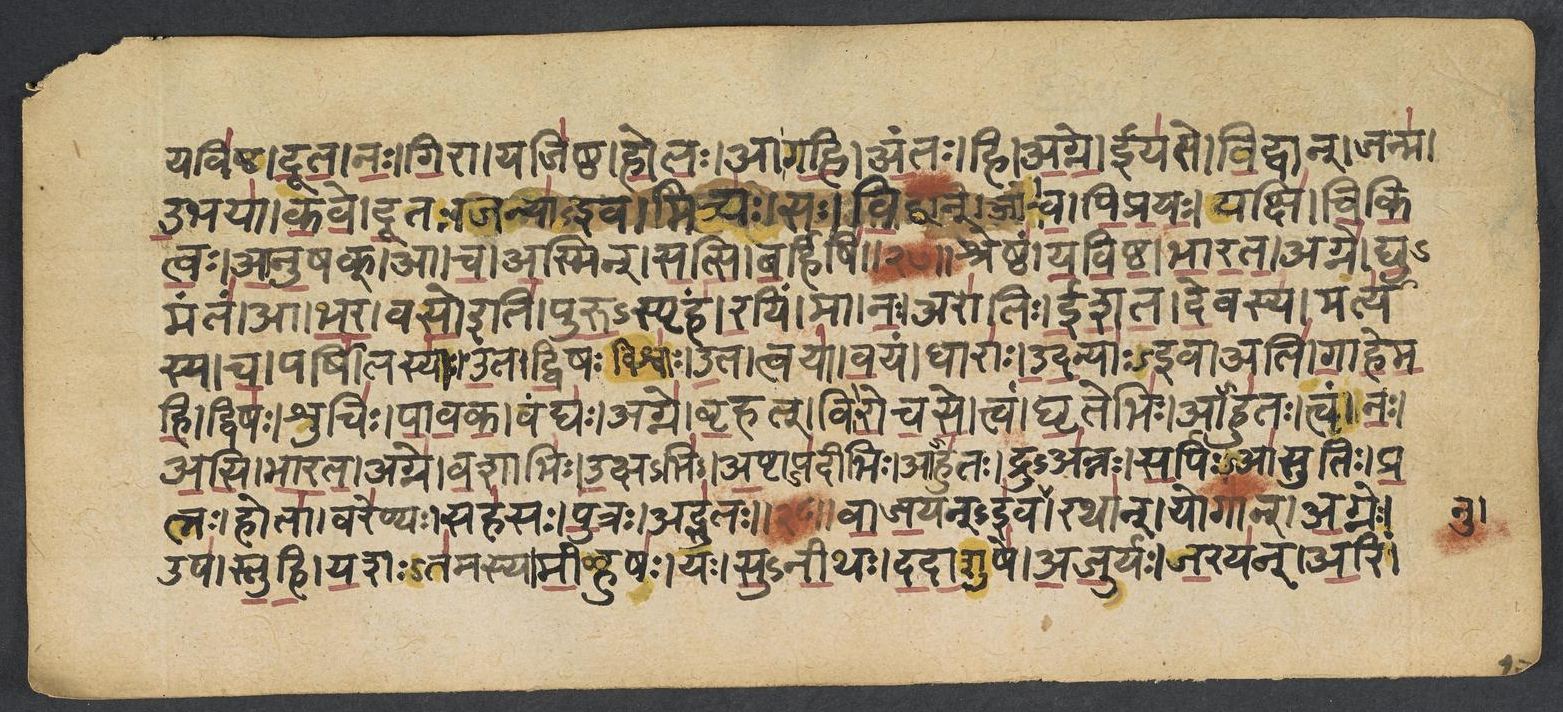
Where on the image
Penn Ms. Coll. 390 Item 41, fol. 154v (numbered 12v by the scribe) (OPenn image 156, upper leaf). Checked on the image: the Rigveda text on this page begins in RV 2.6.6 ‹yaviṣṭha dūta naḥ girā›. The next page with Rigveda text, fol. 155r (numbered 1r by the scribe), begins in RV 2.8.2 ‹cāru-pratīkaḥ āhutaḥ›. Verses 2.6.6-8 end on this page; 2.6.6 begins on fol. 154r (numbered 12r by the scribe).
6īḻā̍nāyāva̱syave̱ yavi̍ṣṭha dūta no gi̱rā | yaji̍ṣṭha hota̱r ā ga̍hi ||
7a̱ntar hy a̍gna̱ īya̍se vi̱dvāñ janmo̱bhayā̍ kave | dū̱to janye̍va̱ mitrya̍ḥ ||
8sa vi̱dvām̐ ā ca̍ piprayo̱ yakṣi̍ cikitva ānu̱ṣak | ā cā̱smin sa̍tsi ba̱rhiṣi̍ ||
Compare: Padapāṭha (word-by-word text written in the manuscript; Sansknet e-text via GRETIL)
6īḷānāya | avasyave | yaviṣṭha | dūta | naḥ | girā | yajiṣṭha | hotaḥ | ā | gahi
7antaḥ | hi | agne | īyase | vidvān | janma | ubhayā | kave | dūtaḥ | janyāiva | mitryaḥ
8saḥ | vidvān | ā | ca | piprayaḥ | yakṣi | cikitvaḥ | ānuṣak | ā | ca | asmin | satsi | barhiṣi
6To him who lauds thee, craving help, most youthful envoy! through our song, Most holy Herald! come thou nigh.
7Between both races, Agni, Sage, well skilled thou passest to and fro, As envoy friendly to mankind.
8Befriend us thou as knowing all. Sage, duly worship thou the Gods, And seat thee on this sacred grass.
Notes
- Sanskrit: Aufrecht's edition (1877) with the Vedic accents, as entered by van Nooten and Holland (GRETIL).
- English: Ralph T. H. Griffith, The Hymns of the Rigveda (1889-1892; 2nd ed. 1896-1897), from the VedaWeb digital text; OCR slips in that text were corrected against the printed 2nd edition (data/sources/rigveda/griffith_errata.json).
- Padapāṭha (edition text): Sansknet e-text via GRETIL (CC BY-NC-SA 4.0).
Cite
Sources
- Source: Penn Ms. Coll. 390 Item 41 (undated (catalogued with Penn's 18th-19th c. Vedic manuscripts)), OPenn, Public Domain Mark + Aufrecht's accented text (GRETIL) + Griffith's English (VedaWeb) (holding institution)
- Critical edition: Aufrecht (1877), accented e-text via GRETIL
← previous · → next · v cycle view · l back to library