Rigveda 2.9: To Agni
Introduction
Rigveda 2.9 is a hymn of 6 verses addressed to Agni. It stands in book (maṇḍala) 2, the family book of Gṛtsamada. The Rigveda is the oldest collection of Sanskrit hymns, composed in the second half of the second millennium BCE and handed down orally for many centuries before it was written down.
The manuscript shown is Penn Ms. Coll. 390 Item 41 (University of Pennsylvania), an undated paper manuscript of the padapāṭha (the word-by-word recitation text, in which every word is written separately and compounds are split) of the whole Ṛgveda in Devanāgarī, 884 leaves in fascicles, 7-9 lines to the page, accents in red; this hymn stands on fol. 155r-155v. Each section below gives the verses that end on one page; the page boundaries were read on the images (the opening words of every page), not counted out. Where the manuscript is a padapāṭha (the word-by-word recitation text), the section shows Aufrecht's continuous (saṃhitā) text first and, as the edition text, the padapāṭha of the same verses, which is the form written on the page.
How was this verified? (Provenance)
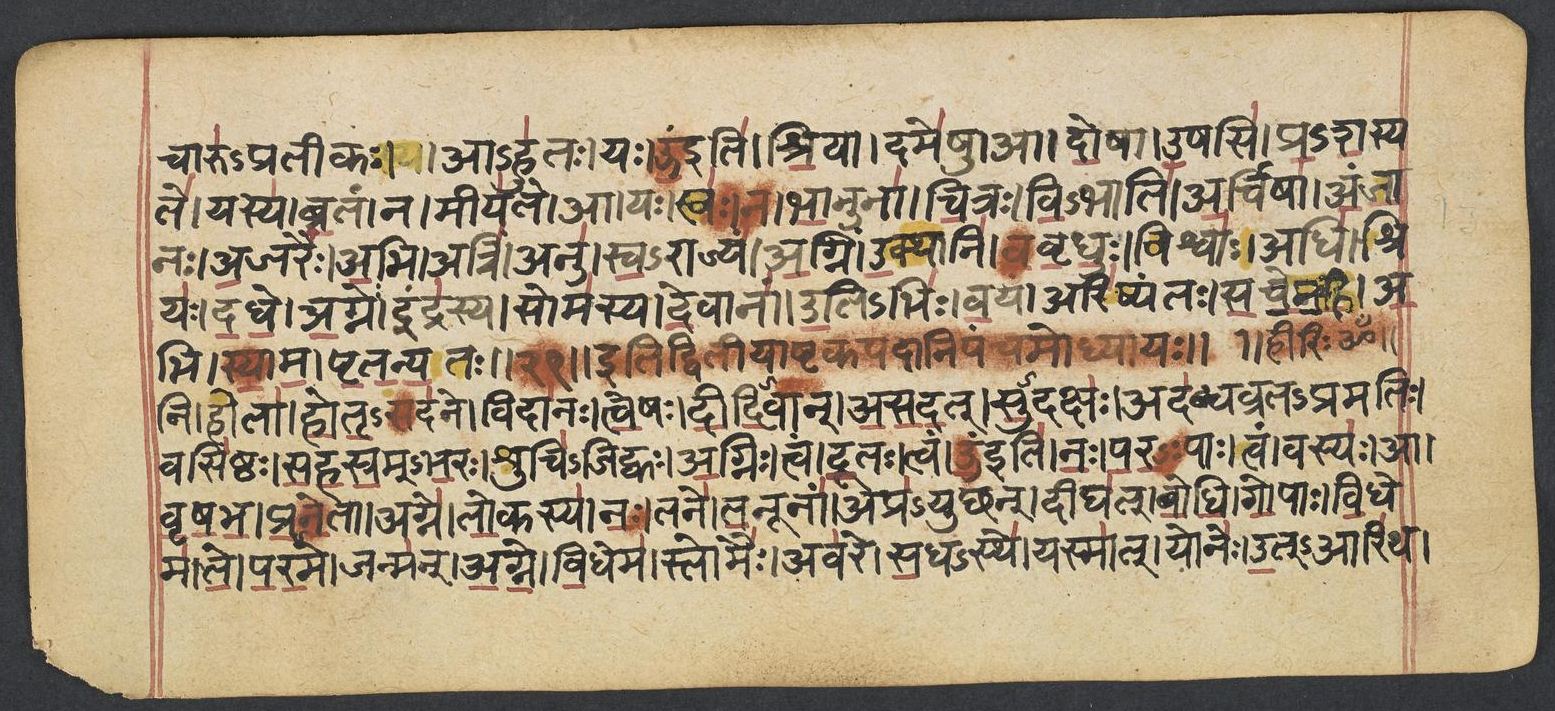
Where on the image
Penn Ms. Coll. 390 Item 41, fol. 155r (numbered 1r by the scribe) (OPenn image 156, lower leaf). Checked on the image: the Rigveda text on this page begins in RV 2.8.2 ‹cāru-pratīkaḥ āhutaḥ›. The next page with Rigveda text, fol. 155v (numbered 1v by the scribe), begins in RV 2.9.3 ‹yaje tam pra tve›. Verses 2.9.1-2 end on this page.
1ni hotā̍ hotṛ̱ṣada̍ne̱ vidā̍nas tve̱ṣo dī̍di̱vām̐ a̍sadat su̱dakṣa̍ḥ | ada̍bdhavratapramati̱r vasi̍ṣṭhaḥ sahasrambha̱raḥ śuci̍jihvo a̱gniḥ ||
2tvaṁ dū̱tas tvam u̍ naḥ para̱spās tvaṁ vasya̱ ā vṛ̍ṣabha praṇe̱tā | agne̍ to̱kasya̍ na̱s tane̍ ta̱nūnā̱m apra̍yuccha̱n dīdya̍d bodhi go̱pāḥ ||
Compare: Padapāṭha (word-by-word text written in the manuscript; Sansknet e-text via GRETIL)
1ni | hotā | hotṛ-sadane | vidānaḥ | tveṣaḥ | dīdi-vān | asadat | su-dakṣaḥ | adabdha-vratapramatiḥ | vasiṣṭhaḥ | sahasram-bharaḥ | śuci-jihvaḥ | agniḥ
2tvam | dūtaḥ | tvam | oṃ iti | naḥ | paraḥ-pāḥ | tvam | vasyaḥ | ā | vṛṣabha | pra-netā | agne | tokasya | naḥ | tane | tanūnām | apra-yucchan | dīdyat | bodhi | gopāḥ
1ACCUSTOMED to the Herald's place, the Herald hath seated him, bright, splendid, passing mighty, Whose foresight keeps the Law from violation, excellent, pure-tongued, bringing thousands, Agni.
2Envoy art thou, protector from the foeman, strong God, thou leadest us to higher blessings. Refulgent, be an ever-heedful keeper, Agni, for us and for our seed offspring.
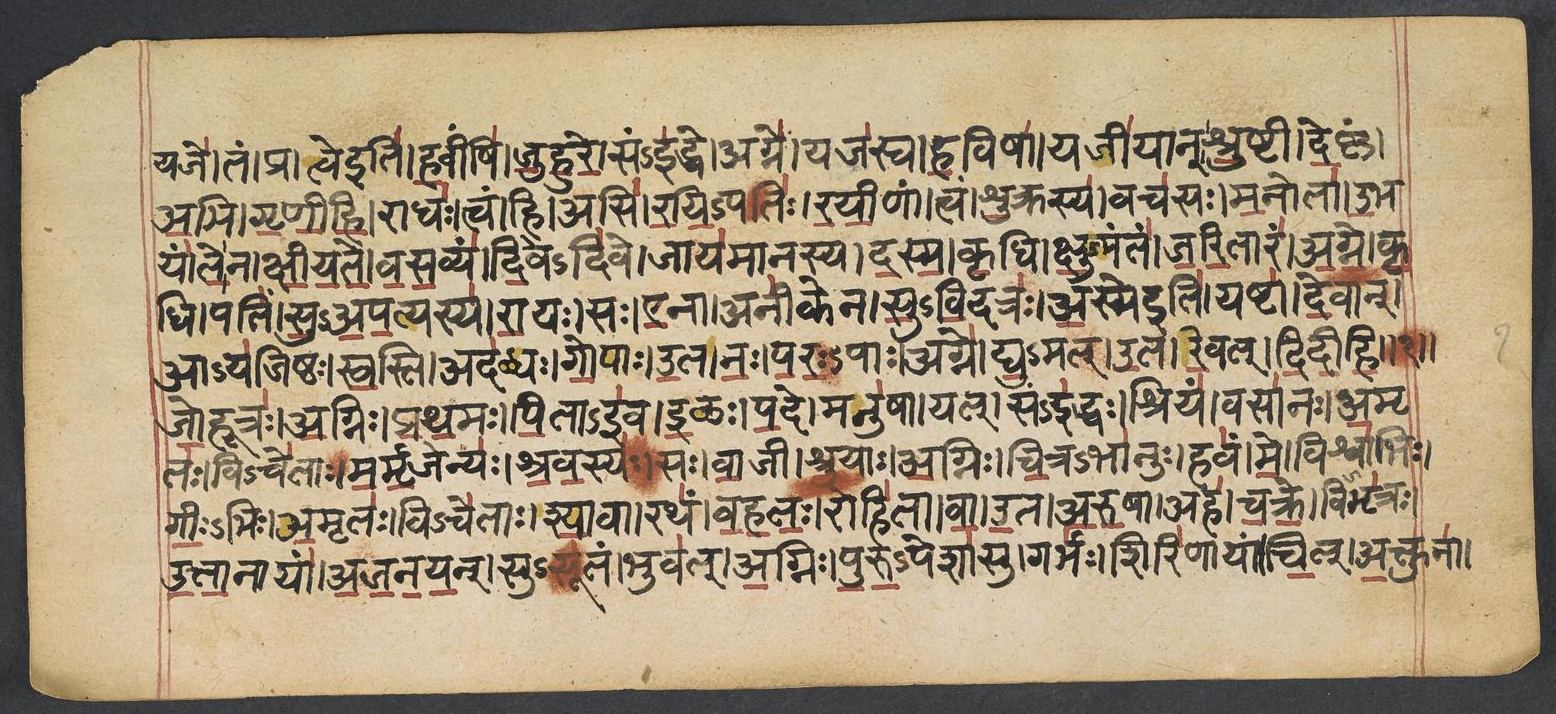
Where on the image
Penn Ms. Coll. 390 Item 41, fol. 155v (numbered 1v by the scribe) (OPenn image 157, upper leaf). Checked on the image: the Rigveda text on this page begins in RV 2.9.3 ‹yaje tam pra tve›. The next page with Rigveda text, fol. 156r (numbered 2r by the scribe), begins in RV 2.10.3 ‹mahaḥ-bhiḥ apari-vṛtaḥ vasati pra-cetāḥ›. Verses 2.9.3-6 end on this page; 2.9.3 begins on fol. 155r (numbered 1r by the scribe).
3vi̱dhema̍ te para̱me janma̍nn agne vi̱dhema̱ stomai̱r ava̍re sa̱dhasthe̍ | yasmā̱d yone̍r u̱dāri̍thā̱ yaje̱ tam pra tve ha̱vīṁṣi̍ juhure̱ sami̍ddhe ||
4agne̱ yaja̍sva ha̱viṣā̱ yajī̍yāñ chru̱ṣṭī de̱ṣṇam a̱bhi gṛ̍ṇīhi̱ rādha̍ḥ | tvaṁ hy asi̍ rayi̱patī̍ rayī̱ṇāṁ tvaṁ śu̱krasya̱ vaca̍so ma̱notā̍ ||
5u̱bhaya̍ṁ te̱ na kṣī̍yate vasa̱vya̍ṁ di̱ve-di̍ve̱ jāya̍mānasya dasma | kṛ̱dhi kṣu̱manta̍ṁ jari̱tāra̍m agne kṛ̱dhi pati̍ṁ svapa̱tyasya̍ rā̱yaḥ ||
6sainānī̍kena suvi̱datro̍ a̱sme yaṣṭā̍ de̱vām̐ āya̍jiṣṭhaḥ sva̱sti | ada̍bdho go̱pā u̱ta na̍ḥ para̱spā agne̍ dyu̱mad u̱ta re̱vad di̍dīhi ||
Compare: Padapāṭha (word-by-word text written in the manuscript; Sansknet e-text via GRETIL)
3vidhema | te | parame | janman | agne | vidhema | stomaiḥ | avare | sadha-sthe | yasmāt | yoneḥ | ut-āritha | yaje | tam | pra | tve iti | havīṃṣi | juhure | sam-iddhe
4agne | yajasva | haviṣā | yajīyān | śruṣṭī | deṣṇam | abhi | gṛṇīhi | rādhaḥ | tvam | h i | asi | rayi-patiḥ | rayīṇām | tvam | śukrasya | vacasaḥ | manotā
5ubhayam | te | na | kṣīyate | vasavyam | dive--dive | jāyamānasya | dasma | kṛdhi | kṣu-mantam | jaritāram | agne | kṛdhi | patim | su-apatyasya | rāyaḥ
6saḥ | enā | anīkena | su-vidatraḥ | asme iti | yaṣṭā | devān | āyajiṣṭhaḥ | svasti | adabdhaḥ | gopāḥ | uta | naḥ | paraḥ-pāḥ | agne | dyu-mat | uta | revat | didīhi
3May we adore thee in thy loftiest birthplace, and, with our praises, in thy lower station. The place whence thou issued forth I worship: to thee well kindled have they paid oblations.
4Agni, best Priest, pay worship with oblation; quickly commend the gift to be presented; For thou art Lord of gathered wealth and treasure. of the bright song of praise thou art inventor.
5The twofold opulence, O Wonder-Worker, of thee new-born each day never decreases. Enrich with food the man who lauds thee, Agni: make him the lord of wealth with noble offspring.
6May he, benevolent with this fair aspect, best sacrificer, bring the Gods to bless us. Sure guardian, our protector from the foeman, shine, Agni, with thine affluence and splendour.
Notes
- Sanskrit: Aufrecht's edition (1877) with the Vedic accents, as entered by van Nooten and Holland (GRETIL).
- English: Ralph T. H. Griffith, The Hymns of the Rigveda (1889-1892; 2nd ed. 1896-1897), from the VedaWeb digital text; OCR slips in that text were corrected against the printed 2nd edition (data/sources/rigveda/griffith_errata.json).
- Padapāṭha (edition text): Sansknet e-text via GRETIL (CC BY-NC-SA 4.0).
Cite
Sources
- Source: Penn Ms. Coll. 390 Item 41 (undated (catalogued with Penn's 18th-19th c. Vedic manuscripts)), OPenn, Public Domain Mark + Aufrecht's accented text (GRETIL) + Griffith's English (VedaWeb) (holding institution)
- Critical edition: Aufrecht (1877), accented e-text via GRETIL
← previous · → next · v cycle view · l back to library