Rigveda 3.14: To Agni
Introduction
Rigveda 3.14 is a hymn of 7 verses addressed to Agni. It stands in book (maṇḍala) 3, the family book of Viśvāmitra. The Rigveda is the oldest collection of Sanskrit hymns, composed in the second half of the second millennium BCE and handed down orally for many centuries before it was written down.
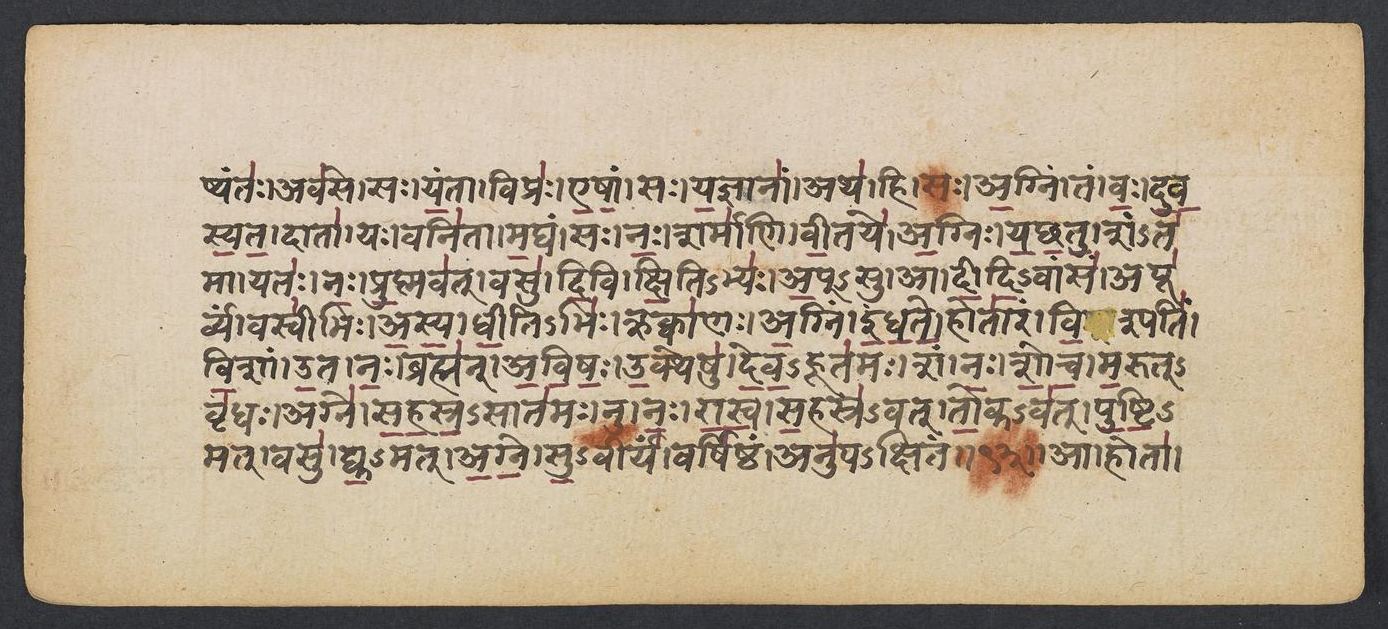
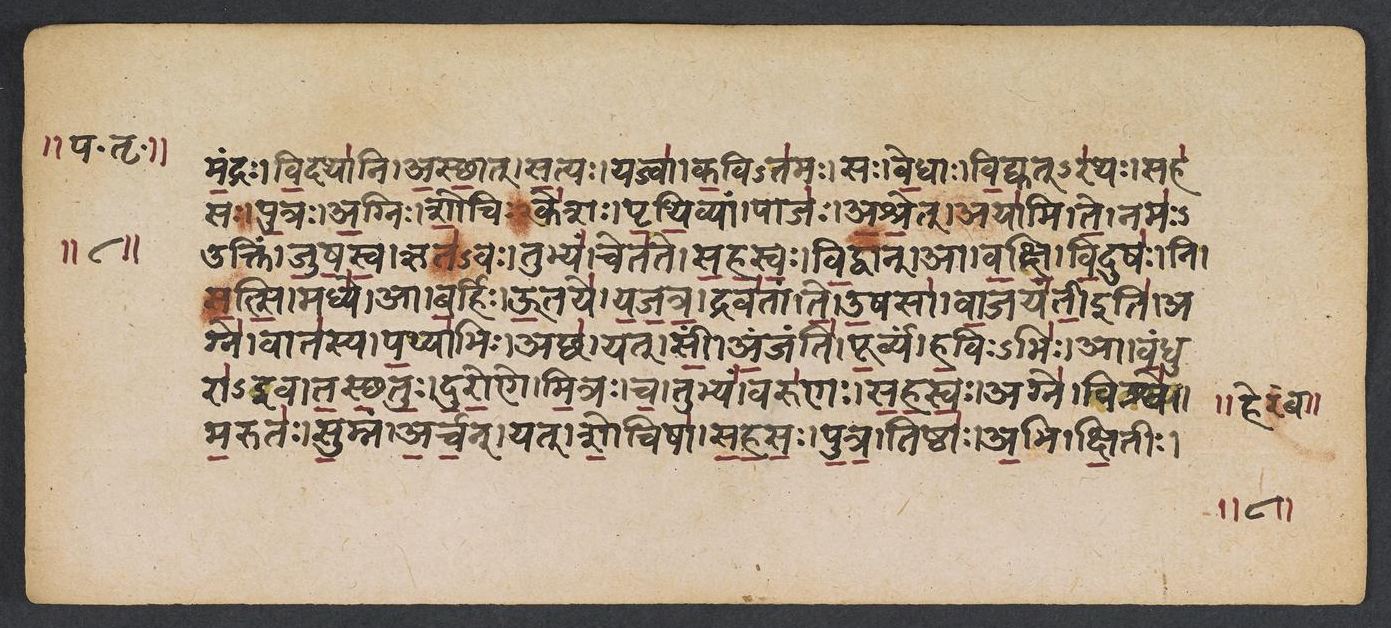
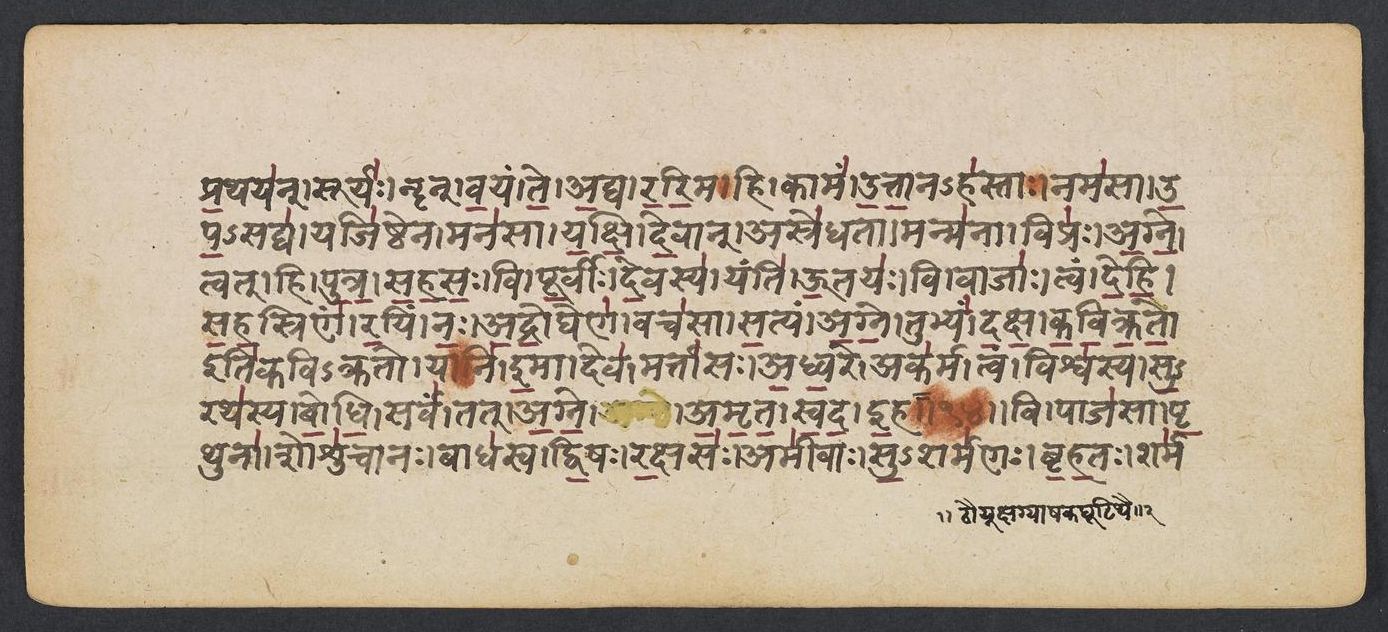
The manuscript shown is Penn Ms. Coll. 390 Item 41 (University of Pennsylvania), an undated paper manuscript of the padapāṭha (the word-by-word recitation text, in which every word is written separately and compounds are split) of the whole Ṛgveda in Devanāgarī, 884 leaves in fascicles, 7-9 lines to the page, accents in red; this hymn stands on fol. 198r-199r. Each section below gives the verses that end on one page; the page boundaries were read on the images (the opening words of every page), not counted out. Where the manuscript is a padapāṭha (the word-by-word recitation text), the section shows Aufrecht's continuous (saṃhitā) text first and, as the edition text, the padapāṭha of the same verses, which is the form written on the page.
How was this verified? (Provenance)
Where on the image
Penn Ms. Coll. 390 Item 41, fol. 198v (numbered 8v by the scribe) (OPenn image 200, upper leaf). Checked on the image: the Rigveda text on this page begins in RV 3.14.1 ‹mandraḥ vadathāni asthāt satyaḥ›. The next page with Rigveda text, fol. 199r (numbered 9r by the scribe), begins in RV 3.14.4 ‹prathayan sūryaḥ nṝn›. Verses 3.14.1-3 end on this page; 3.14.1 begins on fol. 198r (numbered 8r by the scribe).
1ā hotā̍ ma̱ndro vi̱dathā̍ny asthāt sa̱tyo yajvā̍ ka̱vita̍ma̱ḥ sa ve̱dhāḥ | vi̱dyudra̍tha̱ḥ saha̍sas pu̱tro a̱gniḥ śo̱ciṣke̍śaḥ pṛthi̱vyām pājo̍ aśret ||
2ayā̍mi te̱ nama̍üktiṁ juṣasva̱ ṛtā̍va̱s tubhya̱ṁ ceta̍te sahasvaḥ | vi̱dvām̐ ā va̍kṣi vi̱duṣo̱ ni ṣa̍tsi̱ madhya̱ ā ba̱rhir ū̱taye̍ yajatra ||
3drava̍tāṁ ta u̱ṣasā̍ vā̱jaya̍ntī̱ agne̱ vāta̍sya pa̱thyā̍bhi̱r accha̍ | yat sī̍m a̱ñjanti̍ pū̱rvyaṁ ha̱virbhi̱r ā va̱ndhure̍va tasthatur duro̱ṇe ||
Compare: Padapāṭha (word-by-word text written in the manuscript; Sansknet e-text via GRETIL)
1ā | hotā | mandraḥ | vadathāni | asthāt | satyaḥ | yajvā | kavi-tamaḥ | saḥ | vedhāḥ | vidyut-rathaḥ | sahasaḥ | putraḥ | agniḥ | śociḥ-keśaḥ | pṛthivyām | pājaḥ | aśret
2ayāmi | te | namaḥ-uktim | juṣasva | ṛta-vaḥ | tubhyam | cetate | sahasvaḥ | vidvān | ā | vakṣi | viduṣaḥ | ni | ṣatsi | madhye | ā | barhiḥ | ūtaye | yajatra
3dravatām | te | uṣasā | vājayantī iti | agne | vātasya | pathyābhiḥ | accha | yat | sīm | añjanti | pūrvyam | haviḥ-bhiḥ | ā | vandhurāiva | tasthatuḥ | duroṇe
1THE pleasant Priest is come into the synod, true, skilled in sacrifice, most wise, Ordainer. Agni, the Son of Strength, whose car is lightning, whose hair is flame, hath shown on earth his lustre.
2To thee I offer reverent speech: accept it: to thee who markest it, victorious, faithful! Bring, thou who knowest, those who know, and seat thee amid the sacred grass, for help, O Holy.
3The Two who show their vigour, Night and Morning, by the wind's paths shall haste to thee O Agni. When men adorn the Ancient with oblations, these seek, as on two chariot-seats, the dwelling.
Where on the image
Penn Ms. Coll. 390 Item 41, fol. 199r (numbered 9r by the scribe) (OPenn image 200, lower leaf). Checked on the image: the Rigveda text on this page begins in RV 3.14.4 ‹prathayan sūryaḥ nṝn›. The next page with Rigveda text, fol. 199v (numbered 9v by the scribe), begins in RV 3.15.1 ‹-śarmaṇi syām agneḥ aham›. Verses 3.14.4-7 end on this page; 3.14.4 begins on fol. 198v (numbered 8v by the scribe).
4mi̱traś ca̱ tubhya̱ṁ varu̍ṇaḥ saha̱svo 'gne̱ viśve̍ ma̱ruta̍ḥ su̱mnam a̍rcan | yac cho̱ciṣā̍ sahasas putra̱ tiṣṭhā̍ a̱bhi kṣi̱tīḥ pra̱thaya̱n sūryo̱ nṝn ||
5va̱yaṁ te̍ a̱dya ra̍ri̱mā hi kāma̍m uttā̱naha̍stā̱ nama̍sopa̱sadya̍ | yaji̍ṣṭhena̱ mana̍sā yakṣi de̱vān asre̍dhatā̱ manma̍nā̱ vipro̍ agne ||
6tvad dhi pu̍tra sahaso̱ vi pū̱rvīr de̱vasya̱ yanty ū̱tayo̱ vi vājā̍ḥ | tvaṁ de̍hi saha̱sriṇa̍ṁ ra̱yiṁ no̍ 'dro̱gheṇa̱ vaca̍sā sa̱tyam a̍gne ||
7tubhya̍ṁ dakṣa kavikrato̱ yānī̱mā deva̱ martā̍so adhva̱re aka̍rma | tvaṁ viśva̍sya su̱ratha̍sya bodhi̱ sarva̱ṁ tad a̍gne amṛta svade̱ha ||
Compare: Padapāṭha (word-by-word text written in the manuscript; Sansknet e-text via GRETIL)
4mitraḥ | ca | tubhyam | varuṇaḥ | sahasvaḥ | agne | viśve | marutaḥ | sumnam | arcan | yat | śociṣā | sahasaḥ | putra | tiṣṭhāḥ | abhi | kṣitīḥ | prathayan | sūryaḥ | nṝn
5vayam | te | adya | rarima | hi | kāmam | uttāna-hastāḥ | namasā | upa-sadya | yajiṣṭhena | manasā | yakṣi | devān | asredhatā | manmanā | vipraḥ | agne
6tvat | hi | putra | sahasaḥ | vi | pūrvīḥ | devasya | yanti | ūtayaḥ | vi | vājāḥ | tvam | dehi | sahasriṇam | rayim | naḥ | adrogheṇa | vacasā | satyam | agne
7tubhyam | dakṣa | kavikrato itikavi-krato | yāni | imā | deva | martāsaḥ | adhvare | akarma | tvam | viśvasya | su-rathasya | bodhi | sarvam | tat | agne | amṛta | svada | iha
4To thee, strong Agni! Varuṇa and Mitra and all the Maruts sang a song of triumph, What time unto the people's lands thou camest, spreading them as the Sun of men, with lustre.
5Approaching with raised hands and adoration, we have this day fulfilled for thee thy longing. Worship the Gods with most devoted spirit, a Priest with no unfriendly thought, O Agni.
6For, Son of Strength, from thee come many succours, and powers abundant that a God possesses. Agni, to us with speech that hath no falsehood grant riches, real, to be told in thousands.
7Whatever, God, in sacrifice we mortals have wrought is all for thee, strong, wise of purpose! Be thou the Friend of each good chariot's master. All this enjoy thou here, immortal Agni.
Notes
- Sanskrit: Aufrecht's edition (1877) with the Vedic accents, as entered by van Nooten and Holland (GRETIL).
- English: Ralph T. H. Griffith, The Hymns of the Rigveda (1889-1892; 2nd ed. 1896-1897), from the VedaWeb digital text; OCR slips in that text were corrected against the printed 2nd edition (data/sources/rigveda/griffith_errata.json).
- Padapāṭha (edition text): Sansknet e-text via GRETIL (CC BY-NC-SA 4.0).
Cite
Sources
- Source: Penn Ms. Coll. 390 Item 41 (undated (catalogued with Penn's 18th-19th c. Vedic manuscripts)), OPenn, Public Domain Mark + Aufrecht's accented text (GRETIL) + Griffith's English (VedaWeb) (holding institution)
- Critical edition: Aufrecht (1877), accented e-text via GRETIL
← previous · → next · v cycle view · l back to library