Rigveda 3.13: To Agni
Introduction
Rigveda 3.13 is a hymn of 7 verses addressed to Agni. It stands in book (maṇḍala) 3, the family book of Viśvāmitra. The Rigveda is the oldest collection of Sanskrit hymns, composed in the second half of the second millennium BCE and handed down orally for many centuries before it was written down.
The manuscript shown is Penn Ms. Coll. 390 Item 41 (University of Pennsylvania), an undated paper manuscript of the padapāṭha (the word-by-word recitation text, in which every word is written separately and compounds are split) of the whole Ṛgveda in Devanāgarī, 884 leaves in fascicles, 7-9 lines to the page, accents in red; this hymn stands on fol. 197v-198r. Each section below gives the verses that end on one page; the page boundaries were read on the images (the opening words of every page), not counted out. Where the manuscript is a padapāṭha (the word-by-word recitation text), the section shows Aufrecht's continuous (saṃhitā) text first and, as the edition text, the padapāṭha of the same verses, which is the form written on the page.
How was this verified? (Provenance)
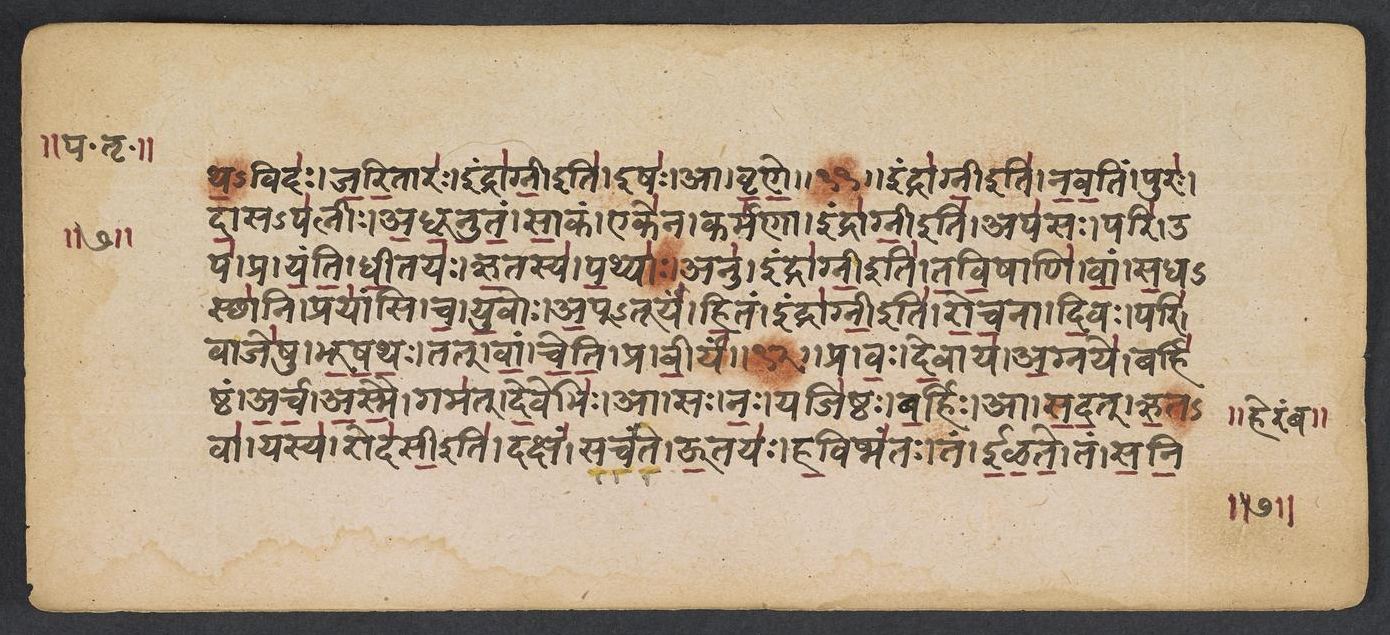
Where on the image
Penn Ms. Coll. 390 Item 41, fol. 197v (numbered 7v by the scribe) (OPenn image 199, upper leaf). Checked on the image: the Rigveda text on this page begins in RV 3.12.5 ‹-nītha-vidaḥ jaritāraḥ indrāgnī iti›. The next page with Rigveda text, fol. 198r (numbered 8r by the scribe), begins in RV 3.13.2 ‹-saniṣyantaḥ avase›. Verse 3.13.1 ends on this page.
1pra vo̍ de̱vāyā̱gnaye̱ barhi̍ṣṭham arcāsmai | gama̍d de̱vebhi̱r ā sa no̱ yaji̍ṣṭho ba̱rhir ā sa̍dat ||
Compare: Padapāṭha (word-by-word text written in the manuscript; Sansknet e-text via GRETIL)
1pra | vaḥ | devāya | agnaye | barhiṣṭham | arca | asmai | gamat | devebhiḥ | ā | saḥ | naḥ | yajiṣṭhaḥ | barhiḥ | ā | sadat
1To Agni, to this God of yours I sing aloud with utmost power. May he come to us with the Gods, and sit, best Offerer, on the grass.
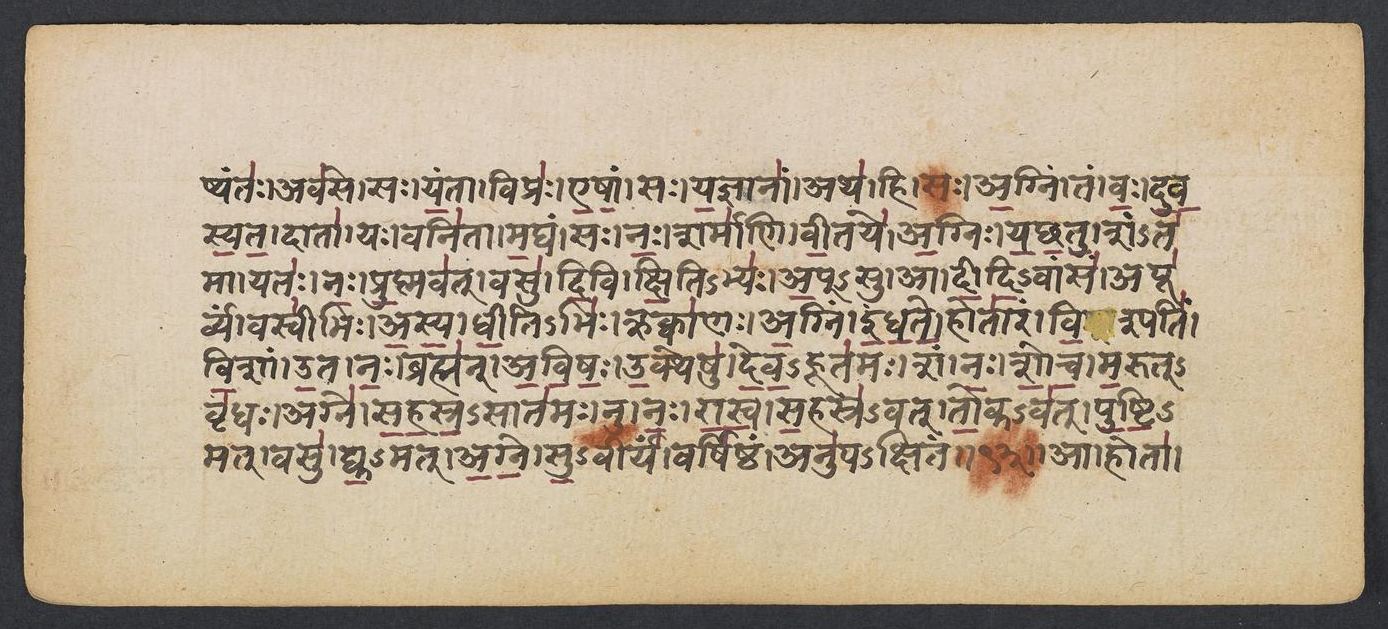
Where on the image
Penn Ms. Coll. 390 Item 41, fol. 198r (numbered 8r by the scribe) (OPenn image 199, lower leaf). Checked on the image: the Rigveda text on this page begins in RV 3.13.2 ‹-saniṣyantaḥ avase›. The next page with Rigveda text, fol. 198v (numbered 8v by the scribe), begins in RV 3.14.1 ‹mandraḥ vadathāni asthāt satyaḥ›. Verses 3.13.2-7 end on this page; 3.13.2 begins on fol. 197v (numbered 7v by the scribe).
2ṛ̱tāvā̱ yasya̱ roda̍sī̱ dakṣa̱ṁ saca̍nta ū̱taya̍ḥ | ha̱viṣma̍nta̱s tam ī̍ḻate̱ taṁ sa̍ni̱ṣyanto 'va̍se ||
3sa ya̱ntā vipra̍ eṣā̱ṁ sa ya̱jñānā̱m athā̱ hi ṣaḥ | a̱gniṁ taṁ vo̍ duvasyata̱ dātā̱ yo vani̍tā ma̱gham ||
4sa na̱ḥ śarmā̍ṇi vī̱taye̱ 'gnir ya̍cchatu̱ śaṁta̍mā | yato̍ naḥ pru̱ṣṇava̱d vasu̍ di̱vi kṣi̱tibhyo̍ a̱psv ā ||
5dī̱di̱vāṁsa̱m apū̍rvya̱ṁ vasvī̍bhir asya dhī̱tibhi̍ḥ | ṛkvā̍ṇo a̱gnim i̍ndhate̱ hotā̍raṁ vi̱śpati̍ṁ vi̱śām ||
6u̱ta no̱ brahma̍nn aviṣa u̱ktheṣu̍ deva̱hūta̍maḥ | śaṁ na̍ḥ śocā ma̱rudvṛ̱dho 'gne̍ sahasra̱sāta̍maḥ ||
7nū no̍ rāsva sa̱hasra̍vat to̱kava̍t puṣṭi̱mad vasu̍ | dyu̱mad a̍gne su̱vīrya̱ṁ varṣi̍ṣṭha̱m anu̍pakṣitam ||
Compare: Padapāṭha (word-by-word text written in the manuscript; Sansknet e-text via GRETIL)
2ṛta-vā | yasya | rodasī iti | dakṣam | sacante | ūtayaḥ | haviṣmantaḥ | tam | īḷate | tam | saniṣyantaḥ | avase
3saḥ | yantā | vipraḥ | eṣām | saḥ | yajñānām | atha | hi | saḥ | agnim | tam | vaḥ | duvasyata | dātā | yaḥ | vanitā | magham
4saḥ | naḥ | śarmāṇi | vītaye | agniḥ | yacchatu | śam-tamā | yataḥ | naḥ | pruṣṇavat | vasu | divi | kṣiti-bhyaḥ | ap-su | ā
5dīdi-vāṃsam | apūrvyam | vasvībhiḥ | asya | dhīti-bhiḥ | ṛkvaaṇaḥ | agnim | indhate | hotāram | viśpatim | viśām
6uta | naḥ | brahman | aviṣaḥ | uktheṣu | deva-hūtamaḥ | śam | naḥ | śoca | marut-vṛdhaḥ | agne | sahasra-sātamaḥ
7nu | naḥ | rāsva | sahasra-vat | toka-vat | puṣṭi-mat | vasu | dyumat | agne | su-vīryam | varṣiṣṭham | anupa-kṣitam
2The Holy, whose are earth and heaven, and succour waits upon his strength; Him men who bring oblations laud, and they who wish to gain, for grace.
3He is the Sage who guides these men, Leader of sacred rites is he. Him your own Agni, serve ye well, who winneth and bestoweth wealth.
4So may the gracious Agni grant most goodly shelter for our use; Whence in the heavens or in the floods he shall pour wealth upon our lands.
5The singers kindle him, the Priest, Agni the Lord of tribes of men, Resplendent and without a peer through his own excellent designs.
6Help us, thou Brahman, best of all invokers of the Gods in song. Beam, Friend of Maruts, bliss on us, O Agni, a most liberal God.
7Yea, grant us treasure thousandfold with children and with nourishment, And, Agni, splendid hero strength, exalted, wasting not away.
Notes
- Sanskrit: Aufrecht's edition (1877) with the Vedic accents, as entered by van Nooten and Holland (GRETIL).
- English: Ralph T. H. Griffith, The Hymns of the Rigveda (1889-1892; 2nd ed. 1896-1897), from the VedaWeb digital text; OCR slips in that text were corrected against the printed 2nd edition (data/sources/rigveda/griffith_errata.json).
- Padapāṭha (edition text): Sansknet e-text via GRETIL (CC BY-NC-SA 4.0).
Cite
Sources
- Source: Penn Ms. Coll. 390 Item 41 (undated (catalogued with Penn's 18th-19th c. Vedic manuscripts)), OPenn, Public Domain Mark + Aufrecht's accented text (GRETIL) + Griffith's English (VedaWeb) (holding institution)
- Critical edition: Aufrecht (1877), accented e-text via GRETIL
← previous · → next · v cycle view · l back to library