Rigveda 3.16: To Agni
Introduction
Rigveda 3.16 is a hymn of 6 verses addressed to Agni. It stands in book (maṇḍala) 3, the family book of Viśvāmitra. The Rigveda is the oldest collection of Sanskrit hymns, composed in the second half of the second millennium BCE and handed down orally for many centuries before it was written down.
The manuscript shown is Penn Ms. Coll. 390 Item 41 (University of Pennsylvania), an undated paper manuscript of the padapāṭha (the word-by-word recitation text, in which every word is written separately and compounds are split) of the whole Ṛgveda in Devanāgarī, 884 leaves in fascicles, 7-9 lines to the page, accents in red; this hymn stands on fol. 200r-200v. Each section below gives the verses that end on one page; the page boundaries were read on the images (the opening words of every page), not counted out. Where the manuscript is a padapāṭha (the word-by-word recitation text), the section shows Aufrecht's continuous (saṃhitā) text first and, as the edition text, the padapāṭha of the same verses, which is the form written on the page.
How was this verified? (Provenance)
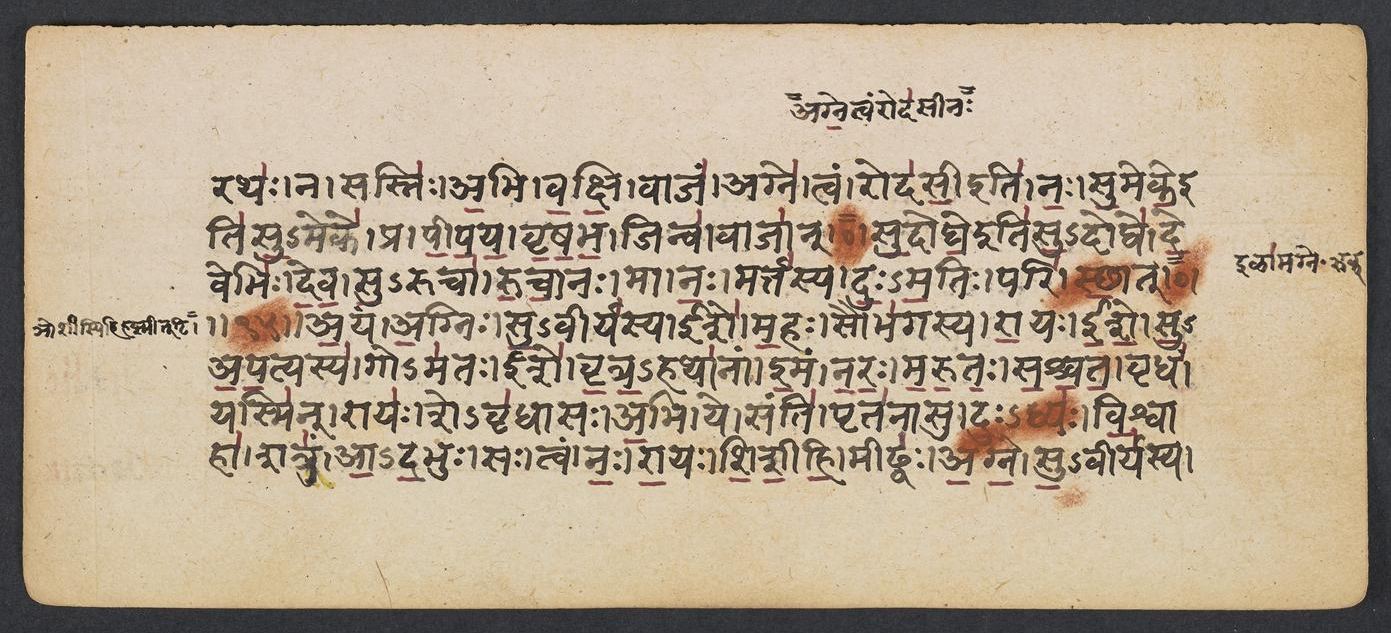
Where on the image
Penn Ms. Coll. 390 Item 41, fol. 200r (numbered 10r by the scribe) (OPenn image 201, lower leaf). Checked on the image: the Rigveda text on this page begins in RV 3.15.5 ‹rathaḥ na sasniḥ abhi›. The next page with Rigveda text, fol. 200v (numbered 10v by the scribe), begins in RV 3.16.3 ‹tuvi-dyumna varṣiṣṭhasya prajāvataḥ anamīvasya›. Verses 3.16.1-2 end on this page.
1a̱yam a̱gniḥ su̱vīrya̱syeśe̍ ma̱haḥ saubha̍gasya | rā̱ya ī̍śe svapa̱tyasya̱ goma̍ta̱ īśe̍ vṛtra̱hathā̍nām ||
2i̱maṁ na̍ro marutaḥ saścatā̱ vṛdha̱ṁ yasmi̱n rāya̱ḥ śevṛ̍dhāsaḥ | a̱bhi ye santi̱ pṛta̍nāsu dū̱ḍhyo̍ vi̱śvāhā̱ śatru̍m āda̱bhuḥ ||
Compare: Padapāṭha (word-by-word text written in the manuscript; Sansknet e-text via GRETIL)
1ayam | agniḥ | su-vīryasya | īśe | mahaḥ | saubhagasya | rāyaḥ | īśe | su-aapatyasya | go--mataḥ | īśe | vṛtra-hathānām
2imam | naraḥ | marutaḥ | saścata | vṛdham | yasmin | rāyaḥ | śe--vṛdhāsaḥ | abhi | ye | santi | pṛtanāsu | duḥ-dhyaḥ | viśvāhā | śatrum | ādabhuḥ
1THIS Agni is the Lord of great felicity and hero Strength; Lord of wealth in herds of kine; Lord of the battles with the foe.
2Wait, Maruts, Heroes, upon him the Prosperer in whom is bliss-increasing wealth; Who in fights ever conquer evil-hearted men, who overcome the enemy.
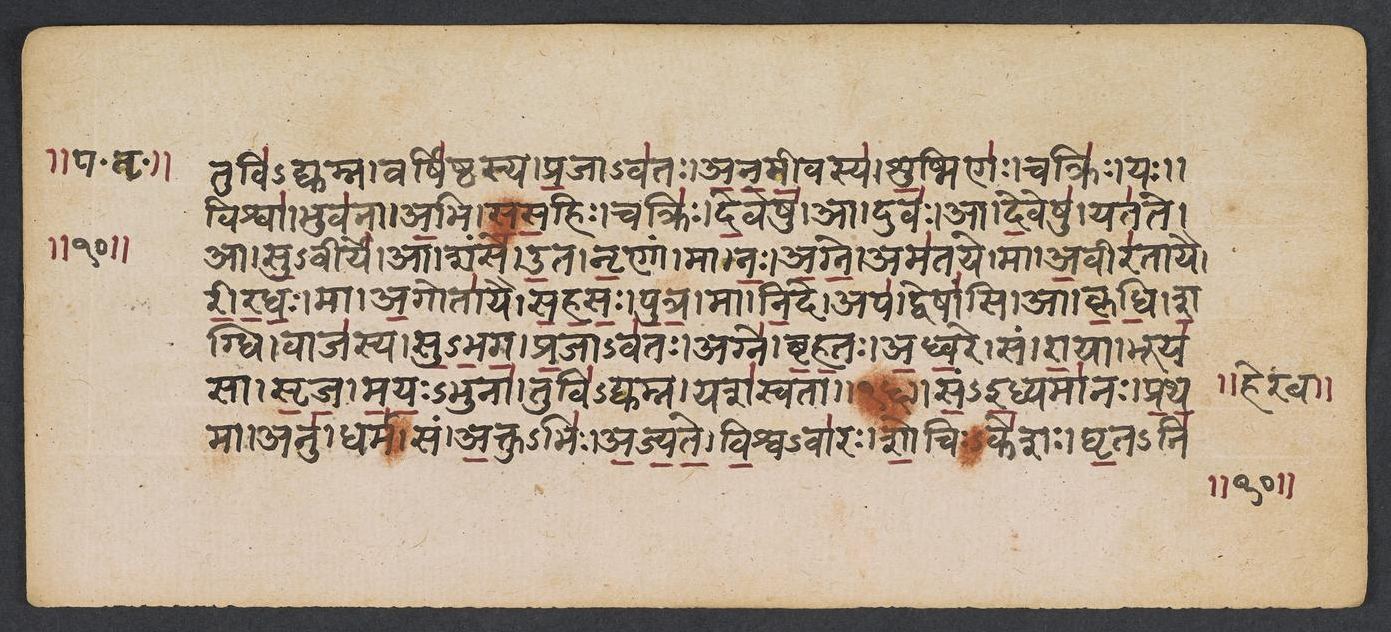
Where on the image
Penn Ms. Coll. 390 Item 41, fol. 200v (numbered 10v by the scribe) (OPenn image 202, upper leaf). Checked on the image: the Rigveda text on this page begins in RV 3.16.3 ‹tuvi-dyumna varṣiṣṭhasya prajāvataḥ anamīvasya›. The next page with Rigveda text, fol. 201r (numbered 11r by the scribe), begins in RV 3.17.1 ‹-ghṛta-nirnik pāvakaḥ su-yajñaḥ agniḥ›. Verses 3.16.3-6 end on this page; 3.16.3 begins on fol. 200r (numbered 10r by the scribe).
3sa tvaṁ no̍ rā̱yaḥ śi̍śīhi̱ mīḍhvo̍ agne su̱vīrya̍sya | tuvi̍dyumna̱ varṣi̍ṣṭhasya pra̱jāva̍to 'namī̱vasya̍ śu̱ṣmiṇa̍ḥ ||
4cakri̱r yo viśvā̱ bhuva̍nā̱bhi sā̍sa̱hiś cakri̍r de̱veṣv ā duva̍ḥ | ā de̱veṣu̱ yata̍ta̱ ā su̱vīrya̱ ā śaṁsa̍ u̱ta nṛ̱ṇām ||
5mā no̍ a̱gne 'ma̍taye̱ māvīra̍tāyai rīradhaḥ | māgotā̍yai sahasas putra̱ mā ni̱de 'pa̱ dveṣā̱ṁsy ā kṛ̍dhi ||
6śa̱gdhi vāja̍sya subhaga pra̱jāva̱to 'gne̍ bṛha̱to a̍dhva̱re | saṁ rā̱yā bhūya̍sā sṛja mayo̱bhunā̱ tuvi̍dyumna̱ yaśa̍svatā ||
Compare: Padapāṭha (word-by-word text written in the manuscript; Sansknet e-text via GRETIL)
3saḥ | tvam | naḥ | rāyaḥ | śiśīhi | mīḍhavaḥ | agne | su-vīryasya | tuvi-dyumna | varṣiṣṭhasya | prajāvataḥ | anamīvasya | śuṣmiṇaḥ
4cakriḥ | yaḥ | viśvā | bhuvanā | abhi | sasahiḥ | cakriḥ | deveṣu | ā | duvaḥ | ā | deveṣu | yatate | ā | su-vīrye | ā | śaṃse | uta | nṛṇām
5mā | naḥ | agne | amataye | mā | avīratāyai | rīradhaḥ | mā | agotāyai | sahasaḥ | putra | mā | nide | apa | dveṣāṃsi | ā | kṛdhi
6śagdhi | vājasya | su-bhaga | prajāvataḥ | agne | bṛhataḥ | adhvare | sam | rāyā | bhūyasā | sṛja | mayaḥ-bhunā | tuvi-dyumna | yaśasvatā
3As such, O Agni, deal us wealth and hero might, O Bounteous One! Most lofty, very glorious, rich in progeny, free from disease and full of power.
4He who made all that lives, who passes all in might, who orders service to the Gods, He works among the Gods, he works in hero strength, yea, also in the praise of men.
5Give us not up to indigence, Agni, nor want of hero sons, Nor, Son of Strength, to lack of cattle, nor to blame. Drive. thou our enemies away.
6Help us to strength, blest Agni! rich in progeny, abundant, in our sacrifice. Flood us with riches yet more plenteous, bringing weal, with high renown, most Glorious One!
Notes
- Sanskrit: Aufrecht's edition (1877) with the Vedic accents, as entered by van Nooten and Holland (GRETIL).
- English: Ralph T. H. Griffith, The Hymns of the Rigveda (1889-1892; 2nd ed. 1896-1897), from the VedaWeb digital text; OCR slips in that text were corrected against the printed 2nd edition (data/sources/rigveda/griffith_errata.json).
- Padapāṭha (edition text): Sansknet e-text via GRETIL (CC BY-NC-SA 4.0).
Cite
Sources
- Source: Penn Ms. Coll. 390 Item 41 (undated (catalogued with Penn's 18th-19th c. Vedic manuscripts)), OPenn, Public Domain Mark + Aufrecht's accented text (GRETIL) + Griffith's English (VedaWeb) (holding institution)
- Critical edition: Aufrecht (1877), accented e-text via GRETIL
← previous · → next · v cycle view · l back to library