Rigveda 3.17: To Agni
Introduction
Rigveda 3.17 is a hymn of 5 verses addressed to Agni. It stands in book (maṇḍala) 3, the family book of Viśvāmitra. The Rigveda is the oldest collection of Sanskrit hymns, composed in the second half of the second millennium BCE and handed down orally for many centuries before it was written down.
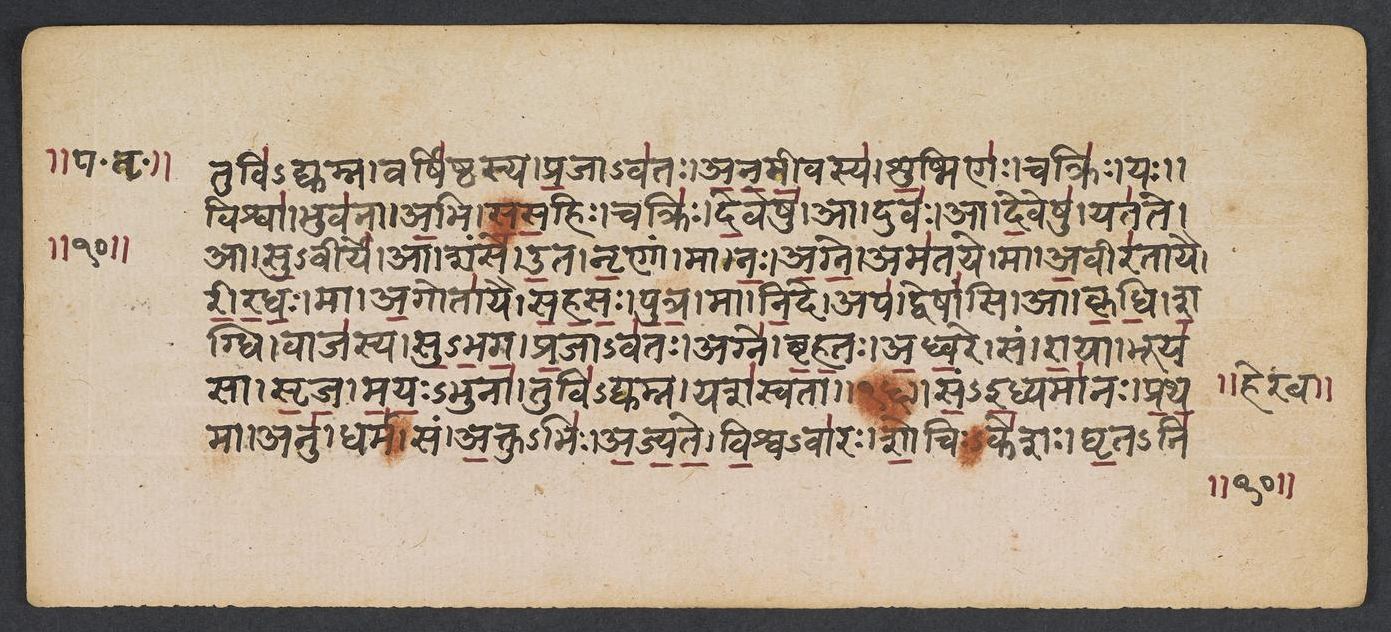
The manuscript shown is Penn Ms. Coll. 390 Item 41 (University of Pennsylvania), an undated paper manuscript of the padapāṭha (the word-by-word recitation text, in which every word is written separately and compounds are split) of the whole Ṛgveda in Devanāgarī, 884 leaves in fascicles, 7-9 lines to the page, accents in red; this hymn stands on fol. 200v-201v. Each section below gives the verses that end on one page; the page boundaries were read on the images (the opening words of every page), not counted out. Where the manuscript is a padapāṭha (the word-by-word recitation text), the section shows Aufrecht's continuous (saṃhitā) text first and, as the edition text, the padapāṭha of the same verses, which is the form written on the page.
How was this verified? (Provenance)
Where on the image
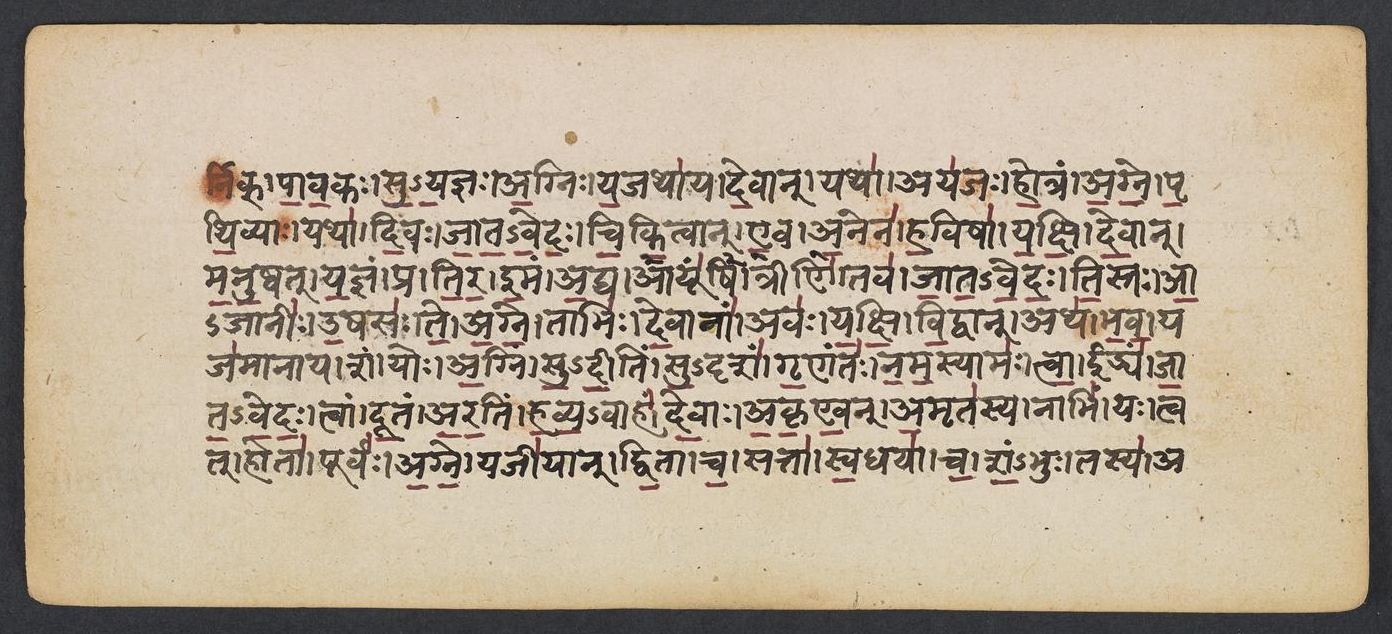
Penn Ms. Coll. 390 Item 41, fol. 201r (numbered 11r by the scribe) (OPenn image 202, lower leaf). Checked on the image: the Rigveda text on this page begins in RV 3.17.1 ‹-ghṛta-nirnik pāvakaḥ su-yajñaḥ agniḥ›. The next page with Rigveda text, fol. 201v (numbered 11v by the scribe), begins in RV 3.17.5 ‹-anu dharma pra yaja›. Verses 3.17.1-4 end on this page; 3.17.1 begins on fol. 200v (numbered 10v by the scribe).
1sa̱mi̱dhyamā̍naḥ pratha̱mānu̱ dharmā̱ sam a̱ktubhi̍r ajyate vi̱śvavā̍raḥ | śo̱ciṣke̍śo ghṛ̱tani̍rṇik pāva̱kaḥ su̍ya̱jño a̱gnir ya̱jathā̍ya de̱vān ||
2yathāya̍jo ho̱tram a̍gne pṛthi̱vyā yathā̍ di̱vo jā̍tavedaś ciki̱tvān | e̱vānena̍ ha̱viṣā̍ yakṣi de̱vān ma̍nu̱ṣvad ya̱jñam pra ti̍re̱mam a̱dya ||
3trīṇy āyū̍ṁṣi̱ tava̍ jātavedas ti̱sra ā̱jānī̍r u̱ṣasa̍s te agne | tābhi̍r de̱vānā̱m avo̍ yakṣi vi̱dvān athā̍ bhava̱ yaja̍mānāya̱ śaṁ yoḥ ||
4a̱gniṁ su̍dī̱tiṁ su̱dṛśa̍ṁ gṛ̱ṇanto̍ nama̱syāma̱s tveḍya̍ṁ jātavedaḥ | tvāṁ dū̱tam a̍ra̱tiṁ ha̍vya̱vāha̍ṁ de̱vā a̍kṛṇvann a̱mṛta̍sya̱ nābhi̍m ||
Compare: Padapāṭha (word-by-word text written in the manuscript; Sansknet e-text via GRETIL)
1sam-idhyamānaḥ | prathamā | anu | dharma | sam | aktu-bhiḥ | ajyate | viśva-vāraḥ | śociḥ-keśaḥ | ghṛta-nirnik | pāvakaḥ | su-yajñaḥ | agniḥ | yajathāya | devān
2yathā | ayajaḥ | hotram | agne | pṛthivyāḥ | yathā | divaḥ | jāta-vedaḥ | cikitvān | eva | anena | haviṣā | yakṣi | devān | manuṣvat | yajñam | pra | tira | imam | adya
3trīṇi | āyūṃṣi | tava | jāta-vedaḥ | tisraḥ | ājānīḥ | uṣasaḥ | te | agne | tābhiḥ | devānām | avaḥ | yakṣi | vidvān | atha | bhava | yajamānāya | śam | yoḥ
4agnim | su-dītim | su-dṛśam | gṛṇantaḥ | namasyāmaḥ | tvā | īḍyam | jāta-vedaḥ | tvām | dūtam | aratim | havya-vāham | devāḥ | akṛṇvan | amṛtasya | nābhim
1DULY enkindled after ancient customs, bringing all treasures, he is balmed with unguents,– Flame-haired, oil-clad, the purifying Agni, skilled in fair rites, to bring the Gods for worship.
2As thou, O Agni, skilful Jâtavedas, hast sacrificed as Priest of Earth, of Heaven, So with this offering bring the Gods, and prosper this sacrifice today as erst for Manu.
3Three are thy times of life, O Jâtavedas, and the three mornings are thy births, O Agni. With these, well-knowing, grant the Gods' kind favour, and help in stir aiid stress the man who worships.
4Agni most bright and fair with song we honour, yea, the adorable, O Jâtavedas. Thee, envoy, messenger, oblation-bearer, the Gods have made centre of life eternal.
Where on the image
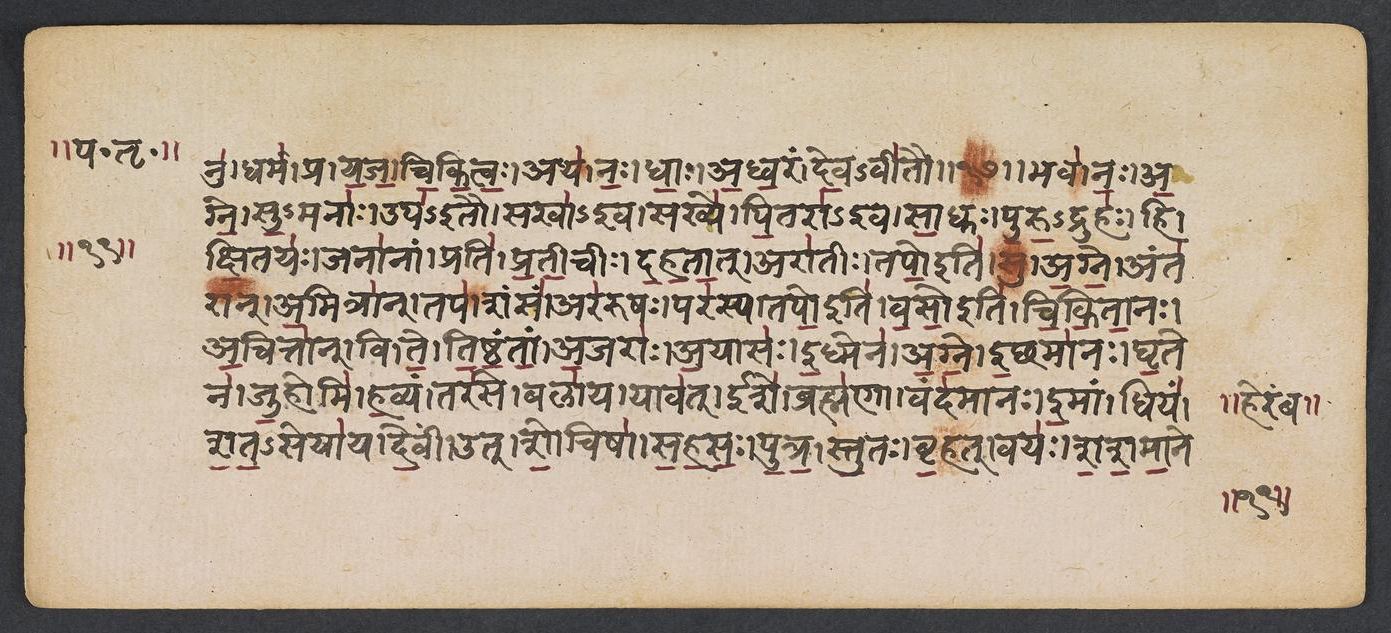
Penn Ms. Coll. 390 Item 41, fol. 201v (numbered 11v by the scribe) (OPenn image 203, upper leaf). Checked on the image: the Rigveda text on this page begins in RV 3.17.5 ‹-anu dharma pra yaja›. The next page with Rigveda text, fol. 202r (numbered 12r by the scribe), begins in RV 3.18.4 ‹-śaśamāneṣu dhehi revat agne›. Verse 3.17.5 ends on this page; 3.17.5 begins on fol. 201r (numbered 11r by the scribe).
5yas tvad dhotā̱ pūrvo̍ agne̱ yajī̍yān dvi̱tā ca̱ sattā̍ sva̱dhayā̍ ca śa̱mbhuḥ | tasyānu̱ dharma̱ pra ya̍jā ciki̱tvo 'thā̍ no dhā adhva̱raṁ de̱vavī̍tau ||
Compare: Padapāṭha (word-by-word text written in the manuscript; Sansknet e-text via GRETIL)
5yaḥ | tvat | hotā | pūrvaḥ | agne | yajīyān | dvitā | ca | sattā | svadhayā | ca | śam-bhuḥ | tasya | anu | dharma | pra | yaja | cikitvaḥ | atha | naḥ | dhāḥ | adhvaram | deva-vītau
5That Priest before thee, yet more skilled in worship, stablished of old, healthgiver by his nature,– After his custom offer, thou who knowest, and lay our sacrifice where Gods may taste it.
Notes
- Sanskrit: Aufrecht's edition (1877) with the Vedic accents, as entered by van Nooten and Holland (GRETIL).
- English: Ralph T. H. Griffith, The Hymns of the Rigveda (1889-1892; 2nd ed. 1896-1897), from the VedaWeb digital text; OCR slips in that text were corrected against the printed 2nd edition (data/sources/rigveda/griffith_errata.json).
- Padapāṭha (edition text): Sansknet e-text via GRETIL (CC BY-NC-SA 4.0).
Cite
Sources
- Source: Penn Ms. Coll. 390 Item 41 (undated (catalogued with Penn's 18th-19th c. Vedic manuscripts)), OPenn, Public Domain Mark + Aufrecht's accented text (GRETIL) + Griffith's English (VedaWeb) (holding institution)
- Critical edition: Aufrecht (1877), accented e-text via GRETIL
← previous · → next · v cycle view · l back to library