Rigveda 3.20: To Agni or all the gods
Introduction
Rigveda 3.20 is a hymn of 5 verses addressed to Agni or all the gods. It stands in book (maṇḍala) 3, the family book of Viśvāmitra. The Rigveda is the oldest collection of Sanskrit hymns, composed in the second half of the second millennium BCE and handed down orally for many centuries before it was written down.
The manuscript shown is Penn Ms. Coll. 390 Item 41 (University of Pennsylvania), an undated paper manuscript of the padapāṭha (the word-by-word recitation text, in which every word is written separately and compounds are split) of the whole Ṛgveda in Devanāgarī, 884 leaves in fascicles, 7-9 lines to the page, accents in red; this hymn stands on fol. 202v-203r. Each section below gives the verses that end on one page; the page boundaries were read on the images (the opening words of every page), not counted out. Where the manuscript is a padapāṭha (the word-by-word recitation text), the section shows Aufrecht's continuous (saṃhitā) text first and, as the edition text, the padapāṭha of the same verses, which is the form written on the page.
How was this verified? (Provenance)
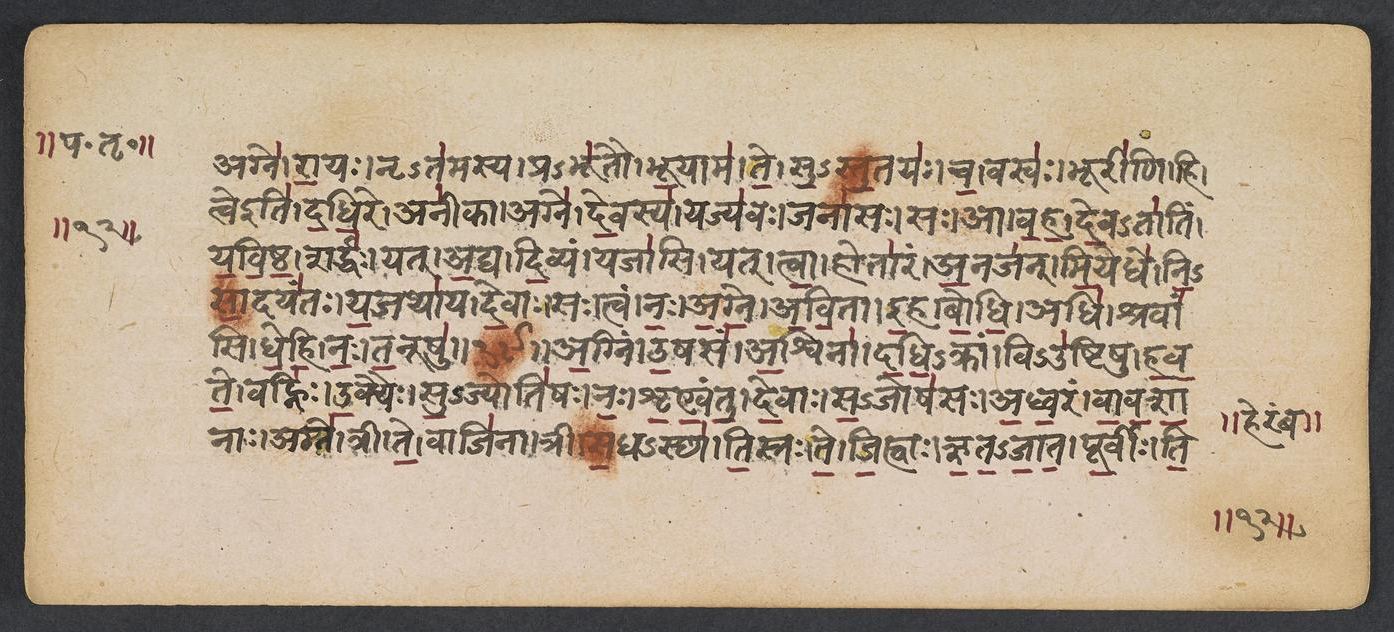
Where on the image
Penn Ms. Coll. 390 Item 41, fol. 202v (numbered 12v by the scribe) (OPenn image 204, upper leaf). Checked on the image: the Rigveda text on this page begins in RV 3.19.3 ‹agne rāyaḥ nṛ-tamasya pra-bhūtau›. The next page with Rigveda text, fol. 203r (numbered 13r by the scribe), begins in RV 3.20.2 ‹sraḥ oṃ iti te›. Verse 3.20.1 ends on this page.
1a̱gnim u̱ṣasa̍m a̱śvinā̍ dadhi̱krāṁ vyu̍ṣṭiṣu havate̱ vahni̍r u̱kthaiḥ | su̱jyoti̍ṣo naḥ śṛṇvantu de̱vāḥ sa̱joṣa̍so adhva̱raṁ vā̍vaśā̱nāḥ ||
Compare: Padapāṭha (word-by-word text written in the manuscript; Sansknet e-text via GRETIL)
1agnim | uṣasam | aśvinā | dadhi-krām | vi-uṣṭiṣu | havate | vahniḥ | ukthaiḥ | su-jyotiṣaḥ | naḥ | śṛṇvantu | devāḥ | sa-joṣasaḥ | adhvaram | vāvaśānāḥ
1WITH lauds at break of morn the priest invoketh Agni, Dawn, Dadhikrâs, and both the Aṣvins. With one consent the Gods whose light is splendid, longing to taste our sacrifice, shall hear us.
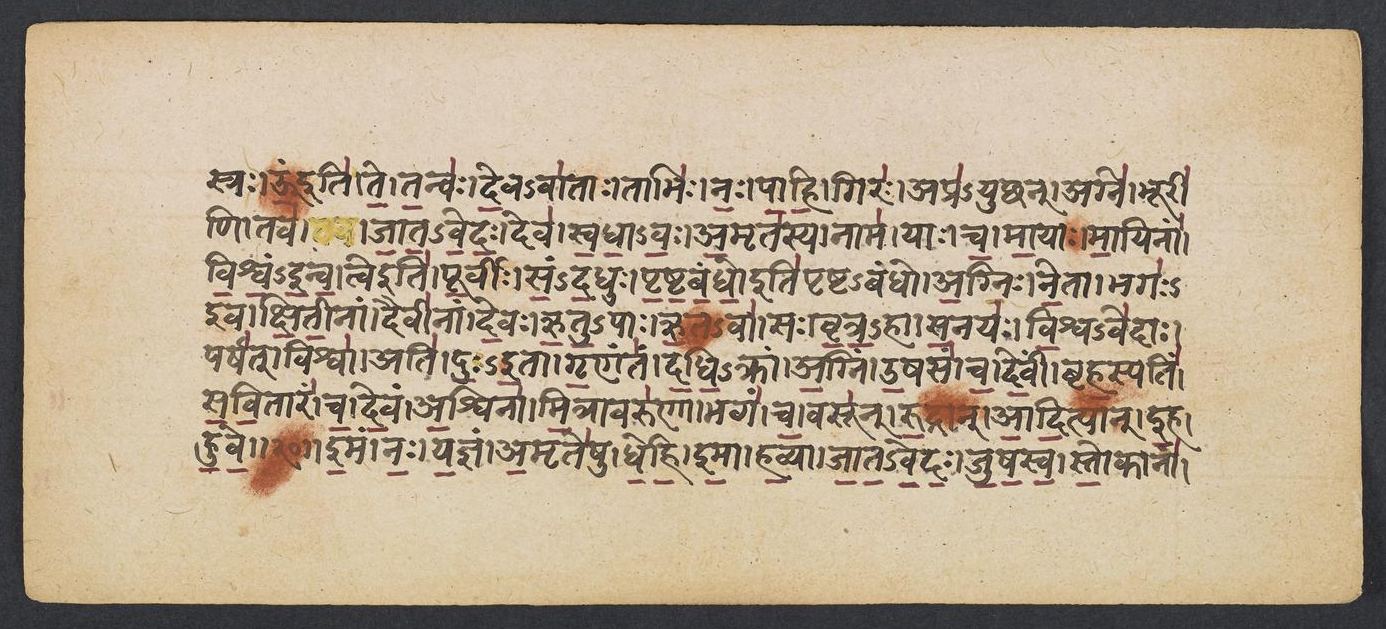
Where on the image
Penn Ms. Coll. 390 Item 41, fol. 203r (numbered 13r by the scribe) (OPenn image 204, lower leaf). Checked on the image: the Rigveda text on this page begins in RV 3.20.2 ‹sraḥ oṃ iti te›. The next page with Rigveda text, fol. 203v (numbered 13v by the scribe), begins in RV 3.21.1 ‹agne medasaḥ ghṛtasya hotariti›. Verses 3.20.2-5 end on this page; 3.20.2 begins on fol. 202v (numbered 12v by the scribe).
2agne̱ trī te̱ vāji̍nā̱ trī ṣa̱dhasthā̍ ti̱sras te̍ ji̱hvā ṛ̍tajāta pū̱rvīḥ | ti̱sra u̍ te ta̱nvo̍ de̱vavā̍tā̱s tābhi̍r naḥ pāhi̱ giro̱ apra̍yucchan ||
3agne̱ bhūrī̍ṇi̱ tava̍ jātavedo̱ deva̍ svadhāvo̱ 'mṛta̍sya̱ nāma̍ | yāś ca̍ mā̱yā mā̱yinā̍ṁ viśvaminva̱ tve pū̱rvīḥ sa̍ṁda̱dhuḥ pṛ̍ṣṭabandho ||
4a̱gnir ne̱tā bhaga̍ iva kṣitī̱nāṁ daivī̍nāṁ de̱va ṛ̍tu̱pā ṛ̱tāvā̍ | sa vṛ̍tra̱hā sa̱nayo̍ vi̱śvave̍dā̱ḥ parṣa̱d viśvāti̍ duri̱tā gṛ̱ṇanta̍m ||
5da̱dhi̱krām a̱gnim u̱ṣasa̍ṁ ca de̱vīm bṛha̱spati̍ṁ savi̱tāra̍ṁ ca de̱vam | a̱śvinā̍ mi̱trāvaru̍ṇā̱ bhaga̍ṁ ca̱ vasū̍n ru̱drām̐ ā̍di̱tyām̐ i̱ha hu̍ve ||
Compare: Padapāṭha (word-by-word text written in the manuscript; Sansknet e-text via GRETIL)
2agne | trī | te | vājinā | trī | ṣadha-sthā | tisraḥ | te | jihvāḥ | ṛta-jāta | pūrvīḥ | ti sraḥ | oṃ iti | te | tanvaḥ | deva-vātāḥ | tābhiḥ | naḥ | pāhi | giraḥ | apra-yucchan
3agne | bhūrīṇi | tava | jāta-vedaḥ | deva | svadhāvaḥ | amṛtasya | nāma | yāḥ | ca | māyā | māyinām | viśvam-inva | tve iti | pūrvīḥ | sam-dadhuḥ | pṛṣṭabandho itipṛṣṭa-bandho
4agniḥ | netā | bhagaḥ-iva | kṣitīnām | daivīnām | devaḥ | ṛtu-pāḥ | ṛta-vā | saḥ | vṛtra-hā | sanayaḥ | viśva-vedāḥ | parṣat | viśvā | ati | duḥ-itā | gṛṇantam
5dadhi-krām | agnim | uṣasam | ca | devīm | bṛhaspatim | savitāram | ca | devam | aśv inā | mitrāvaruṇā | bhagam | ca | vasūn | rudrān | ādityān | iha | huve
2Three are thy powers, O Agni, three thy stations, three are thy tongues, yea, many, Child of Order! Three bodies hast thou which the Gods delight in: with these protect our hymns with care unceasing.
3O Agni, many are the names thou bearest, immortal, God, Divine, and Jâtavedas. And many charms of charmers, All-Inspirer! have they laid in thee, Lord of true attendants!
4Agni, like Bhaga, leads the godly people, he who is true to Law and guards the seasons. Ancient, all-knowing, he the Vr̥itra-slayer shall bear the singer safe through every trouble.
5I call on Savitar the God, on Morning, Br̥ihaspati, and Dadhikrâs, and Agni, On Varuṇa and Mitra, on the Aṣvins, Bhaga, the Vasus, Rudras and Âdityas.
Notes
- Sanskrit: Aufrecht's edition (1877) with the Vedic accents, as entered by van Nooten and Holland (GRETIL).
- English: Ralph T. H. Griffith, The Hymns of the Rigveda (1889-1892; 2nd ed. 1896-1897), from the VedaWeb digital text; OCR slips in that text were corrected against the printed 2nd edition (data/sources/rigveda/griffith_errata.json).
- Padapāṭha (edition text): Sansknet e-text via GRETIL (CC BY-NC-SA 4.0).
Cite
Sources
- Source: Penn Ms. Coll. 390 Item 41 (undated (catalogued with Penn's 18th-19th c. Vedic manuscripts)), OPenn, Public Domain Mark + Aufrecht's accented text (GRETIL) + Griffith's English (VedaWeb) (holding institution)
- Critical edition: Aufrecht (1877), accented e-text via GRETIL
← previous · → next · v cycle view · l back to library