Rigveda 3.19: To Agni
Introduction
Rigveda 3.19 is a hymn of 5 verses addressed to Agni. It stands in book (maṇḍala) 3, the family book of Viśvāmitra. The Rigveda is the oldest collection of Sanskrit hymns, composed in the second half of the second millennium BCE and handed down orally for many centuries before it was written down.
The manuscript shown is Penn Ms. Coll. 390 Item 41 (University of Pennsylvania), an undated paper manuscript of the padapāṭha (the word-by-word recitation text, in which every word is written separately and compounds are split) of the whole Ṛgveda in Devanāgarī, 884 leaves in fascicles, 7-9 lines to the page, accents in red; this hymn stands on fol. 202r-202v. Each section below gives the verses that end on one page; the page boundaries were read on the images (the opening words of every page), not counted out. Where the manuscript is a padapāṭha (the word-by-word recitation text), the section shows Aufrecht's continuous (saṃhitā) text first and, as the edition text, the padapāṭha of the same verses, which is the form written on the page.
How was this verified? (Provenance)
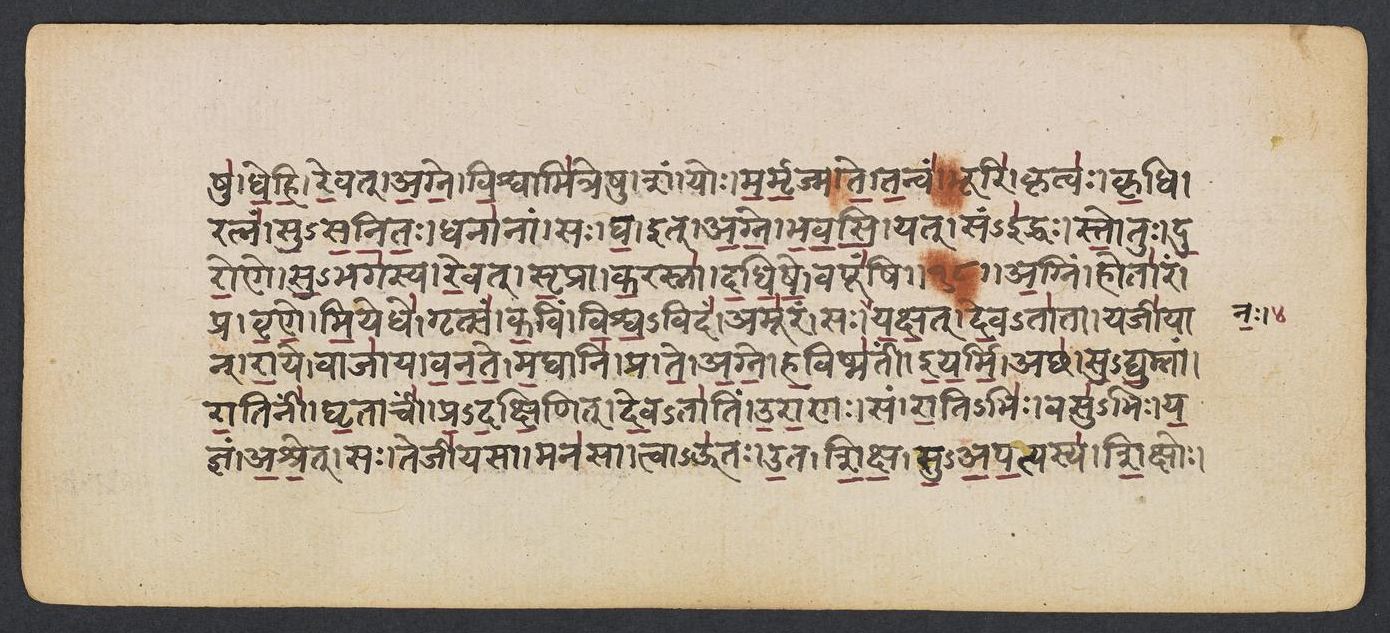
Where on the image
Penn Ms. Coll. 390 Item 41, fol. 202r (numbered 12r by the scribe) (OPenn image 203, lower leaf). Checked on the image: the Rigveda text on this page begins in RV 3.18.4 ‹-śaśamāneṣu dhehi revat agne›. The next page with Rigveda text, fol. 202v (numbered 12v by the scribe), begins in RV 3.19.3 ‹agne rāyaḥ nṛ-tamasya pra-bhūtau›. Verses 3.19.1-2 end on this page.
1a̱gniṁ hotā̍ra̱m pra vṛ̍ṇe mi̱yedhe̱ gṛtsa̍ṁ ka̱viṁ vi̍śva̱vida̱m amū̍ram | sa no̍ yakṣad de̱vatā̍tā̱ yajī̍yān rā̱ye vājā̍ya vanate ma̱ghāni̍ ||
2pra te̍ agne ha̱viṣma̍tīm iya̱rmy acchā̍ sudyu̱mnāṁ rā̱tinī̍ṁ ghṛ̱tācī̍m | pra̱da̱kṣi̱ṇid de̱vatā̍tim urā̱ṇaḥ saṁ rā̱tibhi̱r vasu̍bhir ya̱jñam a̍śret ||
Compare: Padapāṭha (word-by-word text written in the manuscript; Sansknet e-text via GRETIL)
1agnim | hotāram | pra | vṛṇe | miyedhe | gṛtsam | kavim | viśva-vidam | amūram | saḥ | naḥ | yakṣat | deva-tātā | yajīyān | rāye | vājāya | vanate | maghāni
2pra | te | agne | haviṣmatīm | iyarmi | accha | su-dyumnām | rātinīm | ghṛtācīm | pra-dakṣiṇit | devatātim | urāṇaḥ | sam | rāti-bhiḥ | vasu-bhiḥ | yajñam | aśret
1Aow, quick, sage, infallible, all-knowing, I choose to be our Priest at this oblation. In our Gods' service he, best skilled, shall worship: may he obtain us boons for strength and riches.
2Agni, to thee I lift the oil-fed ladle, bright, with an offering, bearing our oblation. From the right hand, choosing the Gods' attendance, he with rich presents hath arranged the worship.
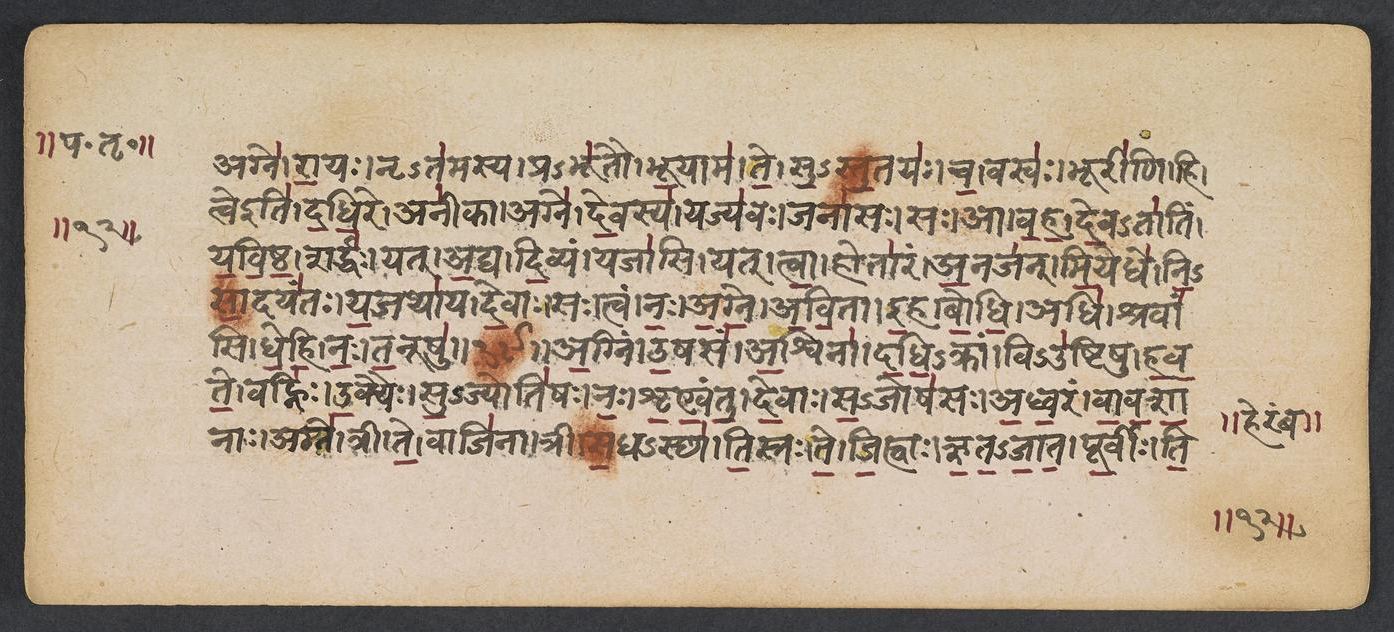
Where on the image
Penn Ms. Coll. 390 Item 41, fol. 202v (numbered 12v by the scribe) (OPenn image 204, upper leaf). Checked on the image: the Rigveda text on this page begins in RV 3.19.3 ‹agne rāyaḥ nṛ-tamasya pra-bhūtau›. The next page with Rigveda text, fol. 203r (numbered 13r by the scribe), begins in RV 3.20.2 ‹sraḥ oṃ iti te›. Verses 3.19.3-5 end on this page; 3.19.3 begins on fol. 202r (numbered 12r by the scribe).
3sa tejī̍yasā̱ mana̍sā̱ tvota̍ u̱ta śi̍kṣa svapa̱tyasya̍ śi̱kṣoḥ | agne̍ rā̱yo nṛta̍masya̱ prabhū̍tau bhū̱yāma̍ te suṣṭu̱taya̍ś ca̱ vasva̍ḥ ||
4bhūrī̍ṇi̱ hi tve da̍dhi̱re anī̱kāgne̍ de̱vasya̱ yajya̍vo̱ janā̍saḥ | sa ā va̍ha de̱vatā̍tiṁ yaviṣṭha̱ śardho̱ yad a̱dya di̱vyaṁ yajā̍si ||
5yat tvā̱ hotā̍ram a̱naja̍n mi̱yedhe̍ niṣā̱daya̍nto ya̱jathā̍ya de̱vāḥ | sa tvaṁ no̍ agne 'vi̱teha bo̱dhy adhi̱ śravā̍ṁsi dhehi nas ta̱nūṣu̍ ||
Compare: Padapāṭha (word-by-word text written in the manuscript; Sansknet e-text via GRETIL)
3saḥ | tejīyasā | manasā | tvāūtaḥ | uta | śikṣa | su-apatyasya | śikṣoḥ | agne | rāyaḥ | nṛ-tamasya | pra-bhūtau | bhūyāma | te | su-stutayaḥ | ca | vasvaḥ
4bhūtīni | hi | tve iti | dadhire | anīkā | agne | devasya | yajyavaḥ | janāsaḥ | saḥ | ā | vaha | devatātim | yaviṣṭha | śardhaḥ | yat | adya | divyam | yajāsi
5yat | tvā | hotāram | anajan | miyedhe | ni-ṣādayantaḥ | yajathāya | devāḥ | saḥ | tvam | naḥ | agne | avitā | iha | bodhi | adhi | śravāṃsi | dhehi | naḥ | tanūṣu
3Of keenest spirit is the man thou aidest give us good offspring, thou who givest freely. In power of wealth most rich in men. O Agni, of thee, the Good, may we sing forth fair praises.
4Men as they worship thee the God, O Agni, have set on thee full many a brilliant, aspect. So bring Most Youthful One, the Gods' assembly, the Heavenly Host which thou to-day shalt honour.
5When Gods anoint thee Priest at their oblation, and seat thee for thy task as Sacrificer, O Agni, be thou here our kind defender, and to ourselves vouchsafe the gift of glory.
Notes
- Sanskrit: Aufrecht's edition (1877) with the Vedic accents, as entered by van Nooten and Holland (GRETIL).
- English: Ralph T. H. Griffith, The Hymns of the Rigveda (1889-1892; 2nd ed. 1896-1897), from the VedaWeb digital text; OCR slips in that text were corrected against the printed 2nd edition (data/sources/rigveda/griffith_errata.json).
- Padapāṭha (edition text): Sansknet e-text via GRETIL (CC BY-NC-SA 4.0).
Cite
Sources
- Source: Penn Ms. Coll. 390 Item 41 (undated (catalogued with Penn's 18th-19th c. Vedic manuscripts)), OPenn, Public Domain Mark + Aufrecht's accented text (GRETIL) + Griffith's English (VedaWeb) (holding institution)
- Critical edition: Aufrecht (1877), accented e-text via GRETIL
← previous · → next · v cycle view · l back to library