Rigveda 3.22: To Agni
Introduction
Rigveda 3.22 is a hymn of 5 verses addressed to Agni. It stands in book (maṇḍala) 3, the family book of Viśvāmitra. The Rigveda is the oldest collection of Sanskrit hymns, composed in the second half of the second millennium BCE and handed down orally for many centuries before it was written down.
The manuscript shown is Penn Ms. Coll. 390 Item 41 (University of Pennsylvania), an undated paper manuscript of the padapāṭha (the word-by-word recitation text, in which every word is written separately and compounds are split) of the whole Ṛgveda in Devanāgarī, 884 leaves in fascicles, 7-9 lines to the page, accents in red; this hymn stands on fol. 203v-204r. Each section below gives the verses that end on one page; the page boundaries were read on the images (the opening words of every page), not counted out. Where the manuscript is a padapāṭha (the word-by-word recitation text), the section shows Aufrecht's continuous (saṃhitā) text first and, as the edition text, the padapāṭha of the same verses, which is the form written on the page.
How was this verified? (Provenance)
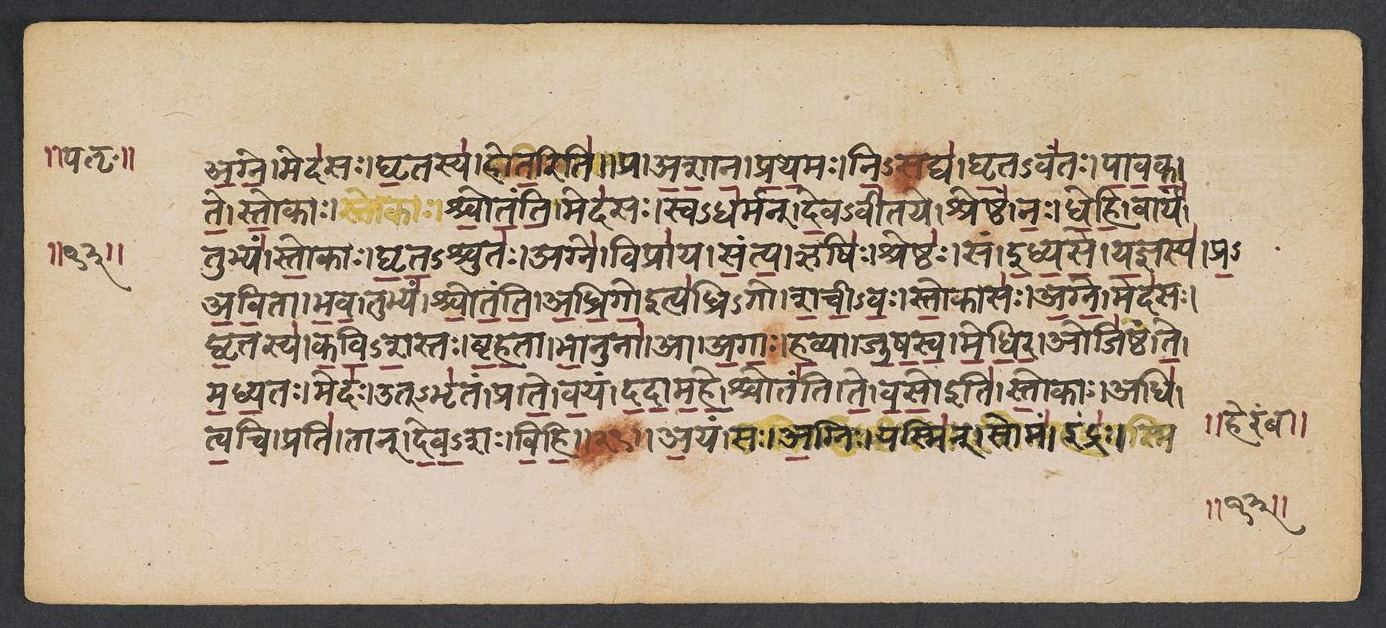
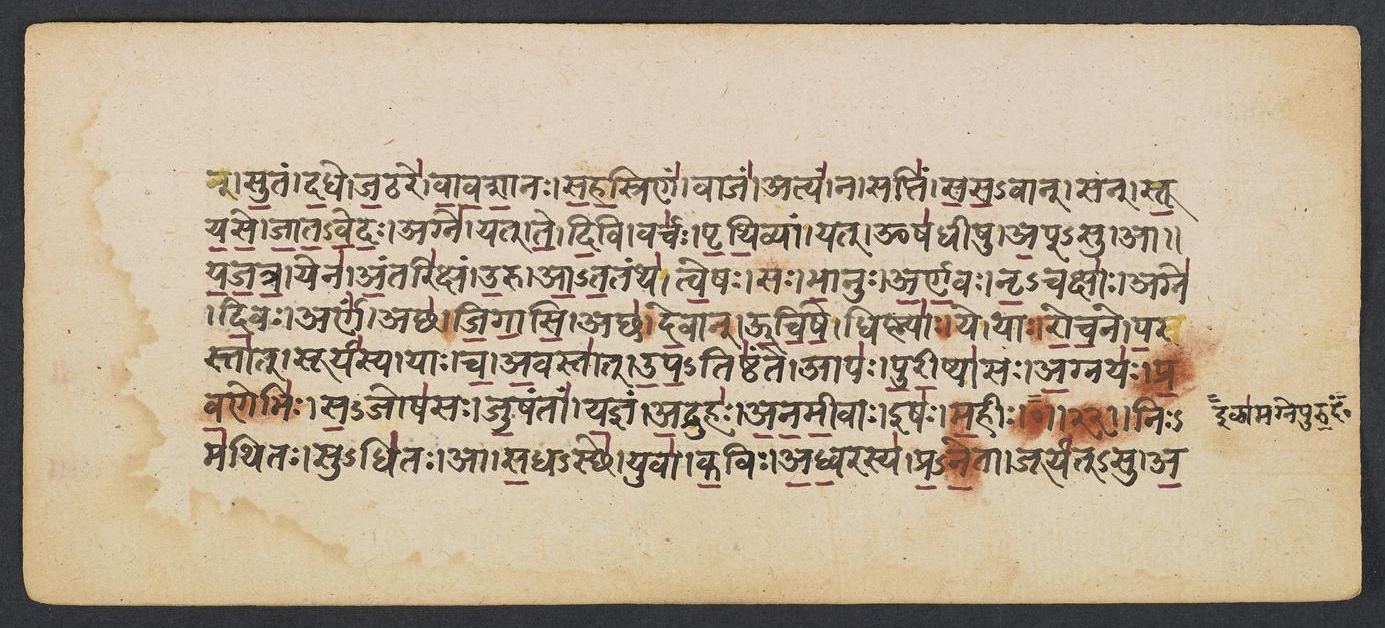
Where on the image
Penn Ms. Coll. 390 Item 41, fol. 204r (numbered 14r by the scribe) (OPenn image 205, lower leaf). Checked on the image: the Rigveda text on this page begins in RV 3.22.1 ‹sutam dadhe jaṭhare vāvaśānaḥ›. The next page with Rigveda text, fol. 204v (numbered 14v by the scribe), begins in RV 3.23.1 ‹-agniḥ ajaraḥ vaneṣu atra›. Verses 3.22.1-5 end on this page; 3.22.1 begins on fol. 203v (numbered 13v by the scribe).
1a̱yaṁ so a̱gnir yasmi̱n soma̱m indra̍ḥ su̱taṁ da̱dhe ja̱ṭhare̍ vāvaśā̱naḥ | sa̱ha̱sriṇa̱ṁ vāja̱m atya̱ṁ na sapti̍ṁ sasa̱vān san stū̍yase jātavedaḥ ||
2agne̱ yat te̍ di̱vi varca̍ḥ pṛthi̱vyāṁ yad oṣa̍dhīṣv a̱psv ā ya̍jatra | yenā̱ntari̍kṣam u̱rv ā̍ta̱tantha̍ tve̱ṣaḥ sa bhā̱nur a̍rṇa̱vo nṛ̱cakṣā̍ḥ ||
3agne̍ di̱vo arṇa̱m acchā̍ jigā̱sy acchā̍ de̱vām̐ ū̍ciṣe̱ dhiṣṇyā̱ ye | yā ro̍ca̱ne pa̱rastā̱t sūrya̍sya̱ yāś cā̱vastā̍d upa̱tiṣṭha̍nta̱ āpa̍ḥ ||
4pu̱rī̱ṣyā̍so a̱gnaya̍ḥ prāva̱ṇebhi̍ḥ sa̱joṣa̍saḥ | ju̱ṣantā̍ṁ ya̱jñam a̱druho̍ 'namī̱vā iṣo̍ ma̱hīḥ ||
5iḻā̍m agne puru̱daṁsa̍ṁ sa̱niṁ goḥ śa̍śvatta̱maṁ hava̍mānāya sādha | syān na̍ḥ sū̱nus tana̍yo vi̱jāvāgne̱ sā te̍ suma̱tir bhū̍tv a̱sme ||
Compare: Padapāṭha (word-by-word text written in the manuscript; Sansknet e-text via GRETIL)
1ayam | saḥ | agniḥ | yasmin | somam | indraḥ | sutam | dadhe | jaṭhare | vāvaśānaḥ | sahasriṇam | vājam | atyam | na | saptim | sasavān | san | stūyase | jāta-vedaḥ
2agne | yat | te | divi | varcaḥ | pṛthivyām | yat | oṣadhīṣu | ap-su | ā | yajatra | yena | antarikṣam | uru | ātatantha | tveṣaḥ | saḥ | bhānuḥ | arṇavaḥ | nṛ-cakṣāḥ
3agne | divaḥ | arṇam | accha | jigāsi | accha | devān | ūciṣe | dhiṣṇyā | ye | yā | rocane | parastāt | sūryasya | yāḥ | ca | avastāt | upa-tiṣṭhante | āpaḥ
4purīṣyāsaḥ | agnayaḥ | pravaṇebhiḥ | sa-joṣasaḥ | juṣantām | yajñam | adruhaḥ | anamīvāḥ | iṣaḥ | mahīḥ
5iḷām | agne | puru-daṃsam | sanim | goḥ | śaśvat-tamam | havamānāya | sādha | syāt | naḥ | sūnuḥ | tanayaḥ | vijāvā | agne | sā | te | su-matiḥ | bhūtu | asme iti
1THIS is that Agni whence the longing Indra took the pressed Soma deep within his body. Winner of spoils in thousands, like a courser, with praise art thou exalted, Jâtavedas.
2That light of thine in heaven and earth, O Agni, in plants, O Holy One, and in the waters, Wherewith thou hast spread wide the air's mid-region-bright is that splendour, wavy, manbeholding.
3O Agni, to the sea of heaven thou goest: thou hast called hither Gods beheld in spirit. The waters, too, come hither, those up yonder in the Sun's realm of light, and those beneath it.
4Let fires that dwell in mist, combined with those that have their home in floods, Guileless accept our sacrifice, great viands free from all disease.
5Agni, as holy food to thine invoker give wealth in cattle, lasting, rich in marvels. To us be born a son and spreading offspring. Agni, be this thy gracious will to us-ward.
Notes
- Sanskrit: Aufrecht's edition (1877) with the Vedic accents, as entered by van Nooten and Holland (GRETIL).
- English: Ralph T. H. Griffith, The Hymns of the Rigveda (1889-1892; 2nd ed. 1896-1897), from the VedaWeb digital text; OCR slips in that text were corrected against the printed 2nd edition (data/sources/rigveda/griffith_errata.json).
- Padapāṭha (edition text): Sansknet e-text via GRETIL (CC BY-NC-SA 4.0).
Cite
Sources
- Source: Penn Ms. Coll. 390 Item 41 (undated (catalogued with Penn's 18th-19th c. Vedic manuscripts)), OPenn, Public Domain Mark + Aufrecht's accented text (GRETIL) + Griffith's English (VedaWeb) (holding institution)
- Critical edition: Aufrecht (1877), accented e-text via GRETIL
← previous · → next · v cycle view · l back to library