Rigveda 3.23: To Agni
Introduction
Rigveda 3.23 is a hymn of 5 verses addressed to Agni. It stands in book (maṇḍala) 3, the family book of Viśvāmitra. The Rigveda is the oldest collection of Sanskrit hymns, composed in the second half of the second millennium BCE and handed down orally for many centuries before it was written down.
The manuscript shown is Penn Ms. Coll. 390 Item 41 (University of Pennsylvania), an undated paper manuscript of the padapāṭha (the word-by-word recitation text, in which every word is written separately and compounds are split) of the whole Ṛgveda in Devanāgarī, 884 leaves in fascicles, 7-9 lines to the page, accents in red; this hymn stands on fol. 204r-204v. Each section below gives the verses that end on one page; the page boundaries were read on the images (the opening words of every page), not counted out. Where the manuscript is a padapāṭha (the word-by-word recitation text), the section shows Aufrecht's continuous (saṃhitā) text first and, as the edition text, the padapāṭha of the same verses, which is the form written on the page.
How was this verified? (Provenance)
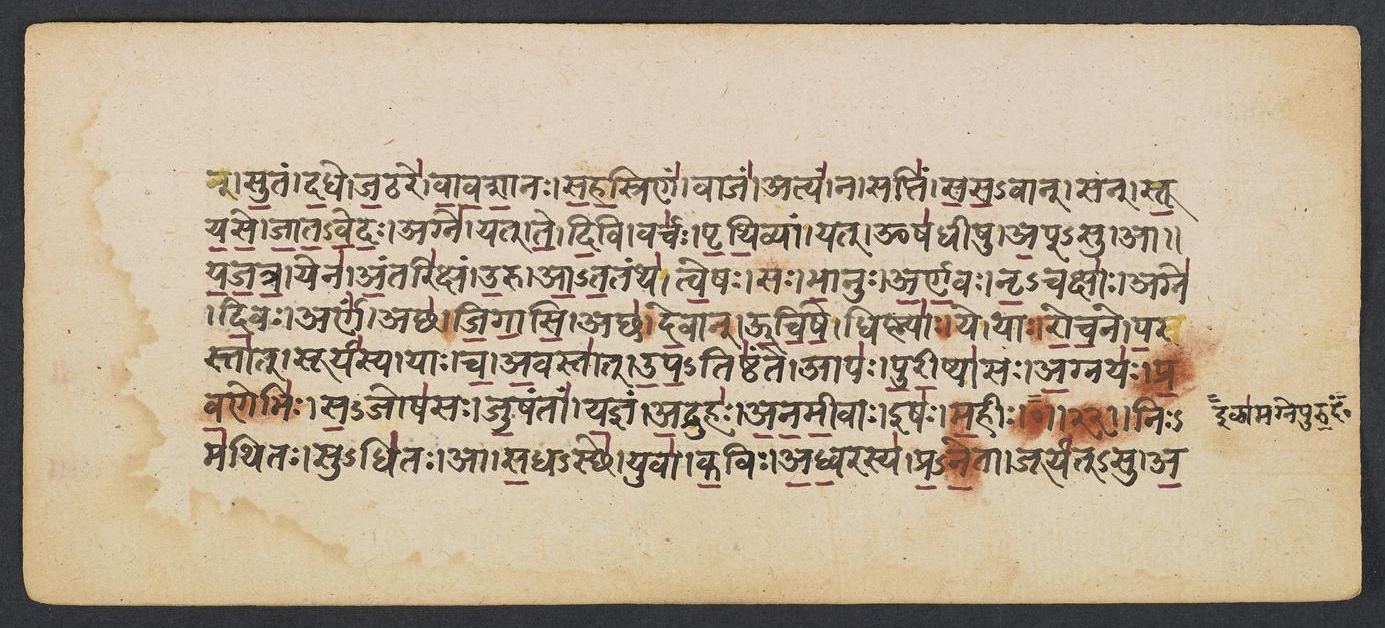
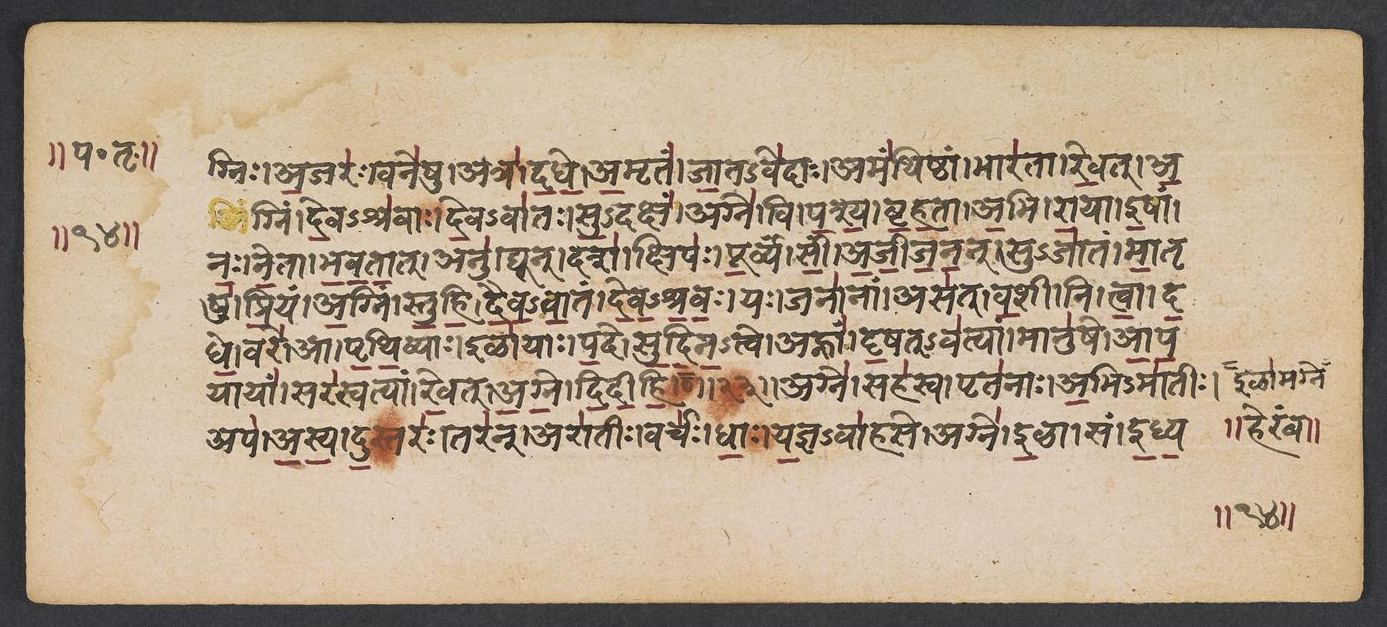
Where on the image
Penn Ms. Coll. 390 Item 41, fol. 204v (numbered 14v by the scribe) (OPenn image 206, upper leaf). Checked on the image: the Rigveda text on this page begins in RV 3.23.1 ‹-agniḥ ajaraḥ vaneṣu atra›. The next page with Rigveda text, fol. 205r (numbered 15r by the scribe), begins in RV 3.24.2 ‹-idhyase vīti-hotraḥ amartyaḥ juṣasva›. Verses 3.23.1-5 end on this page; 3.23.1 begins on fol. 204r (numbered 14r by the scribe).
1nirma̍thita̱ḥ sudhi̍ta̱ ā sa̱dhasthe̱ yuvā̍ ka̱vir a̍dhva̱rasya̍ praṇe̱tā | jūrya̍tsv a̱gnir a̱jaro̱ vane̱ṣv atrā̍ dadhe a̱mṛta̍ṁ jā̱tave̍dāḥ ||
2ama̍nthiṣṭā̱m bhāra̍tā re̱vad a̱gniṁ de̱vaśra̍vā de̱vavā̍taḥ su̱dakṣa̍m | agne̱ vi pa̍śya bṛha̱tābhi rā̱yeṣāṁ no̍ ne̱tā bha̍vatā̱d anu̱ dyūn ||
3daśa̱ kṣipa̍ḥ pū̱rvyaṁ sī̍m ajījana̱n sujā̍tam mā̱tṛṣu̍ pri̱yam | a̱gniṁ stu̍hi daivavā̱taṁ de̍vaśravo̱ yo janā̍nā̱m asa̍d va̱śī ||
4ni tvā̍ dadhe̱ vara̱ ā pṛ̍thi̱vyā iḻā̍yās pa̱de su̍dina̱tve ahnā̍m | dṛ̱ṣadva̍tyā̱m mānu̍ṣa āpa̱yāyā̱ṁ sara̍svatyāṁ re̱vad a̍gne didīhi ||
5iḻā̍m agne puru̱daṁsa̍ṁ sa̱niṁ goḥ śa̍śvatta̱maṁ hava̍mānāya sādha | syān na̍ḥ sū̱nus tana̍yo vi̱jāvāgne̱ sā te̍ suma̱tir bhū̍tv a̱sme ||
Compare: Padapāṭha (word-by-word text written in the manuscript; Sansknet e-text via GRETIL)
1niḥ-mathitaḥ | su-dhitaḥ | ā | sadha-sthe | yuvā | kaviḥ | adhvarasya | pra-netā | jūryat-su | agniḥ | ajaraḥ | vaneṣu | atra | dadhe | amṛtam | jāta-vedāḥ
2amanthiṣṭām | bhāratā | revat | agnim | deva-śravāḥ | deva-vātaḥ | su-dakṣam | agne | vi | paśya | bṛhatā | abhi | rāyā | iṣām | naḥ | netā | bhavatāt | anu | dyūn
3daśa | kṣipaḥ | pūrvyam | sīm | ajījanan | su-jātam | mātṛṣu | priyam | agnim | stuhi | daiva-vātam | deva-śravaḥ | yaḥ | janānām | asat | vaśī
4ni | tvā | dadhe | vare | ā | pṛthivyāḥ | iḷāyāḥ | pade | su-dina-tve | ahnām | dṛṣat-vatyām | mānuṣe | āpayāyām | sarasvatyām | revat | agne | didīhi
5iḷām | agne | puru-daṃsam | sanim | goḥ | śaśvat-tamam | havamānāya | sādha | syāt | naḥ | sūnuḥ | tanayaḥ | vijāvā | agne | sā | te | su-matiḥ | bhūtu | asme iti
1RUBBED into life, well stablished in the dwelling, Leader of sacrifice, the Sage, the youthful, Here in the wasting fuel Jâtavedas, eternal, hath assumed immortal being.
2Both Bharatas, Devaṣravas, Devavâta, have strongly rubbed to life effectual Agni. O Agni, look thou forth with ample riches: be, every day, bearer of food to feed us.
3Him nobly born of old the fingers ten produced, him whom his Mothers counted dear. Praise Devavâta's Agni, thou Devaṣravas, him who shall be the people's Lord.
4He set thee in the earth's most lovely station, in Iḷâ's place, in days of fair bright weather. On man, on Âpayâ, Agni! on the rivers Dr̥ishadvatî, Sarasvatî, shine richly.
5Agni, as holy food to thine invoker give wealth in cattle, lasting, rich in marvels. To us be born a son and spreading offspring Agni, be this thy gracious will to us-ward
Notes
- Sanskrit: Aufrecht's edition (1877) with the Vedic accents, as entered by van Nooten and Holland (GRETIL).
- English: Ralph T. H. Griffith, The Hymns of the Rigveda (1889-1892; 2nd ed. 1896-1897), from the VedaWeb digital text; OCR slips in that text were corrected against the printed 2nd edition (data/sources/rigveda/griffith_errata.json).
- Padapāṭha (edition text): Sansknet e-text via GRETIL (CC BY-NC-SA 4.0).
Cite
Sources
- Source: Penn Ms. Coll. 390 Item 41 (undated (catalogued with Penn's 18th-19th c. Vedic manuscripts)), OPenn, Public Domain Mark + Aufrecht's accented text (GRETIL) + Griffith's English (VedaWeb) (holding institution)
- Critical edition: Aufrecht (1877), accented e-text via GRETIL
← previous · → next · v cycle view · l back to library