Rigveda 3.24: To Agni
Introduction
Rigveda 3.24 is a hymn of 5 verses addressed to Agni. It stands in book (maṇḍala) 3, the family book of Viśvāmitra. The Rigveda is the oldest collection of Sanskrit hymns, composed in the second half of the second millennium BCE and handed down orally for many centuries before it was written down.
The manuscript shown is Penn Ms. Coll. 390 Item 41 (University of Pennsylvania), an undated paper manuscript of the padapāṭha (the word-by-word recitation text, in which every word is written separately and compounds are split) of the whole Ṛgveda in Devanāgarī, 884 leaves in fascicles, 7-9 lines to the page, accents in red; this hymn stands on fol. 204v-205r. Each section below gives the verses that end on one page; the page boundaries were read on the images (the opening words of every page), not counted out. Where the manuscript is a padapāṭha (the word-by-word recitation text), the section shows Aufrecht's continuous (saṃhitā) text first and, as the edition text, the padapāṭha of the same verses, which is the form written on the page.
How was this verified? (Provenance)
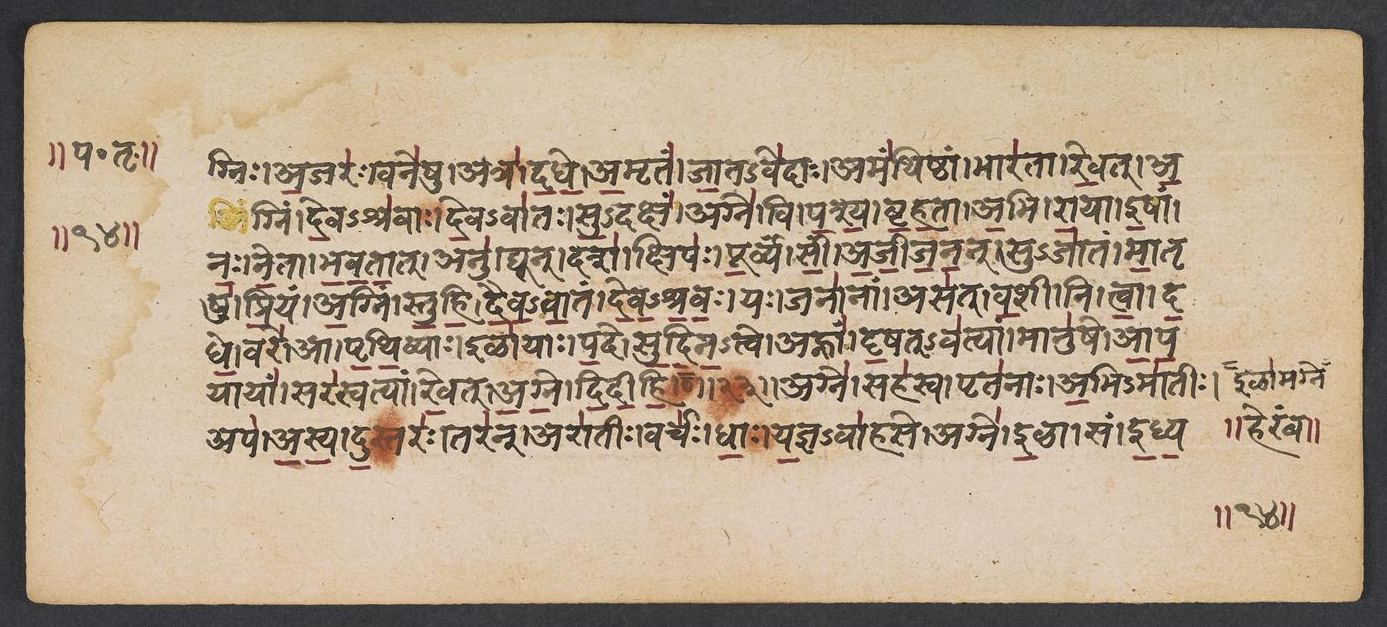
Where on the image
Penn Ms. Coll. 390 Item 41, fol. 204v (numbered 14v by the scribe) (OPenn image 206, upper leaf). Checked on the image: the Rigveda text on this page begins in RV 3.23.1 ‹-agniḥ ajaraḥ vaneṣu atra›. The next page with Rigveda text, fol. 205r (numbered 15r by the scribe), begins in RV 3.24.2 ‹-idhyase vīti-hotraḥ amartyaḥ juṣasva›. Verse 3.24.1 ends on this page.
1agne̱ saha̍sva̱ pṛta̍nā a̱bhimā̍tī̱r apā̍sya | du̱ṣṭara̱s tara̱nn arā̍tī̱r varco̍ dhā ya̱jñavā̍hase ||
Compare: Padapāṭha (word-by-word text written in the manuscript; Sansknet e-text via GRETIL)
1agne | sahasva | pṛtanāḥ | abhi-mātīḥ | apa | asya | dustaraḥ | taran | arātīḥ | varcaḥ | dhāḥ | yajña-vāhase
1AGNI, subdue opposing bands, and drive our enemies away. Invincible, slay godless foes: give splendour to the worshipper.
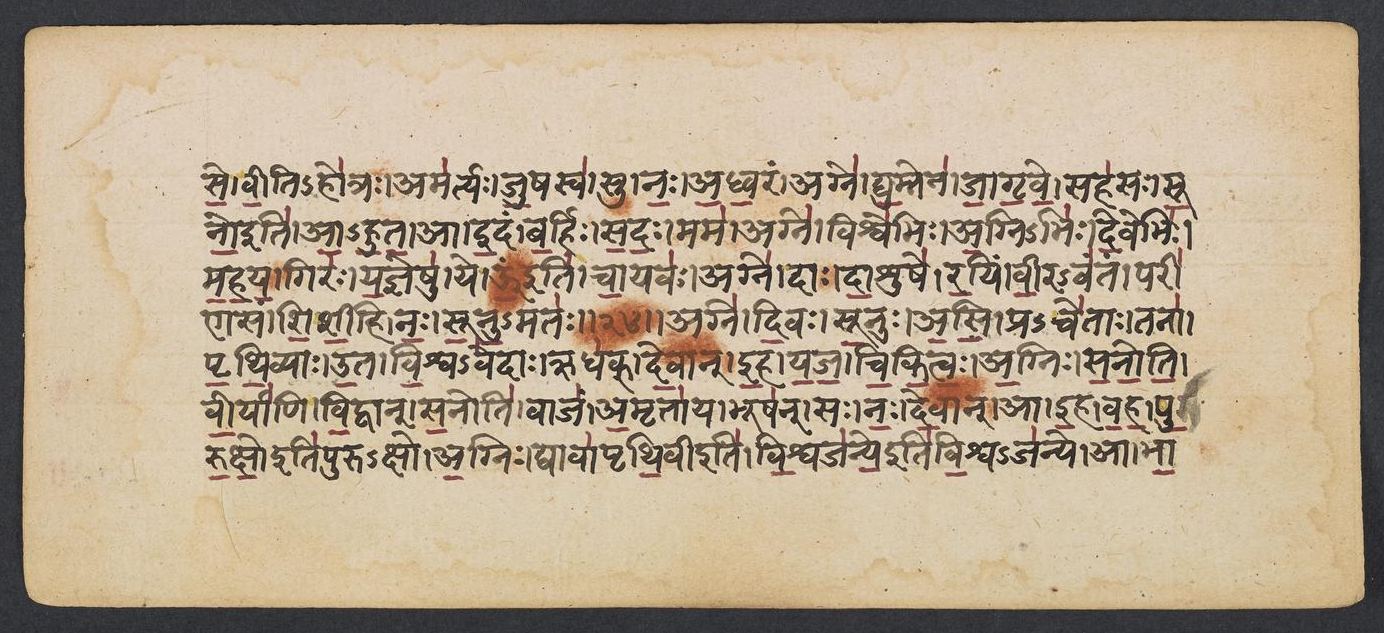
Where on the image
Penn Ms. Coll. 390 Item 41, fol. 205r (numbered 15r by the scribe) (OPenn image 206, lower leaf). Checked on the image: the Rigveda text on this page begins in RV 3.24.2 ‹-idhyase vīti-hotraḥ amartyaḥ juṣasva›. The next page with Rigveda text, fol. 205v (numbered 15v by the scribe), begins in RV 3.25.3 ‹-bhāti devī iti amṛteiti›. Verses 3.24.2-5 end on this page; 3.24.2 begins on fol. 204v (numbered 14v by the scribe).
2agna̍ i̱ḻā sam i̍dhyase vī̱tiho̍tro̱ ama̍rtyaḥ | ju̱ṣasva̱ sū no̍ adhva̱ram ||
3agne̍ dyu̱mnena̍ jāgṛve̱ saha̍saḥ sūnav āhuta | edam ba̱rhiḥ sa̍do̱ mama̍ ||
4agne̱ viśve̍bhir a̱gnibhi̍r de̱vebhi̍r mahayā̱ gira̍ḥ | ya̱jñeṣu̱ ya u̍ cā̱yava̍ḥ ||
5agne̱ dā dā̱śuṣe̍ ra̱yiṁ vī̱rava̍nta̱m parī̍ṇasam | śi̱śī̱hi na̍ḥ sūnu̱mata̍ḥ ||
Compare: Padapāṭha (word-by-word text written in the manuscript; Sansknet e-text via GRETIL)
2agne | iḷā | sam | idhyase | vīti-hotraḥ | amartyaḥ | juṣasva | su | naḥ | adhvaram
3agne | dyumnena | jāgṛve | sahasaḥ | sūno iti | āhuta | ā | idam | barhiḥ | sadaḥ | mama
4agne | viśvebhiḥ | agni-bhiḥ | devebhiḥ | mahaya | giraḥ | yajñeṣu | ye | oṃ iti | cāyavaḥ
5agne | dāḥ | dāśuṣe | rayim | vīra-vantam | parīṇasam | śiśīhi | naḥ | sūnu-mataḥ
2Lit with libation, Agni, thou, deathless, who callest Gods to feast, Accept our sacrifice with joy.
3With splendour, Agni, Son of Strength, thou who art worshipped, wakeful One. Seat thee on this my sacred grass.
4With all thy fires, with all the Gods, Agni, exalt the songs we sing. And living men in holy rites.
5Grant, Agni, to the worshipper wealth rich in heroes, plenteous store, Make thou us rich with many sons.
Notes
- Sanskrit: Aufrecht's edition (1877) with the Vedic accents, as entered by van Nooten and Holland (GRETIL).
- English: Ralph T. H. Griffith, The Hymns of the Rigveda (1889-1892; 2nd ed. 1896-1897), from the VedaWeb digital text; OCR slips in that text were corrected against the printed 2nd edition (data/sources/rigveda/griffith_errata.json).
- Padapāṭha (edition text): Sansknet e-text via GRETIL (CC BY-NC-SA 4.0).
Cite
Sources
- Source: Penn Ms. Coll. 390 Item 41 (undated (catalogued with Penn's 18th-19th c. Vedic manuscripts)), OPenn, Public Domain Mark + Aufrecht's accented text (GRETIL) + Griffith's English (VedaWeb) (holding institution)
- Critical edition: Aufrecht (1877), accented e-text via GRETIL
← previous · → next · v cycle view · l back to library