Rigveda 3.45: To Indra
Introduction
Rigveda 3.45 is a hymn of 5 verses addressed to Indra. It stands in book (maṇḍala) 3, the family book of Viśvāmitra. The Rigveda is the oldest collection of Sanskrit hymns, composed in the second half of the second millennium BCE and handed down orally for many centuries before it was written down.
The manuscript shown is Penn Ms. Coll. 390 Item 41 (University of Pennsylvania), an undated paper manuscript of the padapāṭha (the word-by-word recitation text, in which every word is written separately and compounds are split) of the whole Ṛgveda in Devanāgarī, 884 leaves in fascicles, 7-9 lines to the page, accents in red; this hymn stands on fol. 229v-230r. Each section below gives the verses that end on one page; the page boundaries were read on the images (the opening words of every page), not counted out. Where the manuscript is a padapāṭha (the word-by-word recitation text), the section shows Aufrecht's continuous (saṃhitā) text first and, as the edition text, the padapāṭha of the same verses, which is the form written on the page.
How was this verified? (Provenance)
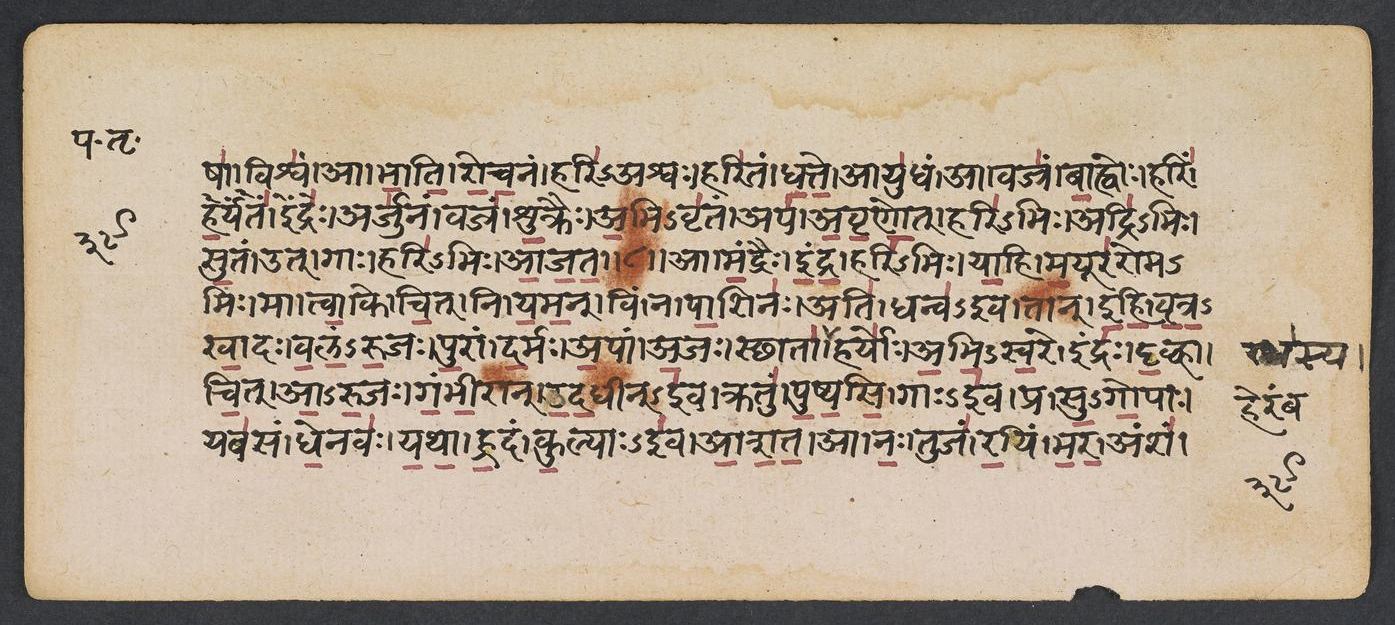
Where on the image
Penn Ms. Coll. 390 Item 41, fol. 229v (numbered 39v by the scribe) (OPenn image 231, upper leaf). Checked on the image: the Rigveda text on this page begins in RV 3.44.4 ‹-vṛṣā viśvam ā bhāti›. The next page with Rigveda text, fol. 230r (numbered 40r by the scribe), begins in RV 3.45.4 ‹na prati-jānate vṛkṣam pakvam›. Verses 3.45.1-3 end on this page.
1ā ma̱ndrair i̍ndra̱ hari̍bhir yā̱hi ma̱yūra̍romabhiḥ | mā tvā̱ ke ci̱n ni ya̍ma̱n viṁ na pā̱śino 'ti̱ dhanve̍va̱ tām̐ i̍hi ||
2vṛ̱tra̱khā̱do va̍laṁru̱jaḥ pu̱rāṁ da̱rmo a̱pām a̱jaḥ | sthātā̱ ratha̍sya̱ haryo̍r abhisva̱ra indro̍ dṛ̱ḻhā ci̍d āru̱jaḥ ||
3ga̱mbhī̱rām̐ u̍da̱dhīm̐r i̍va̱ kratu̍m puṣyasi̱ gā i̍va | pra su̍go̱pā yava̍saṁ dhe̱navo̍ yathā hra̱daṁ ku̱lyā i̍vāśata ||
Compare: Padapāṭha (word-by-word text written in the manuscript; Sansknet e-text via GRETIL)
1ā | mandraiḥ | indra | hari-bhiḥ | yāhi | mayūraroma-bhiḥ | mā | tvā | ke | cit | ni | yaman | vim | na | pāśinaḥ | ati | dhanva-iva | tān | ihi
2vṛtra-khādaḥ | valam-rujaḥ | purām | darmaḥ | apām | ajaḥ | sthātā | rathasya | haryoḥ | abhi-svare | indraḥ | dṛḷhā | cit | ārujaḥ
3gambhīrān | udadhīn-iva | kratum | puṣyasi | gāḥ-iva | pra | su-gopāḥ | yavasam | dhenavaḥ | yathā | hradam | kulyāḥ-iva | āśata
1COME hither, Indra, with Bay Steeds, joyous, with tails like peacocks' plumes. Let no men check thy course as fowlers stay the bird: pass o'er them as o'er desert lands.
2He who slew Vr̥itra, burst the cloud, brake the strongholds and drave the floods, Indra who mounts his chariot at his Bay Steeds' cry, shatters e'en things that stand most firm.
3Like pools of water deep and full, like kine thou cherishest thy might; Like the milch-cows that go well-guarded to the mead, like water-brooks that reach the lake.
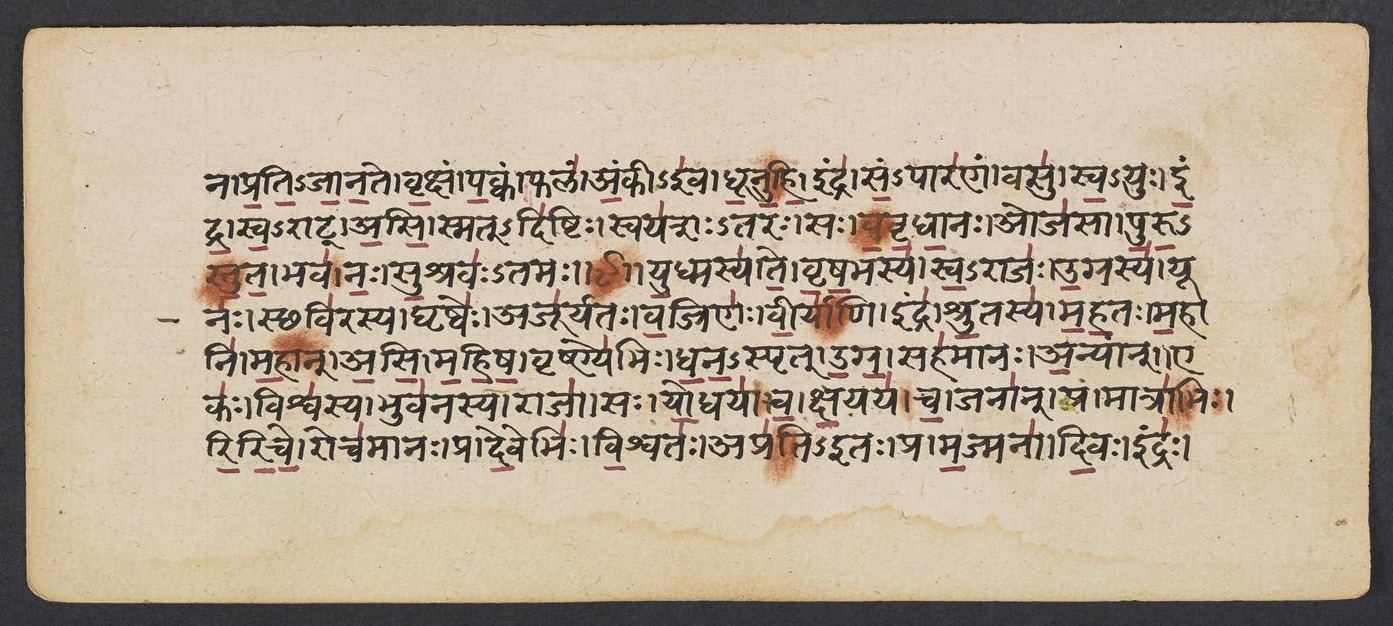
Where on the image
Penn Ms. Coll. 390 Item 41, fol. 230r (numbered 40r by the scribe) (OPenn image 231, lower leaf). Checked on the image: the Rigveda text on this page begins in RV 3.45.4 ‹na prati-jānate vṛkṣam pakvam›. The next page with Rigveda text, fol. 230v (numbered 40v by the scribe), begins in RV 3.46.3 ‹pṛthivyāḥ pra uroḥ mahaḥ›. Verses 3.45.4-5 end on this page; 3.45.4 begins on fol. 229v (numbered 39v by the scribe).
4ā na̱s tuja̍ṁ ra̱yim bha̱rāṁśa̱ṁ na pra̍tijāna̱te | vṛ̱kṣam pa̱kvam phala̍m a̱ṅkīva̍ dhūnu̱hīndra̍ sa̱mpāra̍ṇa̱ṁ vasu̍ ||
5sva̱yur i̍ndra sva̱rāḻ a̍si̱ smaddi̍ṣṭi̱ḥ svaya̍śastaraḥ | sa vā̍vṛdhā̱na oja̍sā puruṣṭuta̱ bhavā̍ naḥ su̱śrava̍stamaḥ ||
Compare: Padapāṭha (word-by-word text written in the manuscript; Sansknet e-text via GRETIL)
4ā | naḥ | tujam | rayim | bhara | aṃśam | na | prati-jānate | vṛkṣam | pakvam | phalam | aṅkī-iva | dhūnuhi | indra | sam-pāraṇam | vasu
5sva-yuḥ | indra | sva-rāṭ | asi | smat-diṣṭiḥ | svayaśaḥ-taraḥ | saḥ | vavṛdhānaḥ | ojasā | puru-stuta | bhava | naḥ | suśravaḥ-tamaḥ
4Bring thou us wealth with power to strike, our share, 'gainst him who calls it his. Shake, Indra, as with hooks, the tree for ripened fruit, for wealth to satisfy our wish.
5Indra, self-ruling Lord art thou, good Leader, of most glorious fame. So, waxen in thy strength, O thou whom many praise, be thou most swift to hear our call.
Notes
- Sanskrit: Aufrecht's edition (1877) with the Vedic accents, as entered by van Nooten and Holland (GRETIL).
- English: Ralph T. H. Griffith, The Hymns of the Rigveda (1889-1892; 2nd ed. 1896-1897), from the VedaWeb digital text; OCR slips in that text were corrected against the printed 2nd edition (data/sources/rigveda/griffith_errata.json).
- Padapāṭha (edition text): Sansknet e-text via GRETIL (CC BY-NC-SA 4.0).
Cite
Sources
- Source: Penn Ms. Coll. 390 Item 41 (undated (catalogued with Penn's 18th-19th c. Vedic manuscripts)), OPenn, Public Domain Mark + Aufrecht's accented text (GRETIL) + Griffith's English (VedaWeb) (holding institution)
- Critical edition: Aufrecht (1877), accented e-text via GRETIL
← previous · → next · v cycle view · l back to library