Rigveda 3.46: To Indra
Introduction
Rigveda 3.46 is a hymn of 5 verses addressed to Indra. It stands in book (maṇḍala) 3, the family book of Viśvāmitra. The Rigveda is the oldest collection of Sanskrit hymns, composed in the second half of the second millennium BCE and handed down orally for many centuries before it was written down.
The manuscript shown is Penn Ms. Coll. 390 Item 41 (University of Pennsylvania), an undated paper manuscript of the padapāṭha (the word-by-word recitation text, in which every word is written separately and compounds are split) of the whole Ṛgveda in Devanāgarī, 884 leaves in fascicles, 7-9 lines to the page, accents in red; this hymn stands on fol. 230r-230v. Each section below gives the verses that end on one page; the page boundaries were read on the images (the opening words of every page), not counted out. Where the manuscript is a padapāṭha (the word-by-word recitation text), the section shows Aufrecht's continuous (saṃhitā) text first and, as the edition text, the padapāṭha of the same verses, which is the form written on the page.
How was this verified? (Provenance)
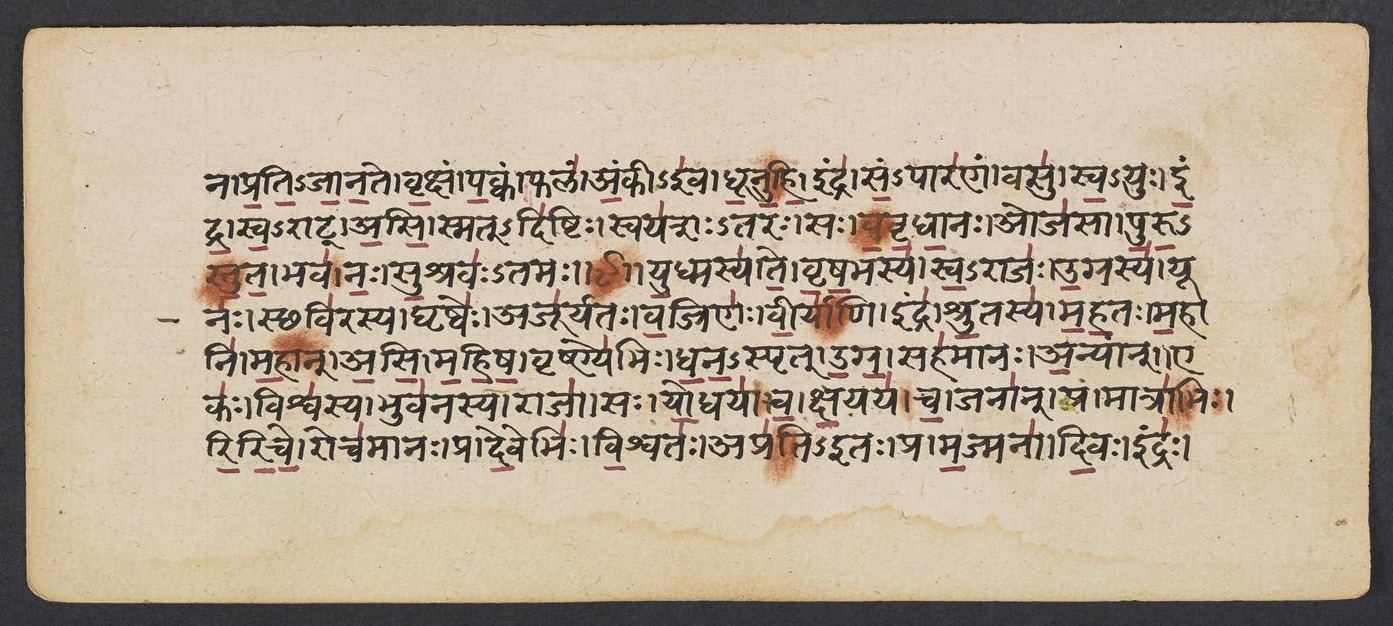
Where on the image
Penn Ms. Coll. 390 Item 41, fol. 230r (numbered 40r by the scribe) (OPenn image 231, lower leaf). Checked on the image: the Rigveda text on this page begins in RV 3.45.4 ‹na prati-jānate vṛkṣam pakvam›. The next page with Rigveda text, fol. 230v (numbered 40v by the scribe), begins in RV 3.46.3 ‹pṛthivyāḥ pra uroḥ mahaḥ›. Verses 3.46.1-2 end on this page.
1yu̱dhmasya̍ te vṛṣa̱bhasya̍ sva̱rāja̍ u̱grasya̱ yūna̱ḥ sthavi̍rasya̱ ghṛṣve̍ḥ | ajū̍ryato va̱jriṇo̍ vī̱ryā̱3̱̍ṇīndra̍ śru̱tasya̍ maha̱to ma̱hāni̍ ||
2ma̱hām̐ a̍si mahiṣa̱ vṛṣṇye̍bhir dhana̱spṛd u̍gra̱ saha̍māno a̱nyān | eko̱ viśva̍sya̱ bhuva̍nasya̱ rājā̱ sa yo̱dhayā̍ ca kṣa̱yayā̍ ca̱ janā̍n ||
Compare: Padapāṭha (word-by-word text written in the manuscript; Sansknet e-text via GRETIL)
1yudhmasya | te | vṛṣabhasya | sva-rājaḥ | ugrasya | yūnaḥ | sthavirasya | ghṛṣveḥ | ajūryataḥ | vajriṇaḥ | vīryāṇi | indra | śrutasya | mahataḥ | mahāni
2mahān | asi | mahiṣa | vṛṣṇyebhiḥ | dhana-spṛt | ugra | sahamānaḥ | anyān | ekaḥ | viśvasya | bhuvanasya | rājā | saḥ | yodhayā | ca | kṣayayā | ca | janān
1OF thee, the Bull, the Warrior, Sovran Ruler, joyous and fierce, ancient and ever youthful, The undecaying One who wields the thunder, renowned and great, great are the exploits, Indra.
2Great art thou, Mighty Lord, through manly vigour, O fierce One, gathering spoil, subduing others, Thyself alone the universe's Sovran: so send forth men to combat and to rest them.
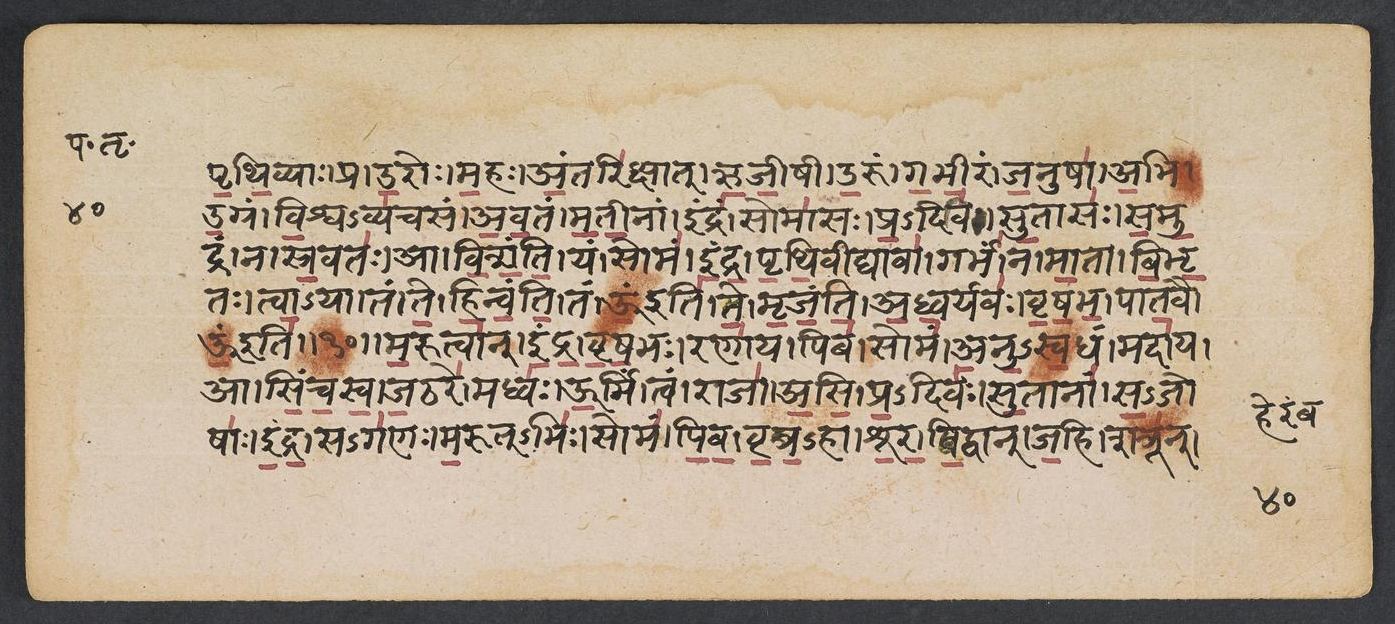
Where on the image
Penn Ms. Coll. 390 Item 41, fol. 230v (numbered 40v by the scribe) (OPenn image 232, upper leaf). Checked on the image: the Rigveda text on this page begins in RV 3.46.3 ‹pṛthivyāḥ pra uroḥ mahaḥ›. The next page with Rigveda text, fol. 231r (numbered 41r by the scribe), begins in RV 3.47.2 ‹apa mṛdhaḥ nudasva atha›. Verses 3.46.3-5 end on this page; 3.46.3 begins on fol. 230r (numbered 40r by the scribe).
3pra mātrā̍bhī ririce̱ roca̍māna̱ḥ pra de̱vebhi̍r vi̱śvato̱ apra̍tītaḥ | pra ma̱jmanā̍ di̱va indra̍ḥ pṛthi̱vyāḥ proror ma̱ho a̱ntari̍kṣād ṛjī̱ṣī ||
4u̱ruṁ ga̍bhī̱raṁ ja̱nuṣā̱bhy u1̱̍graṁ vi̱śvavya̍casam ava̱tam ma̍tī̱nām | indra̱ṁ somā̍saḥ pra̱divi̍ su̱tāsa̍ḥ samu̱draṁ na sra̱vata̱ ā vi̍śanti ||
5yaṁ soma̍m indra pṛthi̱vīdyāvā̱ garbha̱ṁ na mā̱tā bi̍bhṛ̱tas tvā̱yā | taṁ te̍ hinvanti̱ tam u̍ te mṛjanty adhva̱ryavo̍ vṛṣabha̱ pāta̱vā u̍ ||
Compare: Padapāṭha (word-by-word text written in the manuscript; Sansknet e-text via GRETIL)
3pra | mātrābhiḥ | ririce | rocamānaḥ | pra | devebhiḥ | viśvataḥ | aprati-itaḥ | pra | majmanā | divaḥ | indraḥ | pṛthivyāḥ | pra | uroḥ | mahaḥ | antarikṣāt | ṛjīṣī
4urum | gabhīram | januṣā | abhi | ugram | viśva-vyacasam | avatam | matīnām | indram | somāsaḥ | pra-divi | sutāsaḥ | samudram | na | sravataḥ | ā | viśanti
5yam | somam | indra | pṛthivīdyāvā | garbham | na | mātā | bibhṛtaḥ | tvāyā | tam | te | hinvanti | tam | oṃ iti | te | mṛjanti | adhvaryavaḥ | vṛṣabha | pātavai | oṃ iti
3He hath surpassed all measure in his brightness, yea, and the Gods, for none may be his equal. Impetuous Indra in his might cxccedcth wide vast mid-air and heaven and earth together.
4To Indra, even as rivers to the ocean, flow forth from days of old the Soma juices; To him wide deep and mighty from his birth-time, the well of holy thoughts, aIl-comprehending.
5The Soma, Indra, which the earth and heaven bear for thee as a mother bears her infant, This they send forth to thee, this, vigorous Hero! Adhvaryus purify for thee to drink of.
Notes
- Sanskrit: Aufrecht's edition (1877) with the Vedic accents, as entered by van Nooten and Holland (GRETIL).
- English: Ralph T. H. Griffith, The Hymns of the Rigveda (1889-1892; 2nd ed. 1896-1897), from the VedaWeb digital text; OCR slips in that text were corrected against the printed 2nd edition (data/sources/rigveda/griffith_errata.json).
- Padapāṭha (edition text): Sansknet e-text via GRETIL (CC BY-NC-SA 4.0).
Cite
Sources
- Source: Penn Ms. Coll. 390 Item 41 (undated (catalogued with Penn's 18th-19th c. Vedic manuscripts)), OPenn, Public Domain Mark + Aufrecht's accented text (GRETIL) + Griffith's English (VedaWeb) (holding institution)
- Critical edition: Aufrecht (1877), accented e-text via GRETIL
← previous · → next · v cycle view · l back to library