Rigveda 4.10: To Agni
Introduction
Rigveda 4.10 is a hymn of 8 verses addressed to Agni. It stands in book (maṇḍala) 4, the family book of Vāmadeva. The Rigveda is the oldest collection of Sanskrit hymns, composed in the second half of the second millennium BCE and handed down orally for many centuries before it was written down.
The manuscript shown is Penn Ms. Coll. 390 Item 41 (University of Pennsylvania), an undated paper manuscript of the padapāṭha (the word-by-word recitation text, in which every word is written separately and compounds are split) of the whole Ṛgveda in Devanāgarī, 884 leaves in fascicles, 7-9 lines to the page, accents in red; this hymn stands on fol. 265v-266r. Each section below gives the verses that end on one page; the page boundaries were read on the images (the opening words of every page), not counted out. Where the manuscript is a padapāṭha (the word-by-word recitation text), the section shows Aufrecht's continuous (saṃhitā) text first and, as the edition text, the padapāṭha of the same verses, which is the form written on the page.
How was this verified? (Provenance)
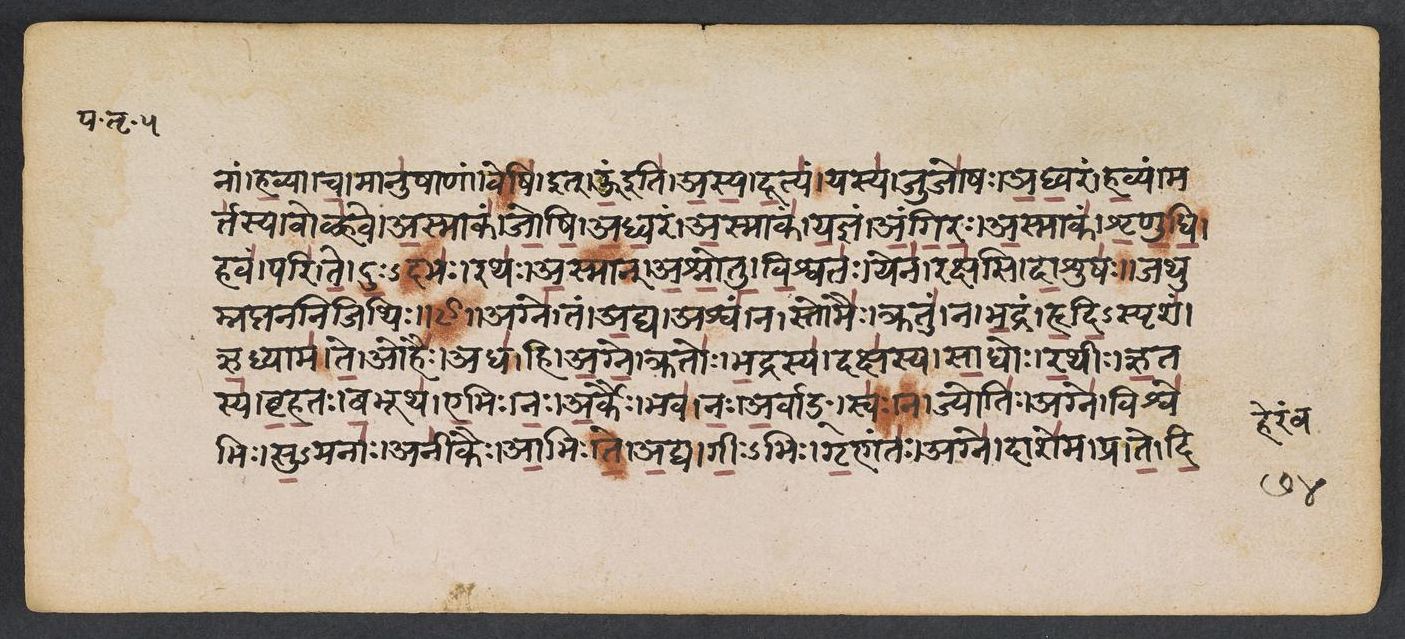
Where on the image
Penn Ms. Coll. 390 Item 41, fol. 265v (numbered 74v by the scribe) (OPenn image 266, upper leaf). Checked on the image: the Rigveda text on this page begins in RV 4.9.5 ‹-janānām havyā ca mānuṣāṇām›. The next page with Rigveda text, fol. 266r (numbered 75r by the scribe), begins in RV 4.10.4 ‹divaḥ na stanayanti śuṣmāḥ›. Verses 4.10.1-3 end on this page.
1agne̱ tam a̱dyāśva̱ṁ na stomai̱ḥ kratu̱ṁ na bha̱draṁ hṛ̍di̱spṛśa̍m | ṛ̱dhyāmā̍ ta̱ ohai̍ḥ ||
2adhā̱ hy a̍gne̱ krato̍r bha̱drasya̱ dakṣa̍sya sā̱dhoḥ | ra̱thīr ṛ̱tasya̍ bṛha̱to ba̱bhūtha̍ ||
3e̱bhir no̍ a̱rkair bhavā̍ no a̱rvāṅ sva1̱̍r ṇa jyoti̍ḥ | agne̱ viśve̍bhiḥ su̱manā̱ anī̍kaiḥ ||
Compare: Padapāṭha (word-by-word text written in the manuscript; Sansknet e-text via GRETIL)
1agne | tam | adya | aśvam | na | stomaiḥ | kratum | na | bhadram | hṛdi-spṛśam | ṛdhyāma | te | ohaiḥ
2adha | hi | agne | kratoḥ | bhadrasya | dakṣasya | sādhoḥ | rathīḥ | ṛtasya | bṛhataḥ | babhūtha
3ebhiḥ | naḥ | arkaiḥ | bhava | naḥ | arvāṅ | svaḥ | ṇa | jyotiḥ | agne | viśvebhiḥ | su-manāḥ | anīkaiḥ
1This day with praises, Agni, we bring thee that which thou lovest. Right judgment, like a horse, with our devotions.
2For thou hast ever been the Car-driver, Agni, of noble Strength, lofty sacrifice, and rightful judgment.
3Through these our praises come thou to meet us, bright as the sunlight, O Agni, well disposed, with all thine aspects.
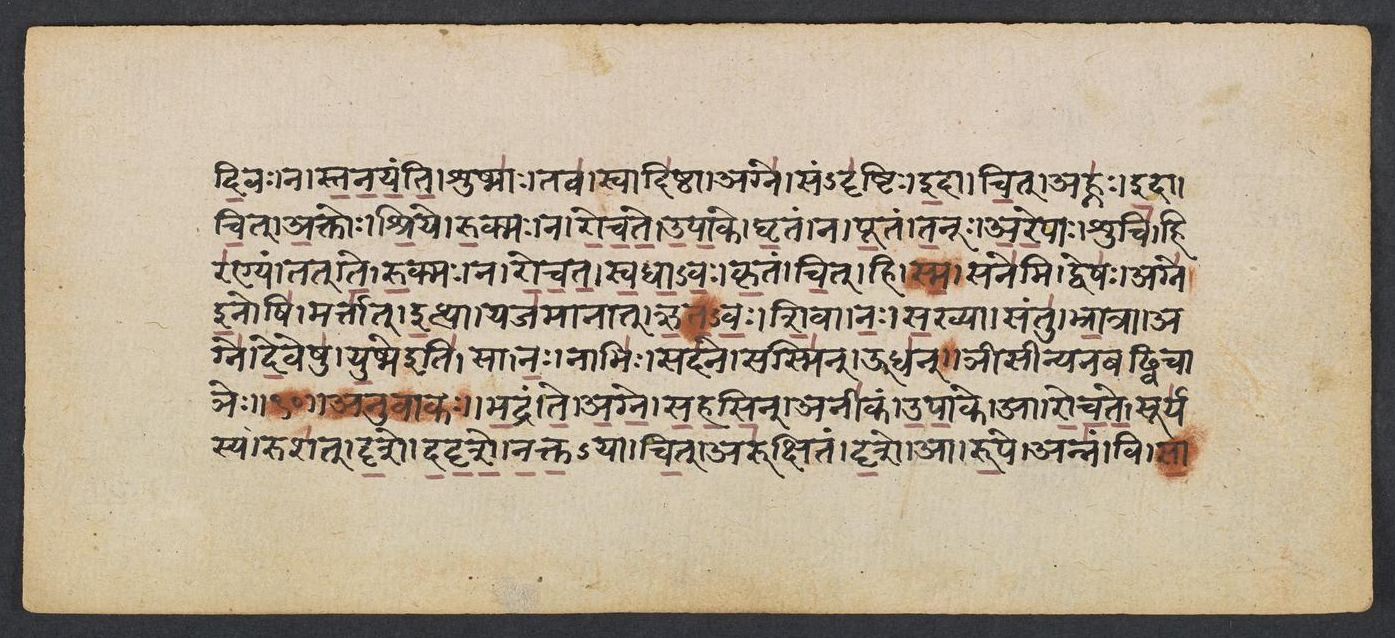
Where on the image
Penn Ms. Coll. 390 Item 41, fol. 266r (numbered 75r by the scribe) (OPenn image 266, lower leaf). Checked on the image: the Rigveda text on this page begins in RV 4.10.4 ‹divaḥ na stanayanti śuṣmāḥ›. The next page with Rigveda text, fol. 266v (numbered 75v by the scribe), begins in RV 4.11.2 ‹-sāhi agne gṛṇate manīṣām›. Verses 4.10.4-8 end on this page; 4.10.4 begins on fol. 265v (numbered 74v by the scribe).
4ā̱bhiṣ ṭe̍ a̱dya gī̱rbhir gṛ̱ṇanto 'gne̱ dāśe̍ma | pra te̍ di̱vo na sta̍nayanti̱ śuṣmā̍ḥ ||
5tava̱ svādi̱ṣṭhāgne̱ saṁdṛ̍ṣṭir i̱dā ci̱d ahna̍ i̱dā ci̍d a̱ktoḥ | śri̱ye ru̱kmo na ro̍cata upā̱ke ||
6ghṛ̱taṁ na pū̱taṁ ta̱nūr a̍re̱pāḥ śuci̱ hira̍ṇyam | tat te̍ ru̱kmo na ro̍cata svadhāvaḥ ||
7kṛ̱taṁ ci̱d dhi ṣmā̱ sane̍mi̱ dveṣo 'gna̍ i̱noṣi̱ martā̍t | i̱tthā yaja̍mānād ṛtāvaḥ ||
8śi̱vā na̍ḥ sa̱khyā santu̍ bhrā̱trāgne̍ de̱veṣu̍ yu̱ṣme | sā no̱ nābhi̱ḥ sada̍ne̱ sasmi̱nn ūdha̍n ||
Compare: Padapāṭha (word-by-word text written in the manuscript; Sansknet e-text via GRETIL)
4ābhiḥ | te | adya | gīḥ-bhiḥ | gṛṇantaḥ | agne | dāśema | pra | te | divaḥ | na | stanayanti | śuṣmāḥ
5tava | svādiṣṭhā | agne | sam-dṛṣṭiḥ | idā | cit | ahnaḥ | idā | cit | aktoḥ | śriye | rukmaḥ | na | rocate | upāke
6ghṛtam | na | pūtam | tanūḥ | arepāḥ | śuci | hiraṇyam | tat | te | rukmaḥ | na | rocata | svadhāvaḥ
7kṛtam | cit | hi | sma | sanemi | dveṣaḥ | agne | inoṣi | martāt | itthā | yajamānāt | ṛta-vaḥ
8śivā | naḥ | sakhyā | santu | bhrātrā | agne | deveṣu | yuṣme iti | sā | naḥ | nābhiḥ | sadane | sasmin | ūdham
4Now may we serve thee singing these lauds this day to thee, Agni. Loud as the voice of Heaven thy blasts are roaring.
5just at this time of the day and the night thy look is the sweetest . It shineth near us even as gold for glory.
6Spotless thy body, brilliant as gold, like clarified butter: This gleams like gold on thee, O Self. dependent.
7All hate and mischief, yea, if committed, Agni, thou turnest, Holy One, from the man who rightly worships.
8Agni, with you Gods, prosperous be our friendships and kinships. Be this our bond here by this place, thine al tar.
Notes
- Sanskrit: Aufrecht's edition (1877) with the Vedic accents, as entered by van Nooten and Holland (GRETIL).
- English: Ralph T. H. Griffith, The Hymns of the Rigveda (1889-1892; 2nd ed. 1896-1897), from the VedaWeb digital text; OCR slips in that text were corrected against the printed 2nd edition (data/sources/rigveda/griffith_errata.json).
- Padapāṭha (edition text): Sansknet e-text via GRETIL (CC BY-NC-SA 4.0).
Cite
Sources
- Source: Penn Ms. Coll. 390 Item 41 (undated (catalogued with Penn's 18th-19th c. Vedic manuscripts)), OPenn, Public Domain Mark + Aufrecht's accented text (GRETIL) + Griffith's English (VedaWeb) (holding institution)
- Critical edition: Aufrecht (1877), accented e-text via GRETIL
← previous · → next · v cycle view · l back to library