Rigveda 4.13: To Agni
Introduction
Rigveda 4.13 is a hymn of 5 verses addressed to Agni. It stands in book (maṇḍala) 4, the family book of Vāmadeva. The Rigveda is the oldest collection of Sanskrit hymns, composed in the second half of the second millennium BCE and handed down orally for many centuries before it was written down.
The manuscript shown is Penn Ms. Coll. 390 Item 41 (University of Pennsylvania), an undated paper manuscript of the padapāṭha (the word-by-word recitation text, in which every word is written separately and compounds are split) of the whole Ṛgveda in Devanāgarī, 884 leaves in fascicles, 7-9 lines to the page, accents in red; this hymn stands on fol. 267v-268r. Each section below gives the verses that end on one page; the page boundaries were read on the images (the opening words of every page), not counted out. Where the manuscript is a padapāṭha (the word-by-word recitation text), the section shows Aufrecht's continuous (saṃhitā) text first and, as the edition text, the padapāṭha of the same verses, which is the form written on the page.
How was this verified? (Provenance)
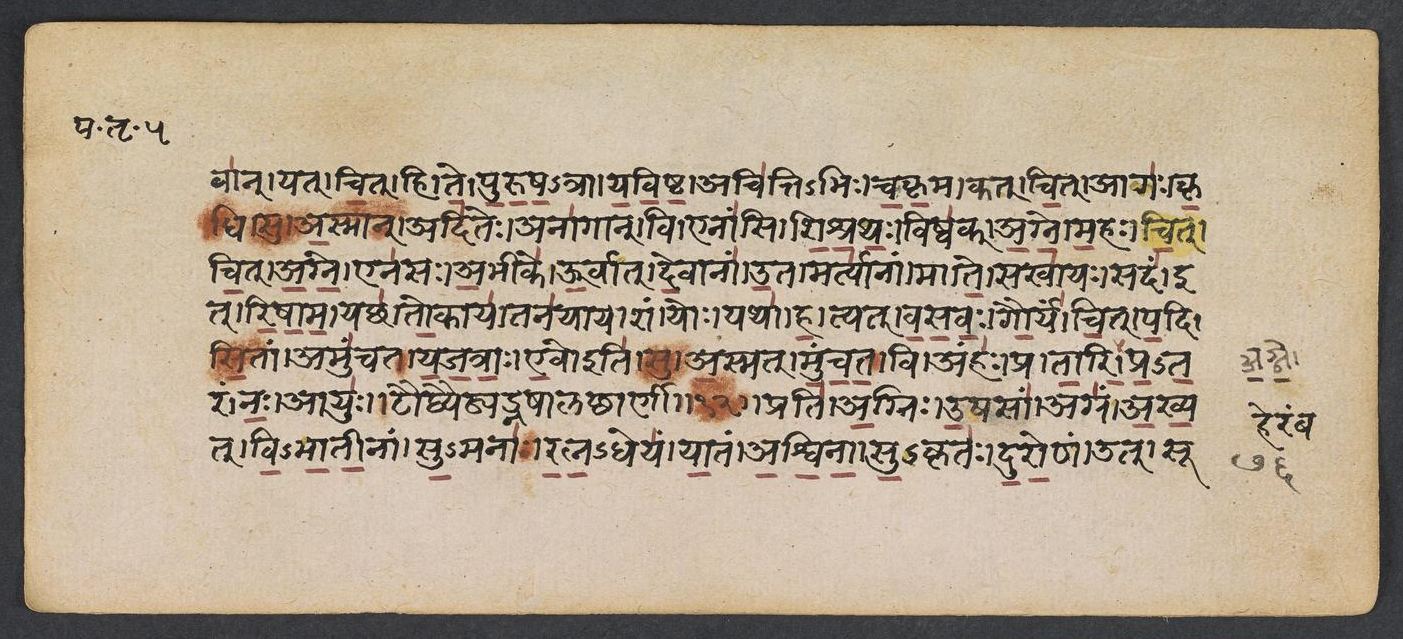
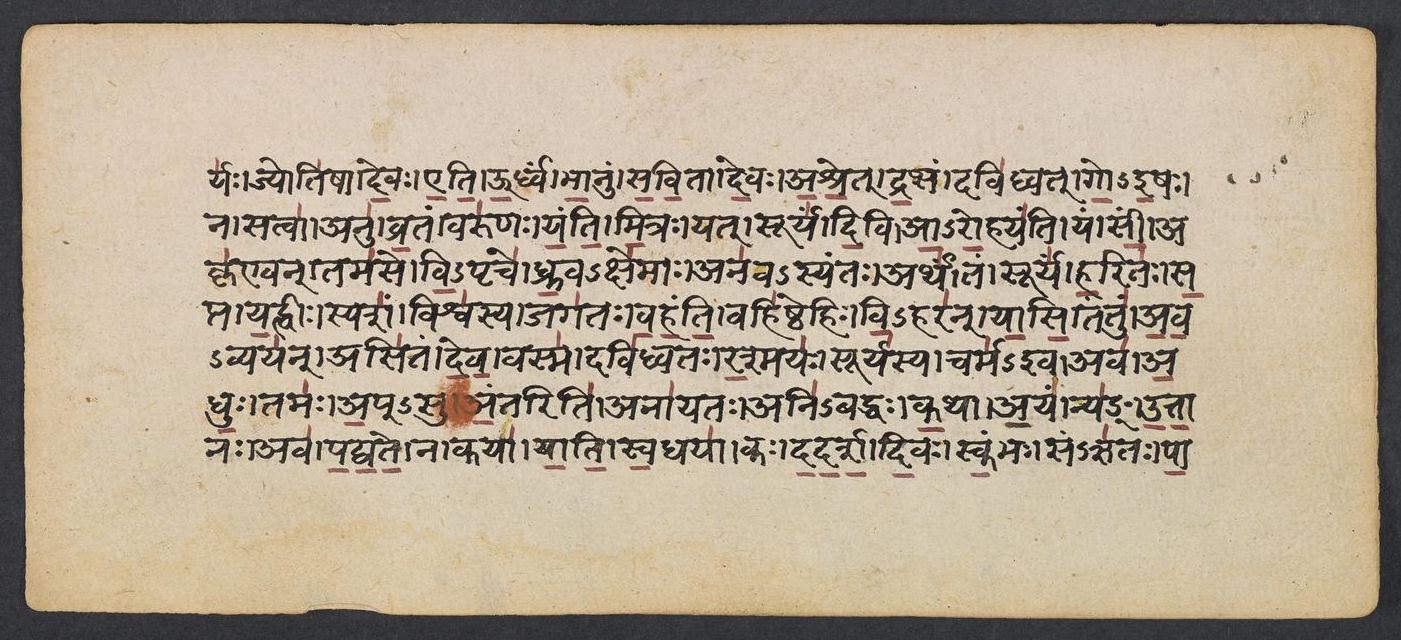
Where on the image
Penn Ms. Coll. 390 Item 41, fol. 268r (numbered 77r by the scribe) (OPenn image 268, lower leaf). Checked on the image: the Rigveda text on this page begins in RV 4.13.1 ‹-sūryaḥ jyotiṣā devaḥ eti›. The next page with Rigveda text, fol. 268v (numbered 77v by the scribe), begins in RV 4.14.1 ‹-agniḥ uṣasaḥ jāta-vedāḥ akhyat›. Verses 4.13.1-5 end on this page; 4.13.1 begins on fol. 267v (numbered 76v by the scribe).
1praty a̱gnir u̱ṣasā̱m agra̍m akhyad vibhātī̱nāṁ su̱manā̍ ratna̱dheya̍m | yā̱tam a̍śvinā su̱kṛto̍ duro̱ṇam ut sūryo̱ jyoti̍ṣā de̱va e̍ti ||
2ū̱rdhvam bhā̱nuṁ sa̍vi̱tā de̱vo a̍śred dra̱psaṁ davi̍dhvad gavi̱ṣo na satvā̍ | anu̍ vra̱taṁ varu̍ṇo yanti mi̱tro yat sūrya̍ṁ di̱vy ā̍ro̱haya̍nti ||
3yaṁ sī̱m akṛ̍ṇva̱n tama̍se vi̱pṛce̍ dhru̱vakṣe̍mā̱ ana̍vasyanto̱ artha̍m | taṁ sūrya̍ṁ ha̱rita̍ḥ sa̱pta ya̱hvīḥ spaśa̱ṁ viśva̍sya̱ jaga̍to vahanti ||
4vahi̍ṣṭhebhir vi̱hara̍n yāsi̱ tantu̍m ava̱vyaya̱nn asi̍taṁ deva̱ vasma̍ | davi̍dhvato ra̱śmaya̱ḥ sūrya̍sya̱ carme̱vāvā̍dhu̱s tamo̍ a̱psv a1̱̍ntaḥ ||
5anā̍yato̱ ani̍baddhaḥ ka̱thāyaṁ nya̍ṅṅ uttā̱no 'va̍ padyate̱ na | kayā̍ yāti sva̱dhayā̱ ko da̍darśa di̱vaḥ ska̱mbhaḥ samṛ̍taḥ pāti̱ nāka̍m ||
Compare: Padapāṭha (word-by-word text written in the manuscript; Sansknet e-text via GRETIL)
1prati | agniḥ | uṣasām | agram | akhyat | vi-bhātīnām | su-manāḥ | ratna-dheyam | yātam | aśvinā | su-kṛtaḥ | duroṇam | ut | sūryaḥ | jyotiṣā | devaḥ | eti
2ūrdhvam | bhānum | savitā | devaḥ | aśret | drapsam | davidhvat | go--iṣaḥ | na | satvā | anu | vratam | varuṇaḥ | yanti | mitraḥ | yat | sūryam | divi | ārohayanti
3yam | sīm | akṛṇvan | tamase | vi-pṛce | dhruva-kṣemāḥ | anava-syantaḥ | atharm | tam | sūryam | haritaḥ | sapta | yahvīḥ | spaśam | viśvasya | jagataḥ | vahanti
4vahiṣṭebhiḥ | vi-haran | yāsi | tantum | ava-vyayan | asitam | deva | vasma | davidhvataḥ | raśmayaḥ | sūryasya | carma-iva | ava | adhuḥ | tamaḥ | ap-su | antariti
5anāyataḥ | ani-baddhaḥ | kathā | ayam | nyaṅ | uttānaḥ | ava | padyate | na | kayā | yāti | svadhayā | kaḥ | dadarśa | divaḥ | skambhaḥ | sam-ṛtaḥ | pāti | nākam
1AGNI hath looked, benevolently-minded, on the wealth-giving spring of radiant Mornings. Come, Aṣvins, to the dwelling of the pious: Sûrya the God is rising with his splendour.
2Savitar, God, hath spread on high his lustre, waving his flag like a spoil-seeking hero. Their stablished way go Varuṇa and Mitra, what time they make the Sun ascend the heaven.
3Him whom they made to drive away the darkness, Lords of sure mansions, constant to their object, Him who beholds the universe, the Sun-God, seven strong and youthful Coursers carry onward.
4Spreading thy web with mightiest Steeds thou comest, rending apart, thou God, the black-hued mantle. The rays of Sûrya tremulously shining sink, like a hide, the darkness in the waters.
5How is it that, unbound and not supported, he falleth not although directed downward? By what self power moves he? Who hath seen it? He guards the vault of heaven, a close-set pillar.
Notes
- Sanskrit: Aufrecht's edition (1877) with the Vedic accents, as entered by van Nooten and Holland (GRETIL).
- English: Ralph T. H. Griffith, The Hymns of the Rigveda (1889-1892; 2nd ed. 1896-1897), from the VedaWeb digital text; OCR slips in that text were corrected against the printed 2nd edition (data/sources/rigveda/griffith_errata.json).
- Padapāṭha (edition text): Sansknet e-text via GRETIL (CC BY-NC-SA 4.0).
Cite
Sources
- Source: Penn Ms. Coll. 390 Item 41 (undated (catalogued with Penn's 18th-19th c. Vedic manuscripts)), OPenn, Public Domain Mark + Aufrecht's accented text (GRETIL) + Griffith's English (VedaWeb) (holding institution)
- Critical edition: Aufrecht (1877), accented e-text via GRETIL
← previous · → next · v cycle view · l back to library