Rigveda 4.15: To Agni
Introduction
Rigveda 4.15 is a hymn of 10 verses addressed to Agni. It stands in book (maṇḍala) 4, the family book of Vāmadeva. The Rigveda is the oldest collection of Sanskrit hymns, composed in the second half of the second millennium BCE and handed down orally for many centuries before it was written down.
The manuscript shown is Penn Ms. Coll. 390 Item 41 (University of Pennsylvania), an undated paper manuscript of the padapāṭha (the word-by-word recitation text, in which every word is written separately and compounds are split) of the whole Ṛgveda in Devanāgarī, 884 leaves in fascicles, 7-9 lines to the page, accents in red; this hymn stands on fol. 268v-269v. Each section below gives the verses that end on one page; the page boundaries were read on the images (the opening words of every page), not counted out. Where the manuscript is a padapāṭha (the word-by-word recitation text), the section shows Aufrecht's continuous (saṃhitā) text first and, as the edition text, the padapāṭha of the same verses, which is the form written on the page.
How was this verified? (Provenance)
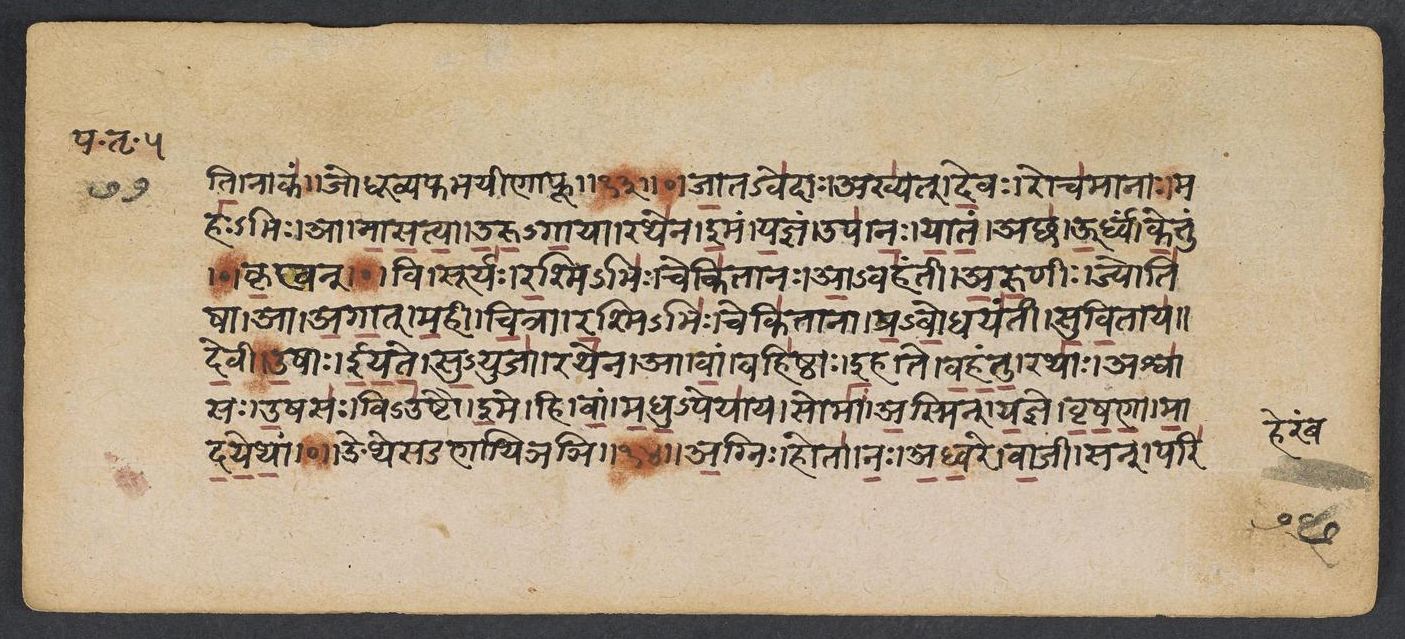
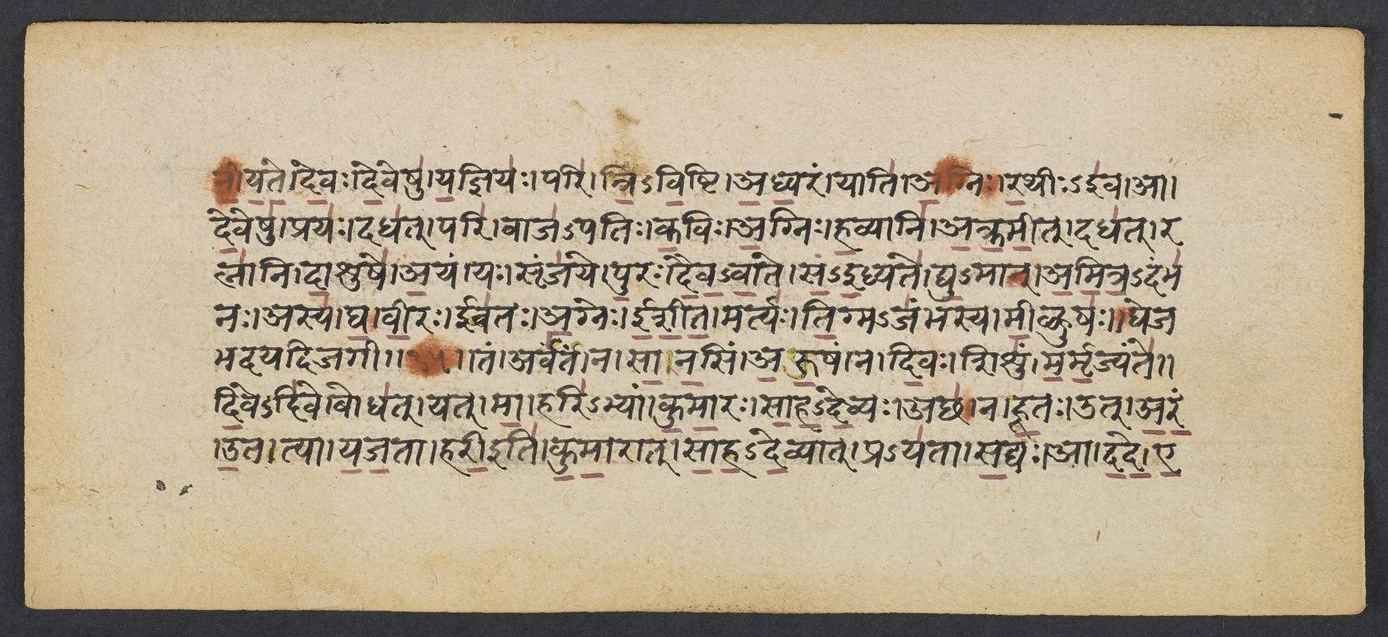
Where on the image
Penn Ms. Coll. 390 Item 41, fol. 269r (numbered 78r by the scribe) (OPenn image 269, lower leaf). Checked on the image: the Rigveda text on this page begins in RV 4.15.1 ‹-nīyate devaḥ deveṣu yajñiyaḥ›. The next page with Rigveda text, fol. 269v (numbered 78v by the scribe), begins in RV 4.15.9 ‹eṣaḥ vām devau aśvinā›. Verses 4.15.1-8 end on this page; 4.15.1 begins on fol. 268v (numbered 77v by the scribe).
1a̱gnir hotā̍ no adhva̱re vā̱jī san pari̍ ṇīyate | de̱vo de̱veṣu̍ ya̱jñiya̍ḥ ||
2pari̍ trivi̱ṣṭy a̍dhva̱raṁ yāty a̱gnī ra̱thīr i̍va | ā de̱veṣu̱ prayo̱ dadha̍t ||
3pari̱ vāja̍patiḥ ka̱vir a̱gnir ha̱vyāny a̍kramīt | dadha̱d ratnā̍ni dā̱śuṣe̍ ||
4a̱yaṁ yaḥ sṛñja̍ye pu̱ro dai̍vavā̱te sa̍mi̱dhyate̍ | dyu̱mām̐ a̍mitra̱dambha̍naḥ ||
5asya̍ ghā vī̱ra īva̍to̱ 'gner ī̍śīta̱ martya̍ḥ | ti̱gmaja̍mbhasya mī̱ḻhuṣa̍ḥ ||
6tam arva̍nta̱ṁ na sā̍na̱sim a̍ru̱ṣaṁ na di̱vaḥ śiśu̍m | ma̱rmṛ̱jyante̍ di̱ve-di̍ve ||
7bodha̱d yan mā̱ hari̍bhyāṁ kumā̱raḥ sā̍hade̱vyaḥ | acchā̱ na hū̱ta ud a̍ram ||
8u̱ta tyā ya̍ja̱tā harī̍ kumā̱rāt sā̍hade̱vyāt | praya̍tā sa̱dya ā da̍de ||
Compare: Padapāṭha (word-by-word text written in the manuscript; Sansknet e-text via GRETIL)
1agniḥ | hotā | naḥ | adhvare | vājī | san | pari | nīyate | devaḥ | deveṣu | yajñiyaḥ
2pari | tri-viṣṭi | adhvaram | yāti | agniḥ | rathīḥ-iva | ā | deveṣu | prayaḥ | dadhat
3pari | vāja-patiḥ | kaviḥ | agniḥ | havyāni | akramīt | dadhat | ratnāni | dāśuṣe
4ayam | yaḥ | sṛñjaye | puraḥ | daiva-vāte | sam-idhyate | dyu-mān | amitra-dambhanaḥ
5asya | gha | vīraḥ | īvataḥ | agneḥ | īśīta | martyaḥ | tigma-jambhasya | mīḷhuṣaḥ
6tam | arvantam | na | sānasim | aruṣam | na | divaḥ | śiśum | marmṛjyante | dive--dive
7bodhat | yat | mā | hari-bhyām | kumāraḥ | sāha-devyaḥ | accha | na | hūtaḥ | ut | aram
8uta | tyā | yajatā | harī iti | kumārāt | sāhadevyāt | pra-yatā | sadyaḥ | ā | dade
1AGNI the Herald, like a horse, is led forth at our solemn rite, God among Gods adorable.
2Three times unto our solemn rite comes Agni like a charioteer, Bearing the viands to the Gods.
3Round the oblations hath he paced, Agni the Wise, the Lord of Strength, Giving the offerer precious boons.
4He who is kindled eastward for Sr̥injaya, Devavâta's son, Resplendent, tamer of the foe.
5So mighty be the Agni whom the mortal hero shall command, With sharpened teeth and bountiful.
6Day after day they dress him, as they clean a horse who wins the prize. Dress the red Scion of the Sky.
7When Sahadeva's princely son with two bay horses thought of me, Summoned by him I drew not back.
8And truly those two noble bays I straightway took when offered me, From Sahadeva's princely son.
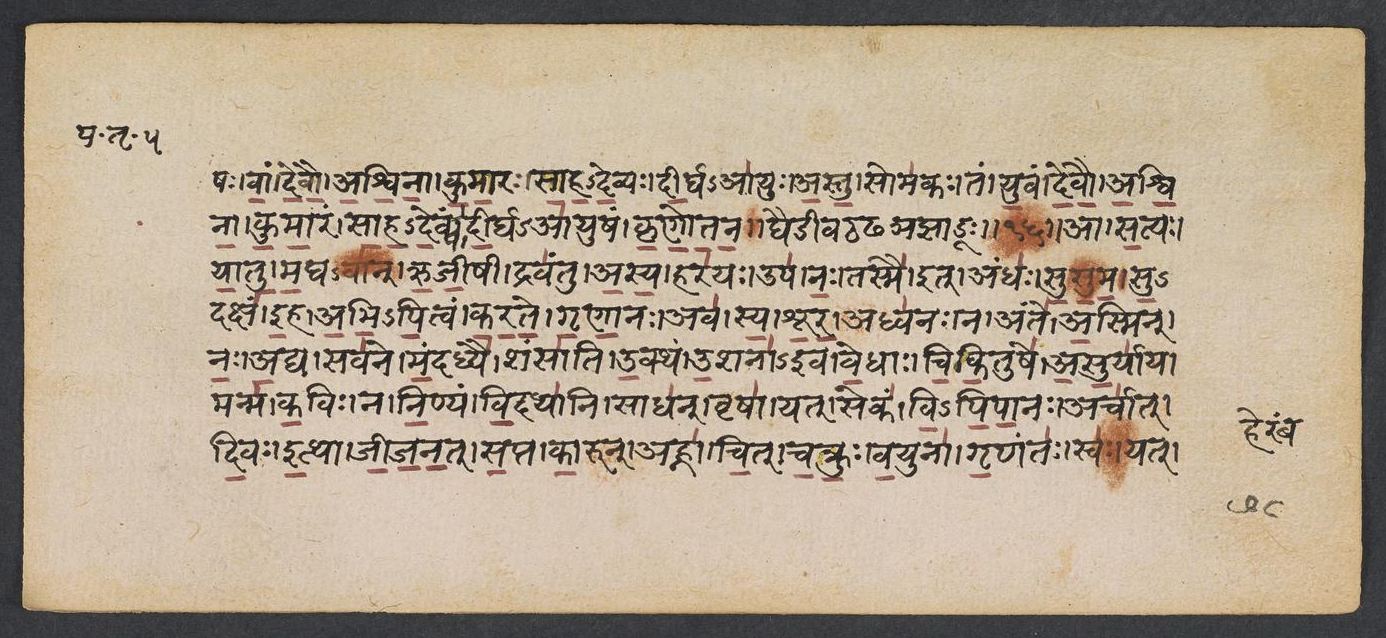
Where on the image
Penn Ms. Coll. 390 Item 41, fol. 269v (numbered 78v by the scribe) (OPenn image 270, upper leaf). Checked on the image: the Rigveda text on this page begins in RV 4.15.9 ‹eṣaḥ vām devau aśvinā›. The next page with Rigveda text, fol. 270r (numbered 79r by the scribe), begins in RV 4.16.4 ‹vedi su-dṛśīkam arkaiḥ mahi›. Verses 4.15.9-10 end on this page.
9e̱ṣa vā̍ṁ devāv aśvinā kumā̱raḥ sā̍hade̱vyaḥ | dī̱rghāyu̍r astu̱ soma̍kaḥ ||
10taṁ yu̱vaṁ de̍vāv aśvinā kumā̱raṁ sā̍hade̱vyam | dī̱rghāyu̍ṣaṁ kṛṇotana ||
Compare: Padapāṭha (word-by-word text written in the manuscript; Sansknet e-text via GRETIL)
9eṣaḥ | vām | devau | aśvinā | kumāraḥ | sāha-devyaḥ | dīrgha-āyuḥ | astu | somakaḥ
10tam | yuvam | devau | aśvinā | kumāram | sāha-devyam | dīrgha-āyuṣam | kṛṇotana
9Long, O ye Aṣvins, may he live, your care, ye Gods, the princely son. Of Sahadeva, Somaka.
10Cause him the youthful prince, the son of Sahadeva, to enjoy Long life, O Aṣvins, O ye Gods.
Notes
- Sanskrit: Aufrecht's edition (1877) with the Vedic accents, as entered by van Nooten and Holland (GRETIL).
- English: Ralph T. H. Griffith, The Hymns of the Rigveda (1889-1892; 2nd ed. 1896-1897), from the VedaWeb digital text; OCR slips in that text were corrected against the printed 2nd edition (data/sources/rigveda/griffith_errata.json).
- Padapāṭha (edition text): Sansknet e-text via GRETIL (CC BY-NC-SA 4.0).
Cite
Sources
- Source: Penn Ms. Coll. 390 Item 41 (undated (catalogued with Penn's 18th-19th c. Vedic manuscripts)), OPenn, Public Domain Mark + Aufrecht's accented text (GRETIL) + Griffith's English (VedaWeb) (holding institution)
- Critical edition: Aufrecht (1877), accented e-text via GRETIL
← previous · → next · v cycle view · l back to library