Rigveda 4.48: To Vayu
Introduction
Rigveda 4.48 is a hymn of 5 verses addressed to Vayu. It stands in book (maṇḍala) 4, the family book of Vāmadeva. The Rigveda is the oldest collection of Sanskrit hymns, composed in the second half of the second millennium BCE and handed down orally for many centuries before it was written down.
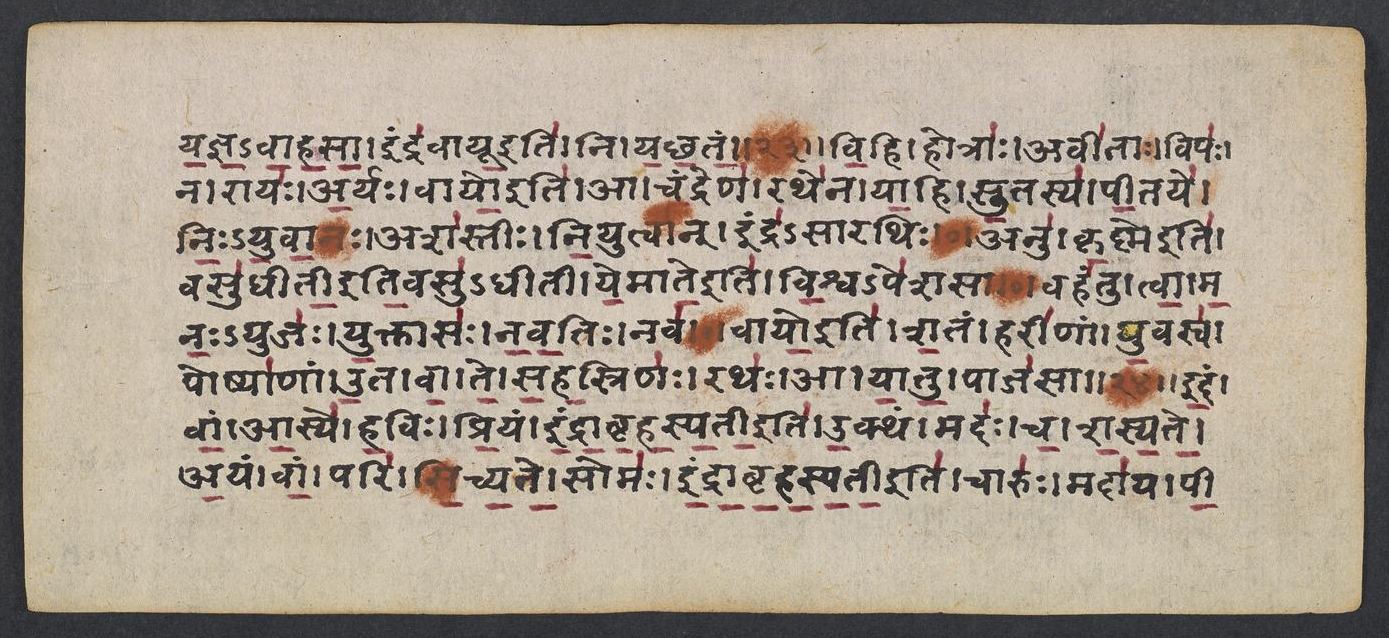
The manuscript shown is Penn Ms. Coll. 390 Item 41 (University of Pennsylvania), an undated paper manuscript of the padapāṭha (the word-by-word recitation text, in which every word is written separately and compounds are split) of the whole Ṛgveda in Devanāgarī, 884 leaves in fascicles, 7-9 lines to the page, accents in red; this hymn stands on fol. 308r. Each section below gives the verses that end on one page; the page boundaries were read on the images (the opening words of every page), not counted out. Where the manuscript is a padapāṭha (the word-by-word recitation text), the section shows Aufrecht's continuous (saṃhitā) text first and, as the edition text, the padapāṭha of the same verses, which is the form written on the page.
How was this verified? (Provenance)
Where on the image
Penn Ms. Coll. 390 Item 41, fol. 308r (numbered 117r by the scribe) (OPenn image 308, lower leaf). Checked on the image: the Rigveda text on this page begins in RV 4.47.4 ‹yajña-vāhasā indravāyūiti ni yacchatam›. The next page with Rigveda text, fol. 308v (numbered 117v by the scribe), begins in RV 4.49.2 ‹-pītaye›. Verses 4.48.1-5 end on this page.
1vi̱hi hotrā̱ avī̍tā̱ vipo̱ na rāyo̍ a̱ryaḥ | vāya̱v ā ca̱ndreṇa̱ rathe̍na yā̱hi su̱tasya̍ pī̱taye̍ ||
2ni̱ryu̱vā̱ṇo aśa̍stīr ni̱yutvā̱m̐ indra̍sārathiḥ | vāya̱v ā ca̱ndreṇa̱ rathe̍na yā̱hi su̱tasya̍ pī̱taye̍ ||
3anu̍ kṛ̱ṣṇe vasu̍dhitī ye̱māte̍ vi̱śvape̍śasā | vāya̱v ā ca̱ndreṇa̱ rathe̍na yā̱hi su̱tasya̍ pī̱taye̍ ||
4vaha̍ntu tvā mano̱yujo̍ yu̱ktāso̍ nava̱tir nava̍ | vāya̱v ā ca̱ndreṇa̱ rathe̍na yā̱hi su̱tasya̍ pī̱taye̍ ||
5vāyo̍ śa̱taṁ harī̍ṇāṁ yu̱vasva̱ poṣyā̍ṇām | u̱ta vā̍ te saha̱sriṇo̱ ratha̱ ā yā̍tu̱ pāja̍sā ||
Compare: Padapāṭha (word-by-word text written in the manuscript; Sansknet e-text via GRETIL)
1vihi | hotrā | avītāḥ | vipaḥ | na | rāyaḥ | aryaḥ | vāyo iti | ā | candreṇe | rathena | yāhi | sutasya | pītaye
2niḥ-yuvānaḥ | aśastīḥ | niyutvān | indra-sārathiḥ | vāyo iti | ā | candreṇe | rathena | yāhi | sutasya | pītaye
3anu | kṛṣṇe | vasudhitī itivasu-dhitī | yemāteiti | viśva-peśasā | vāyo iti | ā | candreṇe | rathena | yāhi | sutasya | pītaye
4vahantu | tvā | manaḥ-yujaḥ | yuktāsaḥ | navatiḥ | nava | vāyo iti | ā | candreṇe | rathena | yāhi | sutasya | pītaye
5vāyo iti | śatam | harīṇām | yuvasva | poṣyāṇām | uta | vā | te | sahasriṇaḥ | rathaḥ | ā | yātu | pājasā
1TASTE offerings never tasted yet, as bards enjoy the foeman's wealth. O Vâyu, on refulgent car come to the drinking of the juice.
2Removing curses, drawn by teams, with Indra seated by thy side, O Vâyu, on refulgent car come to the drinking of the juice.
3The two dark treasuries of wealth that wear all beauties wait on thee. O Vâyu, on refulgent car come to the drinking of the juice.
4May nine-and-ninety harnessed steeds who yoke them at thy will bring thee. O Vâyu, on refulgent car come to the drinking of the juice.
5Harness, O Vâyu, to thy car a hundred well-fed tawny steeds, Yea, or a thousand steeds, and let thy chariot come to us with might.
Notes
- Sanskrit: Aufrecht's edition (1877) with the Vedic accents, as entered by van Nooten and Holland (GRETIL).
- English: Ralph T. H. Griffith, The Hymns of the Rigveda (1889-1892; 2nd ed. 1896-1897), from the VedaWeb digital text; OCR slips in that text were corrected against the printed 2nd edition (data/sources/rigveda/griffith_errata.json).
- Padapāṭha (edition text): Sansknet e-text via GRETIL (CC BY-NC-SA 4.0).
Cite
Sources
- Source: Penn Ms. Coll. 390 Item 41 (undated (catalogued with Penn's 18th-19th c. Vedic manuscripts)), OPenn, Public Domain Mark + Aufrecht's accented text (GRETIL) + Griffith's English (VedaWeb) (holding institution)
- Critical edition: Aufrecht (1877), accented e-text via GRETIL
← previous · → next · v cycle view · l back to library