Rigveda 5.12: To Agni
Introduction
Rigveda 5.12 is a hymn of 6 verses addressed to Agni. It stands in book (maṇḍala) 5, the family book of the Atri clan. The Rigveda is the oldest collection of Sanskrit hymns, composed in the second half of the second millennium BCE and handed down orally for many centuries before it was written down.
The manuscript shown is Penn Ms. Coll. 390 Item 41 (University of Pennsylvania), an undated paper manuscript of the padapāṭha (the word-by-word recitation text, in which every word is written separately and compounds are split) of the whole Ṛgveda in Devanāgarī, 884 leaves in fascicles, 7-9 lines to the page, accents in red; this hymn stands on fol. 330v-331r. Each section below gives the verses that end on one page; the page boundaries were read on the images (the opening words of every page), not counted out. Where the manuscript is a padapāṭha (the word-by-word recitation text), the section shows Aufrecht's continuous (saṃhitā) text first and, as the edition text, the padapāṭha of the same verses, which is the form written on the page.
How was this verified? (Provenance)
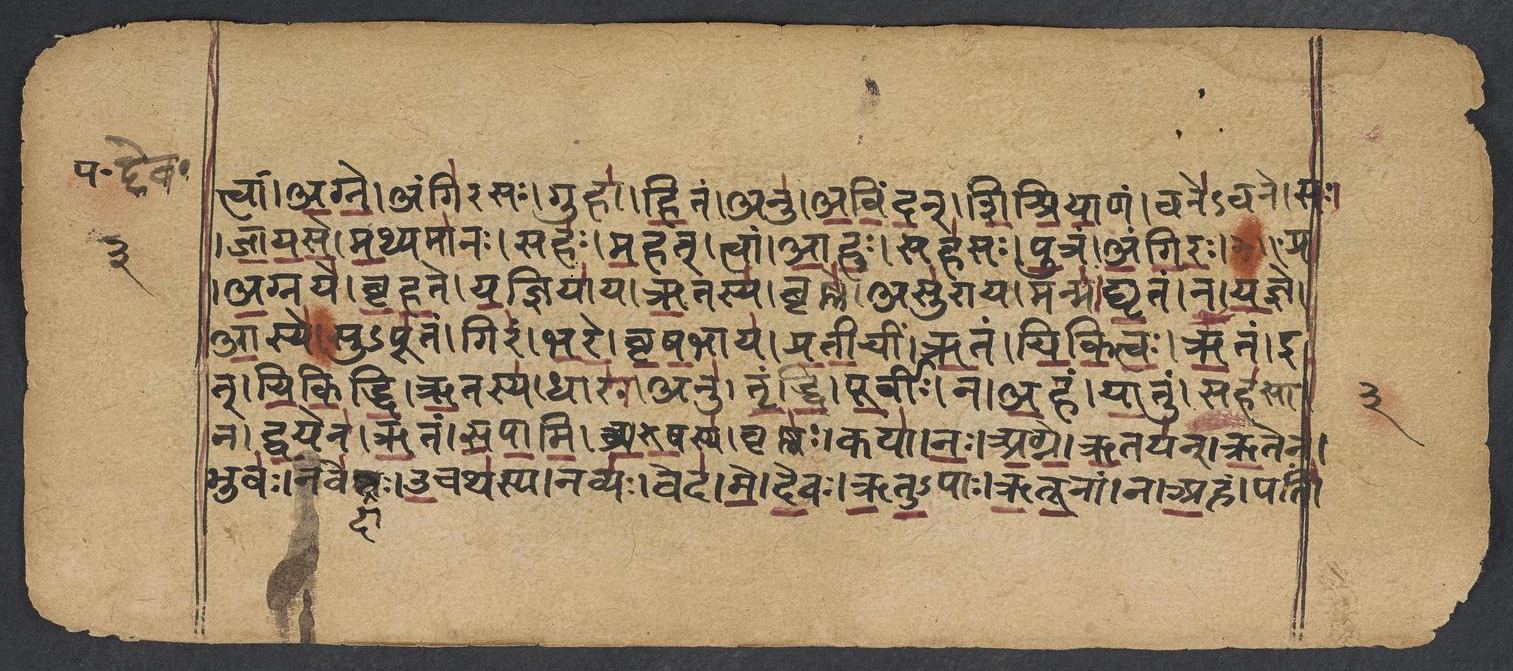
Where on the image
Penn Ms. Coll. 390 Item 41, fol. 330v (numbered 3v by the scribe) (OPenn image 331, upper leaf). Checked on the image: the Rigveda text on this page begins in RV 5.11.6 ‹tvām agne aṅgirasaḥ guhā›. The next page with Rigveda text, fol. 331r (numbered 4r by the scribe), begins in RV 5.12.3 ‹sanituḥ asya rāyaḥ›. Verses 5.12.1-2 end on this page.
1prāgnaye̍ bṛha̱te ya̱jñiyā̍ya ṛ̱tasya̱ vṛṣṇe̱ asu̍rāya̱ manma̍ | ghṛ̱taṁ na ya̱jña ā̱sye̱3̱̍ supū̍ta̱ṁ gira̍m bhare vṛṣa̱bhāya̍ pratī̱cīm ||
2ṛ̱taṁ ci̍kitva ṛ̱tam ic ci̍kiddhy ṛ̱tasya̱ dhārā̱ anu̍ tṛndhi pū̱rvīḥ | nāhaṁ yā̱tuṁ saha̍sā̱ na dva̱yena̍ ṛ̱taṁ sa̍pāmy aru̱ṣasya̱ vṛṣṇa̍ḥ ||
Compare: Padapāṭha (word-by-word text written in the manuscript; Sansknet e-text via GRETIL)
1pra | agnaye | bṛhate | yajñiyāya | ṛtasya | vṛṣṇe | asurāya | manma | ghṛtam | na | yajñe | āsye | su-pūtam | giram | bhare | vṛṣabhāya | pratīcīm
2ṛtam | cikitvaḥ | ṛtam | it | cikiddhi | ṛtasya | dhārāḥ | anu | tṛndhi | pūrvīḥ | na | aham | yātum | sahasā | na | dvayena | ṛtam | sapāmi | aruṣasya | vṛṣṇaḥ
1To Agni, lofty Asura, meet for worship, Steer of eternal Law, my prayer I offer; I bring my song directed to the Mighty like pure oil for his mouth at sacrifices.
2Mark the Law, thou who knowest, yea, observe it: send forth the full streams of eternal Order. I use no sorcery with might or falsehood the sacred Law of the Red Steer I follow.
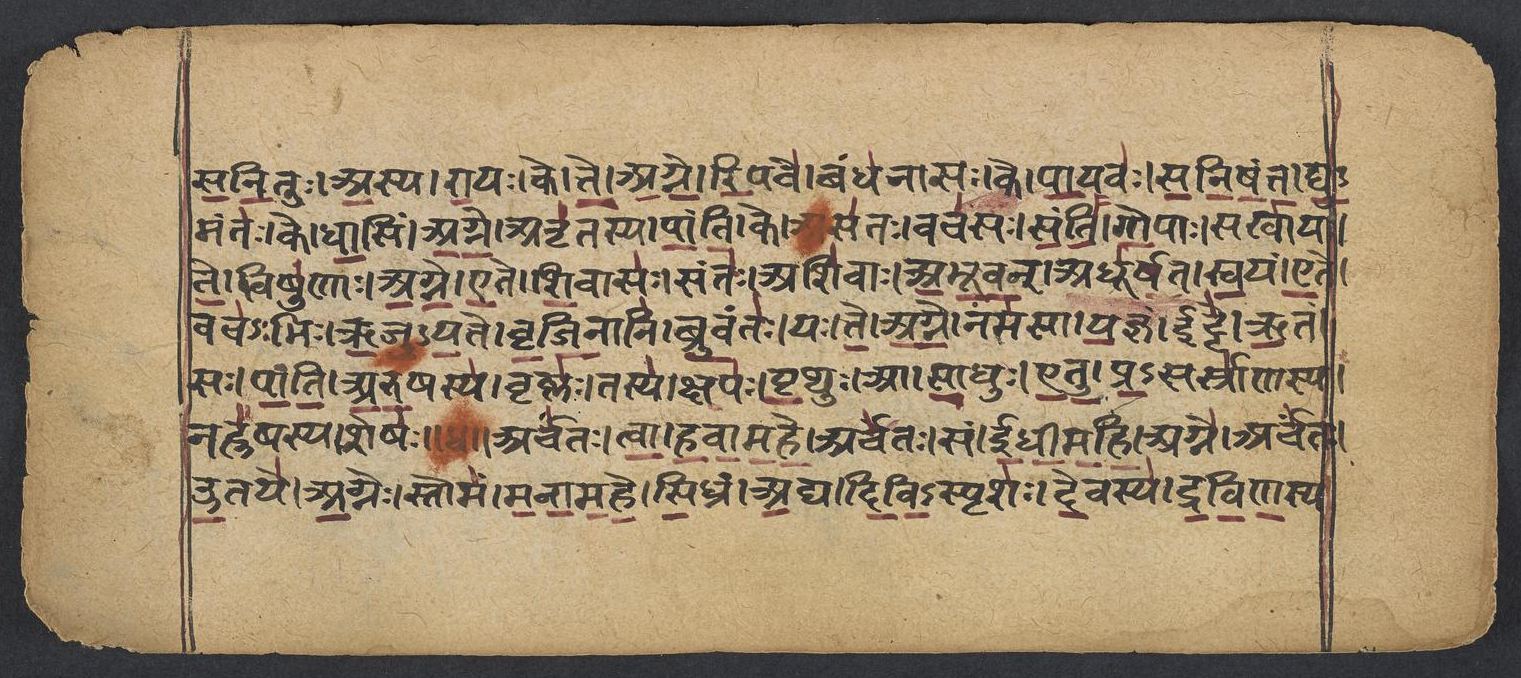
Where on the image
Penn Ms. Coll. 390 Item 41, fol. 331r (numbered 4r by the scribe) (OPenn image 331, lower leaf). Checked on the image: the Rigveda text on this page begins in RV 5.12.3 ‹sanituḥ asya rāyaḥ›. The next page with Rigveda text, fol. 331v (numbered 4v by the scribe), begins in RV 5.13.2 ‹-draviṇasyavaḥ›. Verses 5.12.3-6 end on this page; 5.12.3 begins on fol. 330v (numbered 3v by the scribe).
3kayā̍ no agna ṛ̱taya̍nn ṛ̱tena̱ bhuvo̱ nave̍dā u̱catha̍sya̱ navya̍ḥ | vedā̍ me de̱va ṛ̍tu̱pā ṛ̍tū̱nāṁ nāham pati̍ṁ sani̱tur a̱sya rā̱yaḥ ||
4ke te̍ agne ri̱pave̱ bandha̍nāsa̱ḥ ke pā̱yava̍ḥ saniṣanta dyu̱manta̍ḥ | ke dhā̱sim a̍gne̱ anṛ̍tasya pānti̱ ka āsa̍to̱ vaca̍saḥ santi go̱pāḥ ||
5sakhā̍yas te̱ viṣu̍ṇā agna e̱te śi̱vāsa̱ḥ santo̱ aśi̍vā abhūvan | adhū̍rṣata sva̱yam e̱te vaco̍bhir ṛjūya̱te vṛ̍ji̱nāni̍ bru̱vanta̍ḥ ||
6yas te̍ agne̱ nama̍sā ya̱jñam īṭṭa̍ ṛ̱taṁ sa pā̍ty aru̱ṣasya̱ vṛṣṇa̍ḥ | tasya̱ kṣaya̍ḥ pṛ̱thur ā sā̱dhur e̍tu pra̱sarsrā̍ṇasya̱ nahu̍ṣasya̱ śeṣa̍ḥ ||
Compare: Padapāṭha (word-by-word text written in the manuscript; Sansknet e-text via GRETIL)
3kayā | naḥ | agne | ṛtayan | ṛtena | bhuvaḥ | navedāḥ | ucathasya | navyaḥ | veda | me | devaḥ | ṛtu-pāḥ | ṛtūnām | na | aham | patim | sanituḥ | asya | rāyaḥ
4ke | te | agne | ripave | bandhanāsaḥ | ke | pāyavaḥ | saniṣanta | dyu-mantaḥ | ke | dhāsim | agne | anṛtasya | pānti | ke | asataḥ | vacasaḥ | santi | gopāḥ
5sakhāyaḥ | te | viṣuṇāḥ | agne | ete | śivāsaḥ | santaḥ | aśivāḥ | abhūvan | adhūrṣata | svayam | ete | vacaḥ-bhiḥ | ṛju-yate | vṛjināni | bruvantaḥ
6yaḥ | te | agne | namasā | yajñam | īṭe | ṛtam | saḥ | pāti | aruṣasya | vṛṣṇaḥ | tasya | kṣayaḥ | pṛthuḥ | ā | sādhuḥ | etu | pra-sarsrāṇasya | nahuṣasya | śeṣaḥ
3How hast thou, follower of the Law eternal, become the knower of a new song, Agni? The God, the Guardian of the seasons, knows me: the Lord of him who won this wealth I know not.
4Who, Agni, in alliance with thy foeman, what splendid helpers won for them their riches? Agni, who guard the dwelling-place of falsehood? Who are protectors of the speech of liars?
5Agni, those friends of thine have turned them from thee: gracious of old, they have become ungracious. They have deceived themselves by their own speeches, uttering wicked words against the righteous.
6He who pays sacrifice to thee with homage, O Agni, keeps the Red Steer's Law eternal; Wide is his dwelling. May the noble offspring of Nahusha who wandered forth come hither.
Notes
- Sanskrit: Aufrecht's edition (1877) with the Vedic accents, as entered by van Nooten and Holland (GRETIL).
- English: Ralph T. H. Griffith, The Hymns of the Rigveda (1889-1892; 2nd ed. 1896-1897), from the VedaWeb digital text; OCR slips in that text were corrected against the printed 2nd edition (data/sources/rigveda/griffith_errata.json).
- Padapāṭha (edition text): Sansknet e-text via GRETIL (CC BY-NC-SA 4.0).
Cite
Sources
- Source: Penn Ms. Coll. 390 Item 41 (undated (catalogued with Penn's 18th-19th c. Vedic manuscripts)), OPenn, Public Domain Mark + Aufrecht's accented text (GRETIL) + Griffith's English (VedaWeb) (holding institution)
- Critical edition: Aufrecht (1877), accented e-text via GRETIL
← previous · → next · v cycle view · l back to library