Rigveda 5.11: To Agni
Introduction
Rigveda 5.11 is a hymn of 6 verses addressed to Agni. It stands in book (maṇḍala) 5, the family book of the Atri clan. The Rigveda is the oldest collection of Sanskrit hymns, composed in the second half of the second millennium BCE and handed down orally for many centuries before it was written down.
The manuscript shown is Penn Ms. Coll. 390 Item 41 (University of Pennsylvania), an undated paper manuscript of the padapāṭha (the word-by-word recitation text, in which every word is written separately and compounds are split) of the whole Ṛgveda in Devanāgarī, 884 leaves in fascicles, 7-9 lines to the page, accents in red; this hymn stands on fol. 329v-330v. Each section below gives the verses that end on one page; the page boundaries were read on the images (the opening words of every page), not counted out. Where the manuscript is a padapāṭha (the word-by-word recitation text), the section shows Aufrecht's continuous (saṃhitā) text first and, as the edition text, the padapāṭha of the same verses, which is the form written on the page.
How was this verified? (Provenance)
Where on the image
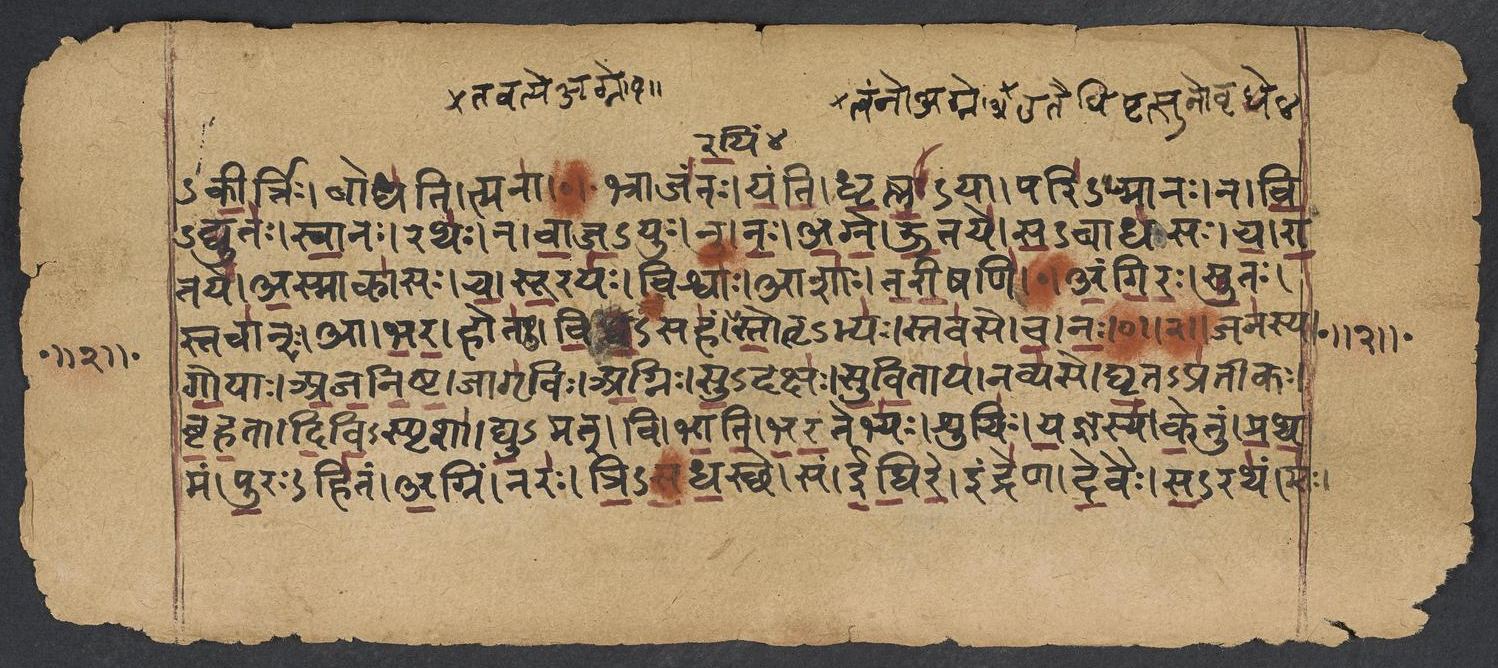
Penn Ms. Coll. 390 Item 41, fol. 329v (numbered 2v by the scribe) (OPenn image 330, upper leaf). Checked on the image: the Rigveda text on this page begins in RV 5.10.4 ‹-su-kīrtiḥ bodhati tmanā›. The next page with Rigveda text, fol. 330r (numbered 3r by the scribe), begins in RV 5.11.2 ‹barhiṣi sīdat ni hotā›. Verse 5.11.1 ends on this page.
1jana̍sya go̱pā a̍janiṣṭa̱ jāgṛ̍vir a̱gniḥ su̱dakṣa̍ḥ suvi̱tāya̱ navya̍se | ghṛ̱tapra̍tīko bṛha̱tā di̍vi̱spṛśā̍ dyu̱mad vi bhā̍ti bhara̱tebhya̱ḥ śuci̍ḥ ||
Compare: Padapāṭha (word-by-word text written in the manuscript; Sansknet e-text via GRETIL)
1anasya | gopāḥ | ajaniṣṭa | jāgṛviḥ | agniḥ | su-dakṣaḥ | suvitāya | navyase | ghṛta-pratīkaḥ | bṛhatā | divi-spṛśā | dyu-mat | vi | bhāti | bharatebhyaḥ | śuciḥ
1THE watchful Guardian of the people hath been born, Agni, the very strong, for fresh prosperity. With oil upon his face, with high heaventouching flame, he shineth splendidly, pure, for the Bharatas.
Where on the image
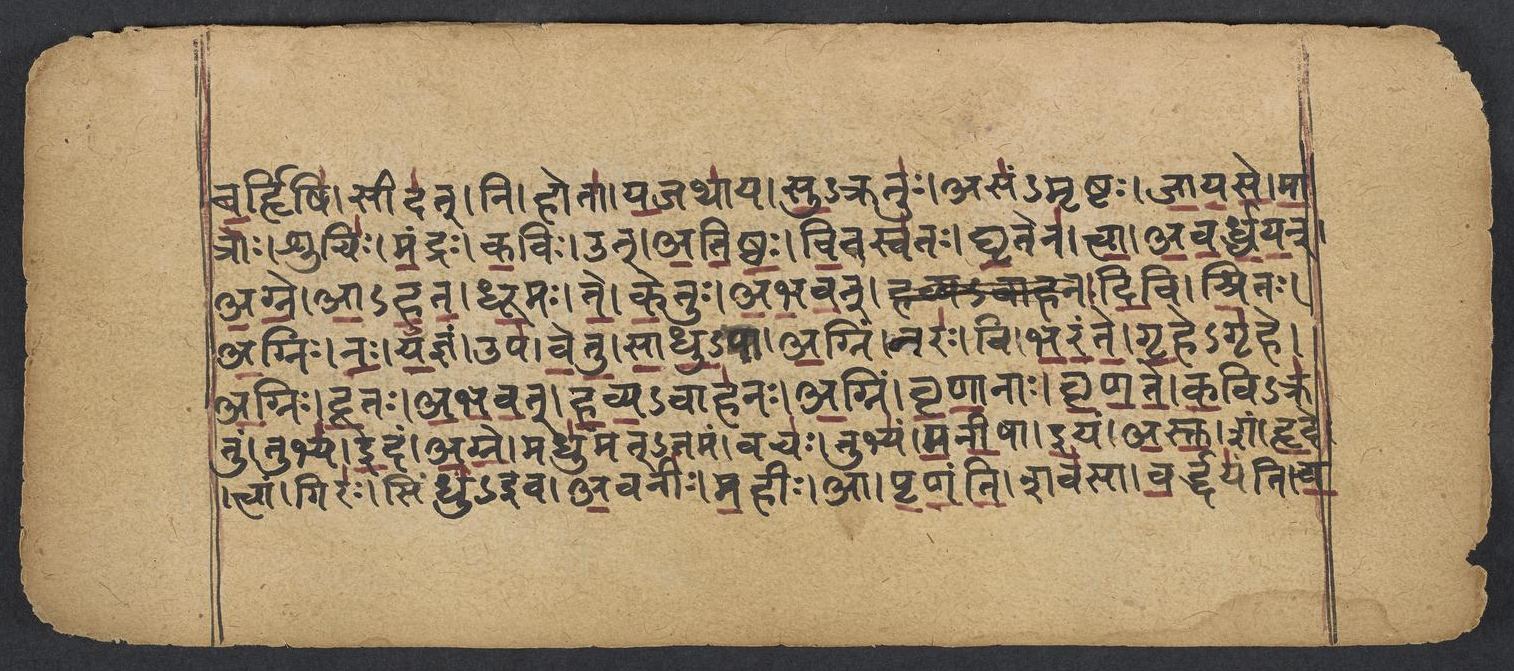
Penn Ms. Coll. 390 Item 41, fol. 330r (numbered 3r by the scribe) (OPenn image 330, lower leaf). Checked on the image: the Rigveda text on this page begins in RV 5.11.2 ‹barhiṣi sīdat ni hotā›. The next page with Rigveda text, fol. 330v (numbered 3v by the scribe), begins in RV 5.11.6 ‹tvām agne aṅgirasaḥ guhā›. Verses 5.11.2-5 end on this page; 5.11.2 begins on fol. 329v (numbered 2v by the scribe).
2ya̱jñasya̍ ke̱tum pra̍tha̱mam pu̱rohi̍tam a̱gniṁ nara̍s triṣadha̱sthe sam ī̍dhire | indre̍ṇa de̱vaiḥ sa̱ratha̱ṁ sa ba̱rhiṣi̱ sīda̱n ni hotā̍ ya̱jathā̍ya su̱kratu̍ḥ ||
3asa̍mmṛṣṭo jāyase mā̱troḥ śuci̍r ma̱ndraḥ ka̱vir ud a̍tiṣṭho vi̱vasva̍taḥ | ghṛ̱tena̍ tvāvardhayann agna āhuta dhū̱mas te̍ ke̱tur a̍bhavad di̱vi śri̱taḥ ||
4a̱gnir no̍ ya̱jñam upa̍ vetu sādhu̱yāgniṁ naro̱ vi bha̍rante gṛ̱he-gṛ̍he | a̱gnir dū̱to a̍bhavad dhavya̱vāha̍no̱ 'gniṁ vṛ̍ṇā̱nā vṛ̍ṇate ka̱vikra̍tum ||
5tubhye̱dam a̍gne̱ madhu̍mattama̱ṁ vaca̱s tubhya̍m manī̱ṣā i̱yam a̍stu̱ śaṁ hṛ̱de | tvāṁ gira̱ḥ sindhu̍m ivā̱vanī̍r ma̱hīr ā pṛ̍ṇanti̱ śava̍sā va̱rdhaya̍nti ca ||
Compare: Padapāṭha (word-by-word text written in the manuscript; Sansknet e-text via GRETIL)
2yajñasya | ketum | prathamam | puraḥ-hitam | agnim | naraḥ | tri-sadhasthe | sam | īdhire | indreṇa | devaiḥ | saratham | saḥ | barhiṣi | sīdat | ni | hotā | yajathāya | su-kratuḥ
3asam-mṛṣṭaḥ | jāyase | mātroḥ | śuciḥ | mandraḥ | kaviḥ | ut | atiṣṭhaḥ | vivasvataḥ | ghṛtena | tvā | avardhayan | agne | āhuta | dhūmaḥ | te | ketuḥ | abhavat | divi | śṛitaḥ
4agniḥ | naḥ | yajñam | upa | vetu | sādhu-yā | agnim | naraḥ | vi | bharante | gṛhe--gṛhe | agniḥ | dūtaḥ | abhavat | havya-vāhanaḥ | agnim | vṛṇānāḥ | vṛṇate | kavi-kratum
5tubhya | idam | agne | madhumat-tamam | vacaḥ | tubhyam | manīṣā | iyam | astu | śam | hṛde | tvām | giraḥ | sindhum-iva | avanīḥ | mahīḥ | ā | pṛṇanti | śavasā | vardhayanti | ca
2Ensign of sacrifice, the earliest Household-Priest, the. men have kindled Agni in his threefold seat, With Indra and the Gods together on the grass let the wise Priest sit to complete the sacrifice.
3Pure , unadorned, from thy two Mothers art thou born: thou camest fromVivasvan as a charming Sage. With oil they strengthened thee, O Agni, worshipped God: thy banner was the smoke that mounted to the sky.
4May Agni graciously come to our sacrifice. The men bear Agni here and there in every house. He hath become an envoy, bearer of our gifts: electing Agni, men choose one exceeding wise.
5For thee, O Agni, is this sweetest prayer of mine: dear to thy spirit be this product of my thought. As great streams fill the river so our song of praise fill thee, and make thee yet more mighty in thy strength.
Where on the image
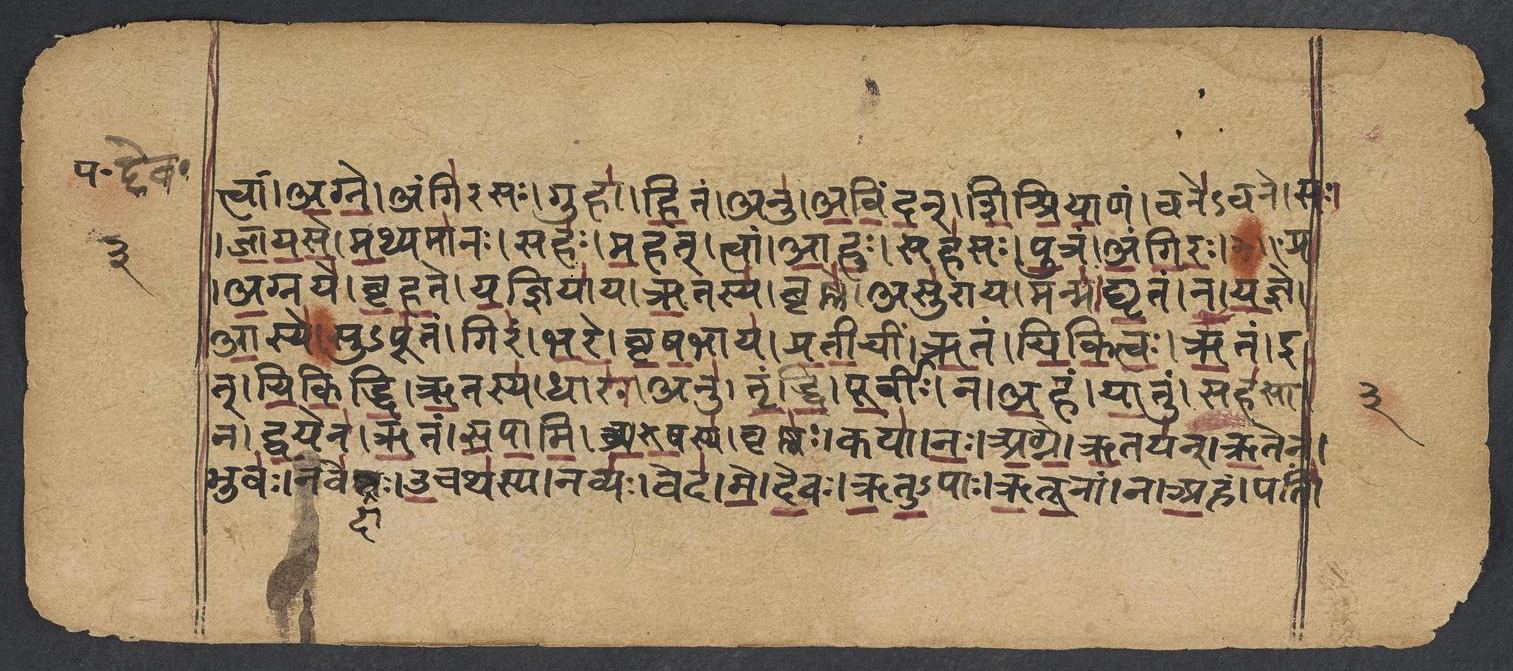
Penn Ms. Coll. 390 Item 41, fol. 330v (numbered 3v by the scribe) (OPenn image 331, upper leaf). Checked on the image: the Rigveda text on this page begins in RV 5.11.6 ‹tvām agne aṅgirasaḥ guhā›. The next page with Rigveda text, fol. 331r (numbered 4r by the scribe), begins in RV 5.12.3 ‹sanituḥ asya rāyaḥ›. Verse 5.11.6 ends on this page.
6tvām a̍gne̱ aṅgi̍raso̱ guhā̍ hi̱tam anv a̍vindañ chiśriyā̱ṇaṁ vane̍-vane | sa jā̍yase ma̱thyamā̍na̱ḥ saho̍ ma̱hat tvām ā̍hu̱ḥ saha̍sas pu̱tram a̍ṅgiraḥ ||
Compare: Padapāṭha (word-by-word text written in the manuscript; Sansknet e-text via GRETIL)
6tvām | agne | aṅgirasaḥ | guhā | hitam | anu | avindan | śiśriyāṇam | vane--vane | saḥ | jāyase | mathyamānaḥ | sahaḥ | mahat | tvām | āhuḥ | sahasaḥ | putram | aṅgiraḥ
6O Agni, the Angirases discovered thee what time thou layest hidden, fleeing back from wood to wood. Thou by attrition art produced as conquer.ing might, and men, O Angiras, call thee the Son of Strength.
Notes
- Sanskrit: Aufrecht's edition (1877) with the Vedic accents, as entered by van Nooten and Holland (GRETIL).
- English: Ralph T. H. Griffith, The Hymns of the Rigveda (1889-1892; 2nd ed. 1896-1897), from the VedaWeb digital text; OCR slips in that text were corrected against the printed 2nd edition (data/sources/rigveda/griffith_errata.json).
- Padapāṭha (edition text): Sansknet e-text via GRETIL (CC BY-NC-SA 4.0).
Cite
Sources
- Source: Penn Ms. Coll. 390 Item 41 (undated (catalogued with Penn's 18th-19th c. Vedic manuscripts)), OPenn, Public Domain Mark + Aufrecht's accented text (GRETIL) + Griffith's English (VedaWeb) (holding institution)
- Critical edition: Aufrecht (1877), accented e-text via GRETIL
← previous · → next · v cycle view · l back to library