Rigveda 5.17: To Agni
Introduction
Rigveda 5.17 is a hymn of 5 verses addressed to Agni. It stands in book (maṇḍala) 5, the family book of the Atri clan. The Rigveda is the oldest collection of Sanskrit hymns, composed in the second half of the second millennium BCE and handed down orally for many centuries before it was written down.
The manuscript shown is Penn Ms. Coll. 390 Item 41 (University of Pennsylvania), an undated paper manuscript of the padapāṭha (the word-by-word recitation text, in which every word is written separately and compounds are split) of the whole Ṛgveda in Devanāgarī, 884 leaves in fascicles, 7-9 lines to the page, accents in red; this hymn stands on fol. 333r-333v. Each section below gives the verses that end on one page; the page boundaries were read on the images (the opening words of every page), not counted out. Where the manuscript is a padapāṭha (the word-by-word recitation text), the section shows Aufrecht's continuous (saṃhitā) text first and, as the edition text, the padapāṭha of the same verses, which is the form written on the page.
How was this verified? (Provenance)
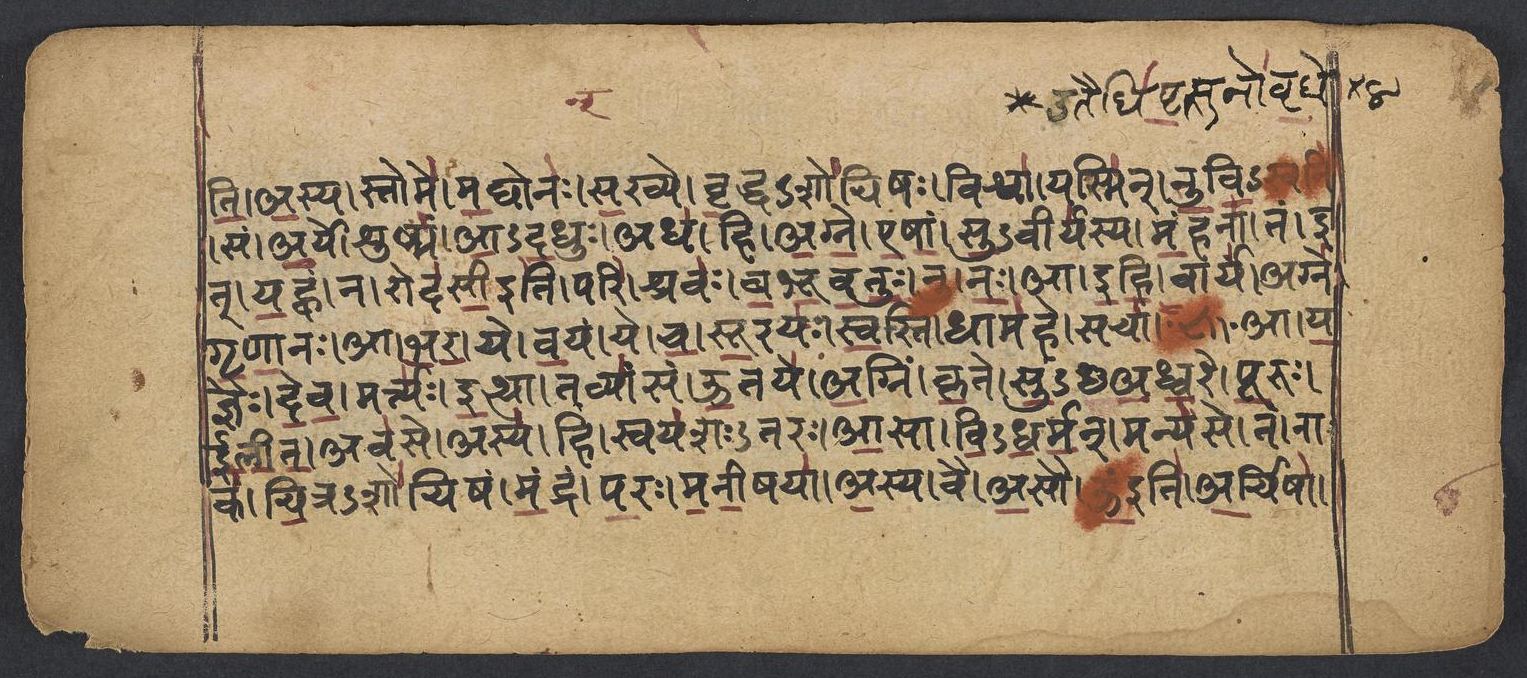
Where on the image
Penn Ms. Coll. 390 Item 41, fol. 333r (numbered 6r by the scribe) (OPenn image 333, lower leaf). Checked on the image: the Rigveda text on this page begins in RV 5.16.2 ‹-ṛṇvati›. The next page with Rigveda text, fol. 333v (numbered 6v by the scribe), begins in RV 5.17.3 ‹yaḥ ayukta tujā girā›. Verses 5.17.1-2 end on this page.
1ā ya̱jñair de̍va̱ martya̍ i̱tthā tavyā̍ṁsam ū̱taye̍ | a̱gniṁ kṛ̱te sva̍dhva̱re pū̱rur ī̍ḻī̱tāva̍se ||
2asya̱ hi svaya̍śastara ā̱sā vi̍dharma̱n manya̍se | taṁ nāka̍ṁ ci̱traśo̍ciṣam ma̱ndram pa̱ro ma̍nī̱ṣayā̍ ||
Compare: Padapāṭha (word-by-word text written in the manuscript; Sansknet e-text via GRETIL)
1ā yajñaiḥ | deva | martyaḥ | itthā | tavyāṃsam | ūtaye | agnim | kṛte | su-adhvare | pūruḥ | īḷīta | avase
2asya | hi | svayaśaḥ-taraḥ | āsā | vi-dharman | manyase | tam | nākam | citra-śociṣam | mandram | paraḥ | manīṣayā
1GOD, may a mortal call the Strong hither, with solemn rites, to aid, A man call Agni to protect when sacrifice is well prepared.
2Near him thou seemest mightier still in native glory, set to hold Apart yon flame-hued vault of heaven, lovely beyond the thought of man.
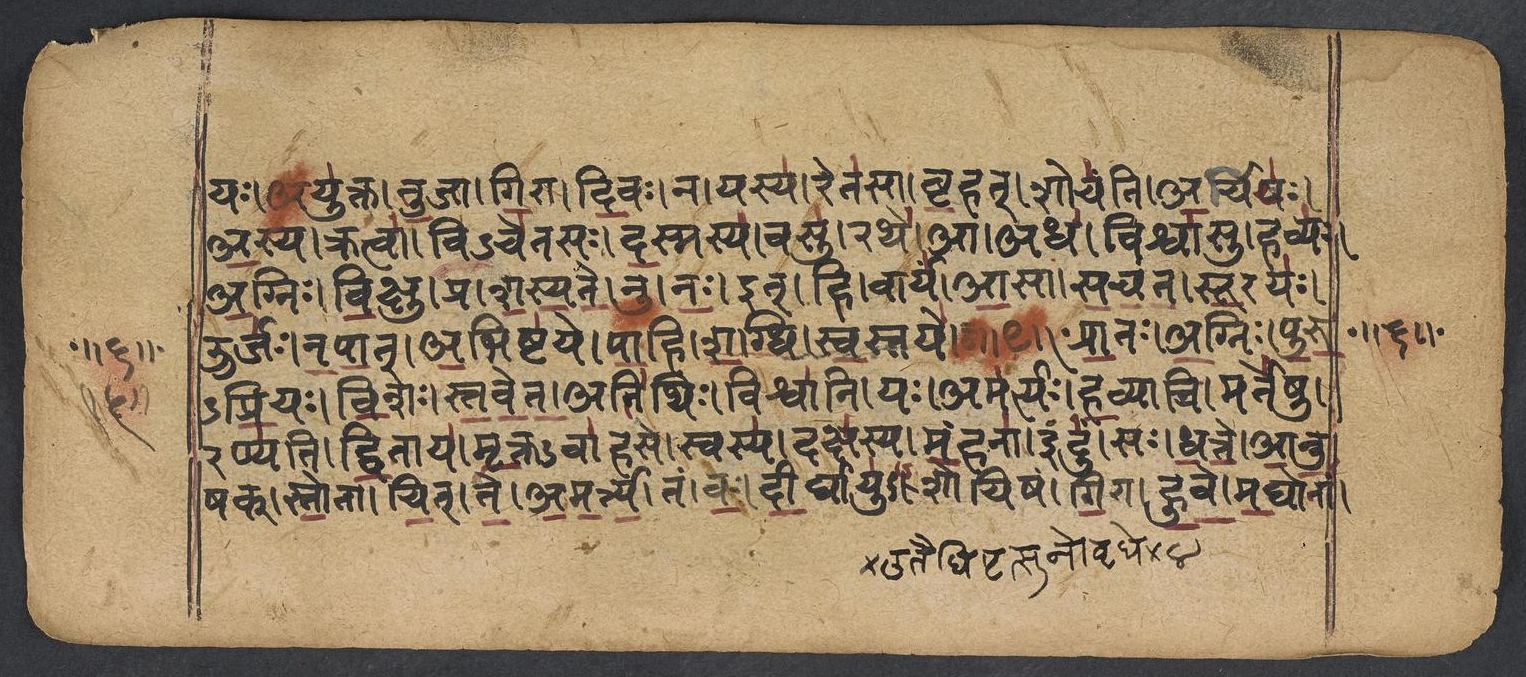
Where on the image
Penn Ms. Coll. 390 Item 41, fol. 333v (numbered 6v by the scribe) (OPenn image 334, upper leaf). Checked on the image: the Rigveda text on this page begins in RV 5.17.3 ‹yaḥ ayukta tujā girā›. The next page with Rigveda text, fol. 334r (numbered 7r by the scribe), begins in RV 5.18.3 ‹ariṣṭaḥ yeṣām rathaḥ vi›. Verses 5.17.3-5 end on this page; 5.17.3 begins on fol. 333r (numbered 6r by the scribe).
3a̱sya vāsā u̍ a̱rciṣā̱ ya āyu̍kta tu̱jā gi̱rā | di̱vo na yasya̱ reta̍sā bṛ̱hac choca̍nty a̱rcaya̍ḥ ||
4a̱sya kratvā̱ vice̍taso da̱smasya̱ vasu̱ ratha̱ ā | adhā̱ viśvā̍su̱ havyo̱ 'gnir vi̱kṣu pra śa̍syate ||
5nū na̱ id dhi vārya̍m ā̱sā sa̍canta sū̱raya̍ḥ | ūrjo̍ napād a̱bhiṣṭa̍ye pā̱hi śa̱gdhi sva̱staya̍ u̱taidhi̍ pṛ̱tsu no̍ vṛ̱dhe ||
Compare: Padapāṭha (word-by-word text written in the manuscript; Sansknet e-text via GRETIL)
3asya | vai | asau | oṃ iti | arciṣā | yaḥ | ayukta | tujā | girā | divaḥ | na | yasya | retasā | bṛhat | śocanti | arcayaḥ
4asya | kratvā | vi-cetasaḥ | dasmasya | vasu | rathe | ā | adha | viśvāsu | havyaḥ | agniḥ | vikṣu | pra | śasyate
5nu | naḥ | it | hi | vāryam | āsā | sacanta | sūrayaḥ | ūrjaḥ | napāt | abhiṣṭaye | pāhi | śagdhi | svastaye | uta | edhi | pṛt-su | naḥ | vṛdhe
3Yea, this is by the light of him whom powerful song hath bound to act, Whose beams of splendour flash on high as though they sprang from heavenly seed.
4Wealth loads the Wonder-Worker's car through his, the very wise One's power. Then, meet to be invoked among all tribes, is Agni ghorified.
5Now, too, the princes shall obtain excellent riches by our lips. Protect us for our welfare: lend thy succour, O thou Son of Strength. Be near in fight to prosper us.
Notes
- Sanskrit: Aufrecht's edition (1877) with the Vedic accents, as entered by van Nooten and Holland (GRETIL).
- English: Ralph T. H. Griffith, The Hymns of the Rigveda (1889-1892; 2nd ed. 1896-1897), from the VedaWeb digital text; OCR slips in that text were corrected against the printed 2nd edition (data/sources/rigveda/griffith_errata.json).
- Padapāṭha (edition text): Sansknet e-text via GRETIL (CC BY-NC-SA 4.0).
Cite
Sources
- Source: Penn Ms. Coll. 390 Item 41 (undated (catalogued with Penn's 18th-19th c. Vedic manuscripts)), OPenn, Public Domain Mark + Aufrecht's accented text (GRETIL) + Griffith's English (VedaWeb) (holding institution)
- Critical edition: Aufrecht (1877), accented e-text via GRETIL
← previous · → next · v cycle view · l back to library