Rigveda 5.19: To Agni
Introduction
Rigveda 5.19 is a hymn of 5 verses addressed to Agni. It stands in book (maṇḍala) 5, the family book of the Atri clan. The Rigveda is the oldest collection of Sanskrit hymns, composed in the second half of the second millennium BCE and handed down orally for many centuries before it was written down.
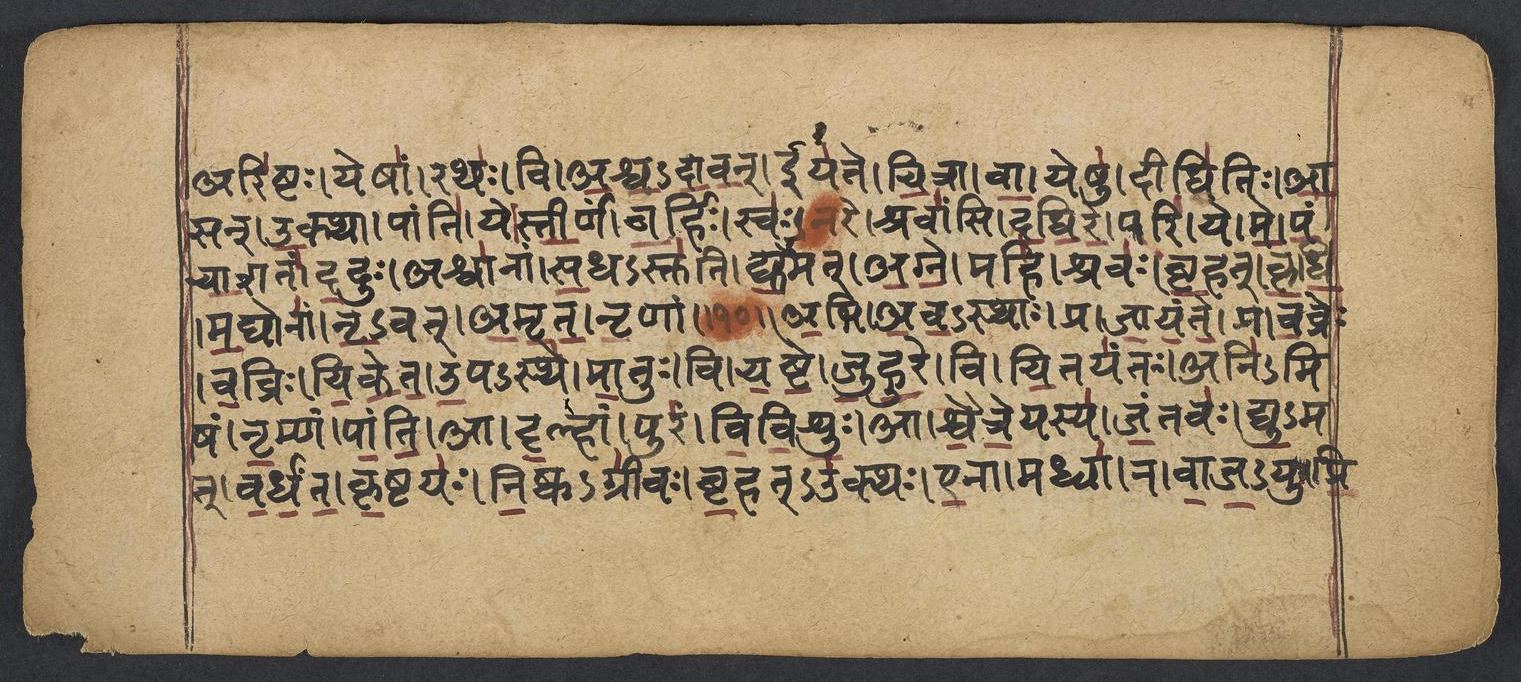
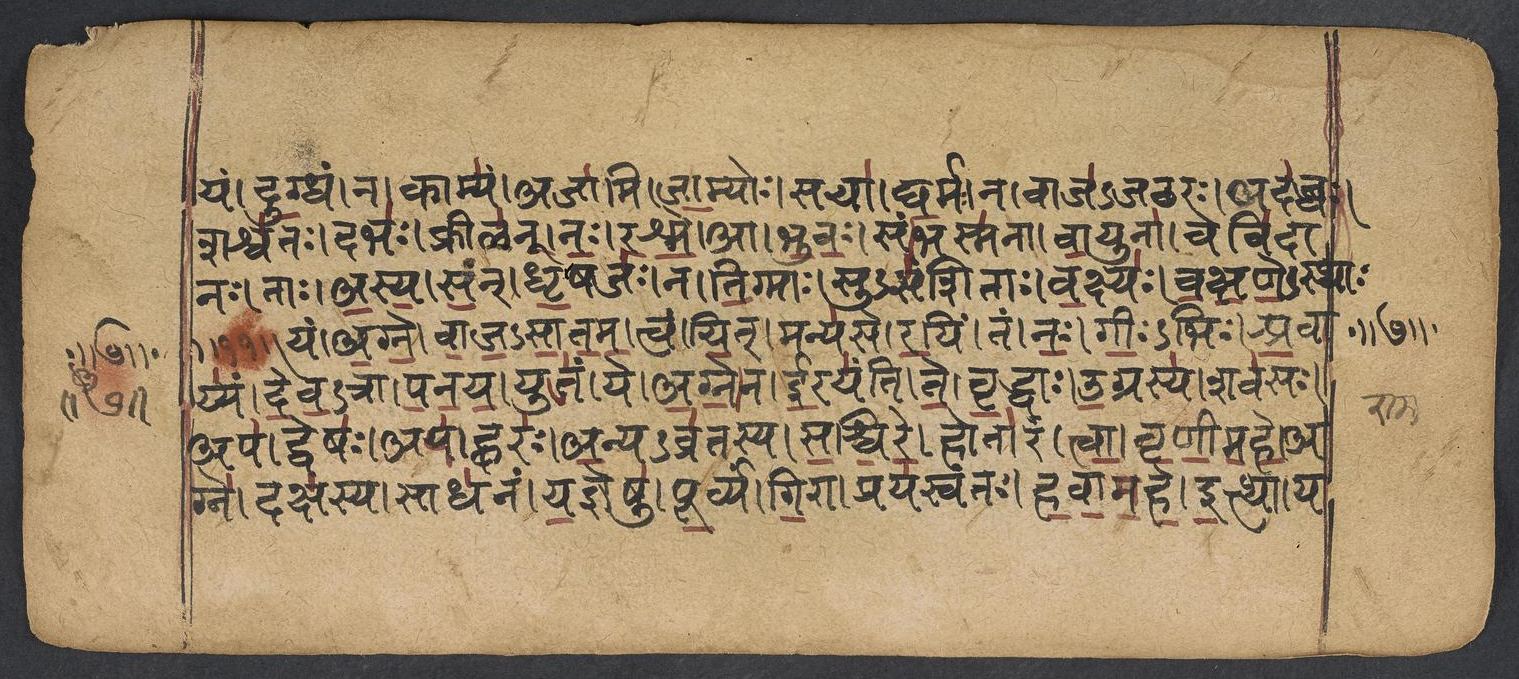
The manuscript shown is Penn Ms. Coll. 390 Item 41 (University of Pennsylvania), an undated paper manuscript of the padapāṭha (the word-by-word recitation text, in which every word is written separately and compounds are split) of the whole Ṛgveda in Devanāgarī, 884 leaves in fascicles, 7-9 lines to the page, accents in red; this hymn stands on fol. 334r-334v. Each section below gives the verses that end on one page; the page boundaries were read on the images (the opening words of every page), not counted out. Where the manuscript is a padapāṭha (the word-by-word recitation text), the section shows Aufrecht's continuous (saṃhitā) text first and, as the edition text, the padapāṭha of the same verses, which is the form written on the page.
How was this verified? (Provenance)
Where on the image
Penn Ms. Coll. 390 Item 41, fol. 334r (numbered 7r by the scribe) (OPenn image 334, lower leaf). Checked on the image: the Rigveda text on this page begins in RV 5.18.3 ‹ariṣṭaḥ yeṣām rathaḥ vi›. The next page with Rigveda text, fol. 334v (numbered 7v by the scribe), begins in RV 5.19.4 ‹-priyam dugdham na kāmyam›. Verses 5.19.1-3 end on this page.
1a̱bhy a̍va̱sthāḥ pra jā̍yante̱ pra va̱vrer va̱vriś ci̍keta | u̱pasthe̍ mā̱tur vi ca̍ṣṭe ||
2ju̱hu̱re vi ci̱taya̱nto 'ni̍miṣaṁ nṛ̱mṇam pā̍nti | ā dṛ̱ḻhām pura̍ṁ viviśuḥ ||
3ā śvai̍tre̱yasya̍ ja̱ntavo̍ dyu̱mad va̍rdhanta kṛ̱ṣṭaya̍ḥ | ni̱ṣkagrī̍vo bṛ̱hadu̍ktha e̱nā madhvā̱ na vā̍ja̱yuḥ ||
Compare: Padapāṭha (word-by-word text written in the manuscript; Sansknet e-text via GRETIL)
1abhi | ava-sthāḥ | pra | jāyante | pra | vavreḥ | vavriḥ | ciketa | upa-sthe | mātuḥ | vi | caṣte
2juhure | vi | citayantaḥ | animiṣam | nṛmṇam | pānti | ā | dṛḷhām | puram | viviśuḥ
3ā | śvaitreyasya | jantavaḥ | dyu-mat | vardhanta | kṛṣṭayaḥ | niṣka-grīvaḥ | bṛhat-ukthaḥ | enā | madhvā | na | vāja-yuḥ
1ONE state begets another state: husk is made visible from husk: Within his Mother's side he speaks.
2Discerning, have they offered gifts: they guard the strength that never wastes. To a strong fort have they pressed in.
3Ṣvaitreya's people, all his men, have gloriously increased in might. A gold chain Br̥ihaduktha wears, as, through this Soma, seeking spoil.
Where on the image
Penn Ms. Coll. 390 Item 41, fol. 334v (numbered 7v by the scribe) (OPenn image 335, upper leaf). Checked on the image: the Rigveda text on this page begins in RV 5.19.4 ‹-priyam dugdham na kāmyam›. The next page with Rigveda text, fol. 335r (numbered 8r by the scribe), begins in RV 5.20.4 ‹-yathā te ūtaye sahasāvan›. Verses 5.19.4-5 end on this page; 5.19.4 begins on fol. 334r (numbered 7r by the scribe).
4pri̱yaṁ du̱gdhaṁ na kāmya̱m ajā̍mi jā̱myoḥ sacā̍ | gha̱rmo na vāja̍jaṭha̱ro 'da̍bdha̱ḥ śaśva̍to̱ dabha̍ḥ ||
5krīḻa̍n no raśma̱ ā bhu̍va̱ḥ sam bhasma̍nā vā̱yunā̱ vevi̍dānaḥ | tā a̍sya san dhṛ̱ṣajo̱ na ti̱gmāḥ susa̍ṁśitā va̱kṣyo̍ vakṣaṇe̱sthāḥ ||
Compare: Padapāṭha (word-by-word text written in the manuscript; Sansknet e-text via GRETIL)
4priyam | dugdham | na | kāmyam | ajāmi | jāmyoḥ | sacā | gharmaḥ | na | vāja-jaṭharaḥ | adabdhaḥ | śaśvataḥ | dabhaḥ
5krīḷan | naḥ | raśme | ā | bhuvaḥ | sam | bhasmanā | vāyunā | vevidānaḥ | tāḥ | asya | san | dhṛṣajaḥ | na | tigmāḥ | su-saṃśitāḥ | vakṣyaḥ | vakṣaṇe--sthāḥ
4I bring, as 'twere, the longed-for milk, the dear milk of the Sister-Pair. Like to a caldron filled with food is he, unconquered, conquering all.
5Beam of light, come to us in sportive fashion, finding thyself close to the wind that fans thee. These flames of his are wasting flames, like arrows keen-pointed, sharpened, on his breast.
Notes
- Sanskrit: Aufrecht's edition (1877) with the Vedic accents, as entered by van Nooten and Holland (GRETIL).
- English: Ralph T. H. Griffith, The Hymns of the Rigveda (1889-1892; 2nd ed. 1896-1897), from the VedaWeb digital text; OCR slips in that text were corrected against the printed 2nd edition (data/sources/rigveda/griffith_errata.json).
- Padapāṭha (edition text): Sansknet e-text via GRETIL (CC BY-NC-SA 4.0).
Cite
Sources
- Source: Penn Ms. Coll. 390 Item 41 (undated (catalogued with Penn's 18th-19th c. Vedic manuscripts)), OPenn, Public Domain Mark + Aufrecht's accented text (GRETIL) + Griffith's English (VedaWeb) (holding institution)
- Critical edition: Aufrecht (1877), accented e-text via GRETIL
← previous · → next · v cycle view · l back to library