Rigveda 5.24: To Agni
Introduction
Rigveda 5.24 is a hymn of 4 verses addressed to Agni. It stands in book (maṇḍala) 5, the family book of the Atri clan. The Rigveda is the oldest collection of Sanskrit hymns, composed in the second half of the second millennium BCE and handed down orally for many centuries before it was written down.
The manuscript shown is Penn Ms. Coll. 390 Item 41 (University of Pennsylvania), an undated paper manuscript of the padapāṭha (the word-by-word recitation text, in which every word is written separately and compounds are split) of the whole Ṛgveda in Devanāgarī, 884 leaves in fascicles, 7-9 lines to the page, accents in red; this hymn stands on fol. 336r-336v. Each section below gives the verses that end on one page; the page boundaries were read on the images (the opening words of every page), not counted out. Where the manuscript is a padapāṭha (the word-by-word recitation text), the section shows Aufrecht's continuous (saṃhitā) text first and, as the edition text, the padapāṭha of the same verses, which is the form written on the page.
How was this verified? (Provenance)
Where on the image
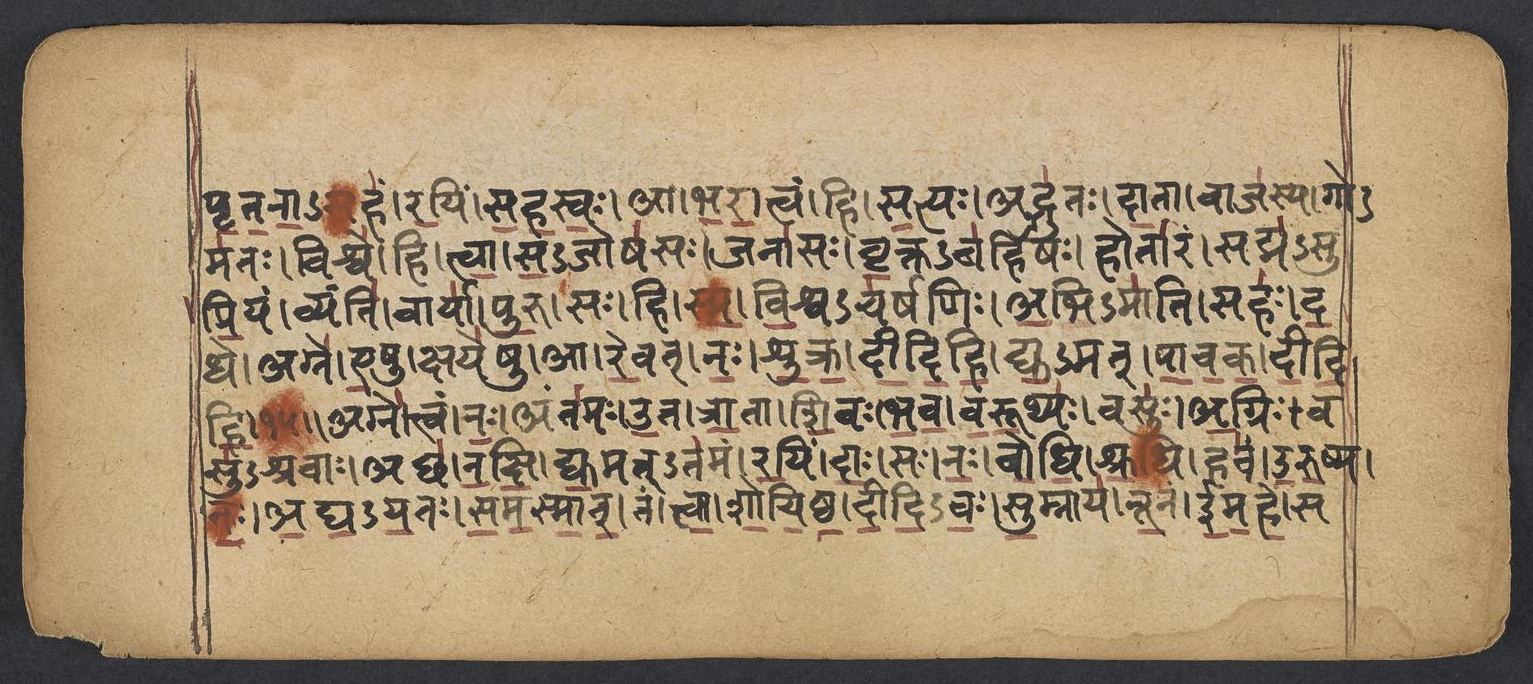
Penn Ms. Coll. 390 Item 41, fol. 336r (numbered 9r by the scribe) (OPenn image 336, lower leaf). Checked on the image: the Rigveda text on this page begins in RV 5.23.2 ‹pṛtanāsaham rayim sahasvaḥ ā›. The next page with Rigveda text, fol. 336v (numbered 9v by the scribe), begins in RV 5.24.4 ‹-sakhi-bhyaḥ›. Verses 5.24.1-3 end on this page.
1agne̱ tvaṁ no̱ anta̍ma u̱ta trā̱tā śi̱vo bha̍vā varū̱thya̍ḥ ||
2vasu̍r a̱gnir vasu̍śravā̱ acchā̍ nakṣi dyu̱matta̍maṁ ra̱yiṁ dā̍ḥ ||
3sa no̍ bodhi śru̱dhī hava̍m uru̱ṣyā ṇo̍ aghāya̱taḥ sa̍masmāt ||
Compare: Padapāṭha (word-by-word text written in the manuscript; Sansknet e-text via GRETIL)
1agne | tvam | naḥ | antamaḥ | uta | trātā | śivaḥ | bhava | varūthyaḥ
2vasuḥ | agniḥ | vasu-śravā | accha | nakṣi | dyumat-tamam | rayim | dāḥ
3saḥ | naḥ | bodhi | śrudhi | havam | uruṣya | naḥ | agha-yataḥ | samasmāt
1O AGNI, be our nearest Friend, be thou a kind deliverer and a gracious Friend.
2Excellent Agni, come thou nigh to us, and give us wealth most splendidly renowned.
3So hear us, listen to this call of ours, and keep us far from every sinful man.
Where on the image
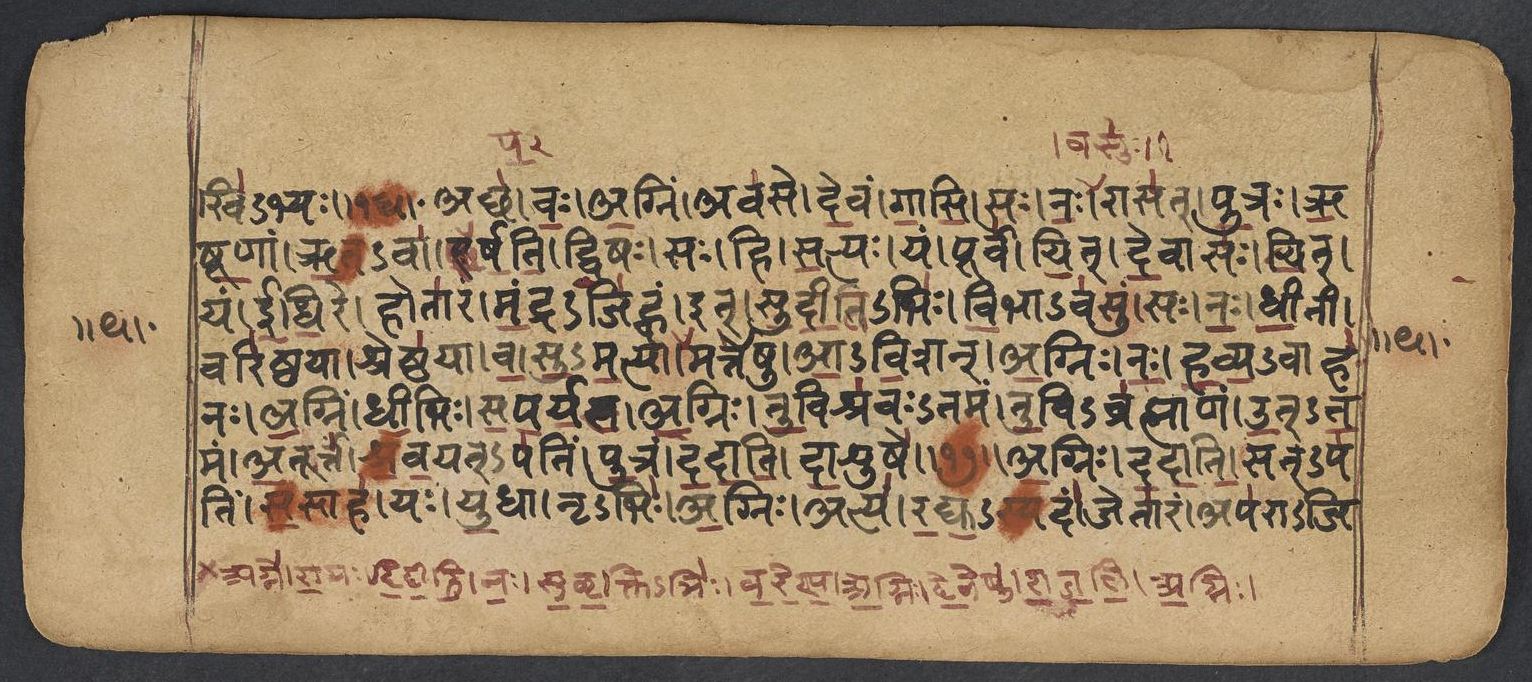
Penn Ms. Coll. 390 Item 41, fol. 336v (numbered 9v by the scribe) (OPenn image 337, upper leaf). Checked on the image: the Rigveda text on this page begins in RV 5.24.4 ‹-sakhi-bhyaḥ›. The next page with Rigveda text, fol. 337r (numbered 10r by the scribe), begins in RV 5.25.6 ‹-aparājitam›. Verse 5.24.4 ends on this page; 5.24.4 begins on fol. 336r (numbered 9r by the scribe).
4taṁ tvā̍ śociṣṭha dīdivaḥ su̱mnāya̍ nū̱nam ī̍mahe̱ sakhi̍bhyaḥ ||
Compare: Padapāṭha (word-by-word text written in the manuscript; Sansknet e-text via GRETIL)
4tam | tvā | śociṣṭha | dīdi-vaḥ | sumnāya | nūnam | īmahe | sakhi-bhyaḥ
4To thee then, O Most Bright, O Radiant God, we come with prayer for happiness for our friends.
Notes
- Sanskrit: Aufrecht's edition (1877) with the Vedic accents, as entered by van Nooten and Holland (GRETIL).
- English: Ralph T. H. Griffith, The Hymns of the Rigveda (1889-1892; 2nd ed. 1896-1897), from the VedaWeb digital text; OCR slips in that text were corrected against the printed 2nd edition (data/sources/rigveda/griffith_errata.json).
- Padapāṭha (edition text): Sansknet e-text via GRETIL (CC BY-NC-SA 4.0).
Cite
Sources
- Source: Penn Ms. Coll. 390 Item 41 (undated (catalogued with Penn's 18th-19th c. Vedic manuscripts)), OPenn, Public Domain Mark + Aufrecht's accented text (GRETIL) + Griffith's English (VedaWeb) (holding institution)
- Critical edition: Aufrecht (1877), accented e-text via GRETIL
← previous · → next · v cycle view · l back to library